CSPX Expense Ratio 2026: What the 0.07% TER Actually Costs You (vs VOO)
A Singapore investor’s breakdown of CSPX’s true annual cost — and why the withholding tax gap usually matters more than the fee.
CSPX, the iShares Core S&P 500 UCITS ETF, charges a 0.07% per annum expense ratio (TER) — more than double VOO’s 0.03%. On a SGD 100,000 portfolio, that gap costs roughly USD 30 extra a year. But CSPX’s Irish domicile cuts US dividend withholding tax to 15% instead of 30%, which typically saves Singapore investors far more than the TER gap costs them.
Not financial advice. All figures are for educational reference only. Data verified as at November 2026 unless noted.
Table of Contents
Contents — Click to expand
- What Is TER and Why It Matters for CSPX
- CSPX’s Expense Ratio: The Numbers
- CSPX vs VOO vs IVV: TER and Withholding Tax Compared
- The Real Cost: A SGD 100,000 Worked Example
- Why UCITS ETFs Cost More Than US-Listed Funds
- SPYL and VUAA: Cheaper (and Pricier) UCITS Alternatives
- Does the TER Difference Actually Matter for You?
- Frequently Asked Questions
What Is TER and Why It Matters for CSPX
The Total Expense Ratio (TER) is the annual fee a fund charges to cover management, custody, index licensing, and administration. It is not billed separately — it is deducted daily from the fund’s net asset value (NAV), so you never see a line-item charge on your brokerage statement. A fund with a 0.07% TER simply grows 0.07 percentage points slower per year than an identical fund with a 0% TER, all else equal.
For a Singapore investor comparing CSPX (the iShares Core S&P 500 UCITS ETF) against US-listed alternatives like VOO or IVV, the TER is usually the first number people look at — and the one most likely to be misread in isolation. CSPX’s 0.07% looks expensive next to VOO’s 0.03% until you factor in the other cost that moves in the opposite direction: US dividend withholding tax (WHT). This article walks through both, with a worked SGD example, so you can see the actual net cost rather than just the headline fee.
CSPX’s Expense Ratio: The Numbers
| Metric | Detail |
|---|---|
| Full Name | iShares Core S&P 500 UCITS ETF (Acc) |
| Ticker (LSE) | CSPX |
| ISIN | IE00B5BMR087 |
| Index Tracked | S&P 500 (full physical replication) |
| Domicile | Ireland |
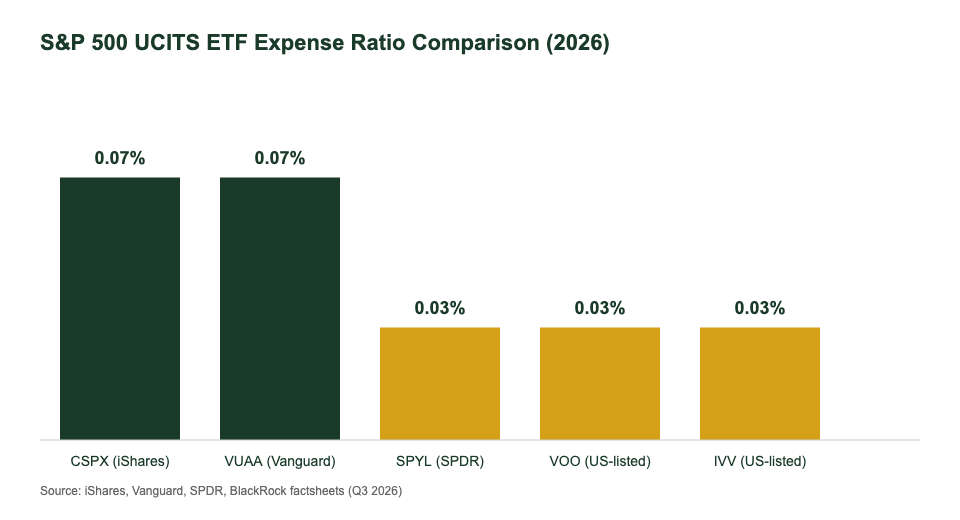
| TER (Expense Ratio) | 0.07% p.a. |
| AUM | ~USD 155 billion (as at August 2026) |
| Number of Holdings | ~504 |
| Structure | Accumulating, physically replicated |
Source: iShares CSPX product page, BlackRock factsheet, August 2026.
CSPX vs VOO vs IVV: TER and Withholding Tax Compared
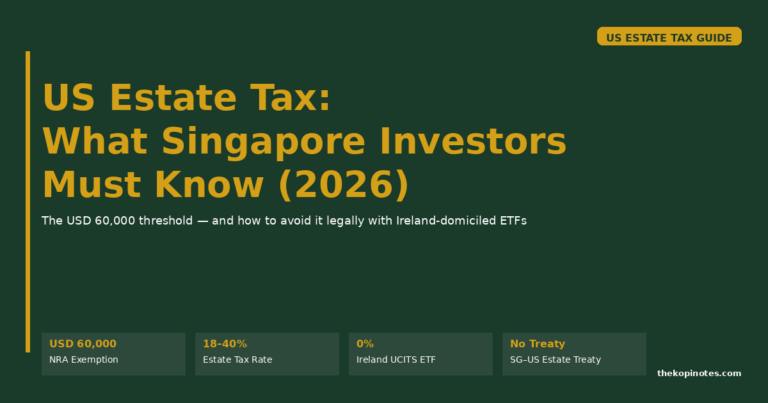
The headline TER only tells half the story. US-listed ETFs like VOO (Vanguard) and IVV (iShares) charge a lower 0.03% TER, but because they are domiciled in the US, non-US investors — including Singaporeans — face a 30% withholding tax on dividends and, for estates above USD 60,000 in US-situated assets, potential US estate tax exposure. CSPX, being Ireland-domiciled, benefits from the US-Ireland tax treaty: dividend withholding tax drops to 15%, and Irish-domiciled funds fall outside the scope of US estate tax entirely.
| ETF | Domicile | TER | US Dividend WHT | US Estate Tax Risk |
|---|---|---|---|---|
| CSPX (LSE) | Ireland | 0.07% | 15% | None |
| VOO (NYSE) | USA | 0.03% | 30% | Yes (above USD 60k) |
| IVV (NYSE Arca) | USA | 0.03% | 30% | Yes (above USD 60k) |
Source: iShares, Vanguard factsheets; US-Ireland tax treaty, Article 10. US estate tax threshold per IRS guidance for nonresident estates, verified November 2026.
The Real Cost: A SGD 100,000 Worked Example
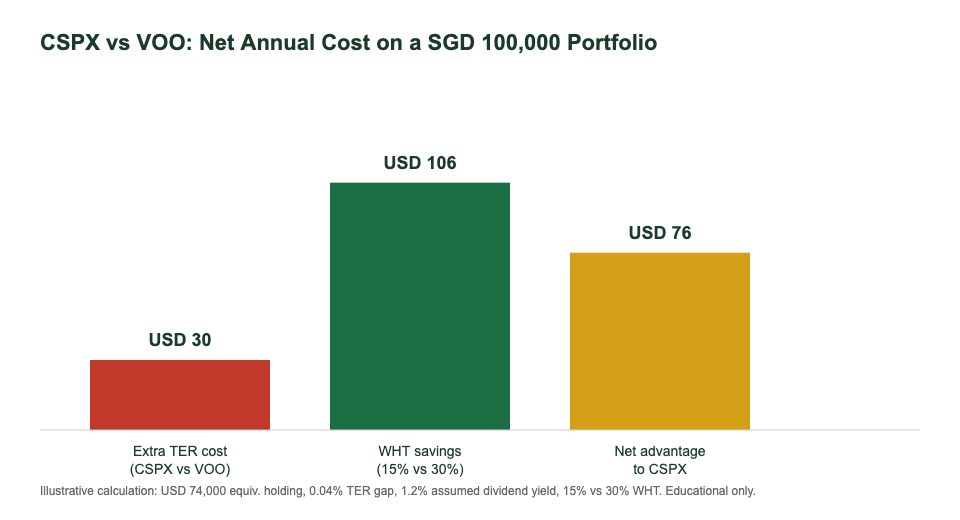
Take a Singapore investor holding the equivalent of SGD 100,000 (roughly USD 74,000 at current rates) in CSPX versus the same amount in VOO.
Extra TER cost of CSPX: the 0.04 percentage point gap (0.07% − 0.03%) works out to about USD 30 a year on a USD 74,000 holding. That’s the entire “CSPX is more expensive” argument in dollar terms.
Withholding tax saving of CSPX: assuming the S&P 500’s dividend yield is roughly 1.2% (it has trended toward multi-decade lows through 2026), a USD 74,000 holding generates about USD 888 in annual dividends. At 15% WHT, CSPX investors lose USD 133 to US tax. At 30% WHT, VOO investors lose USD 266. That’s a saving of roughly USD 133 a year in CSPX’s favour.
Netting the two out: USD 133 saved on withholding tax minus USD 30 extra in TER leaves CSPX about USD 103 a year better off on a USD 74,000 (SGD 100,000) holding — before accounting for FX spread or brokerage commissions, which are broker-dependent and roughly similar for both tickers on most Singapore platforms.
Why UCITS ETFs Cost More Than US-Listed Funds
If CSPX and VOO both own roughly the same 500 US stocks, why does CSPX cost more to run? A few structural reasons. First, UCITS funds domiciled in Ireland carry additional cross-border compliance costs — they are registered for sale across dozens of European and Asian jurisdictions, each with its own regulatory filing requirements, on top of Irish and EU fund administration. Second, CSPX is listed on multiple exchanges (the London Stock Exchange, Euronext Amsterdam, and others), which multiplies market-making and listing costs compared to a single-listing US fund. Third, US mutual fund giants like Vanguard and BlackRock’s US arm benefit from decades of scale and a simpler single-jurisdiction regulatory regime that UCITS funds, by design, cannot replicate.
None of this means UCITS ETFs are “ripped off” — it’s simply the cost of the tax-treaty and estate-tax advantages that make them the sensible default for Singapore investors in the first place.
SPYL and VUAA: Cheaper (and Pricier) UCITS Alternatives
CSPX is not the only Ireland-domiciled S&P 500 option. SPDR’s SPYL and Vanguard’s VUAA both track the same index with the same tax treatment, but at different costs.
| ETF | TER | Domicile | Structure | Best For |
|---|---|---|---|---|
| SPYL (SPDR) | 0.03% | Ireland | Accumulating | Lowest-cost UCITS option |
| CSPX (iShares) | 0.07% | Ireland | Accumulating | Deepest liquidity, largest AUM |
| VUAA (Vanguard) | 0.07% | Ireland | Accumulating | Vanguard brand familiarity |
Source: SPDR, iShares, Vanguard UCITS factsheets, as at Q3 2026. SPYL is roughly USD 0.04/year cheaper per USD 100 invested than CSPX or VUAA — a real but small difference that matters more for larger, long-hold portfolios than for the liquidity-sensitive trader.
In practice, SPYL’s 0.03% TER narrows — and can even flip — the net cost comparison against CSPX, since both share the same 15% WHT advantage. For a long-term, buy-and-hold investor who doesn’t need CSPX’s deeper liquidity, SPYL is worth considering purely on cost. For investors who prioritise the largest, most liquid S&P 500 UCITS ETF with the tightest bid-ask spreads, CSPX’s extra 0.04% is a small price for that depth.
Does the TER Difference Actually Matter for You?
The TER gap matters less than headlines suggest if: you’re investing for the long term and the withholding tax saving (which scales with your dividend income, not your TER) outweighs the small fee gap — which, as shown above, it usually does once your holding exceeds a few thousand SGD. It also matters less if you value CSPX’s deep liquidity and tight spreads during London-New York trading hours overlap.
The TER gap matters more if: you’re running a very large, low-dividend-sensitivity portfolio where the compounding fee drag over 20-30 years outweighs the tax saving — in which case SPYL’s 0.03% is worth a serious look. It also matters more for traders making frequent round-trips, where even small cost differences compound quickly.
For most Singapore investors building a long-term retirement portfolio, the combination of CSPX’s 15% withholding tax rate, no US estate tax exposure, and strong liquidity outweighs the 0.04 percentage point TER gap against US-listed alternatives. Use our Singapore retirement calculator to model how a 0.04%–0.07% fee difference compounds over your actual investment horizon.
If you’re deciding between CPF-linked instruments and a DIY ETF approach like CSPX, our CPF investment strategy guide covers how the two fit together. And if you want the full breakdown of why the 15% vs 30% withholding tax gap exists in the first place, see our CSPX withholding tax guide.
Singapore investors who want to start buying CSPX, SPYL, or VUAA on the LSE can open a brokerage account through Syfe’s referral programme for a sign-up bonus. For context on why CSPX doesn’t show a “dividend” on your statement despite the underlying stocks paying one, see our guide on why CSPX doesn’t pay dividends. And if you’re also holding VWRA for global diversification, our VWRA expense ratio guide runs the same calculation for the world-ex-concentration version of this trade-off.
Not financial advice. TER and tax figures are accurate as at November 2026 based on official fund factsheets and IRS/treaty guidance, but fees and tax treaties can change — always check the current factsheet before investing.
Frequently Asked Questions
What is CSPX's expense ratio in 2026?
CSPX’s total expense ratio (TER) is 0.07% per annum as at its 2026 factsheet. This is deducted daily from the fund’s NAV rather than billed separately, so it reduces your returns gradually rather than appearing as a visible charge.
Is CSPX more expensive than VOO?
Yes, on TER alone — CSPX charges 0.07% versus VOO’s 0.03%. However, CSPX’s lower 15% US dividend withholding tax (versus VOO’s 30% for non-US holders) typically saves Singapore investors more than the TER gap costs, making CSPX the lower net-cost option for most dividend-yielding portfolios.
Why is CSPX's TER higher than SPYL's?
SPYL (SPDR) charges a 0.03% TER versus CSPX’s 0.07%, despite both being Ireland-domiciled, accumulating S&P 500 UCITS ETFs with the same 15% withholding tax treatment. The difference comes down to each provider’s pricing strategy and fund scale — SPYL is a newer, more aggressively priced fund, while CSPX’s larger size and deeper liquidity command a premium.
Does CSPX's TER get charged to my brokerage account directly?
No. The TER is deducted internally from the fund’s assets and reflected in its NAV — you won’t see a separate line-item fee on your brokerage statement. What you pay in practice is a slightly lower total return than the index itself delivers, roughly equal to the TER over time.
Can I buy CSPX using CPF or SRS funds?
CSPX is not on the CPF Investment Scheme (CPFIS) approved list since it’s an LSE-listed, not SGX-listed, instrument. It is generally SRS-compatible if your brokerage supports SRS funding for foreign-listed ETFs — check with your broker, as not all platforms allow this.
Is a 0.04% TER difference really worth worrying about?
On a typical long-term portfolio, the 0.04 percentage point gap between CSPX and lower-cost alternatives like SPYL amounts to a few tens of dollars a year per USD 100,000 invested — usually smaller than the withholding tax savings or even typical FX spread costs. It’s worth knowing, but it shouldn’t be the deciding factor over structural advantages like liquidity and tax treatment.
Ready to Start Investing in CSPX or Alternatives?
Open a brokerage account and buy your first S&P 500 UCITS ETF today. Use our referral links for exclusive sign-up bonuses.
This article was researched with the help of AI. While we strive to keep all information accurate and up to date, there may be errors. If you notice any discrepancies, please contact us.