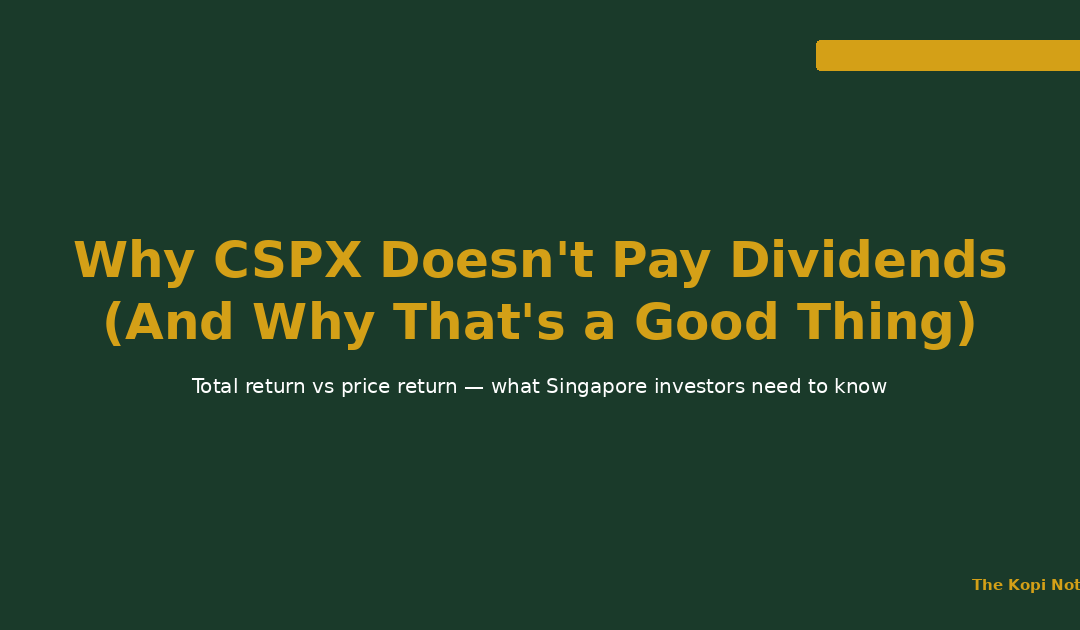
Why CSPX Doesn’t Pay Dividends: Total Return vs Price Return Explained (2026 Guide)
CSPX has never paid a cash dividend since its 2010 LSE listing — here’s exactly where the money goes instead, and why it matters for Singapore investors.
CSPX, the iShares Core S&P 500 UCITS ETF, pays no cash dividends because it is an accumulating (Acc) fund — the dividends its underlying S&P 500 stocks pay are automatically reinvested into the fund’s net asset value (NAV) rather than distributed to unitholders. For Singapore investors, that means your return shows up entirely as a rising share price, and it’s taxed more favourably than if you held a cash-distributing US ETF directly.
Not financial advice. All figures are for educational reference only. Data verified as at October 2026 unless otherwise noted.
Table of Contents
Why This Confuses So Many CSPX Investors
If you search “does CSPX pay dividends” or scroll through your brokerage app expecting a quarterly payout into your cash balance, you’ll come up empty. CSPX (the iShares Core S&P 500 UCITS ETF, LSE-listed) has never distributed a single cent of cash to unitholders since it launched in May 2010. That surprises investors who are used to US-listed ETFs like VOO or SPY, which pay out dividends every quarter.
The confusion usually comes from comparing CSPX’s price chart to a US dividend-paying stock’s price chart and assuming CSPX is “missing” the dividend return. It isn’t — the dividend is still there, it’s just hidden inside the rising NAV instead of sitting in your cash balance. Understanding exactly how that happens matters, because it changes how you should read CSPX’s performance charts and compare it against alternatives like CSPX’s securities lending programme or distributing ETFs.
How an Accumulating ETF Actually Works
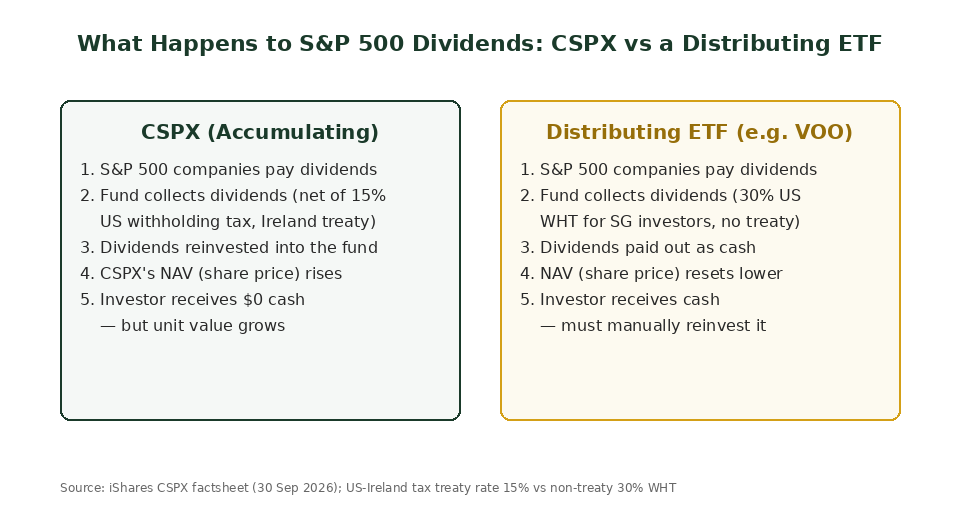
CSPX tracks the S&P 500 and holds (or synthetically replicates exposure to) the same roughly 500 US companies as the index, physically, according to the iShares factsheet. Those 500 companies pay regular cash dividends to their shareholders — CSPX, as a fund, is one of those shareholders. Because CSPX is structured as an Acc (accumulating) share class rather than a Dist (distributing) one, BlackRock/iShares does not pass those dividends on to you as cash. Instead, the fund retains the dividend income and it is reflected directly in a higher NAV per unit — effectively, the fund uses the dividend cash flow to support the value of your existing units rather than issuing a separate payout.
This is the practical difference between a Price Return index (which strips out dividends — this is the “S&P 500 closed at…” number you see quoted in the news) and a Net Total Return index (which assumes dividends are reinvested, net of withholding tax). CSPX’s NAV tracks something very close to the S&P 500 Net Total Return Index, not the Price Return Index. That one detail explains almost the entire difference between “why does CSPX look like it’s grown more than the headline S&P 500 number I saw on the news” over long periods — the gap is the compounding effect of reinvested dividends.
Tax Treatment: Why “No Dividend” Still Saves You Money
Because CSPX is domiciled in Ireland, dividends it receives from US companies are withheld at the reduced 15% rate available under the US-Ireland double tax treaty, before being reinvested into NAV, according to the iShares factsheet. If a Singapore investor instead held a US-domiciled distributing ETF like VOO directly, the US would withhold tax at the standard 30% non-resident alien rate on the cash dividend paid out to them, since individuals do not get treaty relief that Ireland-domiciled funds enjoy at the fund level.
In practice, this means every dollar of dividend CSPX earns on your behalf keeps 85 cents (after the 15% treaty WHT) compounding inside the fund, versus roughly 70 cents if you received the same dividend directly from a US-domiciled distributing ETF. Singapore itself does not tax dividend income for individuals, so there’s no additional local tax either way — the entire difference comes down to which country’s withholding tax rate applies at source, and CSPX’s structure means that advantage is captured automatically without you doing anything.
A Worked Example: SGD 50,000 in CSPX
Here’s what actually happens to the dividend income on a SGD 50,000 CSPX position over one year, using the S&P 500’s approximate index dividend yield of 1.1% p.a. (as at October 2026, S&P Dow Jones Indices / YCharts data) and CSPX’s TER of 0.07% p.a. (iShares factsheet, 30 September 2026), compared against holding the same amount in VOO, the US-domiciled distributing alternative:
| Step | CSPX (Accumulating, Ireland) | VOO (Distributing, US) |
|---|---|---|
| Gross dividend generated | SGD 550/yr (1.1% of SGD 50,000) | SGD 550/yr (same underlying index) |
| US withholding tax rate | 15% (US-Ireland treaty, at fund level) | 30% (non-resident alien rate) |
| Tax withheld | SGD 82.50 | SGD 165.00 |
| Net amount after WHT | SGD 467.50 | SGD 385.00 |
| What happens to it | Reinvested automatically into NAV | Paid to you as cash; you must manually reinvest |
| Annual TER cost | SGD 35.00 (0.07%) | SGD 15.00 (0.03%) |
| Net dividend advantage | CSPX keeps SGD 82.50 more per year from the WHT difference alone — more than double its extra SGD 20 TER cost versus VOO | |
Source: iShares CSPX factsheet (30 September 2026); S&P Dow Jones Indices / YCharts index dividend yield estimate, October 2026. Calculation by The Kopi Notes; illustrative, assumes full dividend yield withheld at the respective treaty rate with no other deductions.
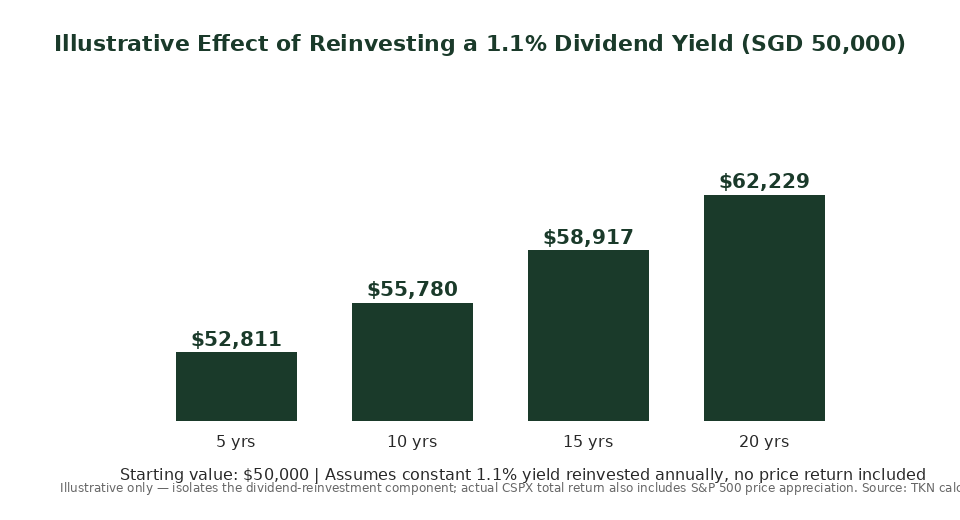
The gap gets larger the longer you hold, because the saved withholding tax compounds year after year inside CSPX’s NAV, while VOO’s cash payout only compounds if you remember to manually buy more units each time — and brokerage minimums or FX conversion costs often mean investors let dividend cash sit idle for a while before reinvesting it, creating a small but real “cash drag” that CSPX avoids entirely.
CSPX vs a Distributing S&P 500 ETF
Putting the structural differences side by side makes it clear why the “no dividend” label is misleading — CSPX isn’t giving up the dividend, it’s just handling it differently:
| Feature | CSPX | VOO |
|---|---|---|
| Domicile | Ireland | United States |
| Exchange | London Stock Exchange (LSE) | NYSE Arca |
| Dividend structure | Accumulating (reinvested into NAV) | Distributing (quarterly cash) |
| TER | 0.07% p.a. | 0.03% p.a. |
| US dividend WHT | 15% (treaty rate, fund level) | 30% (non-resident alien rate) |
| US estate tax exposure | None | Yes, above USD 60,000 |
| Reinvestment effort | Automatic, no action needed | Manual — you buy more units yourself |
| AUM | ~USD 157.6 billion (30 Sep 2026) | ~USD 650+ billion |
Source: iShares CSPX factsheet (30 September 2026); Vanguard VOO fund page; IRS non-resident alien estate tax rules.
What This Means for Your Portfolio
There’s a genuinely useful side effect of CSPX’s accumulating structure that most investors miss: because CSPX never distributes cash, its price chart already is its total return chart. With a distributing ETF, you have to add back every historical dividend payment to compare its true long-term performance against another fund — most free charting tools don’t do this correctly by default. With CSPX, what you see on the price chart on your brokerage app is, structurally, the full total return, since there was never a dividend removed from the NAV in the first place.
Practically, this changes a few things for Singapore investors building a long-term portfolio with CSPX as a core S&P 500 holding:
- Don’t assume CSPX is “underperforming” the S&P 500 headline number you see in the news — that headline is usually the Price Return Index, which excludes dividends by definition.
- CSPX is not eligible for CPF Ordinary or Special Account investment, but it is SRS-compatible through brokers that support SRS funding for LSE-listed ETFs — worth checking against your CPF investment strategy if you’re deciding how to split CPF-eligible versus SRS/cash holdings.
- If you’re retired or need regular cash income from your portfolio, CSPX’s accumulating structure means you’ll need to periodically sell units to generate cash, rather than receiving dividends automatically — factor this into your withdrawal plan using a retirement planning calculator.
- If you’re still accumulating wealth, the automatic reinvestment is a genuine (if modest) behavioural advantage — there’s no cash sitting idle waiting for you to log in and reinvest it.
To start or add to a CSPX position, Singapore investors typically fund a brokerage account via Syfe or Endowus, both of which support LSE-listed UCITS ETFs for cash and SRS portfolios.
Not financial advice. Tax treatment can change and depends on your personal circumstances — this article is for educational reference only and figures are accurate as at October 2026.
Frequently Asked Questions
Does CSPX pay dividends to investors?
No. CSPX is an accumulating (Acc) share class, so it never pays cash dividends to unitholders. The dividends its underlying S&P 500 holdings generate are collected by the fund, taxed at the 15% US-Ireland treaty withholding rate, and reinvested directly into the fund’s NAV — raising the value of your existing units instead of paying you cash.
Why does CSPX's share price keep rising even on dividend ex-dates?
When a stock goes ex-dividend, its price typically drops by roughly the dividend amount because that cash is leaving the company. In a distributing ETF, the fund’s NAV drops similarly on the ex-date because the cash is paid out to investors. CSPX doesn’t pay the cash out — it keeps it inside the fund — so there’s no equivalent NAV drop to offset; the dividend income simply continues compounding inside the share price.
Is CSPX's total return the same as its price return?
For CSPX specifically, yes — because it never distributes cash, its price (NAV) chart already reflects the full total return, including reinvested dividends net of withholding tax. This is different from distributing ETFs, where you need to add back historical dividend payments to see the true total return, which most free charting tools don’t do automatically.
Should I choose CSPX or a distributing S&P 500 ETF?
If you’re still building wealth and don’t need regular cash income, CSPX’s accumulating structure and 15% treaty withholding tax rate typically work in your favour versus a US-domiciled distributing ETF taxed at 30% WHT. If you specifically need periodic cash income without selling units — for example in early retirement — a distributing ETF may suit your cash-flow needs better, even with the less favourable withholding tax rate.
Do I need to declare CSPX's reinvested dividends for Singapore tax purposes?
Singapore does not tax dividend income received by individuals, whether foreign or local, and whether paid out as cash or reinvested inside an accumulating fund. Since CSPX’s reinvested dividends never reach you as a cash distribution, there’s nothing to declare either way — the relevant tax event (the 15% US withholding) happens at the fund level in Ireland, not in your hands as a Singapore investor.
Can I buy CSPX with SRS funds in Singapore?
Yes, through brokers that support SRS-funded purchases of LSE-listed UCITS ETFs, such as Endowus and some full-service brokerages. CSPX is not eligible for CPF Ordinary Account or Special Account investment, so if you want to use CPF funds for S&P 500 exposure you’ll need to look at a CPFIS-approved SGX-listed alternative instead.
Ready to Start Building Your S&P 500 Position?
Open a brokerage account that supports LSE-listed UCITS ETFs and start accumulating CSPX today.
This article was researched with the help of AI. While we strive to keep all information accurate and up to date, there may be errors. If you notice any discrepancies, please contact us.