Best Space ETFs for Singapore Investors (2026 Guide)
JEDI, STRR, WSPC, ARKX and UFO compared — expense ratios, fund size, tax exposure and how to buy each one from Singapore.
Space ETFs give Singapore investors diversified exposure to satellites, rockets and space infrastructure without betting on a single company. The two main routes are LSE-listed UCITS funds — iShares’ STRR and VanEck’s JEDI — domiciled in Ireland with no US estate tax exposure, or US-listed alternatives like ARKX and UFO, which carry that risk above USD 60,000 in holdings.
Not financial advice. All figures are for educational reference only. Data verified as at 12 August 2026 against official fund factsheets and issuer websites.
- STRR and JEDI are Ireland-domiciled UCITS ETFs on the London Stock Exchange — no US estate tax exposure, unlike US-listed ARKX and UFO.
- JEDI is the biggest and most established space ETF at USD 2.0 billion in assets. STRR and WSPC only launched in June 2026, so they’re still small and thinly traded.
- Space ETFs pay almost no dividends, so withholding tax matters less here than for CSPX or VWRA — the real risk you’re managing is US estate tax, not dividend tax.
Table of Contents
What Is Space Investing?
The space economy covers satellite operators, rocket and launch vehicle manufacturers, drone makers, ground station equipment, and the broader supply chain feeding all of it. Instead of trying to pick the next SpaceX, a space ETF spreads your money across dozens of listed companies in one trade.
You get exposure to the sector’s growth — commercial satellite broadband, government defence contracts, reusable rockets — without the binary risk of one company’s launch failing or one IPO disappointing. That diversification matters more here than in most themes, because pure-play space stocks are volatile and many aren’t profitable yet.
Why Space ETFs Are Trending in 2026
SpaceX’s IPO on 12 June 2026 was the trigger. The company debuted at a $1.77 trillion valuation, instantly becoming one of the largest listed companies in the world and pulling retail attention toward the entire space sector.
That listing created an unusual problem for ARK Invest’s ARKX fund. ARKX held a large private stake in SpaceX before the IPO, and once SpaceX started trading publicly, that single position became an outsized share of the fund’s holdings — analysts called it a “concentration crisis.” ARK responded by renaming the fund to the ARK Space & Defense Innovation ETF and widening its mandate to include defence names, reducing the SpaceX weighting over time.
At the same time, three new UCITS space ETFs listed on the London Stock Exchange within days of each other in June 2026 — iShares’ STRR, WisdomTree’s WSPC, and a European version of ARKX. That’s a strong signal that European and Asian fund managers see durable demand for this theme, not just a SpaceX-driven spike.
If you already hold individual space names, our SpaceX IPO guide for Singapore investors covers how the listing itself affects your portfolio.
Best Space ETFs for Singapore Investors
Here’s how the five main space ETFs compare as at 12 August 2026. JEDI is the only one with a multi-year track record — the rest are either newly launched or narrowly focused.
| ETF | Ticker | Exchange | TER | AUM | Domicile |
|---|---|---|---|---|---|
| VanEck Space Innovators | JEDI | LSE | 0.55% | USD 2.0B | Ireland |
| iShares Space Technologies | STRR | LSE | 0.50% | USD 22.6M | Ireland |
| WisdomTree Space Economy | WSPC | LSE | 0.50% | USD ~8.6M | Ireland |
| ARK Space & Defense Innovation | ARKX | NYSE Arca | 0.75% | USD 1.1B | USA |
| Procure Space ETF | UFO | NYSE Arca | 0.75% | USD 850M | USA |
Source: iShares, VanEck, WisdomTree, ARK Invest, Procure ETF Trust fund factsheets and product pages, 5–12 August 2026.
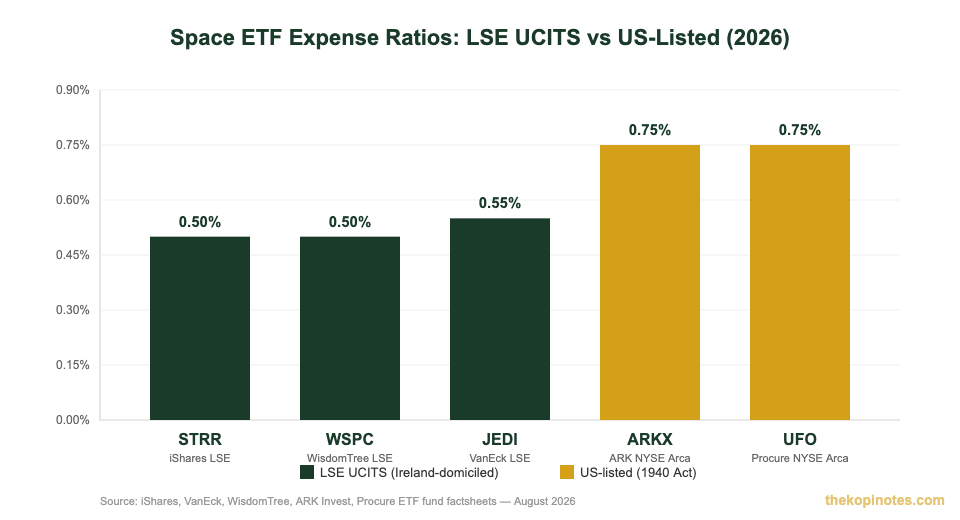
The TER gap is small in absolute terms but consistent: the Ireland-domiciled UCITS funds (STRR, WSPC at 0.50%, JEDI at 0.55%) all undercut the US-listed actively managed funds (ARKX and UFO, both 0.75%). On a SGD 50,000 portfolio, that’s roughly SGD 250–275 a year in STRR or JEDI versus SGD 375 a year in ARKX or UFO — a difference of about SGD 1,250 over 10 years, before compounding.
However, the TER gap isn’t the main reason to prefer the LSE-listed funds. Space ETF holdings — satellite operators, launch companies, defence contractors — generally pay little to no dividends, since most are reinvesting cash into growth. That means the 15% vs 30% US withholding tax difference that matters so much for CSPX or VWRA barely applies here.
The real risk with ARKX and UFO is US estate tax. Because both are US-domiciled funds, a Singapore investor holding more than USD 60,000 in either one is exposed to US estate tax on death — rates that can run up to 40% on the excess. STRR, WSPC, and JEDI, as Ireland-domiciled UCITS funds, carry no such exposure regardless of how much you hold. For a full breakdown of why this structure matters, see our guide on why Singapore investors buy ETFs on the London Stock Exchange.
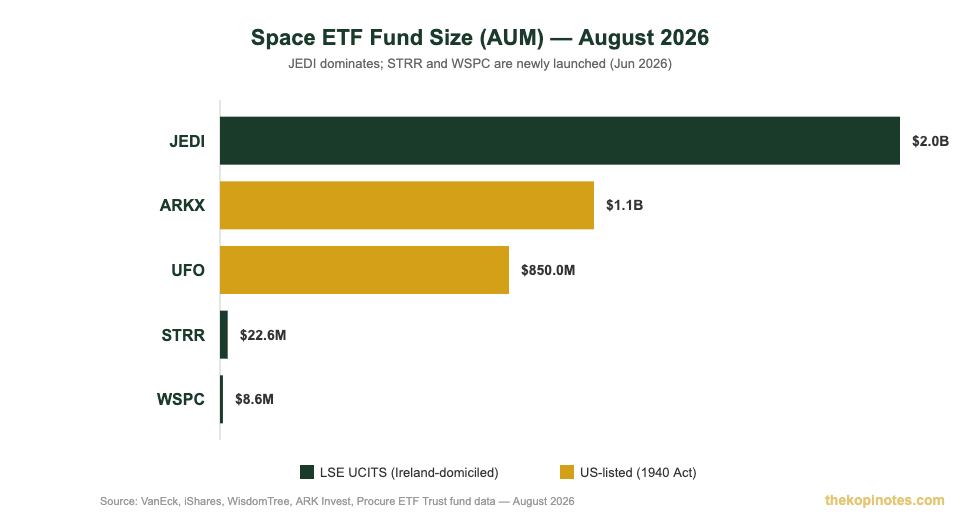
JEDI’s USD 2.0 billion in assets makes it the clear liquidity leader — it’s been running since June 2022 and has weathered a full market cycle. STRR and WSPC only listed on 5 June 2026, so their AUM is still small (USD 22.6 million and roughly USD 8.6 million respectively). That’s normal for brand-new funds, but it does mean wider bid-ask spreads and less depth if you’re placing a large order.
Government budgets are a big part of the “why now” story too. Several governments have expanded space and satellite defence spending through 2025 and into 2026, partly in response to renewed interest in missile defence and secure communications infrastructure. That spending flows directly into the revenue of companies held by ETFs like STRR, which explicitly includes drone and defence-adjacent names alongside pure satellite operators.
How to Buy Space ETFs in Singapore
You’ll need a broker that gives you access to both the London Stock Exchange (for STRR, WSPC, JEDI) and US exchanges (for ARKX, UFO). Here’s how the main options stack up:
Interactive Brokers (IBKR): Supports both LSE and NYSE Arca listings from one account. Fund your account, search the ticker, select the correct exchange (London for STRR/WSPC/JEDI, US for ARKX/UFO), and place your order in the listing currency — GBP for the LSE names, USD for the US ones. Generally the cheapest option for larger, recurring purchases.
Saxo Markets: Similar dual-market access with a more beginner-friendly interface, at a slightly higher commission than IBKR.
moomoo Singapore: Good for US-listed ARKX and UFO, with commission-free trades on US stocks under certain conditions. LSE access is more limited — check current coverage before committing to STRR or JEDI here.
Syfe Brokerage: The simplest option if you’re new to investing and want guided access rather than picking exchanges yourself. Syfe currently offers a sign-up bonus for new accounts opened through partner links.
None of these five ETFs are CPFIS-approved, so you can’t use CPF Ordinary Account funds to buy them. SRS funds can be used if your broker supports SRS-funded trades on the relevant exchange — confirm this with your broker before assuming it’s available.
Risks to Consider
Space ETFs are a concentrated, high-volatility theme — don’t treat this as a core portfolio holding. A few specific risks worth knowing:
Concentration risk: There simply aren’t that many pure-play, liquid space companies yet. STRR holds 84 names, but a handful of large positions can still dominate performance — the ARKX “concentration crisis” around SpaceX is a live example of this.
New fund risk: STRR and WSPC are barely two months old at the time of writing. Small, new ETFs carry a higher risk of low trading volume, wider spreads, and — in a worst case — fund closure if assets don’t grow.
Valuation risk: STRR’s portfolio carries a P/E ratio of 42.43, well above the broader market. You’re paying a growth premium, and growth premiums can compress fast if sentiment turns.
Currency risk: LSE-listed funds trade in GBP or USD depending on the share class; US-listed funds trade in USD. Either way, you’re taking on currency risk against SGD.
Sector cyclicality: A meaningful share of space-sector revenue comes from government contracts. Budget cuts or a shift in defence priorities can hit the whole sector at once.
Profitability risk: Many holdings in these funds are still unprofitable or reinvesting heavily in growth. That is normal for an early-stage industry, but it means valuations rest more on future expectations than current earnings — a risk worth sizing your position around.
Not financial advice. Space ETFs are a high-volatility, concentrated thematic bet — size any position accordingly and consider it a satellite (no pun intended) to a diversified core portfolio, not a replacement for one.
Frequently Asked Questions
What is a space ETF and why do Singapore investors buy one?
A space ETF holds a basket of companies involved in satellites, rockets, launch services and related supply chains, giving you diversified exposure to the space economy in one trade. Singapore investors buy them to gain thematic exposure without the concentrated risk of picking a single space stock.
Is JEDI the same as investing directly in SpaceX?
No. JEDI (VanEck Space Innovators UCITS ETF) holds a basket of around 40–50 listed space companies tracking the MVIS Global Space Industry ESG Index. It may hold SpaceX now that it’s publicly listed, but as one position among many — not a direct, concentrated bet on the company.
Can I buy space ETFs using my CPF or SRS funds?
None of JEDI, STRR, WSPC, ARKX or UFO are CPFIS-approved, so you cannot use CPF Ordinary Account funds. SRS funds may be usable depending on your broker’s SRS trading support — check with IBKR, Saxo or your broker of choice before assuming this is available.
Which broker is best for buying JEDI or STRR in Singapore?
Interactive Brokers (IBKR) and Saxo Markets both offer direct London Stock Exchange access needed for JEDI, STRR and WSPC. IBKR is typically cheaper for larger or recurring purchases; Saxo has a more beginner-friendly interface at a slightly higher cost.
Is ARKX affected by the SpaceX IPO?
Yes. ARKX held a large private stake in SpaceX before its June 2026 IPO, and once SpaceX began trading publicly, that position became an outsized share of the fund — what analysts called a concentration crisis. ARK renamed the fund to ARK Space & Defense Innovation ETF and broadened its mandate to reduce this concentration over time.
Are space ETFs safe? What are the risks?
Space ETFs carry higher-than-average risk: sector concentration, high valuations (STRR’s portfolio trades at a P/E of over 42), currency exposure, and dependence on government spending. STRR and WSPC are also newly launched with small asset bases, meaning wider spreads and less trading depth. Treat this as a small satellite position, not a core holding.
Ready to Start Investing in ETFs?
Open a brokerage account and buy your first ETF today. Use our referral links for exclusive sign-up bonuses.
This article was researched with the help of AI. While we strive to keep all information accurate and up to date, there may be errors. If you notice any discrepancies, please contact us.