Preferred shares ETFs hold hybrid securities that sit between bonds and common stock — they pay a fixed dividend like a bond but trade on an exchange like a stock. PFF, PGX and PFXF (all US-listed) yield roughly 5.5–6.5% but expose you to US estate tax. The Invesco Preferred Shares UCITS ETF (PRFD/PRAC, London-listed, Ireland-domiciled) tracks a similar index without that exposure, at a similar 0.50% cost.
Not financial advice. All figures are for educational reference only. Data verified as at September 2026 unless noted.
- Preferred shares ETFs pay 5.5–6.5% yields, but most (PFF, PGX, PFXF) are US-listed and sit inside your US estate for US estate tax purposes above USD 60,000.
- PRFD/PRAC is an Ireland-domiciled UCITS fund tracking a similar index — same core exposure, no US estate tax, but far smaller (under US$100M) and less liquid.
- As the Fed cuts rates through 2026, more preferreds become likely to get “called” (redeemed early) — a real risk most yield-chasing guides skip.
Table of Contents
What Is a Preferred Shares ETF?
Why Singapore Investors Overlook This Asset Class
PFF vs PGX vs PFXF: The US-Listed Options
The US Estate Tax Problem
The UCITS Alternative: PRFD & PRAC
Callable Risk as Rates Fall
Preferred ETFs vs S-REITs vs Bonds
How to Buy From Singapore
What Is a Preferred Shares ETF?
A preferred share is a hybrid security. It sits above common stock but below bonds in a company’s capital structure if things go wrong. You get a fixed dividend, usually paid quarterly, similar to a bond coupon.
Unlike common stock, a preferred share barely moves with the company’s profits. Unlike a bond, it doesn’t mature — most preferreds are perpetual, with no fixed repayment date. That’s the trade-off: steady income, but no guaranteed return of capital on a fixed schedule.
A preferred shares ETF bundles hundreds of these securities into one fund. Most preferred issuers are banks and insurers — they issue preferred shares to raise regulatory capital without diluting common shareholders. That means these ETFs are heavily concentrated in financials, unless the fund specifically excludes them (more on that below).
Why Singapore Investors Overlook This Asset Class
If you’re reading The Kopi Notes, you probably already own S-REITs for yield. Preferred shares ETFs do a similar job — steady quarterly income — but they’re rarely mentioned in SG investing content. There’s a reason for that, and it’s not a good one: most guides simply don’t know these products exist outside the US market.
That’s a gap. If you hold VWRA or CSPX for growth and S-REITs for yield, a preferred shares ETF is a third, genuinely different income sleeve. It correlates more with interest rates than with property fundamentals or equity earnings — useful diversification, not a replacement for either.
However, plain “PFF pays 6% so buy it” advice misses two things that matter a lot for a Singapore investor: where the fund is domiciled, and what happens to your income when interest rates fall. We cover both below.
PFF vs PGX vs PFXF: The US-Listed Options
These are the three preferred shares ETFs you’ll most often see mentioned. All three trade on US exchanges (NYSE Arca) and are accessible from Singapore via IBKR, Saxo or moomoo.
PFF — iShares Preferred and Income Securities ETF
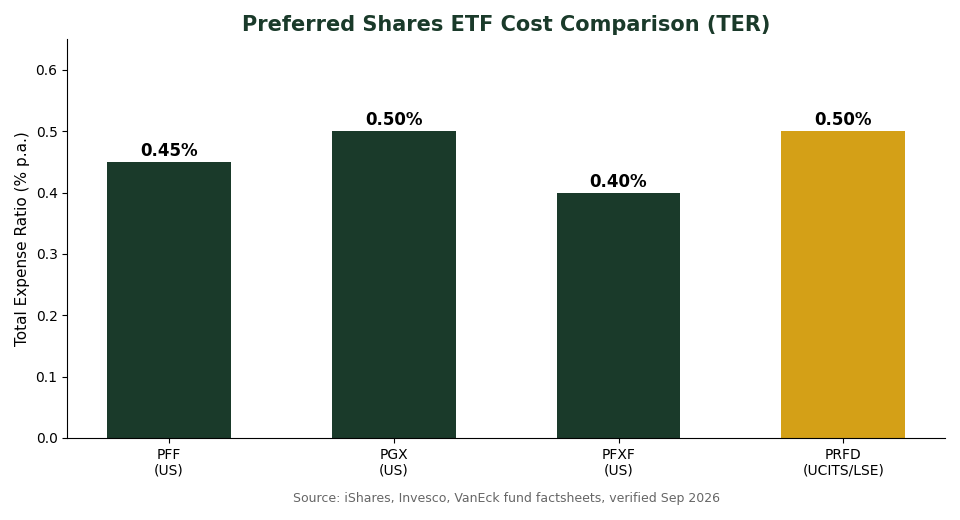
PFF is the largest and oldest fund in the space, with roughly US$13.1 billion in assets as at July 2026. It holds around 250 securities and tracks a broad US-dollar preferred and hybrid securities index. TER is 0.45%, and the trailing dividend yield sits around 5.4%, with a 30-day SEC yield closer to 6.3%.
PGX — Invesco Preferred ETF
PGX tracks a similar ICE preferred securities index. TER is 0.50% — slightly higher than PFF — and it pays monthly rather than quarterly, with a forward yield around 5.5–5.7%. It’s smaller than PFF but still one of the most liquid preferred ETFs available.
PFXF — VanEck Preferred Securities ex Financials ETF
PFXF’s differentiator is right in the name: it deliberately excludes financial-sector preferreds. Since banks and insurers dominate this asset class, that’s a meaningful diversification choice — you get utility, REIT, telecom and energy-sector preferreds instead. TER is 0.40%, the cheapest of the three, with about US$2.4 billion in assets.
| Fund | Domicile | TER | Yield (approx) | AUM |
|---|---|---|---|---|
| PFF (iShares) | US | 0.45% | 5.4–6.3% | ~US$13.1bn |
| PGX (Invesco) | US | 0.50% | ~5.5–5.7% | Multi-billion |
| PFXF (VanEck) | US | 0.40% | ~5.5–6% | ~US$2.4bn |
| PRFD (Invesco UCITS Dist) | Ireland | 0.50% | ~5.7% | ~€86m |
Source: iShares, Invesco, VanEck fund factsheets and fund pages, verified September 2026.
The US Estate Tax Problem
Here’s what most yield-chasing articles skip. PFF, PGX and PFXF are all US-domiciled funds. For a non-US person, that means they count as “US situs assets” for US federal estate tax purposes.
Non-resident aliens get an exemption of just USD 60,000 — far smaller than the multi-million-dollar exemption US citizens get. Above that threshold, your estate pays graduated federal estate tax, from 18% up to 40%, on US-situs assets including US-listed ETFs. This is separate from (and stacks on top of) the same risk in CSPX vs VOO comparisons — if you already know to avoid VOO for this reason, the same logic applies here.
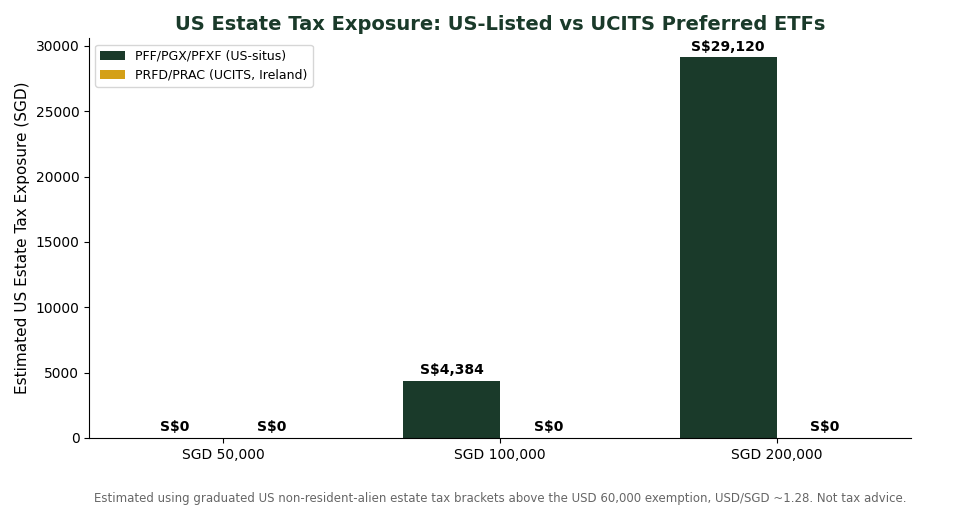
Using 2026 graduated non-resident-alien brackets and a USD/SGD rate of about 1.28, here’s the rough exposure by portfolio size if you die holding only US-listed preferred ETFs:
| Portfolio Value | US-listed (PFF/PGX/PFXF) | UCITS (PRFD/PRAC) |
|---|---|---|
| SGD 50,000 | S$0 (below exemption) | S$0 |
| SGD 100,000 | ~S$4,384 | S$0 |
| SGD 200,000 | ~S$29,120 | S$0 |
Illustrative estimate using graduated US non-resident-alien estate tax brackets above the USD 60,000 exemption, USD/SGD ~1.28. Not tax advice — consult a qualified estate planning professional for your specific situation.
This is exactly the same mechanism covered in our US estate tax guide for Singapore investors — if you haven’t read that yet, it explains the full mechanics, including how joint accounts and beneficiary structuring can (partially) mitigate this.
The UCITS Alternative: PRFD & PRAC
There is a real, LSE-listed, Ireland-domiciled UCITS fund tracking a very similar index: the Invesco Preferred Shares UCITS ETF. It comes in two share classes:
- PRFD (distributing, ISIN IE00BDVJF675) — pays quarterly distributions, currently yielding around 5.69%, fund size roughly €86 million.
- PRAC (accumulating, ISIN IE00BG482169) — reinvests income automatically, fund size roughly US$75 million.
Both track the ICE BofA Diversified Core Plus Fixed Rate Preferred Securities Index — the same family of US preferred securities as PFF and PGX, just wrapped in an Ireland-domiciled UCITS structure. TER is 0.50%, in line with PGX and PRFD’s US peers.
Because it’s Ireland-domiciled, PRFD/PRAC is not a US-situs asset. It falls outside US estate tax entirely — the same reason VWRA and CSPX are the default recommendation over VOO and SPY.
The honest trade-off: PRFD/PRAC has a fraction of PFF’s assets and is meaningfully less liquid. Expect wider bid-ask spreads, especially in size. For a smaller allocation (a few percent of your portfolio) this is a reasonable price for the estate tax protection. For a large, concentrated bet, the liquidity gap is a real consideration — not a reason to avoid the fund, but a reason to use limit orders and avoid market orders in thin trading hours.
Callable Risk as Rates Fall
Most preferred shares are callable. That means the issuer can redeem them at par value after a set date, usually five years after issuance. Issuers call preferreds when it’s cheaper for them to refinance — typically when interest rates have fallen since issuance.
With the Fed’s rate path through 2026 pointing toward further cuts (the next FOMC decision lands 17–18 September 2026), more preferreds issued during the higher-rate years of 2022–2023 become economically attractive for issuers to call. If your preferred gets called, you get your capital back at par — but you lose that income stream and have to reinvest at whatever (likely lower) yield is available then.
This is the preferred-ETF equivalent of prepayment risk in a bond fund. It’s not a reason to avoid the asset class, but it does mean the 5.5–6.5% headline yield is not guaranteed to persist at the fund level as older, higher-coupon issues roll off and get replaced by newer, lower-coupon ones.
Preferred ETFs vs S-REITs vs Bonds
How does this fit next to what you probably already own? Here’s a simple comparison across the three main income asset classes available to you as a Singapore investor.
| Asset Class | Typical Yield | Main Risk | SG Tax Treatment |
|---|---|---|---|
| S-REITs | 5–7% | Property cycle, leverage | Tax-exempt distributions (individuals) |
| Preferred ETFs (US) | 5.5–6.5% | Rate/call risk, US estate tax | 30% US withholding on distributions |
| Singapore T-bills | ~2.5–3% | Reinvestment risk only | Tax-exempt, SDIC-adjacent safety |
Source: TKN estimates based on recent S-REIT yields, T-bill cut-off yields and preferred ETF distribution data, September 2026.
Preferred ETFs sit between S-REITs and T-bills on the risk spectrum — more income-focused than growth-focused, but with real capital-loss risk if rates rise sharply or an issuer’s credit quality deteriorates (preferreds are usually the first thing suspended in a financial crisis, well before common dividends). If you already max out your best S-REITs and Singapore T-bills allocations and want a third income sleeve for diversification, this is where preferred ETFs fit — not as a replacement for either.
How to Buy From Singapore
PFF, PGX and PFXF trade on NYSE Arca and are accessible through Syfe‘s brokerage, IBKR or Saxo. PRFD and PRAC trade on the London Stock Exchange — you’ll need a broker with LSE access, such as IBKR, Saxo or FSMOne. Note that moomoo Singapore does not currently support LSE trading, so it can only get you the US-listed options, not PRFD/PRAC.
Whichever option you pick, hold it in a taxable brokerage account, not CPF — preferred shares ETFs are not CPFIS-approved instruments. If you’re still building your core portfolio, our Singapore REIT ETF guide and retirement planning calculator are good starting points before adding a satellite income position like this.
Frequently Asked Questions
Is a preferred shares ETF a good investment for Singapore investors?
What is the difference between PFF and PGX?
Do preferred shares ETFs trigger US estate tax for Singapore investors?
What is PRFD and how is it different from PFF?
Why do preferred shares ETFs hold mostly bank and insurance stocks?
What happens if my preferred shares get called?
Can I buy preferred shares ETFs with my CPF money?
This article was researched with the help of AI. While we strive to keep all information accurate and up to date, there may be errors. If you notice any discrepancies, please contact us.