Emerging Markets ETF Singapore: EIMI vs VFEA vs VWO Compared (2026 Guide)
A Singapore investor’s guide to the three real ways to buy emerging markets — LSE-listed UCITS ETFs vs the cheaper US-listed alternative, and why the choice matters more than fees alone.
Emerging markets ETFs give Singapore investors exposure to China, India, Taiwan and other fast-growing economies in a single trade. Three main options exist: iShares EIMI and Vanguard VFEA on the London Stock Exchange, or Vanguard’s US-listed VWO. VWO has the lowest fee at 0.06%, but its US domicile creates estate tax exposure that EIMI and VFEA avoid entirely.
Not financial advice. All figures are for educational reference only. Data verified as at 30 June–17 August 2026 unless otherwise noted.
- EIMI (LSE) tracks the MSCI EM IMI index and includes South Korea. VFEA (LSE) and VWO (US) track FTSE Emerging indices, which exclude Korea entirely.
- VWO is by far the cheapest at 0.06% TER. But as a US-domiciled fund, it exposes you to US estate tax above US$60,000 — EIMI and VFEA (Ireland-domiciled) carry no such risk.
- For most SG investors, EIMI or VFEA on the LSE is the safer long-term core holding. VWO works best as a smaller position you actively manage and keep below the estate tax threshold.
Table of Contents
Contents — Click to expand
What Is an Emerging Markets ETF?
An emerging market (EM) is a country whose economy is growing fast but isn’t yet classified as “developed” — think China, India, Taiwan, Brazil and Saudi Arabia. An emerging markets ETF is a single fund that holds hundreds or thousands of stocks across these countries, so you don’t have to pick individual EM companies yourself.
All three ETFs in this guide are UCITS ETFs or their US equivalent. UCITS (Undertakings for Collective Investment in Transferable Securities) is the EU fund structure used by Ireland-domiciled ETFs like EIMI and VFEA. It’s a regulatory wrapper, not an index — the actual holdings depend on which index the fund tracks.
That index choice matters more than most investors realise. MSCI and FTSE Russell, the two big index providers, don’t agree on which countries count as “emerging.” The clearest example: South Korea. We’ll get to that in a moment.
Key Facts at a Glance
| Metric | EIMI | VFEA | VWO |
|---|---|---|---|
| Full Name | iShares Core MSCI EM IMI UCITS ETF | Vanguard FTSE Emerging Markets UCITS ETF (Acc) | Vanguard FTSE Emerging Markets ETF |
| Ticker / Exchange | EIMI – London Stock Exchange (USD) | VFEA – London Stock Exchange (USD) | VWO – NYSE Arca |
| Index Tracked | MSCI Emerging Markets Investable Market Index | FTSE Emerging Index | FTSE Emerging Markets All Cap China A Inclusion Index |
| Domicile | Ireland | Ireland | USA |
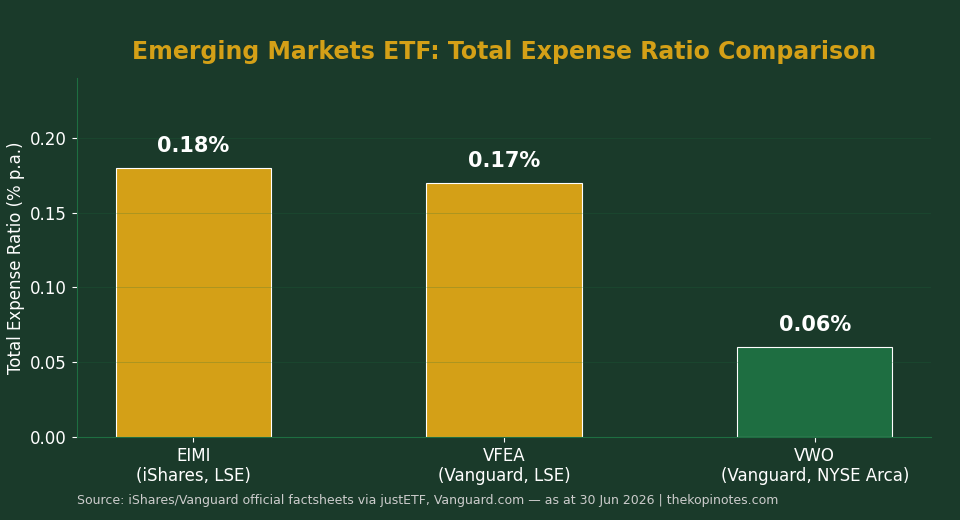
| TER (p.a.) | 0.18% | 0.17% | 0.06% |
| AUM (as at 30 Jun 2026) | €38.1 billion | €2.0 billion (Acc) | US$122.3 billion |
| Holdings | 2,993 | 2,289 | 6,332 |
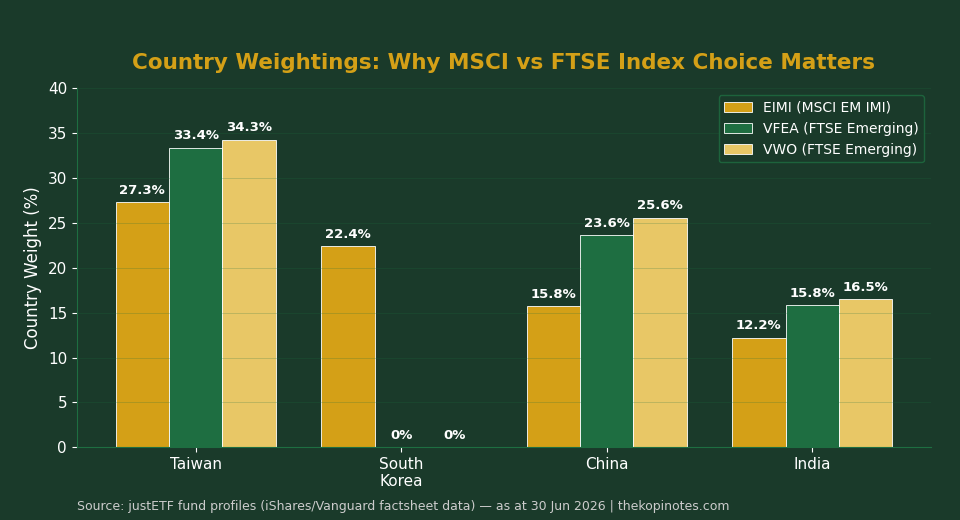
| Includes South Korea? | Yes (~22.4%) | No | No |
Source: iShares EIMI product page and Vanguard VWO fact sheet, as at 30 June 2026.
The Korea Question: Why MSCI and FTSE Disagree
Here’s the single biggest difference between these three funds, and almost no comparison article mentions it. MSCI still classifies South Korea as an emerging market. FTSE Russell reclassified South Korea as a developed market back in 2009.
That one decision changes everything about what you actually own. EIMI, which tracks an MSCI index, holds roughly 22.4% in South Korea — mostly Samsung Electronics and SK Hynix, two of the world’s largest memory-chip makers. VFEA and VWO, which both track FTSE indices, hold 0% in South Korea. That weight gets redistributed into Taiwan, China and India instead.
In practice, this means EIMI is more concentrated in semiconductors: Taiwan Semiconductor, Samsung and SK Hynix together made up over a quarter of the fund as at 30 June 2026. If you already own a “developed Asia” or Korea-tilted fund elsewhere, choosing EIMI could mean double-counting your chip exposure. If you want your EM allocation to stay purely in markets everyone agrees are “emerging,” VFEA or VWO is the cleaner pick.
The Estate Tax Divide: Why Domicile Matters More Than You Think
For a fund like CSPX tracking the S&P 500, the Ireland-vs-US domicile decision is mostly about dividend withholding tax — Ireland’s US tax treaty cuts withholding from 30% to 15% on US-sourced dividends. For emerging markets ETFs, that particular benefit barely applies, because EIMI and VFEA hold almost no US stocks. Their dividends come from Taiwan, China, India and other EM countries, and each country sets its own withholding rate regardless of where the ETF is domiciled.
The real domicile difference for EM ETFs is entirely about US estate tax. VWO is a US-domiciled fund, which makes it a US situs asset. Under IRS rules for nonresident aliens, a non-resident alien’s US situs assets above US$60,000 are subject to federal estate tax at rates of up to 40% — and this exemption is not adjusted for inflation.
Say a Singapore investor holds US$150,000 in VWO and passes away. The taxable amount is US$150,000 minus the US$60,000 exemption, or US$90,000. At graduated non-resident alien rates, the estate could owe tens of thousands of US dollars in tax before heirs can access the funds — on top of the paperwork burden of filing IRS Form 706-NA. EIMI and VFEA, as Ireland-domiciled UCITS funds, are not US situs assets and sit entirely outside this regime.
We cover the full mechanics, thresholds and worked examples in our dedicated US estate tax guide for Singapore investors. If you’re building a long-term EM position of any real size, read that first.
Total Cost of Ownership: Fees vs Risk
On paper, VWO is far cheaper. Here’s what that gap actually costs on a SGD 50,000 EM allocation:
| ETF | TER | Annual Fee on SGD 50,000 | 20-Year Fee Drag (approx.) |
|---|---|---|---|
| EIMI | 0.18% | ~SGD 90 | ~SGD 1,800 |
| VFEA | 0.17% | ~SGD 85 | ~SGD 1,700 |
| VWO | 0.06% | ~SGD 30 | ~SGD 600 |
Illustrative calculation based on published TERs, assuming a flat SGD 50,000 balance with no compounding for simplicity. Actual costs vary with fund performance and FX movements.
The difference between EIMI and VWO works out to roughly SGD 1,200 in extra fees over 20 years on a SGD 50,000 position — a real but modest amount. Compare that to the potential US estate tax bill on a growing VWO position: it can run into the tens of thousands of dollars once your US situs assets cross US$60,000. For most investors, the fee saving doesn’t come close to justifying the estate tax risk once a position grows beyond a token size.
How to Buy EIMI, VFEA or VWO in Singapore
Access differs by broker, and this trips up a lot of first-time EM investors.
For EIMI or VFEA (London Stock Exchange): you need a broker with LSE market access. Interactive Brokers (IBKR) and Saxo Markets both support LSE trading with competitive FX spreads. Search the ticker (EIMI or VFEA), confirm you’re selecting the USD-denominated London listing and not a Euronext or Xetra listing of the same fund, then place a limit order.
MooMoo and Syfe’s brokerage platforms currently do not offer LSE access, so EIMI and VFEA aren’t buyable there — check your platform’s exchange list before assuming a ticker is available.
For VWO (NYSE Arca): access is much broader. IBKR, Tiger Brokers, moomoo and most SG brokers with US market access can buy VWO directly. This is one reason VWO remains popular with smaller investors — it’s simply easier to reach.
Whichever fund you choose, buy in the fund’s base currency (USD) where possible to avoid unnecessary FX conversion fees, and use limit orders rather than market orders on EM ETFs, which can have wider bid-ask spreads than US large-cap funds.
Can You Use CPF or SRS?
None of the three funds in this guide is on the CPFIS-approved list, which is narrow and mostly covers SGX-listed instruments and specific unit trusts. You cannot buy EIMI, VFEA or VWO directly with your CPF Ordinary Account funds.
SRS funds are different. Once you’ve transferred money into your SRS account and it’s sitting in a linked brokerage account, you can generally use it to buy any ETF your broker offers — including these three. Availability varies by SRS operator bank, so confirm with your broker first. For the full CPF picture, including which instruments actually qualify, see our CPF investment strategy guide.
Who Should Buy Which?
Choose EIMI if you want the broadest possible EM exposure, including South Korea and thousands of small-cap names, and you’re comfortable with a slightly higher 0.18% TER for that completeness.
Choose VFEA if you want LSE-listed convenience and Ireland-domiciled safety, but prefer to keep Korea out of your EM sleeve — typically because you already hold Korea through a separate developed-Asia allocation.
Choose VWO if minimising fees is your top priority, you’re comfortable actively tracking your total US situs asset exposure, and you plan to keep the position (plus any other US-domiciled holdings) below the US$60,000 estate tax threshold, or you’re investing for a shorter horizon.
Many Singapore investors end up holding EIMI or VFEA as their core long-term EM sleeve inside a global portfolio, precisely because it removes one more thing — estate tax exposure — that they’d otherwise need to actively manage for decades.
Risks to Consider
Emerging markets are more volatile than developed markets, and these funds are no exception. EIMI’s maximum drawdown since its 2014 inception was -34.34%; VFEA’s was -31.41% since 2019, per justETF risk data as at 30 June 2026. A EM allocation should be sized as part of a diversified portfolio, not a standalone bet.
All three funds carry meaningful China concentration (roughly 15–26% depending on the fund), which means regulatory shifts or geopolitical tension involving China can move your EM holdings significantly. Currency risk is also real — these funds are unhedged, so SGD-based returns will differ from the underlying USD/local-currency returns. Finally, all three funds are top-heavy: Taiwan Semiconductor Manufacturing alone made up between 13% and 17% of each fund as at mid-2026, so a shock to one company can move the whole ETF.
Not financial advice. This article is for educational purposes only and does not account for your individual circumstances. Consult a licensed financial adviser or tax professional before making investment or estate planning decisions.
Frequently Asked Questions
What is the best emerging markets ETF for Singapore investors?
There isn’t a single “best” fund — it depends on your priorities. For most Singapore investors building a long-term core position, EIMI or VFEA on the London Stock Exchange is the safer default because both are Ireland-domiciled and carry no US estate tax exposure. VWO is cheaper on fees but only suits investors who actively manage their US situs asset exposure.
Is EIMI or VFEA better for a Singapore investor?
Both are Ireland-domiciled UCITS ETFs listed on the LSE, so the estate tax and broker access considerations are identical. The real difference is index methodology: EIMI includes South Korea (~22.4% of the fund) and small-cap stocks, while VFEA excludes Korea and sticks to large and mid caps. Pick EIMI for broader coverage, VFEA if you already have Korea exposure elsewhere.
Does VWO's lower fee make it better than EIMI or VFEA?
Not necessarily. VWO’s 0.06% TER is significantly cheaper than EIMI’s 0.18% or VFEA’s 0.17%, saving roughly SGD 1,200 over 20 years on a SGD 50,000 position. But VWO is a US-domiciled fund, which exposes non-resident Singapore investors to US estate tax on the value above US$60,000 — a risk that can dwarf the fee savings as your position grows.
Why does EIMI include South Korea but VFEA and VWO don't?
EIMI tracks an MSCI index, and MSCI still classifies South Korea as an emerging market. VFEA and VWO both track FTSE Russell indices, and FTSE reclassified South Korea as a developed market back in 2009. Neither classification is “wrong” — they’re simply different methodologies, and the practical effect is a large weighting difference in Samsung Electronics and SK Hynix.
Can I buy emerging markets ETFs with my CPF or SRS?
You cannot use CPF Ordinary Account funds to buy EIMI, VFEA or VWO — none of them is on the CPFIS-approved investment list. SRS funds can generally be used, since SRS operates through a normal linked brokerage account once transferred, but confirm fund availability with your specific SRS operator bank first.
What happens if I hold VWO and it grows past US$60,000?
As a non-resident alien, your US situs assets above the US$60,000 exemption become subject to US federal estate tax at rates of up to 40% if you pass away while holding them. This exemption is not adjusted for inflation. Many investors manage this by capping their US-domiciled holdings, switching to Ireland-domiciled equivalents like EIMI or VFEA, or using estate planning structures — see our full US estate tax guide for the complete threshold table and worked examples.
Ready to Add Emerging Markets to Your Portfolio?
Open a brokerage account with LSE and US market access, and read the full estate tax picture before you size your position.
This article was researched with the help of AI. While we strive to keep all information accurate and up to date, there may be errors. If you notice any discrepancies, please contact us.