China ETF Singapore: CNYA vs FLXC vs KWEB Compared (2026 Guide)
Why onshore A-shares are climbing while offshore tech ETFs slide — and how to buy each one.
China ETFs let Singapore investors buy a basket of Chinese companies in one trade. In 2026, the market has split sharply: onshore A-share funds like CNYA are up over 5% year-to-date, while offshore tech-heavy funds like KWEB have fallen more than 20%. Ireland-domiciled, LSE-listed options (CNYA, FLXC, KWEB) avoid US estate tax exposure and are bought through IBKR, Saxo, or moomoo, just like CSPX or VWRA.
Not financial advice. All figures are for educational reference only. Data verified as at 18 August 2026 unless otherwise noted.
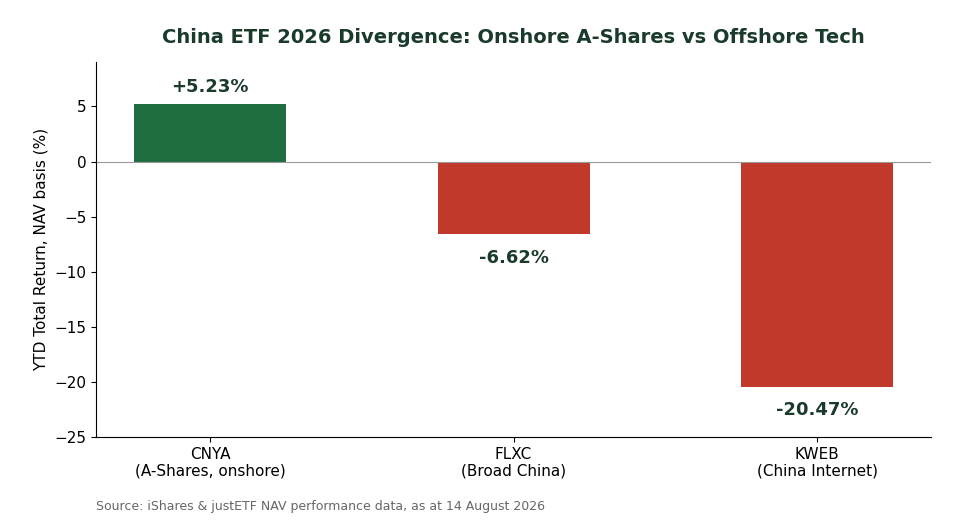
- China’s stock market isn’t moving as one block in 2026 — onshore A-shares (CNYA, +5.23% YTD) are outperforming offshore tech-heavy funds (KWEB, -20.47% YTD) by a wide margin.
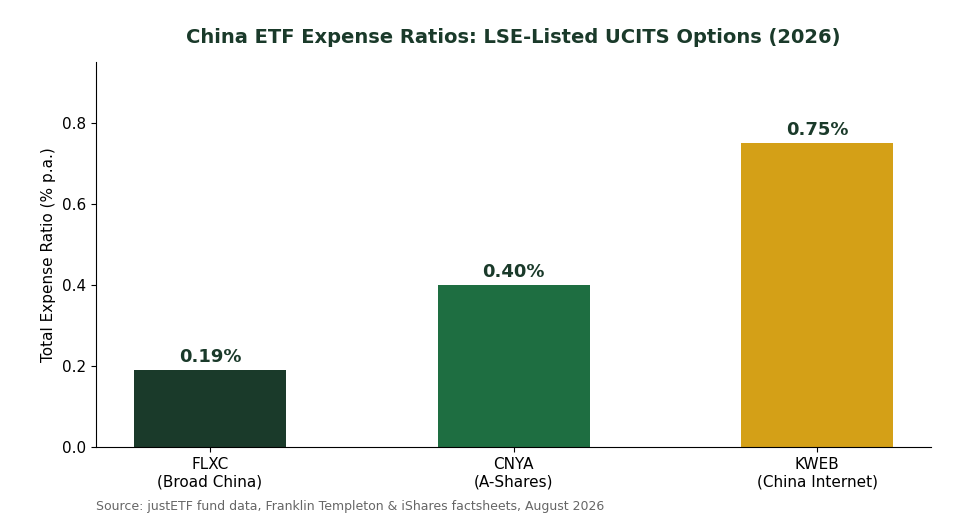
- Three LSE-listed UCITS ETFs cover the main ways in: FLXC (broad, cheapest at 0.19% TER), CNYA (onshore A-shares, 0.40% TER), and KWEB (offshore internet/tech names, 0.75% TER).
- All three are Ireland-domiciled, so you buy them the same way you’d buy CSPX or VWRA — via IBKR, Saxo, or moomoo, with no US estate tax exposure.
Table of Contents
Contents — Click to expand
What Is a China ETF?
A China ETF is a fund that bundles many Chinese companies into a single, tradeable unit. Instead of researching and buying individual stocks like Tencent or a bank listed in Shanghai, you buy one ticker and get exposure to dozens or hundreds of companies at once.
For Singapore investors, two structures matter most. The first is onshore exposure to “A-shares” — companies incorporated in mainland China and listed on the Shanghai or Shenzhen stock exchanges, accessed by fund managers through a trading link called Stock Connect. The second is offshore exposure to Hong Kong-listed “H-shares,” US-listed depositary receipts like Alibaba and PDD, and other Chinese companies trading outside mainland China.
Most China ETFs available to Singapore investors are UCITS funds domiciled in Ireland and listed on European exchanges, including the London Stock Exchange (LSE). This structure matters for two reasons: it avoids the US estate tax exposure that comes with holding US-domiciled funds directly, and any US-listed constituents benefit from a reduced 15% US dividend withholding tax under the Ireland-US tax treaty. You buy these funds the same way you would buy CSPX or VWRA — through a broker with LSE market access.
Why China ETFs Are Trending in 2026
China’s equity market has had a strong 2026 by several measures. Data compiled through mid-April 2026 showed the ChiNext index up 97.2% in USD terms over the trailing year, ahead of the Nasdaq’s 41.3% gain over the same period. The Shanghai Composite was up 35.6% and the CSI300 up 37.7%, both outpacing the S’s 28.9% gain.
The IMF projects China’s real GDP growth at 4.4% for 2026, well above both the 3.1% global average and the 3.9% forecast for emerging markets as a group. Analysts point to three supports: continued momentum in AI-related capital spending, Chinese companies “going global” to sell into new export markets, and Beijing’s anti-involution policy push to curb the destructive price wars that have squeezed corporate margins in sectors like EVs and solar. Goldman Sachs has forecast roughly 20% gains for Chinese stocks in 2026 on the back of these themes.
Here’s the catch: none of these headline numbers tell you which specific ETF actually made you money. By August 2026, the picture inside “China” had split into two very different stories — and the ETF you picked determined which one you experienced.
The 2026 Divergence: A-Shares vs Offshore Tech
If you bought a China ETF in January 2026 expecting the rally to lift every fund equally, the results by mid-August would have surprised you. Onshore A-share funds and offshore tech-heavy funds have moved in almost opposite directions this year.
| ETF | Exposure | YTD Return (NAV, as at 14 Aug 2026) |
|---|---|---|
| CNYA | Onshore A-shares | +5.23% |
| FLXC | Broad China (A + H-shares + ADRs) | -6.62% |
| KWEB | Offshore internet/tech | -20.47% |
Source: iShares & justETF NAV performance data, as at 14 August 2026
The gap comes down to composition. CNYA holds only mainland-listed A-shares, a group dominated by banks, industrials, and materials companies that are more insulated from the export-control headlines and platform-economy regulatory risk that hit Chinese tech names harder in the second half of the year. FLXC and KWEB, by contrast, are heavily weighted toward offshore internet and consumer-platform giants like Tencent, Alibaba, PDD, and Meituan — the same names that led the early-2026 rally and then gave back the most ground once sentiment turned. This is a genuinely useful, non-obvious fact for Singapore investors: “buying China” is not one trade, and the fund you choose can decide whether your year looks like +5% or -20%.
Best China ETFs for Singapore Investors
All three ETFs below are UCITS funds domiciled in Ireland and listed on the London Stock Exchange in USD, so Singapore investors can buy them through any broker with LSE access.
Franklin FTSE China UCITS ETF (FLXC) — Broadest, Cheapest
FLXC tracks the FTSE China 30/18 Capped index, a broad basket of 750 large- and mid-cap Chinese companies spanning A-shares, H-shares, ADRs, and other offshore listings. At a 0.19% TER, it is the cheapest broad China option available on the LSE, and its ~1,486 million euro fund size (August 2026) makes it comfortably liquid (Franklin FTSE China UCITS ETF factsheet, August 2026).
iShares MSCI China A UCITS ETF (CNYA) — Onshore Focus
CNYA tracks the MSCI China A Inclusion Index, giving you pure exposure to 411 mainland-listed A-shares via Stock Connect and RQFII routes. It carries a 0.40% TER and roughly USD 2.78 billion in net assets (14 August 2026), making it the fund that captured this year’s onshore rally (iShares CNYA product page, 14 August 2026).
KraneShares CSI China Internet UCITS ETF (KWEB) — Tech & Platform Names
KWEB tracks the CSI Overseas China Internet Index, a concentrated basket of just 33 offshore-listed internet and consumer-platform names including Tencent, Alibaba, PDD, and Meituan. At 0.75% TER, it is the most expensive and most concentrated of the three — the top 10 holdings make up over 60% of the fund (KraneShares KWEB fund page, August 2026).
| Feature | FLXC | CNYA | KWEB |
|---|---|---|---|
| Full Name | Franklin FTSE China UCITS ETF | iShares MSCI China A UCITS ETF | KraneShares CSI China Internet UCITS ETF |
| Index | FTSE China 30/18 Capped | MSCI China A Inclusion | CSI Overseas China Internet |
| ISIN | IE00BHZRR147 | IE00BQT3WG13 | IE00BFXR7892 |
| Domicile | Ireland | Ireland | Ireland |
| TER | 0.19% p.a. | 0.40% p.a. | 0.75% p.a. |
| Fund Size | ~EUR 1,486m | ~USD 2,782m | ~EUR 450m |
| Holdings | 750 | 411 | 33 |
| Structure | Accumulating | Accumulating | Accumulating |
| Best For | Broad, low-cost core holding | Onshore-only, policy-driven growth | High-conviction tech/platform bet |
Source: iShares CNYA factsheet, Franklin FTSE China UCITS ETF factsheet, KraneShares KWEB fund page — all August 2026
Tax and Cost Considerations for Singapore Investors
Singapore does not tax capital gains, so any price appreciation on your China ETF units is yours to keep regardless of which fund you hold. Because all three funds are Ireland-domiciled accumulating share classes, any dividends from the underlying companies are reinvested inside the fund rather than paid out to you — so there is no dividend income for you to manage at all.
There is one China-specific tax detail worth knowing. For funds like CNYA that invest directly in mainland A-shares via Stock Connect, the PRC/Ireland tax treaty provides an exemption from Chinese capital gains tax on the fund’s own trading of A-shares. This is a fund-level benefit, not something you need to file for yourself — it is baked into the ETF’s structure precisely because it is Ireland-domiciled rather than, say, a US-domiciled fund.
On brokerage costs: expect a similar fee structure to buying CSPX or VWRA. Syfe’s brokerage platform and full-service brokers like IBKR or Saxo all support LSE trading in USD, so your main variable cost is the commission per trade plus any FX spread if you’re funding the trade from SGD.
How to Buy China ETFs in Singapore (Step-by-Step)
You buy FLXC, CNYA, and KWEB the same way as any other LSE-listed UCITS ETF:
1. Fund your brokerage account. You will need a broker with access to the London Stock Exchange. Interactive Brokers (IBKR) offers the widest exchange access and is typically the most cost-effective for larger, less frequent trades. Saxo Markets is a strong alternative with a cleaner interface for beginners. moomoo Singapore also offers LSE access on selected tickers, and Syfe’s brokerage is worth checking for investors who already hold a Syfe portfolio.
2. Search for the ticker. Enter FLXC, CNYA, or KWEB into your broker’s search bar and confirm you have selected the London Stock Exchange (LSE) listing, quoted in USD — some of these ETFs also list on Euronext Amsterdam, Xetra, or SIX Swiss, so double-check the exchange before placing your order.
3. Place your order. Use a limit order rather than a market order, especially for KWEB, which has a smaller fund size and can show a wider bid-ask spread than FLXC or CNYA.
4. Decide how much to allocate. Because China ETFs carry higher volatility than a broad global fund like VWRA, most Singapore investors treat China exposure as a satellite position — commonly in the 5–15% range of an equity portfolio — rather than a core holding.
Risks to Consider
China ETFs carry meaningfully higher risk than a developed-market fund like CSPX or a global fund like VWRA. Volatility is the clearest signal: FLXC’s one-year volatility sits at 18.27%, while KWEB’s concentrated tech basket runs at 27.81% — nearly double.
Other risks are specific to China exposure. Funds using Stock Connect to access A-shares (like CNYA) are subject to daily trading quotas; if a quota is exceeded, buy orders can be rejected and the fund may trade at a premium or discount to its net asset value. Offshore-listed names in FLXC and KWEB carry regulatory and geopolitical risk tied to US-China trade tensions and Chinese platform-economy policy. And because both FLXC and KWEB are concentrated in a relative handful of mega-cap names — Tencent and Alibaba alone make up over 20% of FLXC — company-specific news can move the whole fund.
None of this means China ETFs should be avoided. It means position sizing and fund selection both matter more here than they do for a broad-market ETF.
Who Should Buy China ETFs?
China ETFs suit you if you already hold a core global portfolio (through something like VWRA or IWDA) and want targeted exposure to a growth market that developed-market indices under-represent, if you can tolerate 20%+ swings without needing to sell at the bottom, and if you’re comfortable treating this as a satellite position rather than your main holding.
Consider skipping China ETFs, or keeping the allocation small, if your portfolio is still being built out and you don’t yet have a diversified core, if you’re investing money you’ll need within the next 3–5 years, or if geopolitical and regulatory risk around China specifically makes you uncomfortable regardless of the potential upside. A CPF investment strategy built primarily around CPFIS-approved funds won’t include these LSE-listed ETFs at all, since they sit outside your CPF Ordinary Account — this is cash or SRS money only. If you’re mapping out how a position like this fits your broader retirement timeline, the Singapore retirement calculator is a useful starting point, and our guide to building passive income in Singapore covers how growth positions like this fit alongside income-generating assets.
For investors specifically interested in other emerging-market alternatives, our India ETF Singapore guide covers a comparable growth market with a very different risk profile.
Not financial advice. This article is for educational purposes only and does not constitute a recommendation to buy or sell any security. Past performance, including the 2026 figures cited above, is not indicative of future results.
Frequently Asked Questions
What is the difference between CNYA, FLXC and KWEB?
CNYA holds only mainland-listed China A-shares, giving you pure onshore exposure. FLXC is broader, holding A-shares, H-shares, and offshore ADRs in one fund at the lowest cost (0.19% TER). KWEB is the most concentrated, holding just 33 offshore internet and platform companies like Tencent and Alibaba, and carries the highest cost (0.75% TER) and highest volatility of the three.
Why are China A-share ETFs outperforming Chinese tech ETFs in 2026?
As at 14 August 2026, CNYA (A-shares) was up 5.23% year-to-date while KWEB (offshore tech) was down 20.47%. The gap reflects composition: A-shares are dominated by banks, industrials, and materials companies less exposed to the trade-tension and platform-regulation headlines that have weighed on offshore internet names this year.
Can I buy China ETFs using my CPF or SRS funds?
CNYA, FLXC, and KWEB are LSE-listed UCITS ETFs and are not on the CPFIS list of approved investments, so you cannot use your CPF Ordinary Account funds to buy them directly. SRS funds can be used if your SRS-linked brokerage account supports LSE trading — check with your broker before transferring funds.
Which broker is best for buying China ETFs in Singapore?
Interactive Brokers (IBKR) offers the widest LSE access and is generally the most cost-effective for larger trades. Saxo Markets is a solid alternative with a simpler interface. moomoo Singapore supports LSE trading on selected tickers, and Syfe’s brokerage is convenient if you already hold a Syfe portfolio. Compare commission and FX spread across a few brokers before committing.
Are China ETFs safe for Singapore investors?
China ETFs carry higher volatility and concentration risk than developed-market funds — KWEB’s one-year volatility of 27.81% is roughly double a typical S&P 500 ETF. They are not unsafe in the sense of fraud or counterparty risk (all three are large, regulated UCITS funds), but they should be sized as a satellite position, not a core holding, given the swings involved.
Is now a good time to invest in China ETFs?
This depends entirely on your own timeline and risk tolerance, not on any single data point. What’s clear from 2026 so far is that “China” is not one trade — onshore and offshore Chinese equities have moved in opposite directions this year, so the more useful question is which specific exposure fits your portfolio, not whether China as a whole is “due” for a move.
Ready to Diversify Beyond a Core Global Portfolio?
Open a brokerage account and add targeted exposure like China ETFs alongside your core holdings. Use our referral links for exclusive sign-up bonuses.
This article was researched with the help of AI. While we strive to keep all information accurate and up to date, there may be errors. If you notice any discrepancies, please contact us.