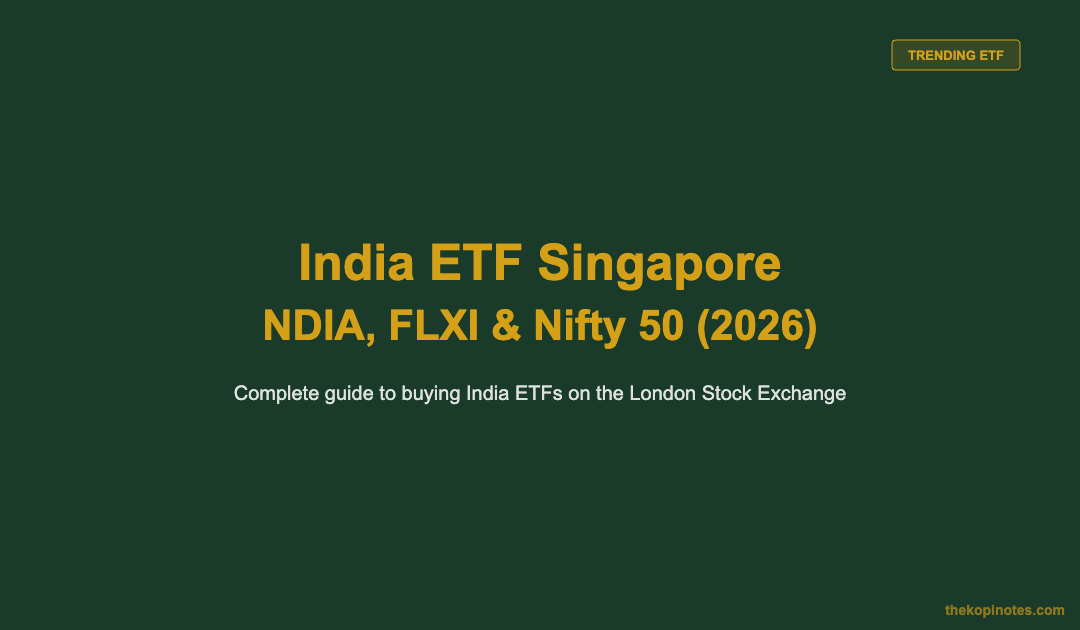
India ETF Singapore: How to Buy NDIA, FLXI & Nifty 50 ETFs (2026 Guide)
A Singapore investor’s guide to India-focused UCITS ETFs — tickers, fees, and how to buy them tax-efficiently on the LSE.
India ETFs let Singapore investors tap one of the world’s fastest-growing economies without buying individual Indian stocks. The main options are LSE-listed UCITS ETFs like NDIA (iShares MSCI India) and FLXI (Franklin FTSE India), bought through Interactive Brokers or Saxo. Like CSPX and VWRA, these Ireland-domiciled funds carry no US estate tax exposure and lower dividend withholding tax than US-listed alternatives.
Not financial advice. All figures are for educational reference only. Data verified as at August 2026 unless noted.
- Two main India ETF choices: NDIA (iShares, largest, 0.65% TER) and FLXI (Franklin FTSE, cheapest at 0.19% TER)
- Only Interactive Brokers and Saxo offer LSE access for these ETFs from Singapore — MooMoo does not support UK-listed funds
- India’s market has been volatile in 2026 (NDIA is down over 8% year-to-date) — this is a long-term growth story, not a quick trade
Table of Contents
What Is India ETF Investing?
India ETFs are exchange-traded funds that hold a basket of Indian company shares. Instead of buying individual stocks like Reliance or HDFC Bank one by one, you buy a single fund that holds hundreds of them at once.
For Singapore investors, the two India ETFs worth knowing are NDIA (iShares MSCI India UCITS ETF) and FLXI (Franklin FTSE India UCITS ETF). Both trade on the London Stock Exchange (LSE) in USD, and both are domiciled in Ireland — the same UCITS structure used by CSPX and VWRA. That matters for tax: Ireland-domiciled ETFs carry no US estate tax exposure for Singapore investors, unlike similar funds listed directly in the US. Read our full explanation of why Singapore investors buy ETFs on the London Stock Exchange and our guide to US estate tax rules for Singapore investors for the full picture.
NDIA tracks the MSCI India Index, covering around 165 large and mid-cap stocks — roughly 85% of India’s investable stock market. FLXI tracks the FTSE India 30/18 Capped Index, a similarly broad basket with capped single-stock weights so no one company dominates the fund. A third option, XNIF (Xtrackers Nifty 50), gives you exposure to India’s benchmark Nifty 50 index through a swap structure — but it’s domiciled in Luxembourg, not Ireland, which changes its risk profile slightly.
All three are accumulating funds. Dividends get reinvested automatically inside the fund, so you don’t receive cash payouts and there’s no dividend paperwork to manage yourself.
Why India Is Trending in 2026
India’s stock market has become a bigger talking point among Singapore investors this year — for two competing reasons.
The bullish case: analysts are calling for a rebound. Nomura projects the Nifty 50 could reach 29,300 by the end of 2026, roughly 12% above mid-year levels, on stronger corporate earnings and policy support, according to Nomura’s 2026 outlook. Jefferies has a similar target of around 28,300. The long-term story hasn’t changed — India still has one of the fastest-growing large economies in the world, a young workforce, and expanding manufacturing and services sectors.
Here’s the catch: 2026 hasn’t been kind to India ETFs so far. NDIA was down about 8.25% year-to-date as at mid-August 2026, even as developed markets have generally held up better. That volatility is the real lesson for you as a Singapore investor. India is a long-term growth story, not a smooth ride. If you’re chasing a quick trend, this isn’t it. If you’re comfortable holding through multi-year cycles for demographic and earnings growth, a small allocation may be worth considering.
That gap between a bullish multi-year forecast and a rough near-term chart is common in emerging-market investing. It’s a reminder to size any single-country position sensibly within a diversified portfolio — and if you want broader emerging Asia exposure beyond just India, see our SGX ETF Asia ex China guide for other options.
Best India ETFs for Singapore Investors
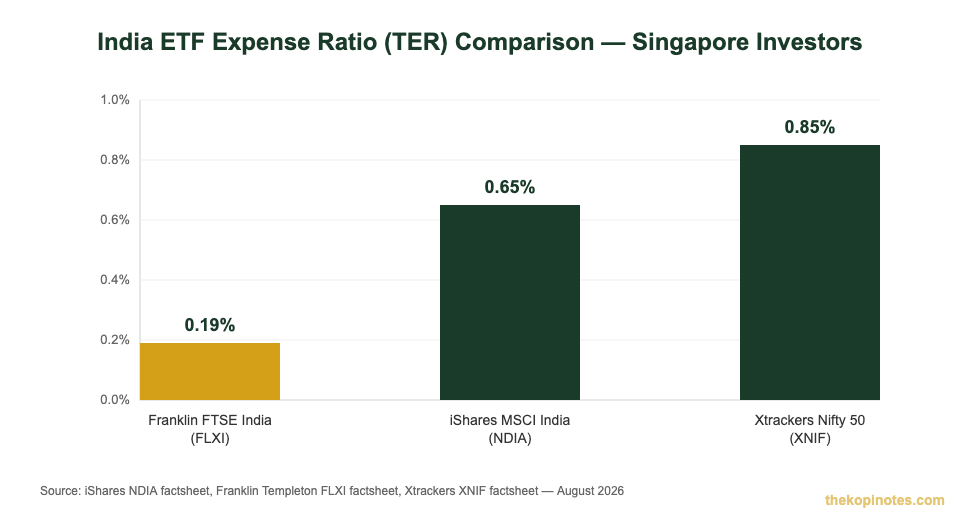
Here’s how the three main India ETF options compare, based on official fund factsheet data as at August 2026.
| ETF | Ticker (LSE) | TER | Index Tracked | Domicile | AUM |
|---|---|---|---|---|---|
| Franklin FTSE India | FLXI | 0.19% | FTSE India 30/18 Capped | Ireland | ~EUR 1.96bn |
| iShares MSCI India | NDIA | 0.65% | MSCI India Index | Ireland | USD 5.23bn |
| Xtrackers Nifty 50 | XNIF | 0.85% | Nifty 50 (swap-based) | Luxembourg | ~USD 208m |
Source: Franklin Templeton FLXI factsheet; iShares NDIA factsheet (14 Aug 2026); Xtrackers XNIF factsheet — August 2026
FLXI is the cheapest by a wide margin — its 0.19% TER is less than a third of NDIA’s cost and less than a quarter of XNIF’s. But NDIA is by far the largest and most liquid, with USD 5.2 billion in assets, which matters if you care about tight bid-ask spreads when trading. XNIF takes a different approach: instead of physically holding Indian shares, it uses a swap to replicate the Nifty 50 index. That adds counterparty risk on top of the usual market risk — something worth weighing before you choose between the three.
Here’s what that fee gap actually costs you over time. If you invested SGD 20,000 in an India ETF and it grew at 8% a year for 10 years, the TER difference alone — assuming identical index performance — would leave you with meaningfully different outcomes.
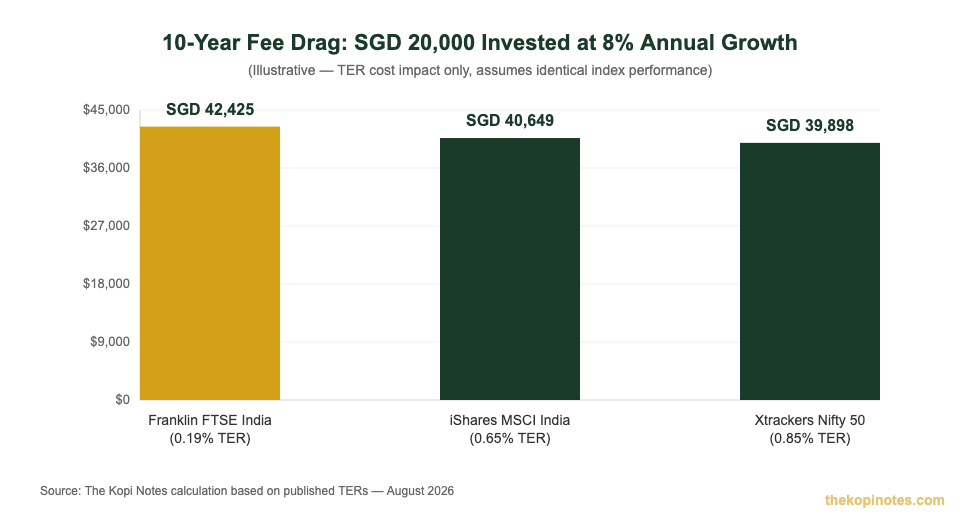
That’s a simplified comparison — NDIA, FLXI, and XNIF track different indices, so real-world returns won’t be identical. But the calculation shows why a 0.66 percentage point TER gap is worth caring about over a decade, especially if you’re building a long-term position rather than trading in and out.
How to Buy India ETFs in Singapore
Not every broker Singapore investors use can actually buy these ETFs. NDIA, FLXI, and XNIF all trade on the London Stock Exchange, and only brokers with UK market access can place the order.
Interactive Brokers (IBKR) offers the broadest access — you can trade NDIA, FLXI, and XNIF directly, on the same LSE access you’d use for CSPX and VWRA. IBKR also tends to have the lowest commissions for larger trades, from around USD 1.70 per order.
Saxo Markets also supports LSE trading, with a more beginner-friendly platform than IBKR, though typically higher minimum commissions per trade.
Here’s the part that catches people out: MooMoo Singapore does not support LSE trading. Its market access is limited to US, SG, HK, China, and Australia — so NDIA and FLXI simply won’t show up in a MooMoo search, no matter how you spell the ticker. If you only have a MooMoo account, you’d need to open an IBKR or Saxo account specifically for India ETF exposure. Syfe Brokerage has the same limitation — its market access currently covers SG, US, HK, and China, with no UK listings.
| Broker | LSE Access | India ETFs Available | Notes |
|---|---|---|---|
| Interactive Brokers | Yes | NDIA, FLXI, XNIF | Lowest commissions, from ~USD 1.70/trade |
| Saxo Markets | Yes | NDIA, FLXI, XNIF | Beginner-friendly platform, higher min. commission |
| MooMoo Singapore | No | Not available | Limited to US, SG, HK, China, AU markets |
| Syfe Brokerage | No | Not available | SG, US, HK, China market access only (as at Aug 2026) |
Source: Broker platform market access pages, verified August 2026
Once you’re on a broker with LSE access, the steps are straightforward:
- Fund your account in USD, or convert SGD to USD within the platform
- Search the exact ticker — NDIA for iShares, FLXI for Franklin FTSE
- Select the London Stock Exchange listing specifically, not the US, Milan, or Amsterdam cross-listings of the same fund
- Place a limit order to control your entry price, since India ETFs can move more sharply intraday than broad-market funds like VWRA
For a full breakdown of account minimums and platform fees, see our IBKR vs Saxo vs MooMoo vs Syfe broker comparison.
Risks to Consider
India ETFs come with risks beyond the usual market ups and downs.
Concentration risk: you’re betting on one country. Unlike a global fund that spreads your money across dozens of countries, an India ETF puts everything into a single economy’s fortunes — political, regulatory, and currency included.
Currency risk: these funds report in USD, but the underlying holdings are in Indian rupees. If the rupee weakens against the US dollar, it can drag down your USD-denominated returns even if Indian stocks rise in local currency terms. Then there’s the SGD conversion on top of that when you eventually cash out.
Valuation risk: Indian equities have historically traded at a premium P/E versus other emerging markets — NDIA’s underlying index carried a P/E of about 22.9 as at August 2026. That premium can compress quickly if earnings growth disappoints.
Swap risk (XNIF only): because XNIF replicates its index synthetically rather than holding the physical shares, you’re also exposed to the creditworthiness of its swap counterparty — a layer of risk that NDIA and FLXI, as physical replication funds, don’t carry.
The bottom line: an India ETF works best as a satellite position — a smaller slice next to a core global holding — not as your entire equity portfolio. If you’re mapping out how a position like this fits your broader retirement plan, run the numbers through our Singapore retirement calculator.
This article is for educational purposes only and does not constitute financial advice. The Kopi Notes may earn a referral fee from some links on this page. Data verified as at August 2026 — fund figures change over time, so check the official factsheet before investing.
Frequently Asked Questions
What is the best India ETF for Singapore investors?
There’s no single “best” — it depends on what you value. Franklin FTSE India (FLXI) has the lowest fee at 0.19% TER, making it the most cost-efficient for long-term holders. iShares MSCI India (NDIA) is the largest and most liquid at USD 5.2 billion in assets, which can mean tighter trading spreads. Both are Ireland-domiciled and physically replicate their index, so either is a reasonable core India holding.
Can I buy India ETFs like NDIA or FLXI using MooMoo Singapore?
No. MooMoo Singapore’s market access covers US, SG, HK, China, and Australia only — it does not support London Stock Exchange trading. To buy NDIA or FLXI, you’ll need a broker with UK market access, such as Interactive Brokers or Saxo Markets.
Can I buy India ETFs with my CPF or SRS funds?
LSE-listed India ETFs are not on the CPF Investment Scheme (CPFIS) approved list, so you can’t use CPF Ordinary Account funds to buy NDIA or FLXI. SRS funds can sometimes be used if your broker supports SRS-funded international trades — check with IBKR or Saxo directly, as SRS eligibility varies by platform and product.
Is investing in India riskier than a global ETF like VWRA?
Yes, in the sense that you’re concentrated in one country instead of spread across more than 40. India ETFs also carry currency risk, since both the rupee and US dollar affect your returns, and can be more volatile — NDIA fell about 8% in the first half of 2026 alone. Most advisors suggest treating a single-country ETF as a smaller satellite position, not a full portfolio replacement.
Why is NDIA down in 2026 if analysts are bullish on India?
Short-term price moves and long-term forecasts often diverge. Analysts like Nomura and Jefferies are projecting Nifty 50 gains into year-end 2026 based on earnings recovery and policy support, but the index had a rough first half of the year on valuation concerns and global risk-off sentiment. That gap between the near-term chart and the multi-year thesis is normal for emerging-market investing.
What's the difference between NDIA and XNIF?
NDIA (iShares) physically holds around 165 Indian stocks to track the MSCI India Index. XNIF (Xtrackers) uses a swap agreement to replicate the Nifty 50 index instead of holding the shares directly. That can make XNIF cheaper to run in some market conditions but adds counterparty risk that NDIA, as a physical fund, doesn’t carry.
Ready to Start Investing in ETFs?
Open a brokerage account and build a globally diversified portfolio. Use our referral links for exclusive sign-up bonuses.
This article was researched with the help of AI. While we strive to keep all information accurate and up to date, there may be errors. If you notice any discrepancies, please contact us.