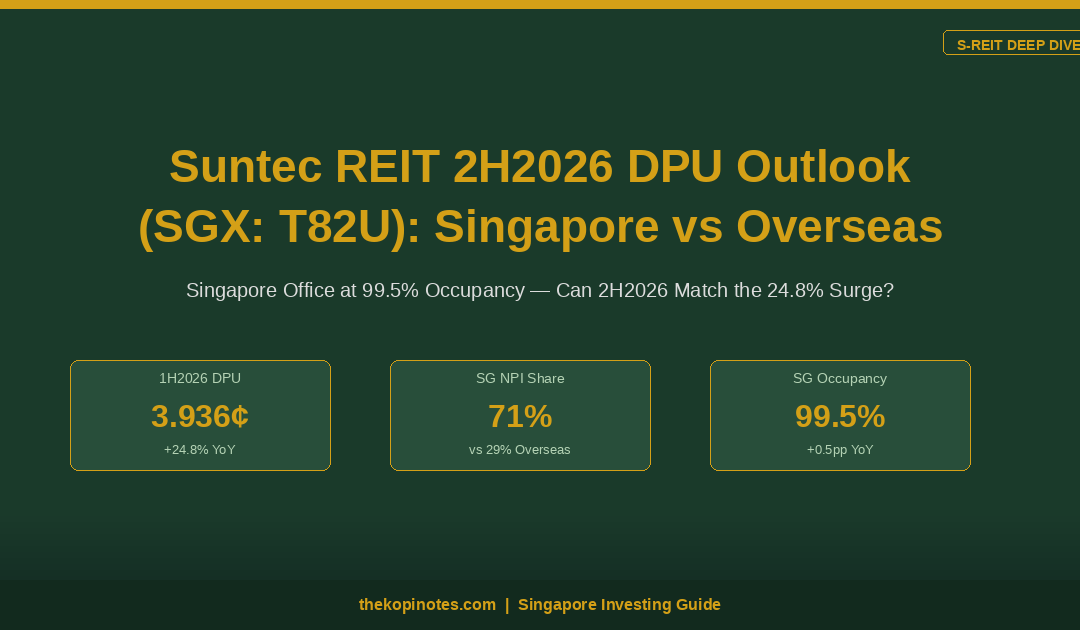
Suntec REIT 2H2026 DPU Outlook (SGX: T82U): Singapore Office Surge vs Overseas Drag
Singapore delivers 99.5% occupancy and +10% rental reversions — but Australia and the UK are holding back full DPU recovery. Here is what 2H2026 holds for T82U unitholders.
Suntec REIT (SGX: T82U) delivered a first-half 2026 distribution per unit of 3.936 cents — up 24.8% year on year — driven by Singapore’s near-full 99.5% office occupancy, double-digit rental reversions, and the absence of a one-off Australian tax provision. The critical question for 2H2026: can the Singapore engine sustain this pace while Australia and the UK continue to drag at the margin?
Not financial advice. Data sourced from Suntec REIT SGX filings and public announcements as at October 2026. Always conduct your own due diligence before investing.
Suntec REIT at a Glance — October 2026
| Metric | Value (Oct 2026) | Context |
|---|---|---|
| Share Price | S$1.49 | ~5.3% annualised yield |
| 1H2026 DPU | 3.936¢ | +24.8% YoY (semi-annual) |
| Gearing | ~43% | Above sector median; rate-sensitive |
| SG Office Occupancy | 99.5% | +0.5pp YoY as at Jun 2026 |
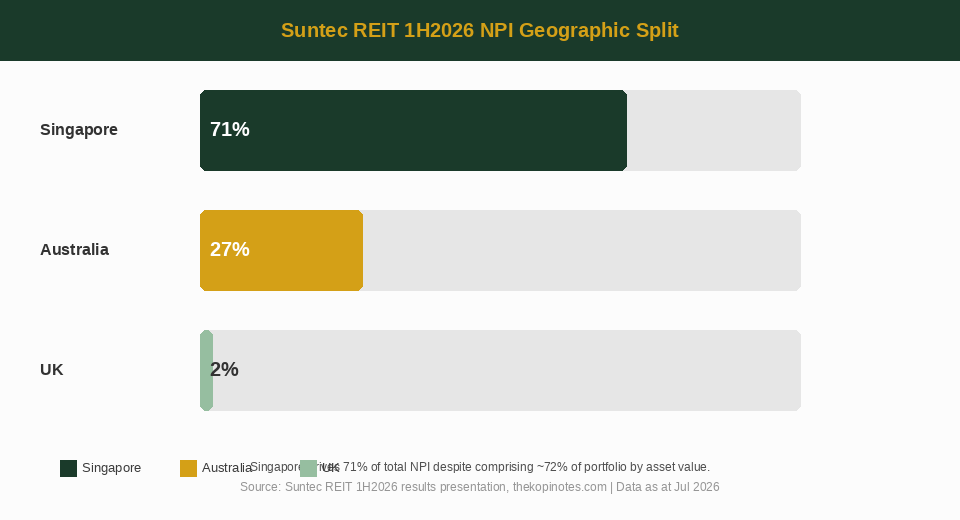
| Singapore NPI Share | 71% | Australia 27%, UK 2% |
| Total Portfolio Assets | ~S$11 billion | Office 78%, Retail+Conv 22% |
Source: Suntec REIT 1H2026 results (Jul 2026), SGX filings. Data as at October 2026.
Singapore: The DPU Engine
Singapore is doing the heavy lifting for Suntec REIT’s 2026 recovery story. As at June 30, 2026, the Singapore office portfolio reached a committed occupancy of 99.5% — up 0.5 percentage points year on year — essentially at full capacity. Rent reversion for Singapore office space came in at a positive 10.1%, meaning expiring leases are being renewed at materially higher rates than the outgoing rent. Retail at Suntec City Mall was similarly buoyant, with 99.5% occupancy and a 10.7% positive rent reversion.
The standout within Singapore is One Raffles Quay (ORQ), Suntec’s partial stake in one of the Raffles Place precinct’s most premium Grade A offices. ORQ delivered office rent reversions of approximately 13% in 1H2026 — above the portfolio average — reflecting strong demand from financial institutions and professional services firms for well-located, ESG-compliant CBD space. Suntec City Mall followed closely with approximately 15% reversions driven by its F&B and experiential retail refresh.
Together, Singapore’s office and retail assets contributed 71% of total net property income (NPI) in the first half of 2026. This is despite Singapore representing approximately 72% of Suntec’s total asset value — indicating that the Singapore portfolio is delivering in line with its asset weight, a meaningful improvement from prior years when overseas assets punched below weight due to COVID recovery lags and the Australian withholding tax provision.
Overseas Portfolio: The Drag Factor
Australia and the United Kingdom together contribute 29% of Suntec REIT’s NPI — with Australia at 27% and the UK at just 2%. While not catastrophically poor, the overseas portfolio introduces volatility that the Singapore segment alone cannot fully absorb.
Australia: Suntec’s Australian assets — principally Olderfleet in Melbourne and high-quality Sydney CBD offices including 177 Pacific Highway and 21 Harris Street — are delivering stable occupancy. Key assets remain well-leased to institutional tenants with long-dated leases. However, the broader Melbourne and Sydney office markets have faced elevated structural vacancy in some sub-markets as hybrid work norms persist. Suntec’s premium assets sit above the market average, but rental reversions in Australia are muted compared to Singapore’s double-digit gains. The prior year also benefited from a one-off income item in Australia; the absence of that item in 1H2026 creates a modest drag on NPI growth comparisons.
United Kingdom: The Nova Victoria complex in London’s Victoria precinct accounts for approximately 2% of NPI. In 1H2026, the UK portfolio absorbed the exit of one tenant at Nova Victoria, creating a near-term income gap until the vacancy is backfilled. London’s office market has been recovering more slowly than Singapore’s, though Victoria’s strong transport connectivity and mixed-use character provide some buffer. The UK exposure is small enough that a single tenant exit has limited impact on the headline DPU, but it does mean the overseas segment is marginally income-negative relative to prior half-year comparisons.
Currency risk is also worth flagging for Singapore unitholders. Suntec earns income in Australian dollars (AUD) and British pounds (GBP). While the REIT hedges a portion of overseas income into Singapore dollars, residual FX exposure means a strengthening SGD directly reduces the SGD-equivalent of overseas distributions. In a falling rate environment where SGD may remain supported, this is a real but manageable headwind.
What Drove the 24.8% DPU Jump?
The 24.8% year-on-year surge in 1H2026 DPU to 3.936 cents was exceptional by any measure — but investors should understand the two main drivers and their sustainability before extrapolating this growth rate forward.
Driver 1 — Stronger Singapore income: Higher committed occupancy and positive rental reversions across the Singapore portfolio contributed to improved NPI and gross revenue. Suntec City’s gross revenue rose 1.9% year on year to S$238.9 million in 1H2026. This is an organic, recurring improvement.
Driver 2 — Absence of Australian withholding tax provision: In 1H2025, Suntec REIT booked a one-off Australian withholding tax provision that reduced distributable income in that period. The absence of this provision in 1H2026 created a significant base effect, inflating the year-on-year comparison. This component of the 24.8% jump is a one-time benefit — it will not repeat in 2H2026 or FY2027 comparisons.
Distributable income for 1H2026 rose 25.5% to S$116.5 million, while NPI actually dipped 0.3% year on year to S$159 million. The divergence between distributable income growth (+25.5%) and NPI growth (-0.3%) confirms that most of the DPU uplift came from below-the-line items — specifically the tax provision unwind — rather than purely from portfolio operating improvement. This nuance matters for forecasting 2H2026 DPU.
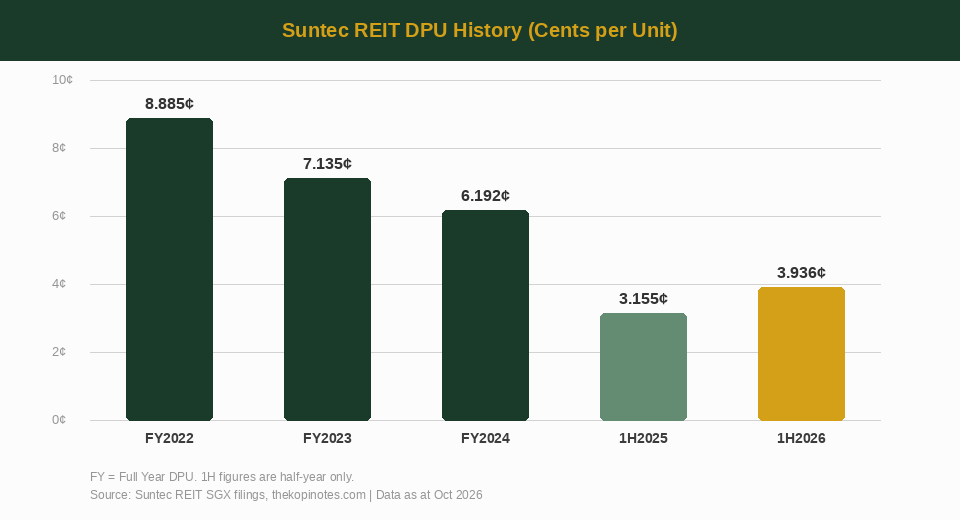
| Period | DPU (Cents) | YoY Change | Key Driver |
|---|---|---|---|
| FY2022 | 8.885¢ | — | Divestment gains, recovery |
| FY2023 | 7.135¢ | −19.7% | Rate hike impact on gearing |
| FY2024 | 6.192¢ | −13.2% | Peak interest expense burden |
| 1H2025 | 3.155¢ | +3.7% | Early recovery, AUS tax provision |
| 1H2026 | 3.936¢ | +24.8% | SG recovery + AUS provision absence |
Source: Suntec REIT SGX filings; 1H figures are half-year DPU only. Data as at October 2026.
2H2026 DPU Outlook & Key Catalysts
For investors evaluating whether Suntec REIT’s current S$1.49 share price offers good value heading into the second half of 2026, the 2H DPU trajectory is the critical variable. Here is what to watch.
1. Singapore office lease expiries: The 2H outlook depends partly on how much of Suntec’s Singapore office lease book expires in July–December 2026. If a large portion of leases is rolling over in this window, investors can expect continued positive reversions — or a risk if any major tenant downsizes. Management’s disclosure of weighted average lease expiry (WALE) and upcoming expiries at each property is worth monitoring closely in the 2H2026 results announcement (expected February 2027).
2. Rate environment — SORA and financing cost: Singapore T-bill yields have fallen to 1.92% as of the September 25, 2026 auction — the lowest 2026 level. For Suntec, which carries approximately S$5 billion of total debt at ~43% gearing, every meaningful decline in SORA-linked borrowing costs incrementally improves distributable income. As fixed-rate debt tranches roll over into this lower rate environment, interest cost savings should increasingly benefit unitholders. This is an incremental but real tailwind for 2H2026 and beyond. Read more about Suntec REIT’s rate-cut sensitivity in our detailed analysis: Suntec REIT Share Price 2026: Rate Cut Tailwinds & Q4 DPU Outlook.
3. Convention Centre recovery: Suntec Singapore Convention and Exhibition Centre has seen strong MICE bookings in 2026. A solid event calendar in 2H2026 contributes both direct venue revenue and indirect footfall to the Suntec City Mall — a positive chain reaction that benefits retail rental income and tenant retention metrics.
4. Australia backfill: The Nova Victoria tenant exit in the UK and any subdued Australia NPI recovery means the 29% overseas NPI segment will likely remain a modest headwind to total portfolio NPI growth in 2H2026. The question is whether Singapore’s continued strong performance can more than offset this. Based on current occupancy and rent reversion momentum, it likely can — but the gap between Singapore growth and overseas stability bears watching.
2H2026 DPU estimate: If Singapore continues its current trajectory and the interest cost environment remains supportive, a 2H2026 DPU in the range of 3.8–4.2 cents appears achievable, implying a full-year 2026 DPU of approximately 7.7–8.1 cents — a roughly 25–30% improvement on FY2024’s 6.192 cents. At S$1.49, this implies a yield of approximately 5.2–5.4%. This is an indicative estimate only, not a forecast. Investors should refer to Suntec REIT’s official guidance when available.
For investors thinking about long-term passive income building, try our free retirement planning calculator for Singapore to model how a S-REIT holding fits into your overall income strategy.
For those wanting broader S-REIT sector exposure, our guide to the Singapore REIT ETF covers low-cost ways to hold diversified commercial, industrial, and retail REIT exposure alongside individual names like Suntec.
Key Risks to Monitor
No REIT investment is without risk. For Suntec REIT specifically, the following factors could negatively impact 2H2026 and FY2027 DPU:
Elevated gearing: At approximately 43%, Suntec’s gearing is above the S-REIT sector median. While this amplifies gains in a falling rate environment, it also amplifies losses if rates reverse, asset valuations decline, or if the REIT needs to raise equity capital to reduce leverage. The 50% MAS gearing cap provides a buffer but leaves less room for error.
Australian office market headwinds: Despite Suntec’s premium assets maintaining healthy occupancy, the broader Australian Grade A office market has higher vacancy rates than Singapore. Any deterioration in the Melbourne or Sydney sub-markets — whether through tenant consolidation, sub-leasing activity, or rental competition — could weigh on the 27% Australia NPI contribution.
Currency volatility: The REIT earns AUD and GBP income. A sustained strengthening of the Singapore dollar reduces the SGD equivalent of overseas distributions. Currency hedging mitigates but does not eliminate this risk.
Concentration in Singapore commercial property: Suntec’s 71% Singapore NPI concentration, while currently a strength, also means the REIT is heavily exposed to any slowdown in Singapore’s Grade A office market — for example, if a major financial institution downsizes its CBD footprint or if economic softness reduces corporate space demand.
Refinancing risk: With ~S$5 billion in total debt, refinancing tranches at unfavourable terms (even in a generally lower rate environment) could offset some of the interest savings benefit. Unitholders should monitor each quarterly results update for refinancing disclosures.
Investors comparing Suntec REIT against other S-REIT options can find an overview of the sector’s best S-REITs in Singapore 2026 on our site. For those building a diversified REIT income portfolio through a robo-advisor, Syfe (referral: SRPRFFFCD) and Endowus (referral: 2V343) offer curated REIT income and income-plus portfolios designed for Singapore investors.
Frequently Asked Questions
What is Suntec REIT's 2H2026 DPU outlook?
Based on 1H2026 performance — 3.936 cents in DPU, 99.5% Singapore office occupancy, and positive +10% rental reversions — the trajectory for 2H2026 looks constructive. An indicative 2H DPU range of 3.8–4.2 cents implies a full-year 2026 DPU of approximately 7.7–8.1 cents. However, this is not an official forecast, and investors should refer to Suntec REIT’s own guidance when available. The key variable is whether Singapore’s strong momentum continues while Australia and the UK remain stable, and whether falling SORA rates incrementally reduce interest expense.
Why did Suntec REIT's 1H2026 DPU jump 24.8%?
The 24.8% year-on-year DPU jump in 1H2026 had two main drivers. First, stronger Singapore office and retail income — with 99.5% committed occupancy and double-digit positive rent reversions across the portfolio. Second, the absence of a one-off Australian withholding tax provision that was booked in 1H2025, creating a favourable base effect. The underlying NPI growth was more modest (NPI actually dipped 0.3% YoY to S$159m), so investors should be careful not to project 24.8% as a sustainable run-rate for future periods.
What is the Singapore vs overseas NPI split for Suntec REIT?
As at the 1H2026 results, Singapore contributed 71% of net property income (NPI), Australia 27%, and the United Kingdom 2%. Singapore’s outsized NPI contribution reflects both its 72% share of total portfolio asset value and its near-perfect 99.5% occupancy rate with strong rental reversion. Australia remains the largest overseas contributor but is growing more slowly than Singapore, while the UK’s Nova Victoria portfolio absorbed a tenant exit in 1H2026 that has created a near-term income gap.
Is Suntec REIT's 43% gearing a concern?
Suntec REIT’s approximately 43% gearing is above the S-REIT sector median and represents a key risk factor for unitholders. The elevated gearing was a headwind during the 2022–2024 rate hike cycle — contributing to the FY2023 and FY2024 DPU declines. In the current easing environment, gearing becomes an amplifier of DPU recovery, as each basis point reduction in borrowing costs on the ~S$5 billion debt book improves distributable income. However, the same leverage that amplifies gains on the upside also amplifies losses if interest rates reverse or if asset valuations decline. Investors should monitor gearing levels each quarter.
How does Suntec REIT compare to CICT and MPACT?
Suntec REIT (T82U), CICT (C38U), and MPACT (N2IU) are Singapore’s three largest diversified commercial REITs. Suntec typically offers the highest distribution yield due to higher gearing and smaller market cap relative to AUM — making it the most leveraged beneficiary of rate cuts. CICT is the defensive choice with the largest Singapore portfolio, lower gearing, and slightly lower yield. MPACT spans five countries including Japan and Hong Kong, offering geographic diversification at the cost of greater currency and market complexity. For a pure rate-cut play with Singapore Grade A office recovery exposure, Suntec is the most direct vehicle among the three.
When does Suntec REIT pay its next distribution?
Suntec REIT pays distributions semi-annually. The 1H2026 distribution of 3.936 cents (covering January to June 2026) was announced with the August 2026 results. The 2H2026 distribution — covering July to December 2026 — will be announced alongside the full-year results, expected in early 2027 (typically February). Unitholders should note the ex-distribution date to ensure they hold units on record before that date to qualify for the distribution.
Where can I buy Suntec REIT (T82U) in Singapore?
Suntec REIT is listed on the Singapore Exchange (SGX) under the ticker T82U. You can buy it through any SGX-connected brokerage, including IBKR, Moomoo, Saxo, CDP-linked platforms, and SRS-enabled brokers. CDP (Central Depository Pte Ltd) holds your shares automatically for SGX-listed securities. For investors using CPF-OA, Suntec REIT is CPFIS-included, which means CPF-OA funds can be used to invest in T82U subject to CPF Board limits. For robo-advisor exposure to a portfolio of S-REITs rather than individual stock picking, platforms like Syfe (referral: SRPRFFFCD) offer diversified REIT income solutions.
Disclaimer: This article is for informational purposes only and does not constitute financial advice. All data is sourced from publicly available SGX filings, Suntec REIT announcements, and market data as at October 2026. DPU estimates are indicative only and not official forecasts. Past performance is not indicative of future results. Always conduct your own due diligence and consult a licensed financial adviser before making investment decisions.
This article was researched with the help of AI. While we strive to keep all information accurate and up to date, there may be errors. If you notice any discrepancies, please contact us.
This article was researched with the help of AI. While we strive to keep all information accurate and up to date, there may be errors. If you notice any discrepancies, please contact us.