Ethereum ETF Singapore: ETHA, FETH & the 2026 Staking Yield War Explained
How Singapore investors buy in, what the new staking-yield ETFs actually pay out, and the US tax traps most guides skip.
Singapore investors can buy spot Ethereum ETFs like ETHA and FETH through MAS-licensed brokers such as IBKR or moomoo after a suitability check — there is no MAS-approved crypto ETF on SGX. A newer generation, including BlackRock’s ETHB and Grayscale’s ETH, now pays out ETH staking rewards (roughly 1.9%–2.6% net yield), but most are US-domiciled, exposing non-resident holders to US estate tax and possible withholding on that staking income.
Not financial advice. All figures are for educational reference only. Data verified as at 6 October 2026 unless otherwise noted.
- No crypto ETF is listed on SGX, but Singapore retail investors can buy overseas-listed spot Ethereum ETFs through a licensed broker after a one-time suitability check.
- Since March 2026, funds like BlackRock’s ETHB and Grayscale’s ETH/ETHE pay out real ETH staking rewards — roughly 1.9%–2.6% net annual yield on top of any price gain.
- Most staking ETFs are US-domiciled, which brings US estate tax exposure above USD 60,000 and a real risk of US withholding tax on the staking distributions themselves. The Jersey-domiciled CoinShares CETH sidesteps both.
Table of Contents
Contents — Click to expand
- What Is an Ethereum ETF?
- Can Singapore Investors Actually Buy One?
- Why Ethereum ETFs Are Trending in 2026: The Staking Yield War
- Best Ethereum ETFs for Singapore Investors
- How the Staking Yield Actually Works
- The Tax Traps: US Estate Tax and Staking Withholding
- How to Buy an Ethereum ETF in Singapore
- Risks to Consider
- Frequently Asked Questions
What Is an Ethereum ETF?
A spot Ethereum ETF is a fund that holds actual ETH in cold storage with a regulated custodian. Buying a share gives you price exposure to Ethereum without ever touching a crypto wallet, seed phrase, or exchange account — you buy and sell it in your normal brokerage account exactly like CSPX or VWRA.
What’s new in 2026 is the staking layer. Ethereum is a proof-of-stake network: validators lock up ETH to help secure the chain and earn rewards for doing so, currently around 3.1%–3.3% annualised. Until late 2025, US spot Ethereum ETFs were barred from staking their holdings. That changed once US regulators cleared the way (details in the next section), and a new breed of “staking ETF” now passes a cut of those rewards on to shareholders — something no Bitcoin ETF can replicate, since Bitcoin doesn’t use proof-of-stake.
For a side-by-side look at how this compares with Bitcoin exposure, see our Bitcoin ETF Singapore guide, which covers IBIT, FBTC and the same MAS access rules in more depth.
Can Singapore Investors Actually Buy One?
MAS has not approved a crypto ETF for listing on SGX — cryptocurrencies aren’t treated as eligible assets for a retail fund here, and MAS has previously cited the “highly volatile and speculative” nature of crypto as the reason.
That doesn’t lock you out. MAS allows retail investors to buy overseas-listed spot crypto ETFs — including Ethereum ETFs like ETHA or ETHB — through a licensed capital markets intermediary based in Singapore, such as IBKR, moomoo or Saxo. The condition is the same one that applies to Bitcoin ETFs: your broker must give you adequate risk disclosures and run a suitability check before your first trade, usually a short online questionnaire or a “complex product” acknowledgement. It’s a one-time step, not a recurring hurdle.
So: no SGX listing, but yes, you can buy ETHA, FETH, ETHB and the rest through a MAS-licensed broker like IBKR or moomoo once you clear that check.
Why Ethereum ETFs Are Trending in 2026: The Staking Yield War
Ethereum ETFs have been investable since 2024, but 2026 is when they got genuinely interesting for income-focused investors. In November 2025, the US Treasury and IRS issued Revenue Procedure 2025-31, giving ETFs a safe harbour to stake proof-of-stake assets like ETH and pass rewards to investors. Grayscale moved first, activating staking on its Ethereum Trust (ETHE) and Ethereum Mini Trust (ETH) that same month, and paid out the first-ever US staking distribution — USD 9.4 million — to ETHE shareholders on 6 January 2026.
BlackRock followed on 12 March 2026 with the iShares Staked Ethereum Trust ETF (ETHB), seeded with just over USD 100 million. On 17 March 2026, a joint SEC-CFTC interpretive release classified staking rewards as non-securities, clearing any remaining doubt for other issuers to follow. Industry commentators have dubbed the resulting scramble among BlackRock, Grayscale and smaller issuers the “Ethereum ETF yield war.”
Not every Ethereum ETF stakes, and not every issuer takes the same cut. The next section breaks down exactly who does what.
Best Ethereum ETFs for Singapore Investors
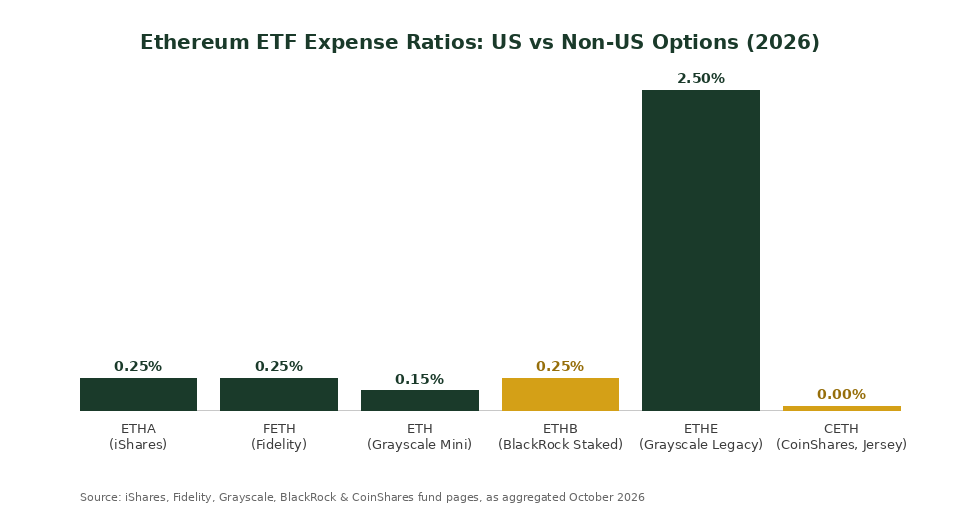
Here’s how the main Ethereum ETFs compare as at October 2026. Ethereum traded at roughly USD 2,710 on 5 October 2026, giving useful context for the worked examples later in this guide.
| ETF | Ticker | Exchange | Domicile | TER | Staking? | AUM (Oct 2026) |
|---|---|---|---|---|---|---|
| iShares Ethereum Trust | ETHA | Nasdaq | USA | 0.25% | No | ~USD 9.8B |
| Fidelity Ethereum Fund | FETH | NYSE Arca | USA | 0.25% | No | ~USD 1.4B |
| Grayscale Ethereum Staking Mini ETF | ETH | NYSE Arca | USA | 0.15% | Yes | ~USD 2.2B |
| iShares Staked Ethereum Trust | ETHB | Nasdaq | USA | 0.25%* | Yes | Launched Mar 2026 |
| Grayscale Ethereum Staking ETF (legacy) | ETHE | NYSE Arca | USA | 2.50% | Yes (~65% staked) | ~USD 1.8B |
| CoinShares Physical Staked Ethereum | CETH | LSE / Xetra / SIX | Jersey | 0.00% + 1.25% staking fee | Yes | Smaller, non-US |
*ETHB’s sponsor fee is temporarily reduced to 0.12% for its first 12 months or until the fund reaches USD 2.5B in assets, whichever comes first. Source: iShares, Fidelity, Grayscale, BlackRock and CoinShares fund pages, as aggregated October 2026.
According to the iShares ETHA fund page, ETHA and FETH are the largest, most liquid, plain-vanilla options — no staking, lowest tracking complexity, best for investors who just want ETH price exposure. ETH (Grayscale’s Mini Trust) and the iShares Staked Ethereum Trust (ETHB) are the two main staking plays with reasonable fees. ETHE is a legacy fund: it was first to pay staking rewards, but its 2.50% TER eats most of the benefit — treat it the same way you’d treat GBTC in the Bitcoin world, a fund to avoid for new money. CETH is the only non-US option on this list, which matters a lot for the tax section below.
How the Staking Yield Actually Works
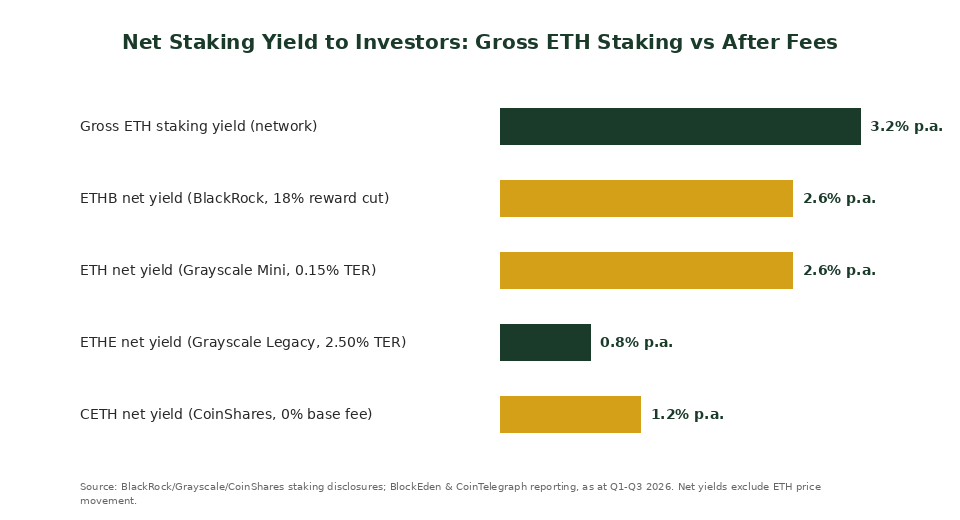
The gross ETH network staking yield runs about 3.1%–3.3% a year as at 2026. No staking ETF passes through all of it — each issuer takes a cut for running the validators and custody.
Worked example — ETHB (BlackRock): ETHB stakes 70%–95% of its ETH holdings through Coinbase Prime and takes 18% of the resulting staking rewards as a fee, distributing the rest to shareholders monthly. Say a Singapore investor holds SGD 50,000 in ETHB — about USD 39,080 at the USD/SGD rate of 1.2795 on 6 October 2026. At a 3.2% gross staking yield, that works out to roughly USD 1,250 a year in staking rewards before ETHB’s cut. After BlackRock keeps 18%, the investor receives about USD 1,025 a year (2.6% net), before the fund’s separate 0.25% sponsor fee (or 0.12% under its current promotional rate) is deducted from NAV. None of this includes any gain or loss from ETH’s own price movement, which will typically dwarf the yield in either direction.
Worked example — CETH (CoinShares): The same SGD 50,000 (~USD 39,080) in CETH earns a flat 1.25% p.a. staking reward pass-through — about USD 488 a year — with a 0% base management fee. The net yield is lower than ETHB’s, but the structure is simpler and, as covered next, avoids two tax complications that apply to the US-domiciled funds.
This is the kind of simple yield math that fund pages rarely spell out directly, which is why it’s worth doing the arithmetic yourself before choosing between a high-gross-yield US fund and a lower-yield, tax-cleaner non-US one.
The Tax Traps: US Estate Tax and Staking Withholding
Long-time readers of this site will recognise the first trap from our CSPX vs VOO tax breakdown: ETHA, FETH, ETH, ETHE and ETHB are all structured as US-domiciled trusts, making them “US-situs assets.” Under IRS rules for non-resident aliens, if you die holding more than USD 60,000 in US-situs assets, your estate can owe US estate tax of up to 40% on the amount above that threshold. A Singapore investor holding SGD 100,000 in ETHA — about USD 78,160 at current rates — is already well past that line.
The second trap is newer and specific to the staking funds. Spot Ethereum ETFs are structured as grantor trusts, so the IRS generally looks through the wrapper and treats each investor as owning a fractional share of the trust’s ETH directly. For a plain spot fund like ETHA that never distributes anything, this detail rarely matters. But once a fund like ETHB or ETH starts distributing staking rewards in cash, those distributions can be treated as US-source income — and non-US holders could face up to 30% US withholding tax on that portion unless a tax treaty provides relief. Singapore does not have a bilateral tax treaty with the US, so this risk should not be assumed away.
| Risk | US-Domiciled Funds (ETHA, FETH, ETH, ETHE, ETHB) | CoinShares CETH (Jersey) |
|---|---|---|
| US estate tax above USD 60,000 | Applies | Does not apply |
| Possible US withholding on staking income | Risk for staking funds (ETH, ETHE, ETHB) | Not a US-source distribution |
| Singapore capital gains / income tax on gains | None for individual non-trading investors | None for individual non-trading investors |
Source: IRS non-resident estate tax guidance, CoinShares product disclosures, as at October 2026. This is general information, not personalised tax advice — speak to a qualified tax advisor before making decisions based on your specific situation.
How to Buy an Ethereum ETF in Singapore
All of these trade on US or European exchanges, so the mechanics are the same as buying any overseas-listed ETF through a Singapore broker.
Interactive Brokers (IBKR): Fund your account, complete the one-time crypto-product risk disclosure when prompted, then search the ticker (ETHA, FETH, ETHB, ETH or ETHE) and select the correct exchange (Nasdaq or NYSE Arca). IBKR is generally the most cost-effective option for larger portfolios and also offers access to LSE-listed CETH if you want the non-US alternative.
moomoo Singapore: moomoo supports US-listed ETFs including the Ethereum funds above, with a similar suitability check on first purchase. See our IBKR vs moomoo Singapore comparison if you’re deciding between the two for crypto ETF access specifically.
Saxo Markets: Saxo also lists these ETFs and, like IBKR, provides access to LSE and European listings such as CETH, which is useful if you specifically want to avoid US domicile.
A practical note: crypto ETFs are not CPFIS-approved, and most Singapore brokers won’t let you fund these purchases with SRS. You’ll need a cash brokerage account for all of the tickers in this guide. If you’re building a broader ETF portfolio around your CPF investment strategy, these crypto allocations will sit outside that structure entirely.
Risks to Consider
Ethereum’s price has been far more volatile than its staking yield in any given year — ETH traded as high as the mid-USD 3,000s and as low as the low-USD 2,000s at points in 2026, a swing that dwarfs even the highest staking yield on this list. Don’t buy a staking ETF for the yield alone; you’re still taking full exposure to ETH’s price.
Staking itself carries protocol-level risk. Validators can be “slashed” (penalised) for downtime or misbehaviour, which can modestly reduce returns at the fund level even though this risk is typically small and diversified across many validators. Custody and smart-contract risk also sit behind every spot ETF, managed by the fund’s custodian rather than the investor directly.
Regulatory risk cuts both ways: the same regulatory clarity that enabled staking ETFs in 2026 could shift again, and MAS’s current stance on retail access to overseas crypto ETFs is not guaranteed to stay unchanged. Finally, concentration risk is real — this is a single-asset bet on one cryptocurrency, not a diversified fund, and should be sized accordingly within a broader portfolio.
Frequently Asked Questions
What is an Ethereum ETF and how is it different from owning ETH directly?
A spot Ethereum ETF holds real ETH with a regulated custodian and trades as a share on a stock exchange, giving you price exposure through your normal brokerage account. Owning ETH directly means holding it yourself in a wallet or on an exchange, with full control but also full responsibility for custody, security and (for staking) running or delegating to a validator.
Can Singapore investors buy ETHA, FETH or ETHB?
Yes. None of these are listed on SGX, but MAS allows retail investors to buy overseas-listed spot Ethereum ETFs through a licensed Singapore broker such as IBKR, moomoo or Saxo, after a one-time suitability check and risk disclosure.
Which Ethereum ETF actually pays staking rewards?
As at October 2026, Grayscale’s ETH (Ethereum Staking Mini ETF) and ETHE (Ethereum Staking ETF), plus BlackRock’s ETHB (iShares Staked Ethereum Trust), all distribute staking rewards. The non-US CoinShares CETH also passes through a staking reward. ETHA and FETH remain plain spot funds with no staking.
Are Ethereum ETF staking rewards taxed for Singapore investors?
Singapore does not impose capital gains tax, and investment income received by individual non-trading investors is generally not taxed locally. The bigger risk is on the US side: staking distributions from US-domiciled funds could be treated as US-source income and face US withholding tax for non-US holders, since Singapore has no tax treaty with the US. Speak to a qualified tax advisor for your specific situation.
Can I buy an Ethereum ETF using my CPF or SRS funds?
No. Crypto ETFs, including all the Ethereum ETFs in this guide, are not CPFIS-approved, and most Singapore brokers do not permit SRS funds to be used for them. You’ll need a cash brokerage account.
Is CoinShares CETH better than ETHA for Singapore investors?
It depends on what you’re optimising for. CETH avoids US estate tax and the US staking-withholding risk entirely, and currently pays a 1.25% staking reward with no base management fee. ETHA has no staking yield but is far larger and more liquid, with tighter bid-ask spreads on Nasdaq. Investors prioritising tax simplicity may prefer CETH; those prioritising liquidity and the deepest market may prefer ETHA, FETH or ETHB despite the US tax exposure.
Ready to Start Investing in ETFs?
Open a brokerage account and build a diversified portfolio alongside any crypto allocation. Use our referral links for exclusive sign-up bonuses.
This article was researched with the help of AI. While we strive to keep all information accurate and up to date, there may be errors. If you notice any discrepancies, please contact us.