MediSave Limit 2026: What Happens to Your ISP Premiums When You Hit the $79,000 BHS
BHS hits $79,000 in 2026 — here’s exactly what it means for your Integrated Shield Plan premiums and MediSave deductions.
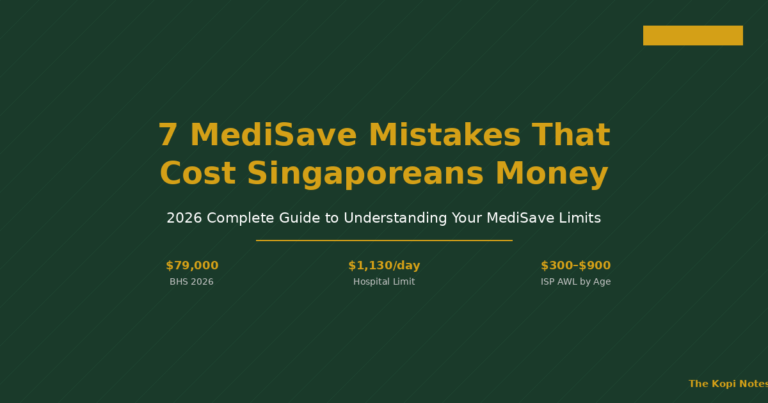
When your MediSave account hits the $79,000 Basic Healthcare Sum (BHS) in 2026, your ISP premiums do not stop being deducted via MediSave. The Annual Withdrawal Limit (AWL) — $300 per year for those aged 1–40, $600 for ages 41–70, and $900 for ages 71 and above — continues to operate independently of the BHS. What changes is where any additional contributions overflow: cash top-ups above the BHS cap flow into your Special Account (under 55) or Retirement Account (55 and above). Your MediSave can temporarily dip below the BHS as premiums are deducted, and the account refills as new contributions and interest arrive.
Not financial advice. All figures are for educational reference only. Data as at October 2026 unless noted.
What Is the $79,000 BHS and Why Does It Matter?
The Basic Healthcare Sum (BHS) is the CPF Board’s target balance for your MediSave account. Once your MediSave reaches the BHS, further mandatory contributions from your monthly CPF deductions are redirected — they overflow into your Special Account (if you are under 55) or Retirement Account (if you are 55 or older). The BHS is not a hard stop on your MediSave balance, and it does not cap withdrawals.
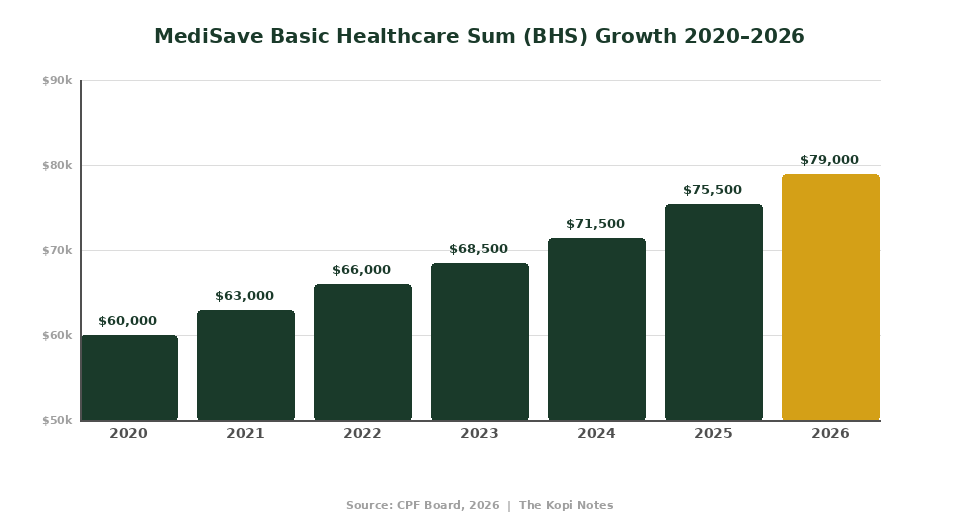
For 2026, the BHS has been set at $79,000, up from $75,500 in 2025. The CPF Board reviews the BHS annually to track rising healthcare costs in Singapore, calibrated to roughly cover approximately 8–9 years of MediShield Life premiums for the average retiree.
BHS Growth 2020–2026
| Year | Basic Healthcare Sum | Year-on-Year Increase |
|---|---|---|
| 2020 | $60,000 | — |
| 2021 | $63,000 | +$3,000 |
| 2022 | $66,000 | +$3,000 |
| 2023 | $68,500 | +$2,500 |
| 2024 | $71,500 | +$3,000 |
| 2025 | $75,500 | +$4,000 |
| 2026 | $79,000 | +$3,500 |
Source: CPF Board, 2026 | The Kopi Notes
Between 2020 and 2026, the BHS has grown by $19,000, an average increase of roughly $3,167 per year. Your MediSave earns a floor interest rate of 4% per annum on balances up to the BHS, making it one of the best-guaranteed returns for healthcare funds in Singapore. For a deeper look at how the $79,000 BHS cap affects your healthcare planning, our full BHS guide walks through every scenario.
How ISP Premiums Are Deducted via MediSave
An Integrated Shield Plan (ISP) is a combination of MediShield Life — the mandatory national health insurance — plus a private insurer’s rider that upgrades your coverage to Class A wards or private hospital rooms. Both the MediShield Life component and a portion of the private rider premium can be paid from your MediSave account, subject to the Annual Withdrawal Limit (AWL).
The AWL is entirely separate from the BHS. It is an annual cap on how much of your MediSave can be used for ISP premiums in a given year, and it scales with age to reflect higher premiums as you get older. Knowing your AWL is critical because it determines how much of your ISP premium is covered by MediSave and how much must be paid in cash. For a full breakdown, see our guide on MediSave AWL 2026 and ISP premiums.
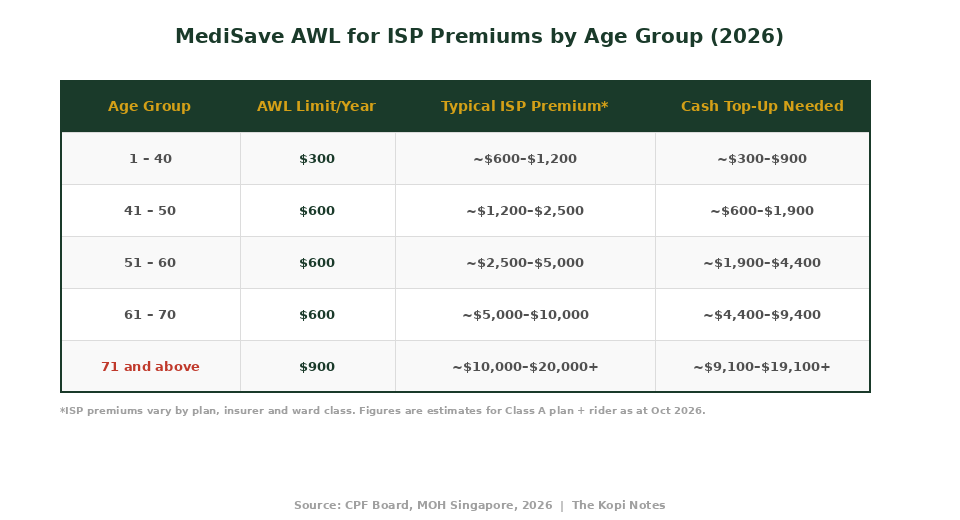
Annual Withdrawal Limit for ISP Premiums by Age (2026)
| Age Group | AWL / Year | Typical ISP Premium* | Est. Cash Top-Up |
|---|---|---|---|
| Age 1–40 | $300 | ~$600–$1,200 | ~$300–$900 |
| Age 41–70 | $600 | ~$1,200–$10,000 | ~$600–$9,400 |
| Age 71 and above | $900 | ~$10,000–$20,000+ | ~$9,100–$19,100+ |
*Estimates for Class A plan with rider as at Oct 2026. Actual premiums vary by insurer, ward class and plan tier. Source: CPF Board, MOH Singapore | The Kopi Notes
A key insight from this table: at older ages, the AWL covers only a small fraction of the actual ISP premium. A 65-year-old on a Class A plan might pay $7,000 annually for their ISP, yet the AWL only covers $600 of that from MediSave. The remaining $6,400 must be paid in cash — regardless of whether the MediSave balance is at or above the BHS. Understanding the full impact of MediSave limits on your ISP deductibles and premiums helps you plan for this cash gap well in advance.
What Actually Happens When Your MediSave Hits $79,000
This is where most Singaporeans have the wrong mental model. Let’s walk through the mechanics precisely.
The Overflow Mechanism Explained
When your MediSave balance reaches the $79,000 BHS, any additional cash contributions — from your monthly CPF deductions, or voluntary top-ups — are redirected as follows:
- If you are under 55: Overflow goes into your Special Account (SA), earning up to 5% interest — potentially better than your MediSave’s 4%.
- If you are 55 and above: Overflow goes into your Retirement Account (RA), up to your Enhanced Retirement Sum (ERS).
- If your SA or RA is also at its cap (Full Retirement Sum/ERS): Overflow goes into your Ordinary Account (OA), earning 2.5% interest.
ISP Premiums: The Balance Does Temporarily Dip Below the BHS
Here is the crucial point that confuses many policyholders: when your ISP premium is deducted from your MediSave — up to the AWL — your MediSave balance falls below the $79,000 BHS temporarily. This is completely normal and expected.
Example: Suppose your MediSave is at exactly $79,000 (BHS). Your ISP premium AWL deduction of $600 is processed. Your MediSave now sits at $78,400. Your next CPF contribution — say, $1,200 for the month — then brings it back above the BHS. Any amount above $79,000 overflows to SA or RA.
This cycle repeats every premium period. Your ISP coverage remains fully intact throughout. The BHS is a savings target for contributions, not a floor that your withdrawals must respect.
The Common Misconception Busted
We’ve seen Singaporeans skip ISP renewals believing their MediSave “can’t pay” once it hits the BHS. This is incorrect. The CPF Board’s system processes AWL deductions for ISP premiums first, then redirects new contributions if the post-deduction balance recovers above the BHS. You will never be denied ISP premium coverage due to hitting the BHS alone. For a comprehensive list of pitfalls, read our article on 7 common MediSave mistakes Singaporeans make in 2026.
What If Your MediSave Falls to Zero?
The one genuine risk is if your MediSave balance is depleted — not by ISP premiums (which are small via AWL), but by hospitalisation claims. If you are hospitalised and MediSave withdrawals draw the balance to zero, your insurer and CPF will typically require you to pay any remaining premium shortfall in cash. This is why maintaining adequate MediSave headroom — and choosing a plan whose premiums are realistic at your age — is important long-term planning.
The April 2026 ISP Rider Changes and Their Cash Impact
Two significant changes came into effect in 2026 that directly affect how much cash you will need to pay out of pocket for ISP claims — even after your MediSave and AWL are accounted for.
1. The 5% Minimum Co-Payment Rule (April 2026)
From April 2026, all new and renewing Integrated Shield Plan riders must incorporate a minimum 5% co-payment by the policyholder, capped at $6,000 per policy year. This was introduced by MOH to discourage over-consumption of healthcare services and to align individual cost consciousness with system sustainability.
In practice, this means: if your total hospitalisation bill is $50,000, you pay 5% = $2,500. If your bill is $200,000, the 5% cap kicks in and you pay $6,000 maximum. For an in-depth cost breakdown of this change, see our analysis of what your ISP rider actually costs in Singapore 2026.
2. Revised MediShield Life Deductibles (June 2026)
MediShield Life deductibles — the amount you pay before insurance kicks in — were revised in June 2026. For Class B2/C subsidised wards, deductibles range from $2,000 for those under 40 to $4,500 for those aged 81 and above. For Class A wards (the tier most ISP holders choose), deductibles are higher. This means the cash floor for any hospitalisation claim starts higher than before the revision.
Cash Impact Summary Table
| Scenario | MediSave (AWL) | Cash Needed |
|---|---|---|
| Annual premium: $1,000, age 35 | $300 | $700 |
| Annual premium: $3,500, age 55 | $600 | $2,900 |
| Annual premium: $12,000, age 72 | $900 | $11,100 |
| Hospitalisation claim: $50,000 (5% co-pay) | Covered by plan | $2,500 (co-pay) |
Source: MOH Singapore, CPF Board 2026 | The Kopi Notes
The takeaway: your MediSave balance and whether it is above or below the BHS is largely irrelevant to your annual ISP cash outflow. The bigger driver is your age, your premium tier, and the new co-payment rules.
Practical Strategy: Managing MediSave Near the $79,000 BHS
With the mechanics clear, here is how to make the most of your MediSave when it is approaching or at the $79,000 BHS.
1. Don’t Over-Contribute to MediSave If You’re Already Near the BHS
Once your MediSave is within touching distance of the BHS, additional voluntary cash top-ups go to your Special Account or RA rather than MediSave. This is not necessarily bad — the SA earns up to 5% interest — but it does mean you lose the flexibility of having the funds easily accessible for healthcare costs. If you have a preference for liquid healthcare reserves, keep the voluntary top-ups modest. The Matched MediSave Scheme 2026 is worth reviewing if you are considering top-ups for tax relief purposes.
2. Do Not Cancel Your ISP Because of the BHS
Your AWL continues to function even when your MediSave is at or above the BHS. Cancelling your ISP to “save” your MediSave balance is counterproductive — you lose Class A/private hospital coverage and still have the MediSave balance at the BHS anyway, since the deductions were well within the AWL. ISP coverage at older ages is particularly critical given the rising premium curve and deductible revisions.
3. Budget Cash for the Premium Gap at Every Age
The earlier table shows that the AWL covers less than half the actual ISP premium for most policyholders aged 41 and above. Build this cash gap into your annual budget explicitly — especially if you are 55+ where premiums can exceed $5,000 per year and the AWL contribution is just $600. Consider a dedicated “healthcare reserve” account in cash for this purpose.
4. At 55+, Embrace the Overflow to RA
When you are 55 and above, contributions overflowing to your Retirement Account earn 4–6% interest (including the extra 1% on the first $30,000 and extra 2% on the first $30,000 of RA for those aged 55+). The overflow is not “lost” — it builds your retirement income stream under CPF LIFE. Many Singaporeans who hit the BHS in their mid-50s find that the RA overflow accelerates their path to the Enhanced Retirement Sum.
5. Review Your Plan Tier Before Renewal
With the 5% co-payment rule now standard and deductibles having risen, some policyholders are downsizing from Class A private hospital plans to Class A restructured hospital plans — cutting premiums by 30–50% while still receiving excellent coverage. Before renewal, ask your insurer for a side-by-side comparison of the premium and co-pay impact at your age and health risk profile.
Frequently Asked Questions
Does hitting the $79,000 BHS mean my ISP premiums are no longer covered by MediSave?
What is the Annual Withdrawal Limit (AWL) for ISP premiums in 2026?
What happens to MediSave contributions after I hit the $79,000 BHS?
Can my MediSave balance go below the BHS after ISP premium deductions?
Should I top up my MediSave if it is near the $79,000 BHS?
How does the April 2026 ISP rider co-payment rule affect my out-of-pocket costs?
Plan Your Healthcare Spending With Confidence
The $79,000 BHS milestone is a sign of a healthy MediSave account, not a problem to worry about. Your ISP continues to draw from MediSave via the AWL, your balance fluctuates naturally, and your overflow builds retirement wealth in SA or RA. The bigger planning challenge is the growing cash gap between the AWL and your actual premium — especially post-50.
For related planning guides: read about MediSave limits and ISP deductibles, and understand the common mistakes to avoid when managing your MediSave and ISP together.
Disclaimer: This article is for educational purposes only and does not constitute financial or insurance advice. Figures are as at October 2026 and subject to change. Consult a licensed financial adviser for personalised guidance.
Get Free Insurance Advice
Speak with a licensed insurance advisor. No obligation, no cost.
By submitting this form, you agree to our Privacy Policy.
This article was researched with the help of AI. While we strive to keep all information accurate and up to date, there may be errors. If you notice any discrepancies, please contact us.