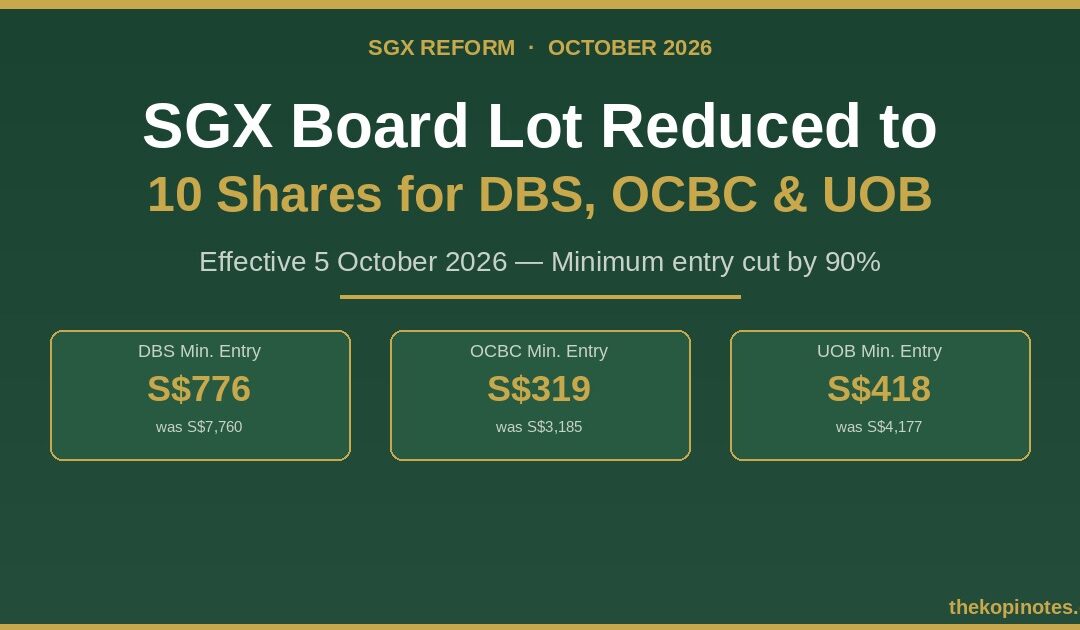
Effective 5 October 2026, the Singapore Exchange reduced minimum board lot sizes for 11 blue-chip stocks — including DBS, OCBC, and UOB — from 100 shares to just 10 shares. This 90% reduction in minimum cash outlay means retail investors can now enter Singapore’s most iconic stocks for under S$800, reshaping how investors build and diversify their portfolios.
This is an editorial analysis. Not financial advice. Data verified as at 6 October 2026.
What Changed: SGX’s New Tiered Lot System
Singapore Exchange (SGX) implemented a tiered board lot framework on 5 October 2026. The new structure:
- Stocks below S$10: Standard 100-unit board lots unchanged
- Stocks priced S$10 to S$100: Reduced from 100 to 10 units
- Stocks above S$100: Reduced from 100 to 1 unit
This is not a stock split. Share prices, dividends per share, and company valuations are entirely unchanged. The only thing that changed is the minimum number of shares per transaction — dropping from 100 to 10 shares for most eligible blue chips, a 90% cut in minimum capital commitment.
Once a stock moves into a smaller lot tier, the change is permanent even if the share price later falls below the threshold. SGX will conduct quarterly reviews from January 2027 to identify further eligible securities.
The 11 Stocks Now in Smaller Lots
These 11 securities collectively represent approximately 35% of SGX securities trading activity in H1 2026:
| Stock | SGX Code | ~Price (Sep 2026) | Old Min. (100 lots) | New Min. (10 lots) |
|---|---|---|---|---|
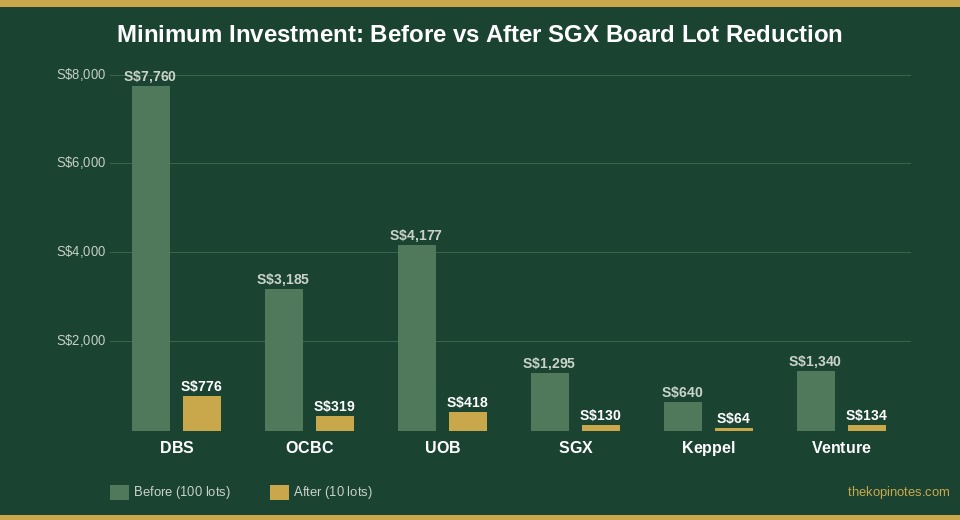
| DBS Group Holdings | D05 | S$77.60 | S$7,760 | S$776 |
| United Overseas Bank (UOB) | U11 | S$41.77 | S$4,177 | S$418 |
| Oversea-Chinese Banking (OCBC) | O39 | S$31.85 | S$3,185 | S$319 |
| Singapore Exchange (SGX) | S68 | S$12.95 | S$1,295 | S$130 |
| Venture Corporation | V03 | S$13.40 | S$1,340 | S$134 |
| Great Eastern Holdings | G07 | S$26.50 | S$2,650 | S$265 |
| Haw Par Corporation | H02 | S$10.20 | S$1,020 | S$102 |
| Jardine Cycle & Carriage | C07 | S$20.80 | S$2,080 | S$208 |
| Keppel Ltd | BN4 | S$6.40* | S$640 | S$64 |
| Jardine Matheson Holdings | J36 | USD 44.20 | USD 4,420 | USD 442 |
| Prudential PLC | K6S | USD 10.40 | USD 1,040 | USD 104 |
*Keppel near S$10 threshold. Prices are approximate from September 2026 (Growbeansprout.com, Phillip Nova). Prices vary at time of purchase.
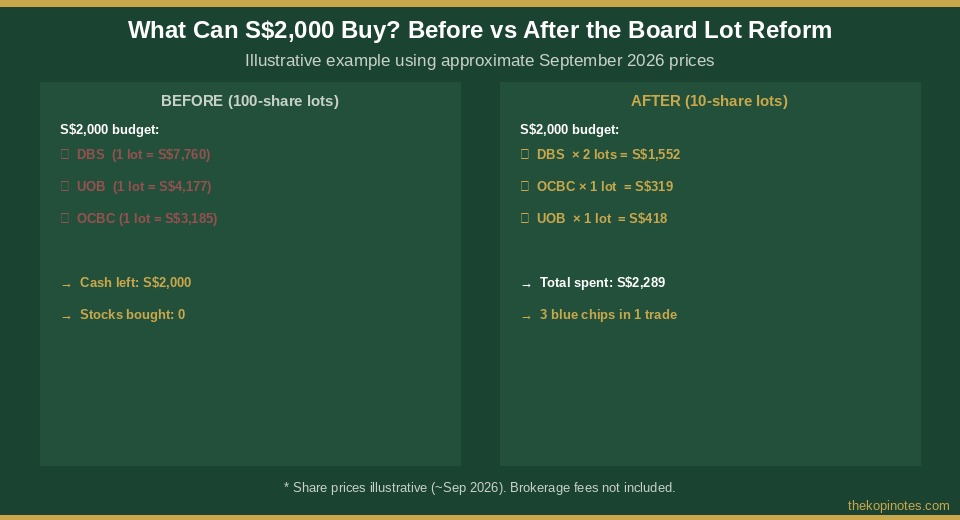
The three local banks — DBS, OCBC, and UOB — which form the bedrock of most Singapore equity portfolios, are now accessible at a fraction of the previous cost. What once required over S$15,000 to hold one board lot of all three banks now costs just S$1,513.
What This Means for Your Portfolio Strategy
This change has direct, practical implications for how Singapore retail investors structure their portfolios.
Better diversification for smaller portfolios: A S$5,000 budget could previously afford only one lot of UOB or OCBC. Now it can hold 3 lots of DBS, 5 lots of OCBC, and 4 lots of UOB — three cornerstone blue-chip positions simultaneously.
Dollar-cost averaging made practical: Instead of saving S$7,760 to add one DBS lot, you can add 10-share increments at ~S$776 monthly. This aligns better with salary cycles and savings plans.
Surgical rebalancing: Portfolio rebalancing requires buying and selling in increments. With 10-share lots, rebalancing is far more precise and less capital-disruptive than with 100-share minimums.
If you’re thinking about how blue chips fit into your overall allocation, our guide on core-satellite investing for Singapore shows how DBS and OCBC anchor a balanced Singapore equity portfolio.
The Brokerage Fee Trap: Don’t Over-Trade
Smaller board lots do not make every small trade efficient. The key risk for new investors is brokerage fee drag on micro-trades.
| Trade (10 shares) | Approx. Cost | S$5 Fee as % of Trade |
|---|---|---|
| Haw Par Corporation | S$102 | 4.9% |
| Venture Corporation | S$134 | 3.7% |
| SGX Ltd | S$130 | 3.8% |
| OCBC Bank | S$319 | 1.6% |
| UOB | S$418 | 1.2% |
| DBS Group | S$776 | 0.6% |
The practical rule: aim for trades where brokerage fees represent less than 1% of trade value. For DBS at S$776 per 10-share lot, a S$5 flat fee is only 0.6% — acceptable. But buying 10 shares of Haw Par at S$102 means paying a 4.9% overhead before earning a cent. Platforms with zero-commission or ultra-low fees — such as Syfe Trade or FSMOne — become especially relevant for smaller lot purchases.
CPF & SRS: Deploying Retirement Funds in Smaller Increments
For CPF Investment Scheme (CPFIS-OA) and SRS investors, the board lot reduction is particularly meaningful. Previously, deploying CPF-OA funds into DBS required a minimum S$7,760 outflow per transaction — too large for many investors with modest investable CPF-OA balances. With 10-share lots, the same DBS investment now starts at approximately S$776 per lot.
Monthly SRS contributions of S$1,000 can now be immediately invested across multiple blue-chip positions rather than sitting idle waiting for the next full lot. For a broader view of where to deploy SRS capital efficiently, see our guide on SRS account investment options in Singapore.
Important: always verify CPFIS eligibility on the CPF Board website before investing CPF funds. Eligibility can change and not all the 11 affected stocks may be on the approved list.
Who Benefits Most?
Several investor profiles benefit disproportionately from this change:
Young investors starting out: A fresh graduate investing S$500–S$1,000/month can now build a meaningful blue-chip equity allocation without waiting years to accumulate S$7,000+ for a single DBS lot.
Dividend income investors: For those following a dividend investing strategy, smaller increments mean dividends can be reinvested immediately. A S$400 quarterly DBS dividend can now be reinvested into half a new DBS lot (at ~S$776 each), rather than sitting in cash.
Regular savers and DCA investors: Monthly savings investors can now buy whole shares in manageable monthly amounts, bridging the gap between regular savings plans (fractional shares, higher fees) and traditional lump-sum lot purchases.
Retirees and drawdown investors: Managing a dividend income portfolio is easier when positions can be trimmed or added in S$700–S$800 increments rather than S$7,000+ blocks.
What’s Next: More Stocks Qualifying in 2027
The October 2026 implementation is Phase 1. SGX’s quarterly reviews from January 2027 will evaluate additional candidates based on price and liquidity criteria. ST Engineering (S63) has been highlighted by market observers as a potential candidate given its share price proximity to the S$10 threshold. Once a stock enters the smaller lot tier, the change is permanent.
This structural improvement sits alongside a broader positive backdrop for Singapore equities: the STI gained 22.9% year-to-date through Q3 2026, making Singapore blue chips an increasingly attractive asset class for retail investors expanding their direct stock exposure.
Bottom Line for SG Investors
The SGX board lot reduction to 10 shares is one of the most meaningful structural improvements to Singapore’s retail investing landscape in years. It doesn’t make DBS a better or worse investment. It doesn’t change yields or valuations. What it does is permanently remove the capital barrier that prevented countless Singapore investors from owning the country’s most iconic companies in any meaningful way.
If you’ve been waiting to enter DBS, OCBC, or UOB but couldn’t justify S$7,000+ per lot, that barrier is now gone. If you’ve been routing regular savings through RSPs to avoid large lot minimums, you now have a more direct and potentially lower-cost alternative. And if you rely on CPF-OA for investing, smaller lots make monthly deployment far more practical.
The dividend yields remain compelling: DBS at approximately 5.6%, OCBC at 6.2%, and UOB at 5.9% (based on September 2026 prices). These are now accessible in far smaller, more manageable increments than ever before. For a comprehensive view of Singapore’s best dividend stocks in 2026 — across blue chips, REITs and ETFs — our complete guide covers all the options.
Frequently Asked Questions
What is a board lot in Singapore investing?
A board lot is the minimum number of shares you must buy in a single transaction on SGX. Traditionally 100 shares for all stocks, it’s now tiered: 10 shares for stocks priced S$10–S$100, and 1 share for stocks above S$100, effective October 5, 2026.
Which 11 stocks are affected by the SGX board lot reduction?
DBS Group (D05), UOB (U11), OCBC (O39), Singapore Exchange (S68), Keppel Ltd (BN4), Venture Corporation (V03), Great Eastern Holdings (G07), Haw Par Corporation (H02), Jardine Cycle & Carriage (C07), Jardine Matheson Holdings (J36), and Prudential PLC (K6S).
How much do I need to buy one board lot of DBS now?
At approximately S$77–S$78 per share (early October 2026), one 10-share board lot of DBS costs approximately S$770–S$780. The exact minimum depends on the live share price at the time of purchase.
Is this the same as a stock split?
No. A stock split divides each share into multiple shares, reducing the price per share proportionally. The board lot reduction only changes the minimum transaction size — share prices, dividends per share, and company valuations are completely unchanged. Existing shareholders are unaffected.
Can I buy these stocks using CPF (CPFIS-OA) or SRS?
DBS, OCBC, and UOB have historically been on the CPFIS approved list for CPF-OA investment. The smaller board lots mean more granular CPF-OA deployment — approximately S$319–S$776 per lot. Always verify current CPFIS eligibility directly on the CPF Board website before investing CPF funds, as the approved list can change.
Will more SGX stocks join the smaller board lot system?
Yes. SGX has committed to quarterly reviews from January 2027. Any SGX-listed stock priced above S$10 that meets liquidity criteria will be evaluated. ST Engineering (S63) is frequently mentioned as a near-term candidate. Once a stock joins the smaller lot tier, it stays there permanently.
What’s the main risk of trading in smaller lots?
Brokerage fees. For very small trades — such as 10 shares of Haw Par at approximately S$102 per lot — a flat brokerage fee of S$5 represents nearly 5% of the trade value. Always calculate fees as a percentage of your trade amount and prioritise low-fee platforms for smaller trades. Aim for trades where fees are under 1% of the transaction value.
This article was researched with the help of AI. While we strive to keep all information accurate and up to date, there may be errors. If you notice any discrepancies, please contact us.