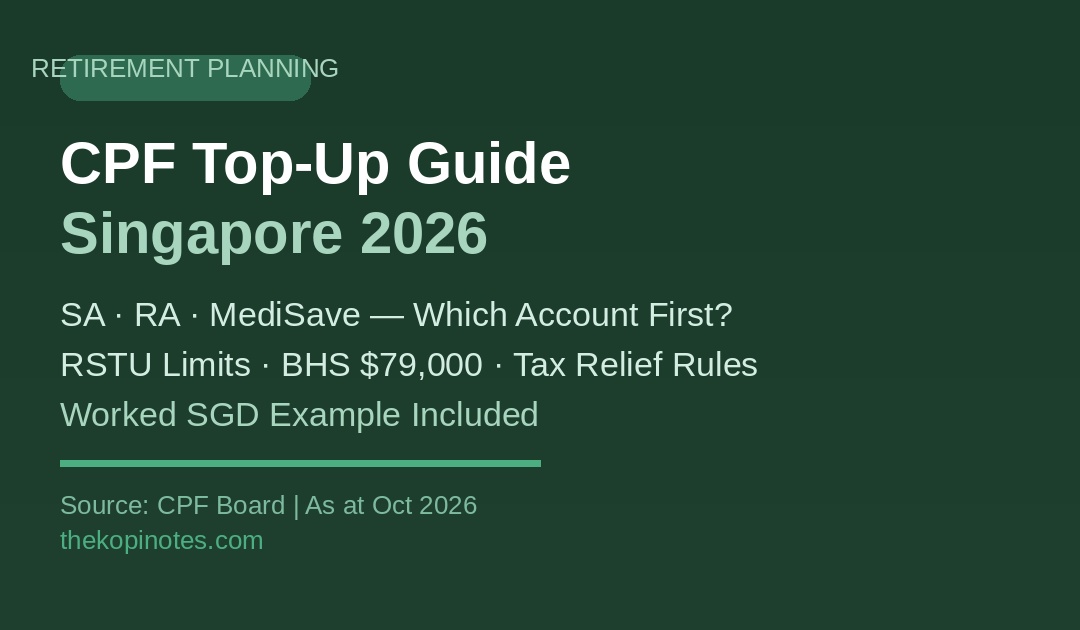
TL;DR — CPF Top-Up 2026
- SA (below 55): Top up with cash via RSTU up to the Full Retirement Sum ($220,400) minus your current balance. Earns 4% + extra interest.
- RA (55 and above): Top up RA via RSTU — up to FRS; or up to ERS ($440,800) if you want to maximise CPF LIFE payouts.
- MediSave (MA): Top up any time to the Basic Healthcare Sum (BHS) cap — $79,000 in 2026. Also earns 4%.
- Tax relief: Up to $8,000/year for your own SA/RA/MA top-ups; additional $8,000 for eligible family members. Both limits are shared across SA/RA and MA.
- New in 2026 — Matched MediSave Scheme (MMSS): If you are aged 55–70, top up your MA and receive matching grants of up to $1,000/year for five years (2026–2030).
- SA vs OA: 4% vs 2.5%. A $10,000 SA top-up at age 35 grows to $32,434 by age 65 vs $20,938 in OA — a $11,496 difference from one top-up.
- Not financial advice: All figures are as at October 2026. Consult a qualified financial adviser before making top-up decisions.
Why Topping Up Your CPF Is One of the Highest-Return Moves Available
CPF accounts are not just mandatory savings. For Singaporeans with the flexibility to make voluntary top-ups, the Special Account, Retirement Account, and MediSave Account collectively offer a guaranteed 4% return — in a near-zero-risk structure backed by the Singapore Government.
Compare that to a fixed deposit at a local bank (typically 2.0–3.0% for short tenors in 2026), or to CPF’s own Ordinary Account at 2.5%. The interest rate gap compounds significantly over a decade or two.
The landscape changed in January 2025 when the Special Account was closed for members aged 55 and above who had met the Full Retirement Sum. If you are below 55, you still have an active SA — and voluntary top-ups to it remain open. If you are 55 or older, your retirement savings now sit in a Retirement Account, which you can top up directly.
This guide covers all three accounts — SA, RA, and MA — their top-up mechanics, the 2026 limits, the tax relief rules, and a worked SGD example so you can see the numbers in action.
The Three Types of Voluntary CPF Top-Up
Before diving into each account, it helps to understand the three distinct pathways for voluntary top-ups:
| Scheme | Accounts Covered | Tax Relief? | Note |
|---|---|---|---|
| RSTU (Retirement Sum Top-Up) | SA (below 55) or RA (55+) | Yes — up to $8,000/yr own | Capped at FRS or ERS in RA |
| Voluntary MA Top-Up | MediSave Account | Yes — shared with RSTU $8k cap | Cap = BHS ($79,000 in 2026) |
| Voluntary Contributions (VC) | OA, SA, MA (proportional) | No | Follows CPF contribution ratio; not targeted to one account |
This guide focuses on RSTU and voluntary MA top-ups — the two routes most Singaporeans use to build retirement savings strategically. Voluntary Contributions (VC) to the OA are covered in a separate guide.
RSTU: Topping Up Your SA (Below Age 55)
If you are below 55, you still have a Special Account. The RSTU scheme lets you top it up with cash — and every dollar you add earns 4% per annum (plus up to 1% extra on the first $60,000 of combined CPF balances, capped at $20,000 for OA).
How Much Can You Top Up?
The cap is the current year’s Full Retirement Sum (FRS) minus your existing SA and OA balances. In 2026:
| Retirement Sum (2026) | Amount |
|---|---|
| Basic Retirement Sum (BRS) | $110,200 |
| Full Retirement Sum (FRS) | $220,400 |
| Enhanced Retirement Sum (ERS) | $440,800 |
For SA top-ups, the cap is FRS ($220,400) minus your combined OA+SA balances. Once your SA balance reaches the FRS (or your combined OA+SA reaches FRS), further RSTU top-ups to SA are not allowed — but you can still do Voluntary Contributions.
Tax Relief for SA Top-Ups
Cash top-ups to your own SA qualify for income tax relief of up to $8,000 per calendar year. This limit is shared across your SA/RA and MA top-ups combined — so if you top up $5,000 to SA and $3,000 to MA, you claim $8,000 in total, not $16,000.
You can also top up your family members’ SA — parents, parents-in-law, grandparents, spouse, and siblings. This earns a separate tax relief of up to $8,000 per year (provided the recipient meets the income conditions).
For the full tax relief mechanics, see our SRS Tax Relief guide and the IRAS website — the tax relief rules are covered in a separate article (R2 in our retirement series).
RSTU: Topping Up Your RA (Age 55 and Above)
Once you turn 55, a Retirement Account is created by merging your SA and OA savings up to the Full Retirement Sum. After that, you can no longer top up an SA — because it no longer exists for you. Instead, RSTU cash top-ups go directly into your RA.
Why Top Up Your RA?
Higher RA balance means higher CPF LIFE monthly payouts when they begin at 65 (or later, if deferred). The relationship is roughly linear: each additional $10,000 in your RA at 65 adds approximately $50–$60 per month to your CPF LIFE payout (depending on the plan chosen).
The ceiling for RA top-ups is the Enhanced Retirement Sum ($440,800 in 2026) — double the FRS. Members who have already reached FRS can continue topping up to ERS to access higher CPF LIFE payouts.
CPF LIFE Connection
Your RA balance at 65 (or at CPF LIFE enrolment) is what determines your monthly income for life. See our full guide on CPF LIFE and CPF Retirement Sums 2026 for the payout tables and scheme comparison.
SA Closure and What Changed
From January 2025, when a member turns 55, their SA is closed. Any SA balance above the FRS flows to the OA (it is not lost). Members aged 55+ now have only three accounts: OA, MA, and RA. The RSTU top-up pathway for this group therefore goes to the RA only.
Note: if you withdrew at age 55 and your RA balance is below the FRS, you can still top up your RA to the FRS — or up to ERS if you want to maximise payouts.
MediSave Top-Up: The Often-Overlooked Account
Most CPF guides focus on SA and RA top-ups because of the tax relief angle. But the MediSave Account is equally worth topping up — particularly for members approaching or past the BHS.
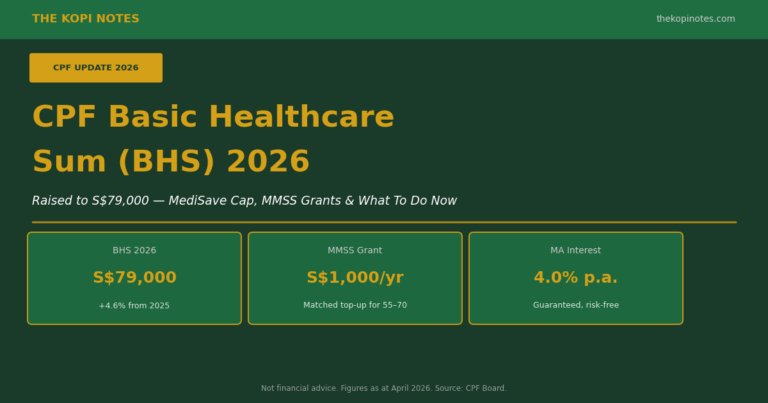
Basic Healthcare Sum (BHS) 2026: $79,000
Your MA is capped at the Basic Healthcare Sum. In 2026, the BHS is $79,000 for members aged 65 and below. Once you reach this cap, any mandatory contributions that would have gone to MA are instead channelled to your OA and SA (or RA after 55).
You can top up your MA at any time, up to the BHS. Cash contributions to MA also qualify for the tax relief (sharing the $8,000 combined cap with SA/RA top-ups).
New in 2026: Matched MediSave Scheme (MMSS)
Starting 1 January 2026, Singapore introduced the Matched MediSave Scheme. Members aged 55 to 70 with lower MediSave savings receive matching grants of up to $1,000 per year on voluntary cash top-ups to their MA. The matching runs for five years (2026–2030).
Eligible members will be notified by CPF Board via email or letter. If you fall in the 55–70 age range and have received a notification, prioritising your MA top-up (up to $1,000 matched) is a straightforward way to earn an instant 100% return on that portion.
What Happens If Your MA Exceeds BHS?
Excess contributions above the BHS cannot stay in MA. Any overshoot is redirected to OA (for members below 55) or OA/RA (for members 55 and above). This is why topping up MA only makes sense when you are below the BHS cap.
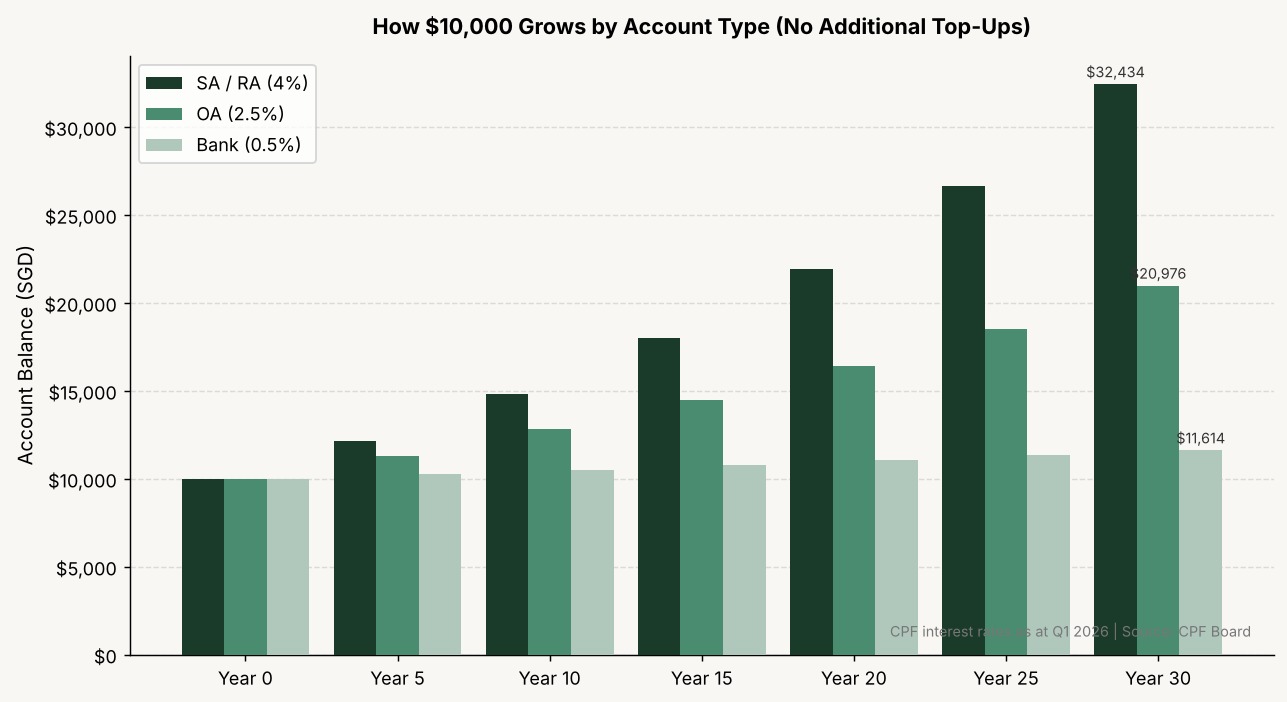
Chart: How a single $10,000 top-up compounds over 30 years by account type. CPF interest rates as at Q1 2026. Source: CPF Board.
Worked SGD Example: Mr Lee, Age 38
Mr Lee is a 38-year-old Singaporean with the following CPF balances:
| Account | Current Balance | 2026 Interest Rate |
|---|---|---|
| OA | $75,000 | 2.5% |
| SA | $55,000 | 4% |
| MA | $52,000 | 4% |
His top-up options for 2026:
- SA RSTU: He can top up SA up to FRS ($220,400) minus his OA+SA balance ($75k + $55k = $130k). That means he can top up $90,400 to SA in total. He chooses to add $8,000 this year for the full tax relief.
- MA top-up: His MA is at $52,000; BHS is $79,000. He can top up $27,000 more. However, if he tops up MA, that shares the $8,000 tax relief cap with his SA top-up. He decides to split: $5,000 to SA + $3,000 to MA = $8,000 tax relief claimed.
Impact of $8,000 SA Top-Up (Annual, for 10 Years)
| Year | Cumulative SA Top-Up | Balance at 4% (approx) | Interest Earned |
|---|---|---|---|
| Year 1 | $8,000 | $8,320 | $320 |
| Year 3 | $24,000 | $25,946 | $1,946 |
| Year 5 | $40,000 | $43,307 | $3,307 |
| Year 10 | $80,000 | $96,049 | $16,049 |
After 10 years, Mr Lee’s $80,000 in top-ups has grown to approximately $96,049 — an additional $16,049 from interest alone. In an OA, the same $80,000 would have grown to about $90,286 (earning $10,286 in interest). The SA earns an additional $5,763 in interest over the 10-year period.
Note: All figures are illustrative. Actual growth depends on the timing of top-ups within the year and any changes to CPF interest rates. Top-up amounts that attract MMSS matching grants do not receive income tax relief in the year matched.
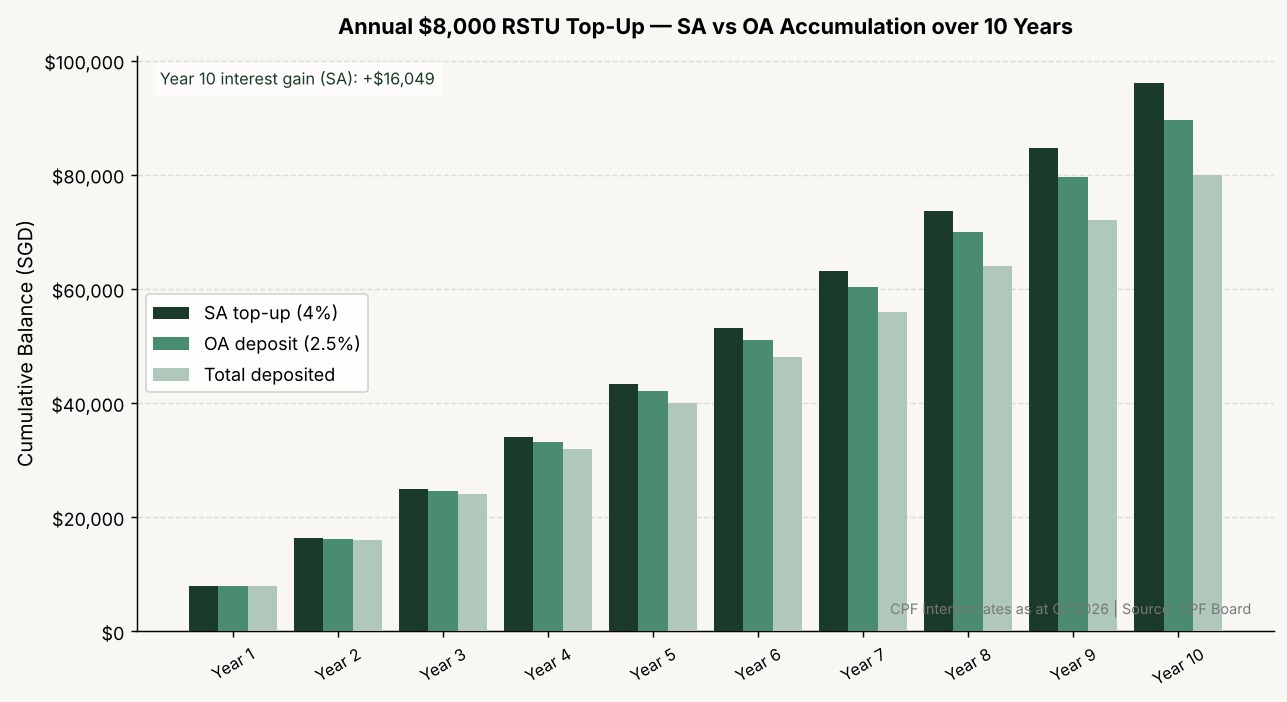
Chart: Annual $8,000 RSTU top-up — cumulative balance in SA (4%) vs OA (2.5%) vs total cash deposited. Source: CPF Board. As at Q1 2026.
Which Account Should You Top Up First? A Decision Framework
Step 1: Are You Aged 55–70 and Eligible for MMSS?
If CPF Board has notified you, top up your MA first — up to the matched $1,000 per year. An immediate 100% return on matched funds beats almost everything else.
Step 2: Is Your MA Below the BHS ($79,000)?
If your MA is significantly below the BHS and you are below 55, consider topping it up. It earns the same 4% as your SA, and the medical coverage buffer is valuable. Weigh this against SA: both earn 4%, but SA compounds toward retirement income, while MA funds healthcare expenses.
Step 3: Are You Below 55 with SA Space Below FRS?
RSTU to SA is the default high-value move for working Singaporeans below 55. The 4% compounding at this life stage over 10–25 years generates meaningful additional retirement savings. The tax relief (up to $8,000/year) reduces your net cost further.
Step 4: Are You 55+ and Below ERS in RA?
Top up RA to enhance your CPF LIFE payout. Every $10,000 added to your RA at 65 adds roughly $50–$60/month to your monthly CPF LIFE payout for life. If you expect to live past 80, this is excellent value. See our full CPF Retirement Sum guide for payout projections.
When NOT to Top Up
- You need the cash in the near term. CPF top-ups are irreversible — once in, the money stays in CPF until retirement age (or death).
- You have high-interest debt. Credit card debt at 24–28% p.a. should be cleared before locking money in at 4%.
- You are using OA for housing shortly. RSTU top-ups to SA reduce your OA+SA to FRS headroom, but your OA remains separate. Just note that voluntary top-ups cannot be reversed.
How to Make a CPF Top-Up (Step by Step)
- Log in to the CPF website using Singpass.
- Navigate to My Requests > Building My Retirement Savings > Top Up My CPF Retirement Savings.
- Choose: Top up your own SA/RA (RSTU) or top up a family member’s SA/RA.
- Select payment method: PayNow (immediate), GIRO (recurring), or eNETS.
- For MA top-ups: navigate to My Requests > Growing My Savings > Top Up My MediSave.
- Tax relief is automatically reflected in your income tax assessment for the calendar year in which the top-up is made.
Related Tools
- CPF Top-Up Calculator (Singapore) — Calculate your RSTU headroom, interest earned and tax relief at your marginal rate.
- Retirement Planning Calculator (Singapore) — Combine your CPF projections with other assets to see your total retirement picture.
- CPF MediSave Account — What It Covers
Disclaimer: This article is for general information only and does not constitute financial advice. All CPF figures are as at October 2026 and sourced from CPF Board (cpf.gov.sg) and IRAS (iras.gov.sg). CPF rules and interest rates are subject to change. Consult a licensed financial adviser before making top-up decisions based on your personal circumstances.
Frequently Asked Questions
Can I still top up my Special Account (SA) in 2026?
What is the maximum I can top up via RSTU in 2026?
Is the $8,000 tax relief limit per account or across all accounts?
What is the BHS, and does topping up MediSave still make sense?
What is the Matched MediSave Scheme (MMSS) and who qualifies?
Can I withdraw the money I top up into my SA or RA?
Do CPF top-ups count as employee CPF contributions for employer matching?
When is the best time of year to make a CPF top-up?
This article was researched with the help of AI. While we strive to keep all information accurate and up to date, there may be errors. If you notice any discrepancies, please contact us.