How to Invest in Singapore: Tax-Efficient Strategies Using SRS and CPF-OA (2026 Guide)
Most Singapore investors focus on what to invest in. But equally important is where you invest — because the right tax wrappers can save you thousands of dollars every year. Singapore’s Supplementary Retirement Scheme (SRS) and CPF Ordinary Account (via CPFIS) both let you invest in ETFs, unit trusts and bonds while reducing your tax bill and growing your retirement nest egg tax-deferred. This guide explains how to use both effectively to compound your wealth.
Not financial advice. All figures are for educational reference only. Data verified as at 21 November 2026 against official sources (IRAS, CPF Board).
📋 In This Guide
Why Tax-Efficient Investing Matters in Singapore
Singapore already has one of the most investor-friendly tax regimes in the world: capital gains are not taxed, and dividends from most Singapore-listed investments are exempt. Yet many investors still leave significant money on the table by ignoring the two official tax-advantaged wrappers the government has set up specifically to help you build retirement wealth.
These are the Supplementary Retirement Scheme (SRS) and the CPF Investment Scheme (CPFIS). Used correctly, they offer a powerful combination: cut your taxes today, invest the savings, and compound your wealth in a tax-deferred environment for decades.
Here’s why this matters in practice. Suppose you earn S$120,000 a year and you contribute the maximum S$15,300 to SRS before 31 December. That contribution reduces your chargeable income by S$15,300. At the 15% marginal rate, you save approximately S$2,295 in taxes — money you can reinvest or use however you like. Over a 20-year working career, those annual tax savings alone could add up to more than S$40,000, without considering any investment growth on the savings themselves.
If you are building a long-term investment portfolio in Singapore, understanding both wrappers is essential. If you are just starting out, we recommend reading our beginner’s guide to investing in Singapore first, then returning here to layer on these tax strategies.
What Is the Supplementary Retirement Scheme (SRS)?
The SRS is a voluntary retirement savings scheme administered by Singapore’s Ministry of Finance (MOF). It is operated through three bank operators: DBS, OCBC, and UOB. You open one account with any of them and can transfer between operators later if you choose.
Here is how SRS works in practice:
- You contribute cash to your SRS account at any time before 31 December each year
- Your contribution reduces your chargeable income by the same amount — generating immediate tax savings
- Your SRS savings can be invested in SRS-eligible products (equities, ETFs, unit trusts, bonds, annuities, Singapore Government Securities)
- Investment returns within SRS accumulate tax-free while you stay invested
- At the prescribed retirement age, you can withdraw over up to 10 years — only 50% of each withdrawal is taxable
SRS Contribution Limits 2026
| Resident Status | Annual SRS Cap | Note |
|---|---|---|
| Singapore Citizen or PR | S$15,300 | Same cap since 2016 |
| Foreigner (Employment Pass, etc.) | S$35,700 | Annual declaration required |
| Overall personal income tax relief cap | S$80,000/yr | Applies to all reliefs combined |
Source: IRAS, SRS contributions and tax relief page, November 2026
SRS Withdrawal Rules and the Prescribed Retirement Age
Singapore’s statutory retirement age rose from 63 to 64 on 1 July 2026. This matters for SRS because the prescribed retirement age for penalty-free withdrawals is determined by the statutory retirement age when you make your first SRS contribution:
- First SRS contribution before 1 July 2026: prescribed age is 63
- First SRS contribution from 1 July 2026 onwards: prescribed age is 64
At the prescribed retirement age, you can withdraw SRS savings at a highly favourable rate: only 50% of the amount withdrawn is added to your taxable income for that year. If you spread withdrawals over 10 years, the annual taxable amount becomes very small — often falling below Singapore’s lowest tax threshold, making the effective tax rate close to zero for many retirees.
Early withdrawal (before prescribed retirement age): attracts a 5% penalty on the amount withdrawn, and 100% of the amount is taxable at standard rates. Early withdrawals generally make financial sense only in a medical emergency.
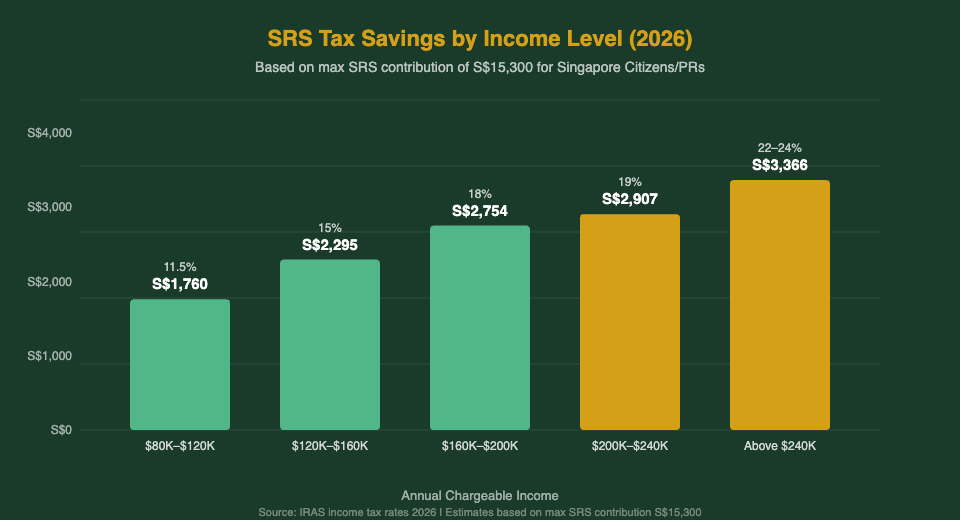
Estimated annual tax savings from maximum SRS contribution of S$15,300 by income bracket. Source: IRAS tax rates 2026. For illustrative purposes only.
What Is CPFIS? Investing Your CPF Ordinary Account
The CPF Investment Scheme (CPFIS) allows you to invest your CPF Ordinary Account (OA) savings that exceed S$20,000. Your CPF-OA currently earns a guaranteed 2.5% per annum (as confirmed by CPF Board for Q3 2026). Members below age 55 also earn an extra 1% on the first S$60,000 of combined CPF balances (capped at S$20,000 from OA), effectively earning 3.5% on that tranche.
CPFIS allows you to invest the OA savings above S$20,000 into a range of approved products:
| Key Rule | Detail |
|---|---|
| Minimum OA balance | S$20,000 must remain in OA; only savings above this are investable |
| CPF-OA interest rate | 2.5% p.a. (guaranteed floor, Q3 2026, per CPF Board) |
| Extra interest (below 55) | +1% p.a. on first S$60K combined balances (OA portion capped at S$20K) |
| Eligible investments | SGX-listed ETFs, unit trusts, SGX shares, Singapore Government Bonds, annuities |
| SA/MA/RA interest | 4% p.a. (floor extended to December 2027, per CPF Board Sep 2026) |
Source: CPF Board, CPF Interest Rates press release (Q3 2026, 26 May 2026)
The key question for CPFIS: can your chosen investment consistently beat 2.5% (or 3.5% with extra interest) after all fees over the long run? Academic evidence and CPF Board’s own studies have consistently found that most actively managed funds in CPFIS fail to clear this hurdle. If you use CPFIS, low-cost, broadly diversified index ETFs give the best probability of outperforming the guaranteed rate over decades.
For a deeper look at optimising your CPF savings, see our guide on CPF investment strategy.
SRS vs CPFIS: Which Should You Prioritise?
For most working Singaporeans, the answer is clear: maximise your SRS contribution first, then consider CPFIS. Here’s why, and a full comparison:
| Feature | SRS | CPFIS-OA |
|---|---|---|
| Annual contribution limit | S$15,300 (Citizens/PRs) | No separate cap; invest OA above S$20K |
| Upfront tax benefit | Yes — immediate income tax relief | No (OA contributions come from payroll) |
| Investment universe | ETFs, unit trusts, equities, bonds, SGS, annuities | SGX ETFs, unit trusts, SGX shares, bonds |
| Opportunity cost rate | None (new cash contributed) | 2.5% p.a. guaranteed (or 3.5% with extra interest) |
| Withdrawal tax | 50% of withdrawals taxable from age 63/64 | No tax on CPF withdrawals at CPF LIFE payout age |
| Flexibility | Any time (penalty for early withdrawal) | Can sell and return proceeds to OA anytime |
| Best suited for | Anyone with tax liability; immediate tax savings | Those with large OA savings and high conviction in outperforming 2.5% |
Our recommendation: If you have unused SRS allowance, contribute up to S$15,300 before 31 December to lock in tax relief for the upcoming assessment year. Only after maximising SRS should you consider investing OA savings via CPFIS — and even then, only with low-cost index ETFs where the probability of beating the guaranteed rate is highest over a 10–20 year horizon.
Need help figuring out how much you need for retirement? Use our Singapore retirement calculator to estimate your target number.
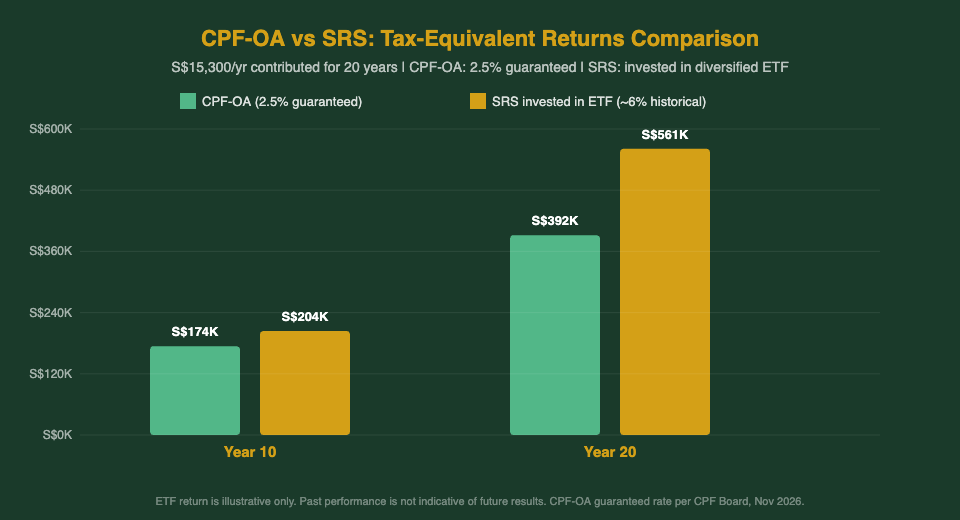
CPF-OA at 2.5% p.a. guaranteed vs SRS invested in a diversified ETF at ~6% historical return. S$15,300/yr contributed. ETF return is illustrative; past performance is not indicative of future results. Source: CPF Board (Nov 2026).
Step-by-Step: How to Get Started With SRS
Opening an SRS account and making your first contribution is straightforward. Here are the five steps:
- Choose an SRS operator: DBS, OCBC, or UOB. All three offer the same contribution mechanics; the choice matters more for which investment platform you plan to use within SRS.
- Open the account online or in-branch: You need your NRIC/passport and existing bank account with the operator. Most accounts can be opened within 15 minutes online.
- Transfer funds to your SRS account: Contributions must be made before 31 December to count for the current year’s tax relief. Online transfers are instant from the same bank; interbank transfers take 1–3 business days, so plan ahead.
- Invest your SRS savings: Contributions sitting as cash in your SRS account earn little to no interest. The goal is to invest them in an SRS-eligible product — a globally diversified ETF or low-cost unit trust is the most common choice for long-term investors.
- Track your contributions and claim tax relief: IRAS automatically picks up your SRS contributions from your bank operator. You do not need to file a separate claim. The relief appears in your Notice of Assessment for the Year of Assessment following your contribution year.
When deciding how much to contribute, factor in the S$80,000 overall personal income tax relief cap. If you are also making CPF cash top-ups, NSman reliefs, course fee reliefs, or parent reliefs, make sure your total reliefs do not exceed this cap — otherwise your SRS contribution generates no additional tax benefit.
Once you have built your first investment portfolio, consider allocating a portion of your annual SRS contribution to the same strategy, so your tax-advantaged and taxable accounts work in concert.
What to Invest in With Your SRS Savings
Once your SRS account is funded, the best approach for most long-term investors is a low-cost, globally diversified index portfolio. Here are the main options available through each platform type:
Managed Platforms (Automated, Hands-Off)
Endowus and Syfe both accept SRS contributions and can invest them in globally diversified, low-cost fund portfolios on your behalf. Endowus is particularly well-suited for SRS because it invests in institutional-share-class funds not available on retail platforms, often at lower total cost. Use our Endowus referral code (code: 2V343) or Syfe referral code and sign-up bonus (code: SRPRFFFCD) when signing up.
Do-It-Yourself: ETFs via FSMOne or IBKR
For investors who prefer to build their own portfolio, FSMOne allows you to invest SRS savings in a broad range of unit trusts, ETFs and SGX-listed equities. It is one of the most cost-competitive platforms for SRS investors. Use our FSMOne referral code (P0544985) when opening your account. IBKR does not directly support SRS investments, but it is worth considering for your non-SRS taxable account alongside your SRS strategy. Use our IBKR referral code (jianxiong368) for a commission rebate.
What to Buy
Inside SRS, the same investment principles apply as outside it: diversify globally, minimise costs, and think in decades. A low-cost globally diversified ETF tracking the MSCI World or MSCI All-Country World Index (ACWI) is the most straightforward choice for most investors. If you want additional exposure to passive income in Singapore, REITs and Singapore dividend stocks can also be held within SRS.
Avoid holding cash in your SRS account for long — idle SRS savings earn near-zero interest, turning your tax-advantaged account into a low-return savings pot.
Common Mistakes to Avoid
Even investors who understand SRS in theory make costly errors in practice. Here are the most common ones:
- Leaving SRS savings as cash: Contributing to SRS but not investing the funds means you get the upfront tax relief but miss out on decades of compounding. Set a reminder to invest within days of contributing.
- Contributing more than your relief cap allows: If your total reliefs already exceed or approach S$80,000/year, additional SRS contributions may not generate any extra tax benefit. Check your total reliefs before committing.
- Not accounting for the prescribed retirement age: Opening your first SRS account from July 2026 means waiting until 64 (not 63) to withdraw penalty-free. Plan your withdrawal strategy accordingly.
- Withdrawing early: The 5% penalty on early SRS withdrawals is punishing. Treat your SRS account as genuinely long-term capital — do not invest money in SRS that you might need before retirement age.
- Using CPFIS for actively managed funds: CPF Board data consistently shows that the majority of CPFIS investors underperform the CPF-OA guaranteed rate after fees. If you use CPFIS, stick to low-cost index ETFs.
- Ignoring the interaction with CPF cash top-ups: CPF cash top-ups to SA/RA also generate income tax relief, up to S$8,000/yr (own account) plus S$8,000 (family members). These reliefs count toward the same S$80,000 cap. Plan both SRS and CPF top-ups together to avoid crowding out one or the other.
Frequently Asked Questions
How much can I contribute to SRS in 2026?
At what age can I withdraw from SRS without penalty?
Is SRS better than topping up my CPF Special Account?
Can I use SRS to invest in ETFs like CSPX or VWRA?
What happens to my SRS if I leave Singapore?
Is CPFIS worth it for Singapore investors?
Start Investing Tax-Efficiently Today
Opening an SRS account and making your first contribution before 31 December is one of the simplest, highest-impact financial moves you can make this year. Use one of TKN’s trusted platforms to get started — and earn a sign-up bonus in the process.
Not financial advice. TKN may earn referral fees from these links. Always read the full terms before opening any financial account.
This article was researched with the help of AI. While we strive to keep all information accurate and up to date, there may be errors. If you notice any discrepancies, please contact us.