MediSave Limit 2026: How the Letter of Guarantee (LOG) Works at Singapore Private Hospitals
What your ISP insurer issues before admission — and what you still pay under 2026 rules
If you have an Integrated Shield Plan (ISP) and are heading for a private hospital stay, one document can save you from producing a large cash deposit at admission: the Letter of Guarantee (LOG). Your ISP insurer issues the LOG directly to the hospital, assuring payment of your covered claim. Under the 2026 ISP co-payment rules — effective 1 April 2026 — you will still pay the deductible and a minimum 5% co-payment capped at $6,000 per policy year, but the LOG takes care of the rest.
Not financial or medical advice. All figures are for educational reference only. Data as at November 2026 unless noted.
What Is a Letter of Guarantee (LOG)?
A Letter of Guarantee (LOG) is a formal assurance from your Integrated Shield Plan (ISP) insurer to the hospital, promising to pay the insured portion of your hospital bill directly. It eliminates — or dramatically reduces — the large cash deposit Singapore private hospitals typically require at the point of admission.
Without an ISP, or without a LOG in place, private hospitals often ask for an upfront deposit equivalent to several days of room-and-board charges before you are admitted. Depending on the ward class and expected length of stay, this deposit can range from $3,000 to $15,000 or more. For many patients — especially those facing an unexpected or urgent procedure — producing this amount at short notice is a significant burden.
With an ISP and a valid LOG, the hospital receives payment assurance directly from your insurer. You still pay the deductible and your co-payment share (covered below), but you do not have to produce the entire estimated bill upfront in cash.
Important: a LOG is not a claim approval. Issuing an LOG does not mean the insurer has agreed to pay the claim in full. The claim is still reviewed after discharge and final billing. If the insurer later finds that treatment is excluded under your policy or the claim has issues, they can decline even after having issued a LOG. This is why understanding your policy exclusions before admission — not after — matters.
For a full overview of what integrated shield plans cover in Singapore, see our integrated shield plan 2026 guide.
How to Request a LOG at a Singapore Hospital
Requesting a LOG is simpler than most patients expect. The process differs slightly between restructured (public) hospitals and private hospitals.
At a Restructured Hospital
Restructured hospitals — including Singapore General Hospital (SGH), National University Hospital (NUH), Changi General Hospital (CGH), Tan Tock Seng Hospital (TTSH), Alexandra Hospital (AH), and Khoo Teck Puat Hospital (KTPH) — have an electronic LOG system linked directly to all major ISP insurers. The process is fast:
- Approach the Business Office or Admissions Counter at or before admission.
- Provide your NRIC, ISP policy number, and insurer name.
- The electronic system contacts your insurer automatically — most LOGs are generated within minutes.
- Sign three documents: the MediSave Authorisation Form, the Letter of Guarantee, and the Private Medical Insurance Claim Form.
- If the patient is under 21, a parent or next of kin signs on their behalf.
At a Private Hospital
For private hospitals — including Mount Elizabeth, Gleneagles, Parkway East, Raffles Hospital, and Thomson Medical Centre — the LOG process typically requires direct contact with your insurer. For a planned admission:
- Call your insurer’s 24-hour medical hotline 1–3 working days before the admission date.
- Log the request via your insurer’s mobile app or online portal if available (all major ISP insurers offer this in 2026).
- Provide the hospital name, ward class, the consultant’s name and specialty, and the diagnosis or procedure code if known.
- The insurer will contact the hospital directly to issue the LOG before your admission.
For emergency admissions, call your insurer as soon as practically possible — most require notification within 24 hours of admission. Insurers have emergency LOG processes and will back-date the guarantee to cover the admission date if notified promptly.
If you recently changed jobs or had a gap in employment, verify that your ISP premiums are current before assuming your coverage is active — see our guide on ISP coverage during retrenchment for what to check.
What the LOG Covers — and What You Still Pay
A LOG guarantees the insurer’s share of your hospital bill — not the total bill. Even with an ISP and a valid LOG, you are responsible for three components:
1. The Annual Deductible
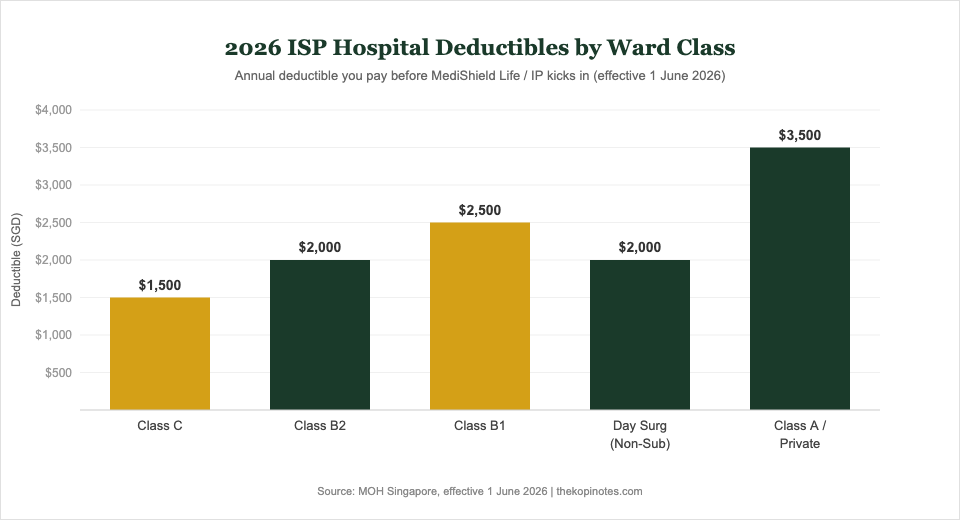
The deductible is the fixed amount you must pay out of pocket before your ISP pays anything. Under the 2026 MediShield Life rules (effective 1 June 2026), the deductible for Class A and private hospital wards is $3,500 per policy year for those aged 80 and below, and $4,500 for those aged 81 and above. The deductible resets each policy year — once paid, further bills in the same policy year are not subject to it again.
2. Your Co-Payment (New 2026 Riders)
Under the 2026 ISP rider rules (effective 1 April 2026 for new riders), you must pay a minimum 5% co-payment on your hospitalisation bill above the deductible. This co-payment is capped at $6,000 per policy year for eligible claims with panel or pre-authorised doctors. Using a non-panel specialist at a private hospital typically increases your co-payment significantly.
3. Non-Covered Charges
Room upgrades above your plan’s coverage class, exclusions in your policy, charges for non-covered treatments, and overseas treatment costs remain your responsibility in full — no LOG, no ISP coverage, and no MediShield Life payout for these.
| Bill Component | Paid By | 2026 Key Figure |
|---|---|---|
| Annual deductible | Patient (via MediSave or cash) | $3,500 for Class A/Private (age ≤80) |
| Co-payment (new riders) | Patient (cash or MediSave) | Min 5%, capped at $6,000/year |
| Non-covered charges | Patient | No cap |
| Covered hospitalisation costs | ISP insurer (via LOG) | Up to policy annual limits |
Source: MOH MediShield Life deductibles (June 2026); MOH ISP rider requirements announcement (November 2025, effective April 2026)
For a worked example of a hospital bill with just the base MediShield Life layer — without an ISP rider — see our article on hospital bills without an ISP rider.
How the 2026 ISP Rules Change Your Out-of-Pocket Costs
The April 2026 changes apply to new ISP riders sold from 1 April 2026 onwards. If you bought your rider before that date, your existing terms apply until renewal — but all riders must comply with the new rules by 1 April 2028, and your insurer must notify you before the transition.
What Changed from 1 April 2026
Deductibles are no longer coverable by riders. Previously, some premium ISP riders — particularly “as-charged” riders — covered the deductible entirely. From 1 April 2026, new riders cannot cover the minimum IP deductibles. You must pay the deductible yourself, from MediSave or cash.
The co-payment cap has been raised. New riders must include a minimum 5% co-payment on eligible claims (the percentage is unchanged from 2018). However, the annual cap on those co-payments has been raised from $3,000 to $6,000 per policy year. In a year with heavy hospital use, your maximum co-payment liability has doubled — but it is still capped at $6,000, not unlimited.
New riders are expected to be cheaper. MOH expects compliant riders to cost around 30% less than the previous full-coverage riders, as the increased patient co-payment transfers part of the cost from the insurer to the policyholder.
Practical Example: Private Hospital Knee Replacement
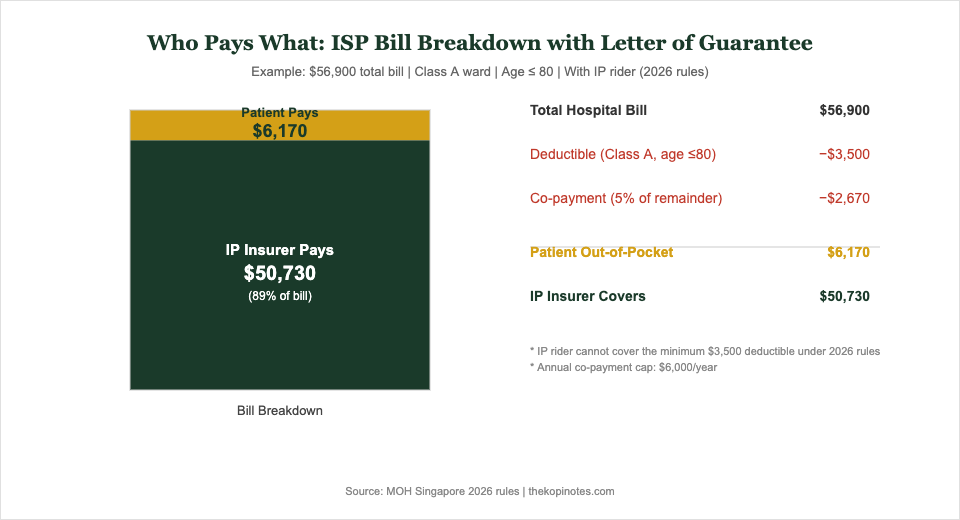
Using MOH’s illustrative worked example (Annex B, November 2025 press release):
- Total bill: $56,900
- Deductible (Class A/Private): $3,500 — patient pays
- 5% co-payment on the remaining $53,400: $2,670 — patient pays
- Total patient out-of-pocket: $6,170
- ISP insurer pays (via LOG): approximately $50,900
| Scenario | Total Bill | Patient Pays (Approx.) | ISP Pays |
|---|---|---|---|
| Private hospital knee replacement (panel) | $56,900 | ~$6,170 | ~$50,900 |
| Private hospital ACL reconstruction (panel) | $38,700 | ~$5,260 | ~$33,500 |
| Restructured hospital Class A (3-day stay) | $15,000 | ~$4,075 | ~$10,925 |
| Day surgery — private hospital (panel) | $8,000 | ~$2,300 | ~$5,700 |
Source: MOH illustrative examples (Annex B, November 2025); figures are approximate and illustrative only. Individual bills vary.
For the full breakdown of the new 2026 co-payment structure, see our guide to the new ISP rider co-payment rules 2026.
When a LOG Is Not Issued
Your ISP insurer can decline to issue a LOG in several circumstances. Knowing these scenarios in advance helps you plan — especially for elective or scheduled admissions.
Common Reasons a LOG May Be Declined
Estimated bill is within the deductible. If the hospital’s projected bill is lower than your remaining deductible for the policy year — meaning you will be paying everything yourself — there is nothing for the insurer to guarantee. No LOG will be issued in this case.
Pre-existing or excluded condition. If the admission relates to a condition excluded under your policy (whether a pre-existing exclusion or a standard policy exclusion), the insurer will not issue a LOG for that treatment.
Non-panel specialist at a private hospital. Under most ISPs, using a specialist who is not on the insurer’s approved panel significantly reduces or eliminates coverage. Without coverage, there is no basis for a LOG. See our guide on ISP panel vs non-panel doctors 2026 for the full implications.
Previously rejected claim for the same condition. If the insurer has previously rejected a claim for the same or related condition, they are unlikely to issue a LOG for a new admission related to that condition.
Outpatient or non-inpatient treatment. LOGs apply to inpatient hospital admissions. Outpatient visits, day therapies at clinics, and non-approved day surgery facilities do not qualify. For procedures commonly done as day surgery — such as gallbladder removal — check whether your plan covers the specific facility, as covered in our article on MediSave limits for gallbladder removal surgery.
Policy lapsed or in a waiting period. If your premiums are unpaid or you are within the waiting period of a recently purchased policy, no LOG will be issued.
Insufficient admission information. If the insurer cannot assess the clinical situation — because the diagnosis is unclear, the procedure is unplanned, or clinical documentation is incomplete — they may withhold the LOG pending more information.
What to Do if No LOG Is Issued
You may need to pay the hospital’s standard admission deposit — typically cash or credit card at a private hospital, potentially $5,000–$15,000. After discharge, submit your original bills, the admission summary, and the consultant’s referral letter to your insurer and claim reimbursement of the covered portion. Keep all original documents: most insurers require them for reimbursement claims.
LOG at Private vs Public Hospitals: Key Differences
The LOG process and its impact differ significantly between restructured hospitals and private hospitals. Here is what to expect at each type.
| Feature | Restructured Hospitals | Private Hospitals |
|---|---|---|
| Electronic LOG system | Yes — instant, automated | Varies; often manual request |
| How to request | At admissions counter | Via insurer hotline or app |
| Lead time needed | At admission (no advance needed) | 1–3 days for planned admissions |
| Emergency LOG | Via admissions, same day | Call insurer within 24 hours |
| Non-panel doctor risk | Lower — most are on panel | High — check before choosing |
| Deposit without LOG | Smaller; MediSave may assist | $5,000–$15,000 upfront |
| MediShield Life coverage | Yes — applies to all ward classes | Yes — at private hospital rates |
Source: TKN research; MOH ISP requirements; major insurer helplines
If you have recently undergone surgery and are now in recovery, check our guide on physiotherapy and rehabilitation after surgery — what your ISP covers for the follow-up care picture.
Frequently Asked Questions
Does the Letter of Guarantee mean my insurer will definitely pay the claim?
No. A LOG is a payment assurance to the hospital, not a final claim approval. The claim is still reviewed after discharge and final billing. If the insurer finds the treatment is excluded under your policy, the admission was not pre-authorised correctly, or there is another issue, they can decline even after having issued a LOG. Always verify your policy exclusions and check with your insurer before admission, not after.
How far in advance should I request a LOG for planned surgery?
For private hospitals, request your LOG 1–3 working days before the admission date. This gives your insurer time to review the clinical details and contact the hospital. For restructured (public) hospitals, the electronic system handles LOG generation at admission — no advance request is needed in most cases. For complex procedures or if you have pre-existing conditions, request earlier to allow time for any additional review.
What if I am admitted as an emergency and cannot request a LOG?
Contact your insurer as soon as practically possible — most request notification within 24 hours of an emergency admission. Insurers have emergency LOG processes and can back-date the guarantee to cover the admission date if notified promptly. If the patient cannot call, ask a family member to do it on their behalf. Save your insurer’s 24-hour medical hotline number to your phone before you need it.
Under the 2026 ISP rules, what is the maximum I could pay out of pocket in a year?
For a new compliant rider purchased from 1 April 2026, your annual exposure for a Class A/private hospital admission with a panel doctor is: the deductible ($3,500 for those aged 80 and below) plus the co-payment (minimum 5%, capped at $6,000 per policy year). That gives a theoretical annual maximum of around $9,500 ($3,500 + $6,000) for covered eligible claims. Non-panel doctors, non-covered treatments, and room upgrades above your plan’s class can add further costs beyond this cap.
Can I use MediSave to pay my deductible and co-payment?
Yes, subject to MediSave withdrawal limits. MediSave can be used to pay for inpatient hospital bills, including the deductible and co-payment, up to applicable limits. The basic inpatient withdrawal limit is $450 per day for general ward claims, plus surgical procedure limits (which vary significantly by procedure). The hospital will advise you on the specific MediSave-claimable amount based on your diagnosis and procedure codes at the time of admission.
If my LOG is declined, can I still be admitted?
Yes. A declined LOG does not stop you from being admitted to hospital. You would need to pay the hospital’s required admission deposit — typically in cash or by credit card at a private hospital, which can be substantial. After discharge, you can submit your bills to the insurer for reimbursement of the covered portion of the claim. This process takes longer and ties up your cash in the interim, but you retain your right to claim under your policy (unless the specific treatment is excluded).
Review Your ISP Before Your Next Hospital Stay
Understanding the LOG process, your deductible, and co-payment exposure before an admission — not during one — gives you time to plan. Start with our complete Integrated Shield Plan 2026 guide to review all your coverage options and compare plans.
Get Free Insurance Advice
Speak with a licensed insurance advisor. No obligation, no cost.
By submitting this form, you agree to our Privacy Policy.
This article was researched with the help of AI. While we strive to keep all information accurate and up to date, there may be errors. If you notice any discrepancies, please contact us.