INTEGRATED SHIELD PLANS · NOVEMBER 2026
Your ISP Without a Rider: What 112,000 Singaporeans Will Actually Pay When Hospitalised (2026)
Over 112,000 people dropped their optional riders in 2025. Here is the real bill breakdown — and what it means for your next hospital stay.
An Integrated Shield Plan (ISP) without a rider means you are responsible for the annual deductible (around S$3,500 for Class A or private hospital) plus 10% co-insurance on everything above it. For a typical S$15,000 Class A hospital bill, that works out to roughly S$4,650 out of pocket — compared to just S$1,500 if you held the new 10% co-payment rider. Over 112,000 Singaporeans dropped their optional riders in 2025. This article breaks down what their hospital bills now look like.
Not financial advice. All figures are illustrative and based on the standard MOH ISP co-payment structure as at November 2026. Actual amounts vary by insurer, ward class, treatment and MediSave balance. Always verify with your insurer.
What “No ISP Rider” Actually Means
Singapore’s healthcare financing has three layers. At the base is MediShield Life, a mandatory scheme that covers Class B2 and C ward bills with its own deductibles and co-insurance. On top of that, an Integrated Shield Plan (ISP) — offered by AIA, Income, Prudential, Great Eastern or HSBC Life — upgrades your coverage to Class A wards or private hospitals. And on top of the ISP itself, some policyholders have historically added an optional rider that covers the deductibles and co-insurance under the ISP, bringing their out-of-pocket costs close to zero.
That optional rider is what 112,000 Singaporeans dropped in 2025. Without it, the ISP base plan is still active — your insurer still pays the bulk of your Class A or private hospital bill. But you now absorb the gap between the ISP’s coverage and 100% of the bill: the annual deductible and the 10% co-insurance that sits on top.
To understand what that gap looks like in real dollars, it helps to map out the ISP co-payment structure before we get to the numbers.
The 2026 Rule Change: Why 112,000 Dropped Their Riders
From April 2026, the Ministry of Health (MOH) mandated that all new and renewed ISP riders must include a minimum 10% co-payment — meaning even with a rider, you now pay at least 10% of your Class A or private hospital bill out of pocket. The old “as-charged” full riders, which absorbed 100% of the deductible and co-insurance, are being phased out and can no longer be renewed from April 2026 onwards. Existing full riders will be discontinued by April 2028.
MOH’s rationale was to reduce overconsumption: with zero out-of-pocket costs, some patients chose more expensive treatments or private hospitals when cheaper alternatives were equally effective. The co-payment rule puts some cost-consciousness back into the equation.
For many policyholders, the premium savings from dropping the rider made more sense than keeping a plan that now only reduced their bill from, say, S$1,500 to zero — especially for younger, healthier individuals who rarely needed hospitalisation. That calculation drove over 112,000 to let their optional riders lapse in 2025 alone, according to Mothership.SG, citing MOH data.
The table below summarises the three coverage scenarios you might find yourself in today.
| Coverage Scenario | What You Pay | Status |
|---|---|---|
| ISP + Old full rider (as-charged) | ~0% — deductible and co-insurance absorbed by rider | Being discontinued; must switch by April 2028 |
| ISP + New 10% co-pay rider | 10% of total bill | Available from April 2026 onwards |
| ISP only (no rider) | Annual deductible (~S$3,500) + 10% co-insurance above deductible | Most impactful for large bills |
Source: Ministry of Health Singapore, ISP co-payment framework, 2026. Rider details vary by insurer.
For a deeper look at the specific rule changes and timelines, see our guide on ISP rider cancellations and what to do in 2025–2026.
Your Out-of-Pocket Bill, Ward Class by Ward Class
The deductible and co-insurance under an ISP apply on a per policy year basis. Once you have met the deductible in a given year, any further claims in that year skip straight to the 10% co-insurance stage. The key figures are set by MOH’s ISP co-payment schedule and vary primarily by ward class.
| Ward Class | Annual Deductible (ISP) | Co-Insurance Rate | Who Covers What |
|---|---|---|---|
| Class B2 / C | ~S$1,500 (MediShield Life) | 10% | MediShield Life (ISP not needed) |
| Class B1 | ~S$2,000 | 10% | ISP covers above MediShield Life limit |
| Class A | ~S$3,500 | 10% | ISP covers above deductible (after co-ins) |
| Private Hospital | ~S$3,500–S$5,000 | 10% | ISP covers above deductible (after co-ins); private bills can run much higher |
Source: MOH ISP co-payment structure, 2026. Deductible amounts are approximate; check your policy document for exact figures. MediSave can be used to pay deductibles and co-insurance.
The important point: ISP deductibles are annual, not per hospitalisation. If you are admitted twice in the same policy year, you only pay the deductible once — your second hospitalisation goes straight into the 10% co-insurance stage. This makes the no-rider scenario less punishing for repeat hospitalisations in the same year.
Your MediSave balance can also absorb part of the deductible and co-insurance, subject to MediSave withdrawal limits. For the latest MediSave withdrawal limits for ISP riders in 2026, see our detailed breakdown.
3 Real Hospital Scenarios: The Numbers
Abstract percentages are hard to act on. Here are three concrete scenarios — a typical 3-day Class A admission, a 5-day private hospital stay, and a major surgery — showing what a Singapore resident without an ISP rider would actually pay in 2026.
These figures assume: Class A or private hospital; ISP base plan in place; no rider; deductible not yet met for the year; and MediSave used to pay the deductible.
Scenario 1: 3-Day Class A Admission (e.g. appendectomy or minor cardiac investigation) — Total bill: S$15,000
- Deductible: S$3,500 (paid from MediSave)
- Co-insurance (10% of S$11,500): S$1,150
- ISP pays: S$10,350
- Your total out-of-pocket: S$4,650 (of which S$3,500 from MediSave)
- With new 10% rider: S$1,500 out of pocket — a S$3,150 difference
Scenario 2: 5-Day Private Hospital Stay (e.g. gallbladder surgery with overnight complications) — Total bill: S$30,000
- Deductible: S$3,500
- Co-insurance (10% of S$26,500): S$2,650
- ISP pays: S$23,850
- Your total out-of-pocket: S$6,150
- With new 10% rider: S$3,000 out of pocket — a S$3,150 difference
Scenario 3: Major Surgery (e.g. coronary bypass or cancer treatment) — Total bill: S$80,000
- Deductible: S$3,500
- Co-insurance (10% of S$76,500): S$7,650 — but many ISPs cap co-insurance at S$3,000/year
- Assuming cap applies: out-of-pocket co-insurance = S$3,000
- ISP pays: S$73,500 (or more, depending on cap)
- Your total out-of-pocket: up to ~S$6,500 (with co-insurance cap)
- With new 10% rider: S$8,000 out of pocket — no rider is actually cheaper here if your ISP has a co-insurance cap
The last scenario highlights a nuance that most articles miss: for very large bills, the no-rider option can be cheaper than a 10% rider, once your insurer’s annual co-insurance cap kicks in. The break-even depends on your insurer’s specific cap — typically between S$3,000 and S$6,000 per year. Check your policy document for the exact figure.
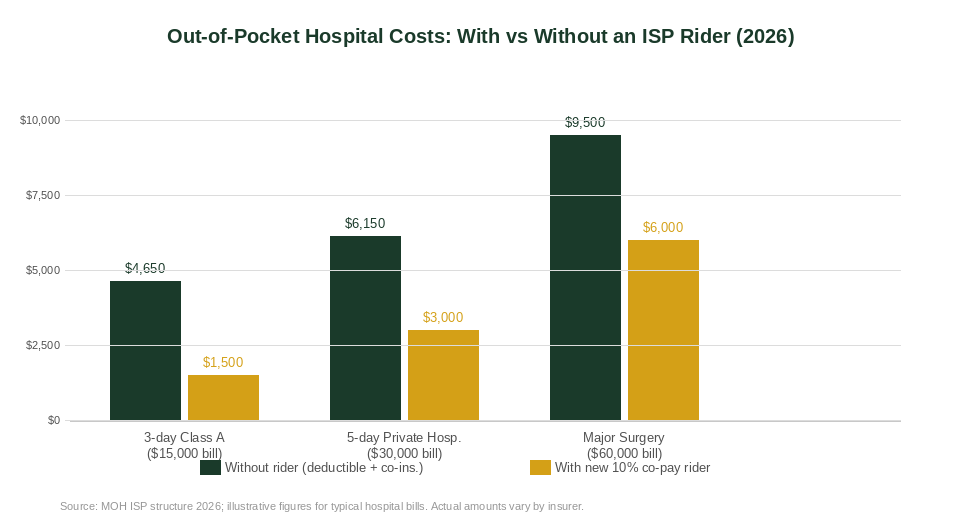
Figure 1: Illustrative out-of-pocket costs under three bill sizes, with and without an ISP rider. Source: MOH ISP co-payment structure 2026; TKN calculations.
Should You Get the New Co-Pay Rider Back?
The question most of the 112,000 are now asking: was dropping the rider the right call? The honest answer depends on two things — your age and how much your bill would need to exceed before the rider pays for itself.
The Break-Even Analysis
The new 10% co-pay rider costs roughly S$400–S$2,200 per year in additional premium, depending on your age and insurer (younger policyholders pay less; riders for people aged 60+ can exceed S$2,000/year). To break even on that premium, your hospital bill in a given year must be large enough that the 10% rider saves you more than the annual cost of holding it.
For a 35-year-old paying S$500/year for the rider: the rider saves you money on any bill above roughly S$5,000. Given that a standard appendectomy in a Class A ward can easily reach S$10,000–S$15,000, one hospitalisation a year justifies the premium for most working-age adults.
For a 60-year-old paying S$2,000/year: you need a bill above roughly S$20,000 before the rider pays off. That is a reasonable threshold for older adults who face higher hospitalisation risk — but those with a co-insurance cap on their ISP base plan should run the numbers carefully, as large bills may already be well-covered without a rider.
The “Self-Insurance” Alternative
Some Singaporeans who dropped their rider are treating the annual premium savings as a self-insurance pool — keeping the money in a liquid emergency fund and accepting the deductible and co-insurance risk themselves. This works if the person is in good health, has a high MediSave balance to cover the deductible, and is disciplined about building the fund. It is a legitimate strategy for lower-risk individuals, but it unravels quickly if hospitalisation happens before the fund is adequately built up.
For a detailed side-by-side comparison of all current ISP options, see our ISP rider guide for 2025–2026.
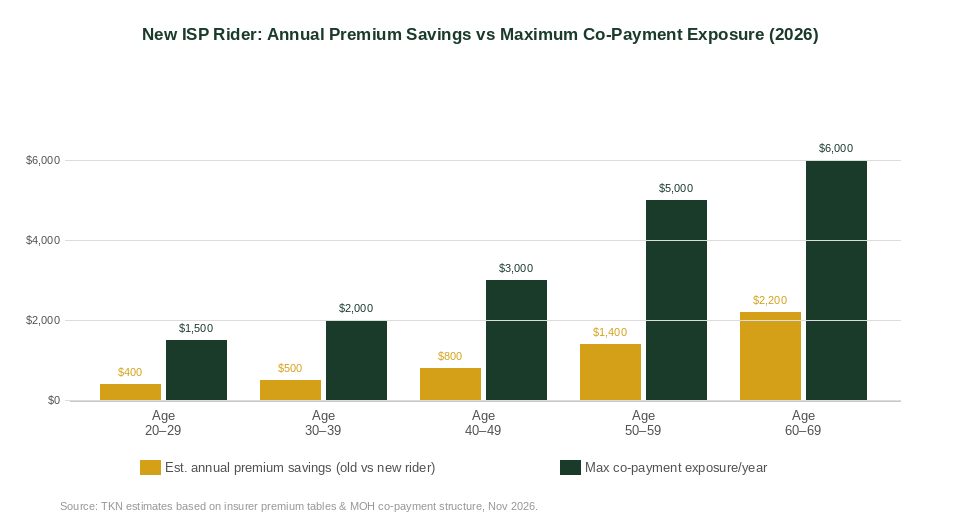
Figure 2: Estimated annual premium savings from switching to the new 10% co-pay rider vs maximum co-payment exposure per year, by age group. Source: TKN estimates based on insurer premium tables, Nov 2026.
What to Do If You Are Now Without a Rider
If you are among the 112,000 who dropped their optional rider, there are four practical steps worth taking now — before you need to use your plan.
1. Find out your ISP’s co-insurance cap
Call your insurer or log into your policy portal and ask for the annual co-insurance cap under your base ISP. As noted in Scenario 3, a S$3,000–S$6,000 annual cap dramatically limits your exposure on large bills. Knowing this figure lets you decide how large your self-insurance buffer needs to be.
2. Check how much you can withdraw from MediSave for the deductible
The MediSave Basic Hospitalisation Sum (BHS) and the Additional Withdrawal Limits (AWL) govern how much of your deductible and co-insurance MediSave can cover. For most Class A or private hospital stays, MediSave can cover the deductible in full — but it cannot cover co-insurance above certain thresholds. See the CPF Board’s MediSave hospitalisation withdrawal page for the current limits.
3. Consider adding the new 10% co-pay rider — if the premium is proportionate
Contact your insurer about adding the new co-pay rider. It is not available to all plans retroactively, but most major ISPs (AIA HealthShield Gold Max, NTUC Income Enhanced IncomeShield, Prudential PRUShield, Great Eastern GREAT SupremeHealth, HSBC Life Shield) have introduced compliant co-pay riders. Get a premium quote specific to your age and coverage tier before deciding.
4. Build a healthcare cash buffer
If you decide to stay without a rider, treat the worst-case out-of-pocket exposure (deductible + co-insurance cap = roughly S$6,500–S$8,500 for most Class A/private plans) as a floor for your emergency medical fund. Keep this accessible in a liquid account or Singapore Savings Bond, not locked in long-term investments. Use our retirement planning calculator to map how this buffer fits your overall financial picture.
Frequently Asked Questions
If I have an ISP with no rider, does my insurer still pay most of my hospital bill?
Can I add the new 10% co-pay rider back after dropping my old rider?
What happens to my old full rider (as-charged) that I still hold?
Is the S$3,500 deductible charged every hospitalisation or once per year?
Can I use MediSave to pay the deductible and co-insurance if I have no rider?
How do the out-of-pocket costs for no-rider compare across the five ISP insurers?
Know What You Are Covered For
With 112,000 Singaporeans now holding ISPs without a rider, understanding your deductible and co-insurance exposure is more important than ever. If you are unsure whether to add a rider back — or which ISP to hold going into 2027 — start with a clear comparison of your current plan.
Get Free Insurance Advice
Speak with a licensed insurance advisor. No obligation, no cost.
By submitting this form, you agree to our Privacy Policy.
This article was researched with the help of AI. While we strive to keep all information accurate and up to date, there may be errors. If you notice any discrepancies, please contact us.