Medisave Limit 2026: What MOH’s Over-Servicing Warning Means for Your ISP Bill
How the April 2026 IP rider rules are designed to cut unnecessary hospital bills — and what policyholders need to watch out for.
Singapore’s Medisave limit for 2026 sits at $79,000 — the Basic Healthcare Sum that caps how much you can hold in your Medisave account before excess flows to your Special Account. But the more important number this year is $6,000: the new minimum co-payment cap on IP riders, nearly double the old $3,000 ceiling. MOH raised this threshold specifically to curb over-servicing — the practice of ordering tests, procedures and admissions that may not be medically necessary when patients are fully insured.
Not financial advice. All figures are for educational reference only. Data as at November 2026 unless noted.
Table of Contents
Contents — Click to expand
- What Is Over-Servicing and Why MOH Is Concerned
- The April 2026 IP Rider Rules: What Changed
- Co-Payment and Deductibles at a Glance
- What 182,000 Policyholders Tell Us About ISP Trends
- How the New Rules Affect Your Hospital Bill
- What to Do If You Are on a Legacy Rider
- Medisave Limit 2026: How BHS Fits In
- Frequently Asked Questions
What Is Over-Servicing and Why MOH Is Concerned
In a September 2026 parliamentary sitting, MOH was asked about the intended reduction in over-servicing that the new IP rider rules were designed to achieve. Its answer was telling: it is too early to measure the full effect, but the concern is real and structural.
MOH’s formal position is that minimal co-payment creates “a greater tendency for over-servicing by healthcare providers” alongside “a higher risk of over-consumption of healthcare services by patients.” In plain terms: when a patient pays nothing out-of-pocket — because a rider covers everything after Medisave — neither the patient nor the doctor faces a financial incentive to question whether a test, a procedure or an admission is strictly necessary.
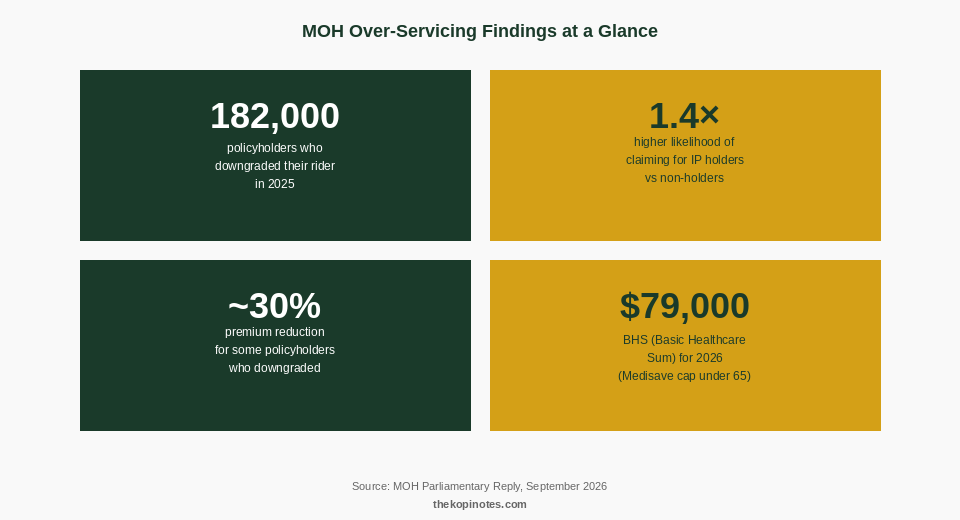
This is not a small problem. MOH’s data shows that private hospital IP policyholders with riders are 1.4 times as likely to make a claim as those without riders, and their average claim size is also 1.4 times larger. The difference is not fully explained by health status — it reflects how coverage shapes behaviour on both sides of the consultation table.
Raising the co-payment cap forces policyholders to have genuine skin in the game, so they are more likely to ask “do I actually need this admission?” rather than defaulting to the most comprehensive (and often the most expensive) care pathway available. For policyholders used to having 100% coverage via legacy “as charged” riders, this represents a significant shift in both mindset and financial exposure.
MOH’s concern about cost escalation is long-standing. Private hospital bills have risen substantially over the past decade, partly driven by the dynamics that full insurance coverage creates. The April 2026 changes are the most direct structural intervention yet, targeting the financial incentives rather than trying to regulate individual clinical decisions.
The April 2026 IP Rider Rules: What Changed
From 1 April 2026, all new IP riders sold in Singapore must comply with stricter co-payment requirements. The rules apply to riders sold from that date onwards. Riders sold before 27 November 2025 remain on their old terms for now, with individual insurers deciding their own transition approach for existing policyholders.
The two key changes — announced by MOH on 26 November 2025 — are as follows.
First, a minimum 5% co-payment on eligible claims is now required. This was already embedded in the basic MediShield Life structure, but new riders can no longer cap the policyholder’s co-payment at zero. The patient must bear at least 5% of the remaining bill after the deductible is paid.
Second, the co-payment cap is raised to a minimum of $6,000 per policy year, up from $3,000, which had been in place since 2018. The cap applies to panel or pre-authorised claims. For non-panel care or treatments that are not pre-authorised, policyholders may face higher out-of-pocket costs beyond the cap.
Critically, new riders also cannot cover the minimum IP deductible. This is a fixed annual amount paid once per year before the insurer’s coverage kicks in. Some of this can be paid using Medisave, subject to withdrawal limits, which limits the actual cash exposure for many policyholders.
Taken together, these changes mean that a new IP rider is no longer a tool for achieving zero out-of-pocket hospitalisation costs. It remains valuable coverage — particularly for catastrophic bills — but policyholders are now expected to contribute meaningfully to routine and elective procedures.
Co-Payment and Deductibles at a Glance
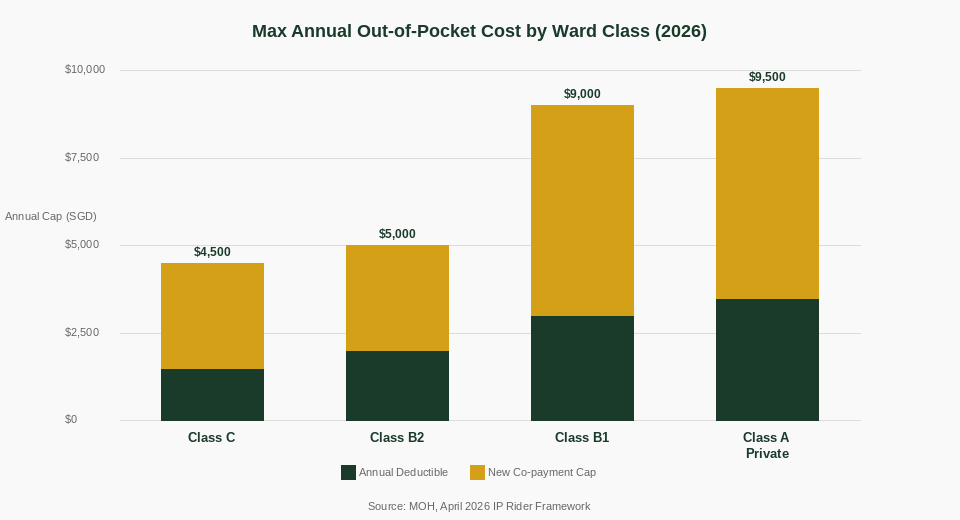
The table below summarises the annual deductibles by ward class, effective for new IP riders sold from 1 April 2026 (Source: MOH press release, 26 November 2025).
| Ward Class | Minimum Deductible (per year) | Co-payment Cap (per year) |
|---|---|---|
| Class A / Private Hospital | $3,500 | $6,000 (panel / pre-authorised) |
| Class B1 | $2,500 | $6,000 (panel / pre-authorised) |
| Class B2 | $2,000 | $6,000 (panel / pre-authorised) |
| Class C | $1,500 | $6,000 (panel / pre-authorised) |
| Day Surgery / Short-stay (non-subsidised) | $2,000 | $6,000 (panel / pre-authorised) |
Source: MOH press release, 26 November 2025. The ward class actually used determines the deductible, regardless of the class you are entitled to.
For a Class A or private hospital patient, the maximum annual out-of-pocket is now $3,500 (deductible) + $6,000 (co-payment cap) = $9,500 per year, compared to essentially zero under legacy “as charged” riders. This is the skin-in-the-game element MOH intended to introduce to reduce over-servicing.
The good news: Medisave can cover both the deductible and the 5% co-payment on eligible claims, within the annual withdrawal limits. If your Medisave is at or near the BHS of $79,000 for 2026, you likely have more than enough in reserve to cover these costs without touching your cash savings.
What 182,000 Policyholders Tell Us About ISP Trends
Before the new riders launched on 1 April 2026, approximately 182,000 policyholders in Singapore chose to downgrade or cancel their IP riders during 2025, according to MOH’s parliamentary response in September 2026. This is a significant signal about how policyholders weighed the value of maximum coverage against rising premiums.
The calculus is straightforward. New compliant riders for private hospitals cost on average 30% less than legacy riders with maximum coverage. That translates to roughly $600 per year in premium savings for the average private hospital rider policyholder, or about $200 per year for public hospital rider holders.
MOH notes it is “too early to assess trends” in policyholder movements since 1 April 2026, partly because the full ecosystem impact will take longer to materialise if only a minority of policyholders are on new, compliant riders. The 182,000 who already switched before the cutoff suggest price-sensitivity is real — especially for older policyholders whose annual premiums can run several thousand dollars.
For those who stayed on legacy riders, the question is how long insurers will continue to offer them. Even if your insurer has not yet set a transition timeline, it is worth reviewing your existing ISP and rider checklist before renewal — particularly the balance between premium cost, panel network coverage, and the actual financial risk you face in a hospitalisation year.
How the New Rules Affect Your Hospital Bill
MOH published two illustrative case examples (based on median 2024 private hospital bills) to show policyholders what the new co-payment structure means in practice.
| Mr A (Age 60) | Mrs B (Age 40) | |
|---|---|---|
| Procedure | Knee replacement | ACL reconstruction |
| Total bill | $56,900 | $38,700 |
| Deductible | $3,500 | $3,500 |
| 5% co-payment | $2,670 | $1,760 |
| Total out-of-pocket | $6,170 | $5,260 |
| Medisave covers | $6,170 (all) | $3,900 |
| Cash out-of-pocket | $0 | $1,360 |
Source: MOH press release, 26 November 2025. Based on median private hospital bills from 2024. Individual bills vary significantly. Co-payment calculated as 5% of bill after deductible (e.g. Mr A: ($56,900 — $3,500) × 5% = $2,670).
Two key takeaways from these examples. First, Medisave can absorb a significant portion of the new out-of-pocket costs — particularly for older policyholders whose accounts are closer to the $79,000 BHS. Mr A’s entire $6,170 out-of-pocket was covered by Medisave, leaving zero cash exposure despite moving off a legacy “as charged” rider.
Second, the actual cash exposure for most claims is manageable when compared against premium savings. MOH’s data suggests an average 60-year-old has day surgery or a hospitalisation about twice over the next 10 years. At $6,170 per episode (worst-case Class A/Private), that is $12,340 in potential out-of-pocket costs over a decade — against roughly $4,800 in cumulative premium savings over just three years at $1,600/year savings for a 60-year-old who switched riders.
For planning purposes, the Singapore retirement calculator can help you model Medisave drawdown alongside hospital cost scenarios across different age bands.
What to Do If You Are on a Legacy Rider
If you bought your IP rider before 27 November 2025, you are on a legacy rider. You are not currently required to transition, and your existing coverage continues at renewal as long as your insurer does not make changes. Individual insurers will decide their own approach to legacy policyholders, which may at some point include a voluntary transition offer.
If you bought between 27 November 2025 and 31 March 2026, you fall into a specific transition group. MOH requires you to switch to a compliant rider by your next policy renewal no later than from April 2028. Your insurer should have notified you of this requirement at the point of purchase.
Policyholders who actively chose to drop their rider entirely in 2025 made a different calculation — accepting full out-of-pocket exposure in exchange for eliminating rider premiums entirely. For young, healthy individuals with strong Medisave balances and limited family medical history, this may be rational. For older policyholders or those with known health conditions, maintaining some form of rider coverage continues to make sense.
The key action item for 2026: review your rider at renewal. Ask your insurer whether a compliant rider is available, what the premium comparison looks like, and whether your preferred panel doctor network is preserved. The CPF investment strategy for your Medisave also bears revisiting at this stage — a higher Medisave balance gives you more capacity to absorb the new deductibles and co-payments without touching cash savings. Our CPF investment strategy guide covers how to optimise your CPF balances for healthcare and retirement.
Medisave Limit 2026: How BHS Fits In
The Basic Healthcare Sum for 2026 is $79,000. This is the maximum balance CPF members can hold in their Medisave account. When your Medisave exceeds this, any excess contributions are redirected to your Special Account (if you are under 55) or Retirement Account. The BHS is revised upward each year to reflect long-run medical cost inflation — it was $75,500 in 2025 and $71,500 in 2024, rising roughly $3,500–4,000 per year.
Under the new IP rider rules, Medisave can be used to pay:
- The minimum IP deductible (the fixed annual amount paid before coverage applies)
- The 5% co-payment on eligible claims (panel or pre-authorised)
- IP rider premiums themselves (within the Additional Withdrawal Limit applicable to your age band)
The practical implication: a Medisave account at or near $79,000 provides substantial protection against the new out-of-pocket exposure under compliant riders. As the MOH case example shows, a 60-year-old facing a $56,900 knee replacement paid $6,170 in total out-of-pocket — all of which was covered by Medisave, with zero cash outlay.
For younger policyholders whose Medisave balances are still building, the annual mandatory contributions continue to accumulate toward that buffer. The BHS increase from $71,500 (2024) to $79,000 (2026) tracks broadly with how ISP premiums and healthcare costs are also rising, so the two are designed to move in tandem over time.
Keeping non-CPF savings in a high-yield account while your Medisave compounds is a complementary approach. High-yield savings accounts such as Trust Bank (available via Trust Bank referral code HTWYQP95) and GXS Bank (available via GXS referral code YONG477) offer rates above 2% on everyday savings, which can help build a cash reserve to cover the co-payment portion that Medisave does not absorb in a given year.
Frequently Asked Questions
What is over-servicing in the context of Integrated Shield Plans?
What is the Medisave limit (BHS) for 2026?
What is the new co-payment cap under IP riders from April 2026?
Do I need to switch from my legacy IP rider?
Can Medisave cover the new deductibles and co-payments?
How much cheaper are new compliant IP riders compared to legacy ones?
What happens if I see a non-panel doctor under a new IP rider?
Offset Rising ISP Premiums With Higher Savings Returns
If your IP rider premiums are increasing, one practical offset is earning more on your everyday cash savings. High-yield savings accounts let your money work harder while you hold reserves for Medisave top-ups or co-payment expenses.
Get Free Insurance Advice
Speak with a licensed insurance advisor. No obligation, no cost.
By submitting this form, you agree to our Privacy Policy.
This article was researched with the help of AI. While we strive to keep all information accurate and up to date, there may be errors. If you notice any discrepancies, please contact us.