MediSave Limit 2026: 7 Months Into the New Rider Rules — Your Year-End Action Plan
S$79,000 BHS limit, S$6,000 co-pay cap, April 2026 rules — here is what to do before December 31.
Seven months have passed since April 1, 2026, when MOH’s new Integrated Shield Plan rider rules took effect. The MediSave Basic Healthcare Sum stands at S$79,000 for 2026. New riders now carry a mandatory minimum 5% co-payment and an annual cap of S$6,000. With year-end approaching, Singaporeans on old riders, new riders, and those who cancelled their cover entirely all face different decisions before December 31.
Not financial advice. All figures are for educational reference only. Data verified as at 4 November 2026.
In This Guide
- April 2026 ISP Rider Changes: A One-Minute Recap
- How the New Rules Interact with the S$79,000 MediSave Limit
- If You Are Still on Your Old Rider
- If You Switched to the New Co-Payment Rider
- If You Cancelled Your Rider in 2026
- Year-End Checklist: 5 Decisions Before December 31
- Real Bill Examples: Old vs New vs No Rider
- Frequently Asked Questions
April 2026 ISP Rider Changes: A One-Minute Recap
If you have been following the full Integrated Shield Plan 2026 guide, you already know the basics. Here is the condensed version for anyone coming in fresh.
MOH introduced sweeping changes to ISP riders with effect from April 1, 2026. The two most significant changes are: (1) all new riders must require policyholders to co-pay at least 5% of their bill, and (2) new riders are no longer permitted to cover the MOH-mandated minimum deductibles. The annual co-payment cap was also raised from S$3,000 to S$6,000 per policy year.
| Rule | Before April 2026 (Old Rider) | From April 2026 (New Rider) |
|---|---|---|
| Co-payment | Optional (many plans: 0%) | Minimum 5% mandatory |
| Annual co-pay cap | S$3,000 (since 2018) | S$6,000 |
| Deductible coverage | Rider could pay deductible | Cannot cover MOH minimum deductibles |
| Premium cost | Higher (full or near-full coverage) | ~30% lower on average |
| Transition deadline | — | First renewal after April 1, 2028 |
Source: Ministry of Health Singapore, April 2026. Data verified as at 4 November 2026.
Critically, the old rider rules did not disappear overnight. If you bought your rider before April 1, 2026, your insurer can continue selling it to you on the same terms until your first renewal after April 1, 2028. After that point, all riders must comply with the new rules. The ISP legacy rider transition timeline to 2028 covers the full picture of that two-year window, including what your insurer is required to do before the changeover.
How the New Rules Interact with the S$79,000 MediSave Limit
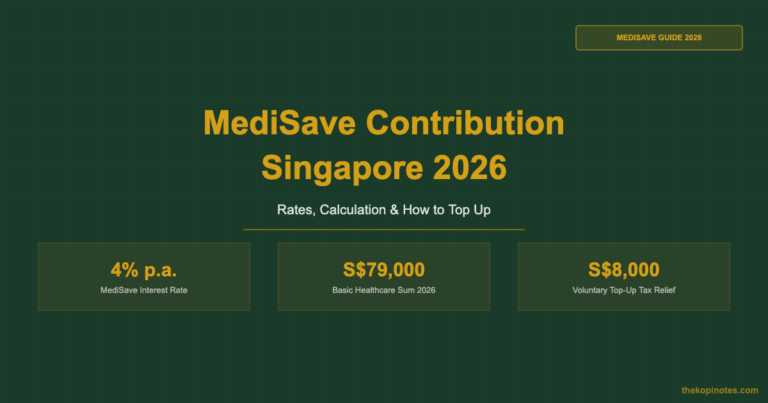
The MediSave Basic Healthcare Sum (BHS) for 2026 is S$79,000. This is the ceiling on how much you can hold in your MediSave Account; any excess is transferred to your CPF Special Account (or Retirement Account if you are 55 or older). What most people miss is that the BHS does not cap your ability to use MediSave for hospitalisation — it only caps what you can accumulate.
Under the new rider framework, MediSave can pay both the deductible and the co-payment, subject to CPF’s standard withdrawal limits per admission. This creates a meaningful buffer even for new rider holders who face the MOH minimum deductibles for the first time.
This also creates an important year-end planning angle: if your MediSave balance has been drawn down by hospitalisation costs in 2026, a voluntary top-up before December 31 not only replenishes your healthcare reserve — it also qualifies for personal income tax relief of up to S$8,000 per year (combined with the CPF cash top-up relief limit).
| Ward Class | MOH Minimum Deductible | Can MediSave Pay It? |
|---|---|---|
| Class A / Private Hospital | S$3,500 | Yes (up to withdrawal limits) |
| Class B1 | S$2,500 | Yes (up to withdrawal limits) |
| Class B2 | S$2,000 | Yes (up to withdrawal limits) |
| Class C | S$1,500 | Yes (up to withdrawal limits) |
| Day Surgery (non-subsidised) | S$2,000 | Yes (up to withdrawal limits) |
| Day Surgery (subsidised) | S$1,500 | Yes (up to withdrawal limits) |
Source: Ministry of Health Singapore, 2026. Deductibles apply per policy year for new ISP riders and cannot be covered by the rider itself.
If You Are Still on Your Old Rider
Good news: nothing changes for you today. If your rider was purchased before April 1, 2026, your insurer can continue renewing it on the same terms up to and including your first renewal after April 1, 2028. That means some policyholders whose annual renewal falls in March 2028 will effectively keep their old rider until March 2029.
That said, the year-end period is a good time to make a deliberate decision rather than drifting. The question is straightforward: do you switch early to the new rider and bank the ~30% premium saving now, or do you hold the old rider for as long as the rules allow?
The case for switching early is strongest if you are younger, in good health, have a low risk of hospitalisation, and primarily use subsidised (Class B2 or C) wards at public hospitals. For this group, the premium savings — averaging S$200 per year for public hospital riders — may outweigh the increased out-of-pocket exposure. Read how the 30% premium saving compares to the new co-payment risk before making that call.
The case for holding your old rider is strongest if you are over 50, planning an elective procedure in the next two years, prefer a private hospital, or simply value the certainty of full coverage above the deductible. A single major surgery — a hip replacement, cardiac procedure, or cancer treatment — can produce a bill of S$50,000 to S$150,000. Under the old rider, your out-of-pocket cost above the deductible is zero. Under the new rider, the first 5% of everything after the deductible is yours, up to S$6,000 per policy year.
Whatever you decide, do not let the transition happen passively. Contact your insurer before your renewal date and confirm in writing whether your policy is being renewed as an old-format or new-format rider.
If You Switched to the New Co-Payment Rider
If you bought or renewed into a new rider after April 1, 2026, you are living with the new rules already. Here are the year-end angles that matter most.
Has your policy-year deductible already been met? This is the most actionable question. If you were hospitalised earlier in 2026 and already paid your full deductible (S$3,500 for Class A or private, S$2,500 for B1), any further hospitalisation before your policy year resets will cost you only the 5% co-payment on each additional dollar. That changes the economics of elective procedures substantially. The November and December hospital planning guide covers exactly how to time elective admissions around your policy year reset date.
Your maximum out-of-pocket is S$6,000 per policy year. Once your combined deductible and 5% co-payments reach S$6,000, the rider covers 100% of further bills for the remainder of that policy year. Here is a worked example for a 60-year-old in a private hospital:
- Total bill: S$56,900 (knee replacement procedure)
- MOH minimum deductible: S$3,500 (Class A / Private)
- Remaining bill after deductible: S$53,400
- 5% co-payment: S$2,670
- Total out-of-pocket: S$6,170 — just above the annual cap; the final S$170 above the cap is covered by the rider
Read the full new ISP rider co-payment breakdown for the complete mechanics, including how MediSave withdrawal limits apply at the admission level and how to calculate your effective out-of-pocket in advance.
MediSave can pay both the deductible and the co-payment. You are not required to pay these from cash. As long as your MediSave balance is sufficient and your admission falls within CPF’s withdrawal limits for that ward class, MediSave covers both items. Keep this in mind for year-end financial planning — particularly if you are considering a voluntary MediSave top-up before December 31 to replenish what was drawn down this year.
If You Cancelled Your Rider in 2026
You are not alone. MOH’s October 2026 data show that the 181,800 Singaporeans who dropped their ISP rider since the new rules came into force represent a substantial shift in how Singaporeans are thinking about healthcare cost-sharing. Many cancelled to avoid higher out-of-pocket exposure from the new rider rules, reasoning that MediShield Life and MediSave together provide adequate cover.
Without a rider, your hospitalisation coverage comes from two sources: MediShield Life and your own MediSave or cash. MediShield Life is mandatory and provides a meaningful safety net for Class B2 and C ward stays at public hospitals. For Class A wards or private hospitals, MediShield Life pays only a fixed daily rate — well below what a private bill typically runs — and you absorb the balance.
The key year-end question is whether your hospitalization risk profile has changed in the last seven months. If you have remained healthy, have adequate MediSave reserves, and use public subsidised wards as a default, the financial exposure is manageable. If your health or circumstances have shifted — a new diagnosis, an upcoming procedure, or a change in preferred ward class — the year-end is a good time to revisit.
Reinstatement windows vary by insurer. Some allow policyholders to reinstate within 30 to 90 days of cancellation without fresh medical underwriting; others treat reinstatement as a new application, which means full underwriting and potential exclusions for pre-existing conditions. Contact your insurer directly to check your specific situation — do not assume the reinstatement window is still open.
Year-End Checklist: 5 Decisions Before December 31
Work through these in order. Each is a 15-minute task that can meaningfully affect your healthcare cost exposure in 2027.
- Confirm your rider status. Log in to your insurer’s portal or call the hotline. Confirm whether your current rider is old-format or new-format, and when your next renewal date falls. This one step resolves most confusion and is the foundation for every other decision below.
- Check your policy-year deductible status. If you are on a new rider and had any hospitalisation this year, ask your insurer how much of your deductible has already been met. If it is fully met, elective procedures before your policy year resets may cost you only the 5% co-pay — a significant saving on planned treatments.
- Review your MediSave balance against the S$79,000 BHS. Log in to CPF Online Services. If your balance has been drawn down by hospitalisation this year, consider a voluntary top-up before December 31. MediSave top-ups qualify for personal income tax relief of up to S$8,000 per year (combined with the CPF cash top-up relief limit).
- Old rider holders: decide on early transition. If your renewal falls between January and March 2027, you have a decision window now. Switching early locks in the lower premium immediately. Waiting preserves full zero-co-pay coverage until your 2028 deadline. Neither is objectively right — it depends on your age, health, and risk tolerance.
- No rider: assess reinstatement eligibility. If you cancelled in the last 90 days and your health is unchanged, check whether your insurer still allows reinstatement without fresh underwriting. If the window has closed, factor a new application — and possible exclusions for pre-existing conditions — into your 2027 healthcare planning.
Real Bill Examples: Old vs New vs No Rider
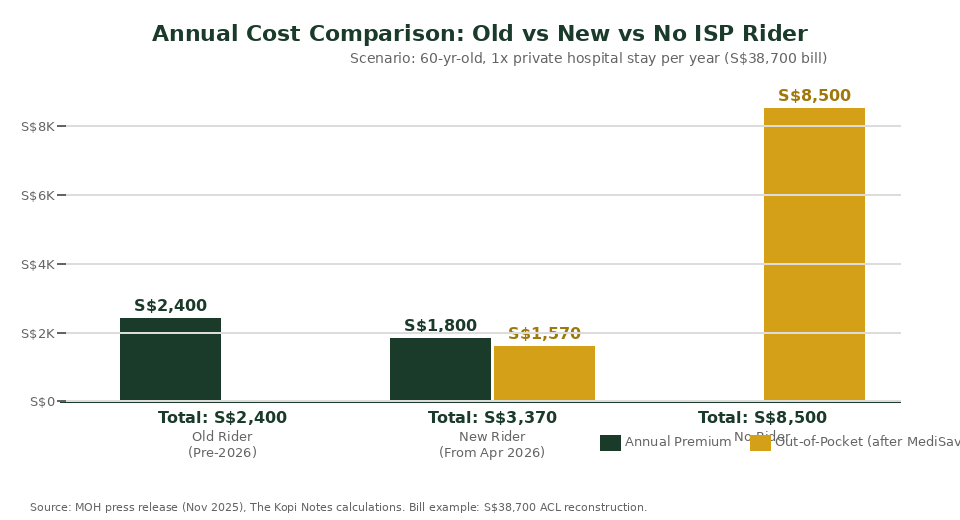
To make the numbers concrete, the chart below compares out-of-pocket costs for a 60-year-old in a private hospital undergoing a S$38,700 ACL reconstruction — a common elective orthopaedic procedure. Three scenarios are shown: holding the old rider, switching to the new co-payment rider, and having no rider at all.
Source: MOH minimum deductible schedule 2026; hypothetical private hospital ACL reconstruction scenario. For illustration only. Data verified as at 4 November 2026.
The difference is not trivial. On the old rider, out-of-pocket cost for this procedure is essentially zero beyond any amount the rider itself covers. On the new rider, the out-of-pocket is the deductible (S$3,500 for Class A / Private) plus 5% of the remaining bill (S$35,200) = approximately S$5,260. Without any rider, MediShield Life pays a small portion at fixed daily rates, and the policyholder absorbs the rest — potentially S$30,000 or more for a bill of this size at a private hospital.
MOH Minimum Deductibles: Quick Reference Chart
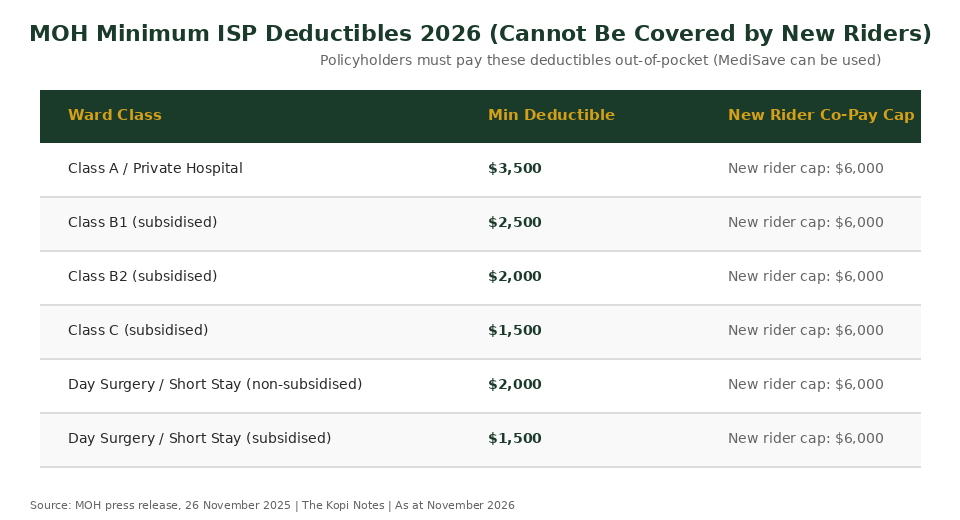
The chart below shows the MOH-mandated minimum deductibles by ward class. These are the amounts new rider holders must pay first, before their rider begins covering the remaining bill. Deductibles apply per policy year, not per admission.
Source: Ministry of Health Singapore, 2026.
Key point: the deductible is paid once per policy year. If you are admitted multiple times in the same policy year, only the first admission counts toward the deductible. All subsequent admissions in that policy year attract only the 5% co-payment, up to the S$6,000 annual cap. This makes the new rider considerably more manageable for anyone with multiple admissions in a single policy year.
Frequently Asked Questions
What is the MediSave limit in 2026?
The MediSave Basic Healthcare Sum (BHS) for 2026 is S$79,000. This is the maximum balance you can hold in your MediSave Account. Any contributions above this ceiling are redirected to your CPF Special Account (or Retirement Account if you are 55 or older). The BHS does not limit how much you can withdraw from MediSave for hospitalisation costs.
Can I use MediSave to pay the deductible under the new ISP rider?
Yes. Even though new ISP riders cannot cover the MOH minimum deductible themselves, you can still pay the deductible using your MediSave balance. The same applies to the 5% co-payment. Both are subject to CPF’s standard MediSave withdrawal limits, which vary by ward class and procedure type.
What happens to my old ISP rider after April 2028?
Old ISP riders (purchased before April 1, 2026) can continue to be renewed on old terms until your first policy renewal after April 1, 2028. After that renewal, your rider must be converted to a new-format rider with the minimum 5% co-payment and no deductible coverage. Your insurer is required to notify you before the transition. If your renewal falls in, say, March 2028, you may effectively keep the old rider until early 2029.
How much cheaper is the new ISP rider compared to the old one?
On average, new co-payment riders are approximately 30% cheaper in annual premium. The actual saving varies by insurer and age band. For private hospital riders, the saving averages around S$600 per year. For public hospital riders, it averages around S$200 per year. These savings should be weighed against the higher out-of-pocket exposure from the deductible and 5% co-pay when you do need hospitalisation.
If I cancelled my ISP rider in 2026, can I get it back?
It depends on your insurer and how long ago you cancelled. Some insurers offer a reinstatement window — typically 30 to 90 days after cancellation — during which you can reinstate without fresh medical underwriting. Outside that window, reinstatement typically requires a new application with full underwriting, and pre-existing conditions may be excluded. Contact your insurer directly to check your specific eligibility.
What is the maximum I will pay out-of-pocket with the new ISP rider?
The annual co-payment cap is S$6,000 per policy year. Your total out-of-pocket cost (deductible plus 5% co-payments) cannot exceed S$6,000 in any single policy year. Once you reach this cap, your rider covers 100% of further bills for the rest of that policy year. The deductible counts toward the S$6,000 cap — so a Class A policyholder with a S$3,500 deductible can only be charged an additional S$2,500 in co-payments before the cap kicks in.
Does the S$6,000 co-payment cap reset each year?
Yes. The S$6,000 annual co-payment cap resets at the start of each policy year — not each calendar year. If your policy year starts in January, the cap resets every January 1. If your policy started in April (the month the new rider rules took effect), it resets every April 1. Check your policy document or insurer portal for your exact policy year start date, as this directly affects how you plan hospitalisation timing.
This article is for general educational purposes only and does not constitute financial, insurance, or medical advice. ISP rules and benefits vary by insurer and policy. Always consult your insurer or a licensed financial adviser before making changes to your insurance coverage. Data verified as at 4 November 2026.
Get Free Insurance Advice
Speak with a licensed insurance advisor. No obligation, no cost.
By submitting this form, you agree to our Privacy Policy.
This article was researched with the help of AI. While we strive to keep all information accurate and up to date, there may be errors. If you notice any discrepancies, please contact us.