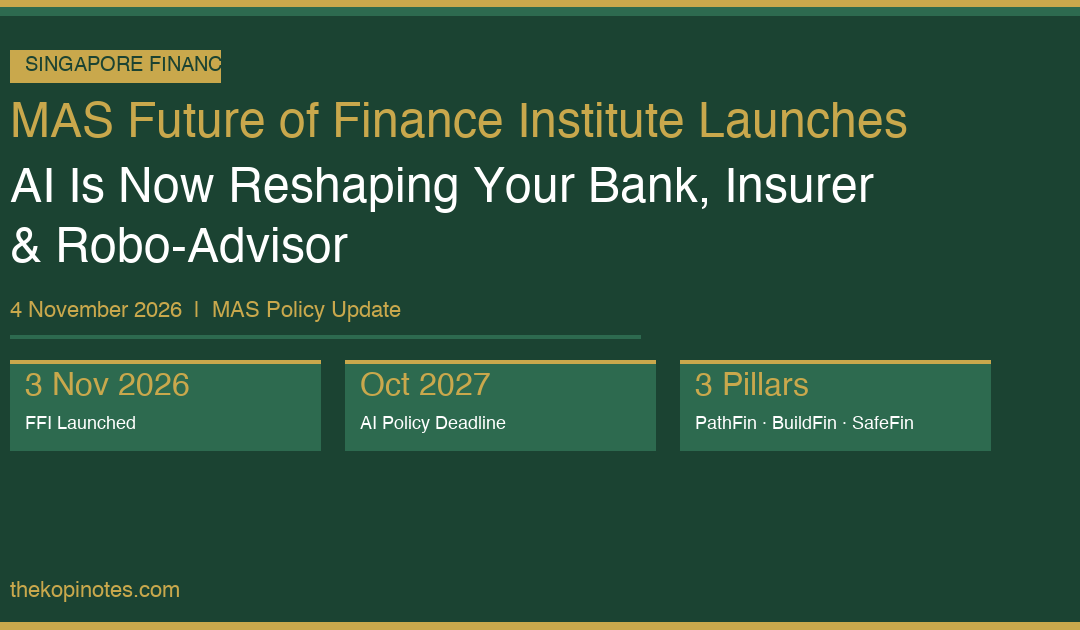
On 3 November 2026, the Monetary Authority of Singapore (MAS) officially launched the Future of Finance Institute (FFI) — a public-private platform designed to fast-track artificial intelligence adoption across Singapore’s entire financial sector. From the DBS app on your phone to the robo-advisor managing your CPF funds and the insurer pricing your Medishield Life top-up, AI is now being formally governed, standardised, and accelerated. For Singapore retail investors, this is a defining moment in how your money will be managed.
This is an editorial analysis. Not financial advice. Data verified as at 4 November 2026.
What Is the MAS Future of Finance Institute?
The Future of Finance Institute (FFI) is not a research lab tucked away in some corner of MAS headquarters. It is a full-fledged public-private platform — bringing together MAS regulators, Singapore’s major financial institutions, global technology firms, and research institutions — with a mandate to change how finance works at the operational level.
MAS first announced the FFI in June 2026 during the Singapore FinTech Festival build-up. After five months of groundwork, it formally commenced operations on 3 November 2026, with AI in finance as its first major focus area. Tokenisation of financial assets is set to follow progressively.
The interim CEO of FFI is Mr Alan Lim, who simultaneously serves as Head of MAS’s Financial Infrastructure and AI Office. That dual role is deliberate — it ensures tight coordination between FFI’s industry programs and MAS’s regulatory agenda. MAS Managing Director Mr Chia Der Jiun described FFI as “a public-private platform for MAS, financial institutions, technology firms and the research community.”
In plain terms: this is Singapore’s official vehicle for making AI in finance work safely and at scale — not just in pilot programmes, but across banking, insurance, capital markets, financial advisory, and payments.
The Three AI Pillars: PathFin.ai, BuildFin.ai, and SafeFin.ai
FFI’s AI work is organised around three distinct pillars, each targeting a different layer of the AI adoption challenge. Understanding these pillars matters for retail investors because they directly shape what AI tools your bank, robo-advisor, and insurer are allowed to use — and how safely.
PathFin.ai — Knowledge Sharing and Communities of Practice
PathFin.ai anchors a Knowledge Hub where financial institutions share practical experience from AI deployments that actually worked (and those that didn’t). FFI will establish Communities of Practice across five verticals: banking, insurance, capital markets, financial advisory, and payments. These are structured forums using industry exchanges, webinars, and site learning journeys — designed so that a mid-sized insurer can learn from DBS’s AI fraud detection without having to build the same capability from scratch.
For retail investors, this means your financial service providers will have faster access to proven AI use cases — shortening the gap between cutting-edge AI and what actually appears in your banking app or insurance portal.
BuildFin.ai — Capability Building and Industry Standards
BuildFin.ai is where FFI does the technical heavy lifting. Working with financial institutions, technology companies, and research bodies, it will develop AI guidance, good practices, shared tools, and industry standards — particularly for agentic AI, where AI systems take autonomous actions such as executing trades, filing claims, or rebalancing portfolios without a human clicking “confirm” at every step.
This pillar builds on the recently released SAFR framework (more on that below) and will also set up sandbox testing environments where institutions can trial AI agents in controlled conditions before deployment.
SafeFin.ai — Risk Management and Consumer Protection
SafeFin.ai is arguably the most important pillar for retail investors. It helps financial institutions implement MAS’s Guidelines on AI Risk Management (published October 2026, compliance deadlines from 2027) and enhances the MindForge AI Risk Management Toolkit. This includes use-case risk assessments, testing and assurance processes, and oversight of third-party AI vendors.
What SafeFin.ai means for you: when an AI agent inside your robo-advisor makes a recommendation, or when an AI pricing engine sets your insurance premium, there will be documented risk assessments, testing records, and audit trails behind that decision. This is Singapore moving from “AI is exciting” to “AI must be accountable.”
The SAFR Framework: Guardrails for AI Money Agents
Published on 3 July 2026, the SAFR (Safeguards for Agentic Finance) framework is the technical backbone underpinning FFI’s BuildFin.ai work. SAFR was developed collaboratively by MAS with leading financial institutions and FinTechs, and sets out governance checkpoints that an AI agent must pass before it can execute financial actions.
SAFR establishes four core safeguards:
- Policy-bound execution: AI agents operate only within predefined mandates approved by human managers or the institution’s risk committee. An AI cannot decide on its own to change your investment allocation beyond the boundaries you’ve set.
- Real-time validation: Proposed actions by AI agents are checked in real time against compliance rules, risk limits, and policy boundaries before execution — not after.
- Auditability: Every action taken by an AI agent is recorded, timestamped, and traceable. If something goes wrong, there is a full audit trail.
- Interoperability: SAFR is designed to work across different AI systems and institutions, so a customer’s data and permissions can move safely between platforms.
Three key use cases where SAFR applies are: agent-assisted payments and treasury operations; wealth management and advisory workflows; and client engagement (where AI agents draft materials within approved content boundaries). The third use case is particularly relevant to retail investors who receive AI-generated financial communications from their bank or robo-advisor.
MAS has opened a pathway for financial institutions and technology partners to join BuildFin.ai work groups to shape future iterations of SAFR — making this a living framework that will evolve alongside AI capabilities.
MAS AI Risk Management Guidelines: What Banks and Insurers Must Do
Separate from FFI but closely linked, MAS published its final Guidelines on AI Risk Management on 7 October 2026, following a public consultation that began in November 2025. These guidelines set binding supervisory expectations for all financial institutions operating in Singapore — covering both Generative AI and AI agents.
The guidelines are structured around four areas with a phased compliance timeline:
| Area | What It Requires | Compliance Deadline |
|---|---|---|
| 1. Board & Senior Management Oversight | Board-level accountability for AI use; approval of AI risk appetite | 7 October 2027 |
| 2. AI Risk Management Systems, Policies & Procedures | Documented policies, risk frameworks, escalation procedures | 7 October 2027 |
| 3. AI Life Cycle Controls | Governance from AI model development through deployment and retirement | 7 October 2028 |
| 4. AI Capability and Capacity | Staff training, internal expertise, vendor management | 7 October 2028 |
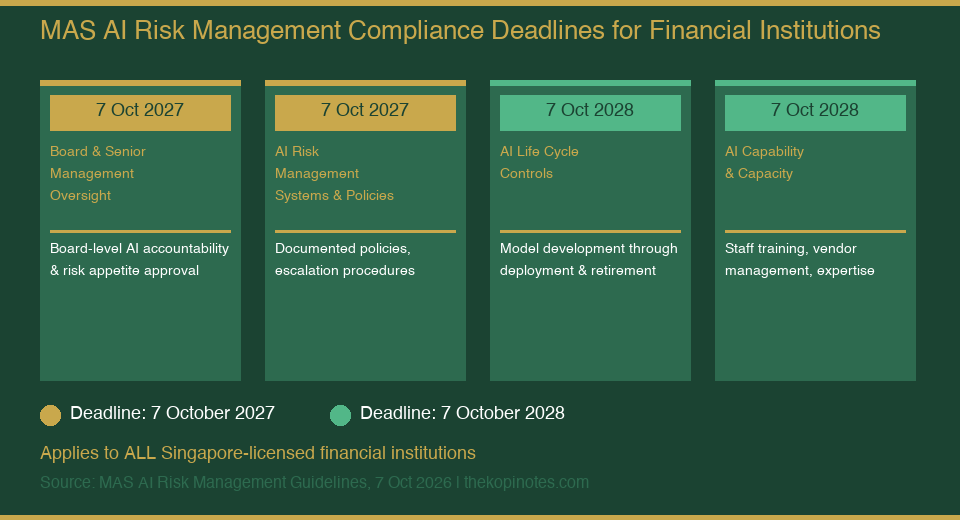
What this means in practice: by October 2027, every bank, insurer, and licensed financial adviser in Singapore must have documented policies governing how they use AI and board-level accountability for AI risk. By October 2028, the full AI lifecycle — from how models are trained to how they are retired — must be governed.
This is a material change. Many financial institutions in Singapore already use AI extensively — for fraud detection, credit scoring, claims processing, and customer service chatbots. The new guidelines require them to retroactively document, test, and govern these systems to MAS’s standards.
How This Directly Affects Singapore Retail Investors
You may be wondering: I’m just trying to invest my savings and plan for retirement. Why does this matter to me?
Here are five direct touchpoints where FFI’s AI agenda intersects with retail financial life in Singapore:
1. Your robo-advisor will operate under stronger guardrails. Platforms like Endowus, StashAway, Syfe, and Kristal.AI use algorithmic engines to manage client portfolios. Under SAFR and the AI Risk Management Guidelines, these platforms must implement policy-bound execution, real-time validation, and full audit trails for AI-driven rebalancing recommendations. This strengthens consumer protection for CPF OA and SRS investors. For more on comparing these platforms, see our guide to robo-advisors in Singapore.
2. AI agents may soon handle routine financial tasks on your behalf. Singapore banks are actively trialing AI agents that can automatically top up your SRS account, rebalance your portfolio, or renew your fixed deposit when rates move. FFI’s BuildFin.ai pillar will accelerate this development — but under strict SAFR safeguards. These agentic capabilities are likely to appear in banking apps over the next 12-24 months.
3. AI pricing in insurance will become more transparent. If your insurer uses AI to price your shield plan or life insurance premium, the new guidelines require that AI model’s risk assessment to be documented and tested. For consumers, this reduces the risk of opaque AI decisions that disadvantage policyholders. See our guide to Singapore digital banks and their AI-powered services.
4. CPF and SRS investment platforms will fall under tighter oversight. Platforms that handle CPF-OA and SRS investments — including CPFIS-approved unit trusts and robo-advisors — must comply with MAS’s AI Risk Management Guidelines. This adds a layer of safety to the funds many Singaporeans have earmarked for retirement. For CPF investment strategies, see our comprehensive CPF Investment Strategy guide.
5. Your financial data may be used in Communities of Practice. FFI’s PathFin.ai pillar will enable financial institutions to share aggregated, anonymised data about AI deployment outcomes. While this is a positive development for industry learning, retail investors should understand that the data informing these community learnings comes from their own financial behaviours.
Singapore’s AI Finance Ambitions: The Bigger Picture
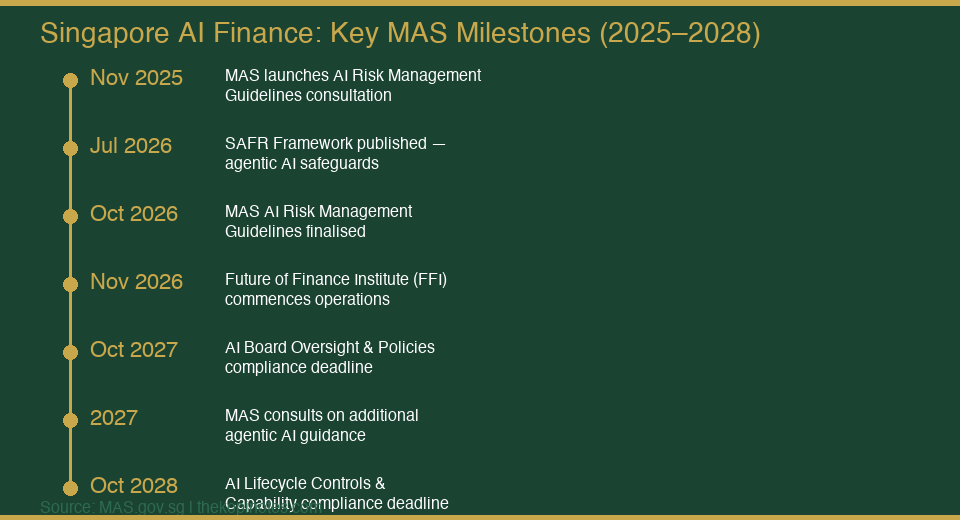
FFI does not exist in a vacuum. Singapore has been methodically building an AI governance infrastructure for financial services over the past three years. The launch of FFI is the capstone of this effort — bringing together the regulatory (MAS AI Guidelines), the technical (SAFR framework), and the institutional (FFI itself) into a single coordinated programme.
This positions Singapore to export AI financial governance standards to the region. ASEAN financial regulators often look to Singapore as a template, and the SAFR framework’s interoperability requirement is explicitly designed for cross-border compatibility. For Singapore-listed companies and S-REITs operating across ASEAN — and for the Singapore investors holding them — this regulatory leadership can translate into a competitive advantage for Singapore-domiciled financial services. See our guide to the best S-REITs in Singapore 2026 for context on how Singapore’s regulatory credibility supports the REIT sector.
The upcoming expansion into tokenisation under FFI’s mandate will be the next significant development to watch. Singapore has been a leader in tokenised asset pilots (Project Guardian, among others), and FFI’s formal role will likely accelerate the timeline for retail investor access to tokenised bonds, REITs, and other digital securities. For investors interested in Singapore ETFs and digital assets, our Singapore REIT ETF Guide covers the current landscape.
Bottom Line for SG Investors
The launch of the MAS Future of Finance Institute on 3 November 2026 is not a headline to skip past. It represents a structural shift in how AI will operate inside every financial institution serving Singapore retail investors — from the robo-advisor managing your CPF savings to the digital bank paying out your dividends to the insurer pricing your hospitalization coverage.
The timeline is clear: AI governance frameworks must be in place at all Singapore financial institutions by October 2027 (policies and board oversight) and October 2028 (full lifecycle controls). Within the next 12-24 months, retail investors should expect to see AI agents with documented safeguards appearing in their banking and investment apps. The SAFR framework ensures these agents operate within approved boundaries with full audit trails.
Three things Singapore retail investors should do now:
- Ask your financial platform about its AI Risk Management compliance roadmap — any MAS-licensed platform should have one.
- Review your CPF and SRS investment allocations to ensure your robo-advisor or fund manager is MAS-licensed and therefore subject to these new guidelines. See our Retirement Planning Guide for a framework.
- Monitor FFI announcements over the next 6-12 months for updates on tokenised assets — this could open new investment opportunities previously unavailable to retail investors.
Singapore’s financial future is being built now. The FFI is the blueprint.
Frequently Asked Questions (FAQ)
What is the MAS Future of Finance Institute (FFI)?
The FFI is a public-private platform launched by the Monetary Authority of Singapore on 3 November 2026. It brings together MAS, financial institutions, technology firms, and research bodies to accelerate AI adoption in Singapore’s financial sector. Its first focus is AI in finance, with tokenisation to follow.
How does FFI affect Singapore retail investors?
FFI directly affects the AI tools and safeguards used by your bank, robo-advisor, and insurer. Through its SafeFin.ai pillar, it strengthens consumer protections by requiring documented risk assessments and audit trails for AI-driven financial decisions — from portfolio rebalancing to insurance pricing.
What is the SAFR framework and why does it matter?
SAFR (Safeguards for Agentic Finance) is a MAS-developed governance framework published on 3 July 2026. It sets four mandatory safeguards for AI agents operating in finance: policy-bound execution, real-time validation, auditability, and interoperability. It ensures AI agents cannot take unsanctioned financial actions on your behalf.
When must Singapore banks comply with MAS AI Risk Management Guidelines?
MAS published its AI Risk Management Guidelines on 7 October 2026. Financial institutions must comply with board oversight and risk management policy requirements by 7 October 2027, and full AI lifecycle controls by 7 October 2028.
Will AI agents start managing my CPF and investment accounts?
AI agents are already being used in advisory workflows at some platforms. Under FFI’s BuildFin.ai pillar and the SAFR framework, more automated agentic capabilities — like automatic SRS top-ups or portfolio rebalancing — are expected to emerge over the next 12-24 months, but only within strict, MAS-approved safeguards.
What is tokenisation and how does FFI relate to it?
Tokenisation refers to representing real-world assets (bonds, REITs, property) as digital tokens on a blockchain. FFI will progressively expand its mandate to cover tokenisation after its initial AI focus, potentially opening new retail investment options in tokenised financial products. MAS has previously run Project Guardian pilots in this space.
Who leads the Future of Finance Institute?
FFI’s interim CEO is Mr Alan Lim, who also serves as Head of MAS’s Financial Infrastructure and AI Office. MAS Managing Director Mr Chia Der Jiun oversees the broader strategic direction of the institution.
How does Singapore’s FFI compare with AI finance initiatives in other countries?
Singapore’s FFI is notable for being one of the first formal public-private institutions specifically designed to govern and accelerate AI in finance at a national level. Other jurisdictions (UK, EU) have AI governance frameworks, but few have created a dedicated operational institute to coordinate knowledge sharing, capability building, and risk management simultaneously.
This article was researched with the help of AI. While we strive to keep all information accurate and up to date, there may be errors. If you notice any discrepancies, please contact us.