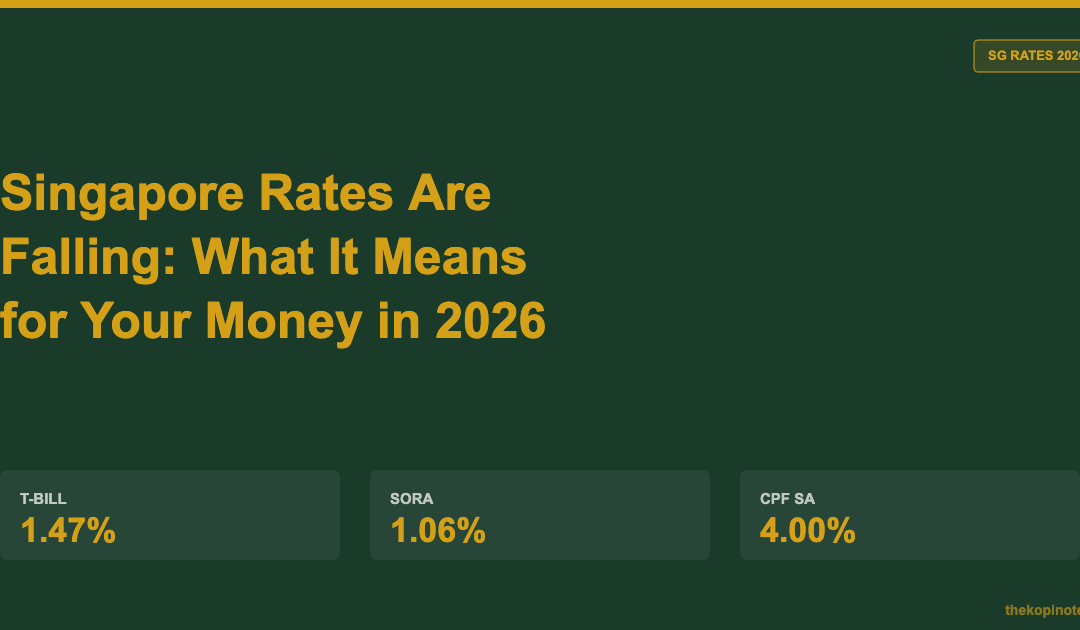
Singapore’s risk-free rates have collapsed. The 6-month T-bill cut off at just 1.47% on 23 June 2026, down from nearly 4% at the 2023 peak, while 3-month compounded SORA sits near 1.06%. For savers who parked cash in T-bills and fixed deposits, the easy yield era is over. Here’s what falling rates mean for your money in 2026.
This is an editorial analysis. Not financial advice. All figures are for educational reference only. Data as at July 2026 unless noted.
- 6-month T-bills now yield about 1.47% — roughly a third less than a year ago.
- Falling rates hurt cash savers but help borrowers and most S-REITs.
- If you rely on T-bill and FD income, it’s time to review where your cash sits.
What Happened: The Yield Slide Explained
Singapore’s short-term rates have been falling all through 2026. The story is simple. Global central banks are cutting rates. Singapore’s rates follow, even though we don’t set them directly.
Here’s why. The Monetary Authority of Singapore (MAS) manages the exchange rate, not interest rates. When MAS keeps the Singapore dollar on an appreciating path, local borrowing costs drift lower. A stronger expected SGD pulls our rates down relative to the US.
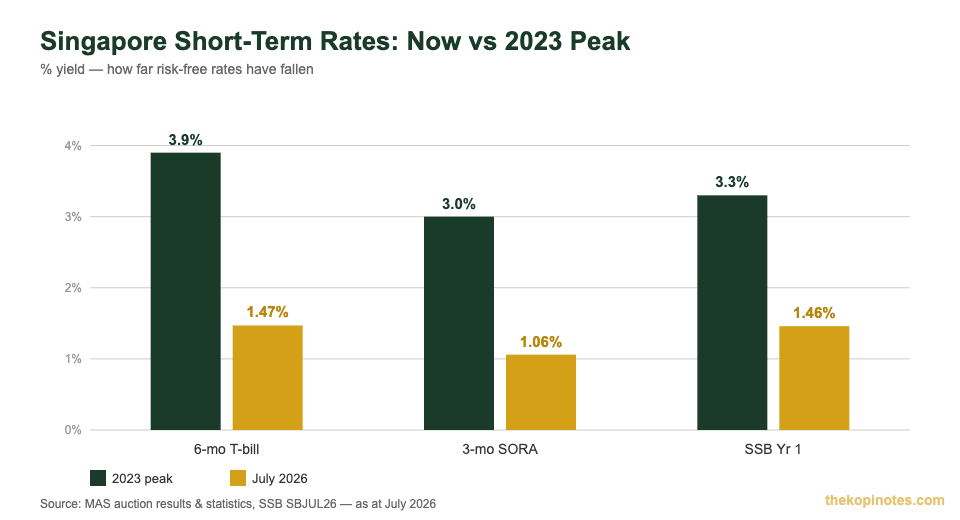
The numbers tell the story. The 6-month T-bill cut-off yield was 1.47% at the 23 June 2026 auction. The previous two auctions landed at 1.47% and 1.48%. Just over a year ago, the same bill paid closer to 3%. The next auction, BS26113X, opened on 2 July 2026.
SORA — the Singapore Overnight Rate Average, the benchmark behind most home loans — tells the same story. The 3-month compounded SORA sat near 1.06% as at 2 June 2026. At its early-2025 peak, it was almost 3%. That’s a steep drop in barely a year.
Where Rates Stand Now vs a Year Ago
The table below shows how far short-term Singapore yields have fallen. If you built a T-bill or fixed deposit ladder in 2024, your renewals are now rolling over at much lower rates.
| Instrument | Rate (July 2026) | Approx. 2023–24 Peak | Direction |
|---|---|---|---|
| 6-month T-bill (cut-off) | 1.47% | ~3.9% | Falling |
| 3-month compounded SORA | ~1.06% | ~3.0% | Falling |
| SSB (Year 1 rate, Jul 2026) | 1.46% | ~3.3% | Falling |
| SSB (10-year average, Jul 2026) | 2.11% | ~3.4% | Stable-to-lower |
| CPF Special / Retirement Account | 4.00% floor | 4.00% | Unchanged |
Source: MAS auction results and statistics, SSB issuance (SBJUL26), CPF Board — as at July 2026.
What This Means for Cash Savers
If you’re a saver, this is the hard part. The risk-free yield you got used to is shrinking. A year ago, $100,000 in 6-month T-bills earned close to $3,000 over six months. Today, the same amount earns about $735. That’s a real drop in passive income.
Fixed deposits tell the same story. Bank promotional FD rates track T-bill and SORA levels. As those fall, so do the headline FD rates you see advertised. The 3%+ FD promos of 2023 are gone.
So what can you do? First, don’t panic-chase yield. Higher return almost always means higher risk. Second, look at where your emergency cash really needs to sit versus money you can lock up longer.
One quiet winner is the CPF Special and Retirement Account. Its 4% floor is now roughly 2.5 times what a 6-month T-bill pays. For long-term retirement money, that gap is striking. Budget 2026 also added a top-up of up to $1,500 for those aged 50 and above in December 2026. If you have spare cash and a long horizon, CPF top-ups look far more attractive than they did in the high-rate years. Our CPF investment strategy guide walks through the trade-offs.
Who Benefits: Borrowers and S-REITs
Falling rates aren’t bad news for everyone. If you have a home loan pegged to SORA, your monthly repayment has likely dropped. Lower SORA means lower interest on floating-rate mortgages. That’s real cash back in your pocket each month.
The bigger story for investors is S-REITs. Real Estate Investment Trusts borrow heavily to buy property. When rates fall, their interest costs drop. That frees up more cash to pay unitholders. It can also lift property values on their books.
Roughly 80% of S-REITs are expected to benefit from stable or lower benchmark rates in 2026. Lower funding costs support distributions and can help asset values recover. That’s why REIT prices often rise when the market expects rate cuts.
That said, don’t buy a REIT just because rates are falling. Look at the balance sheet, the gearing ratio, and the quality of the properties. For a screened list, see our take on the best S-REITs in Singapore 2026, and the broader Singapore REIT ETF guide if you prefer a diversified basket.
The MAS July Review: What to Watch
MAS reviews monetary policy four times a year — in January, April, July and October. The July 2026 review is the next scheduled decision. Markets will watch it closely.
Here’s the link to your wallet. If MAS keeps the SGD on a firm appreciating path, local rates likely stay low. If MAS signals a softer stance, rates could ease even further. Either way, the era of 3%+ risk-free yield looks unlikely to return soon.
In April 2026, MAS kept the Singapore dollar on an appreciating slope while lifting its 2026 inflation forecast. That mix suggests MAS is watching prices carefully but is in no rush to reverse the domestic rate slide. For savers, the practical takeaway is simple: plan around lower-for-longer rates, not a quick bounce back.
A Practical Playbook for SG Investors
You don’t need to overhaul everything. But a few moves make sense when rates fall. Here’s a simple framework.
| If you are… | Consider | Why |
|---|---|---|
| A pure cash saver | Lock some cash in SSB or longer T-bills now | SSB lets you redeem anytime; longer tenors lock today’s rate before further falls |
| Saving for retirement | CPF top-ups for the 4% floor | 4% is now well above T-bills; Budget 2026 adds a top-up bonus for 50+ |
| An income investor | Review quality S-REITs and dividend stocks | Falling funding costs can support distributions |
| A floating-rate borrower | Bank the mortgage savings, don’t overspend | Lower SORA cuts your repayment — redirect the difference to investing |
Source: The Kopi Notes editorial analysis, July 2026. Not personalised advice.
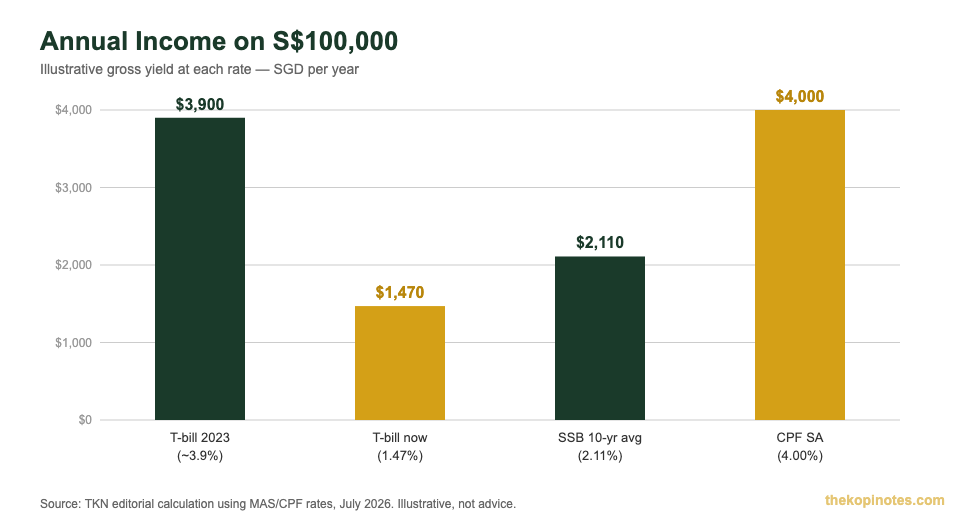
If you’re building a longer-term income stream, our guide to passive income in Singapore lays out the main options. For the mechanics of bidding at auctions, the Singapore T-bills 2026 guide and the Singapore Savings Bonds guide cover the step-by-step.
Bottom Line for SG Investors
The cheap-money era for savers is fading fast. T-bills at 1.47% and SORA near 1.06% mean the risk-free yields of 2023 and 2024 are gone, and the July MAS review is unlikely to reverse that.
The smart response isn’t to chase risky yield. It’s to match your money to your time horizon. Keep genuine emergency cash liquid. Lock in current rates on money you can spare. And for retirement money, the CPF 4% floor now looks like one of the best risk-free deals in Singapore.
Falling rates reward the prepared. Review your cash today, before your next T-bill or FD renewal rolls over at a lower rate.
Frequently Asked Questions
Why are Singapore T-bill yields falling in 2026?
Global central banks are cutting rates, and MAS keeps the Singapore dollar on an appreciating path. Both pull local short-term rates lower. The 6-month T-bill cut off at 1.47% at the 23 June 2026 auction, down from nearly 4% at the 2023 peak.
What is the current 6-month Singapore T-bill yield?
The cut-off yield was 1.47% at the 23 June 2026 auction. The two prior auctions came in at 1.47% and 1.48%. The next auction, BS26113X, opened on 2 July 2026.
Are fixed deposits still worth it in Singapore?
FD rates track T-bill and SORA levels, so the 3%+ promos of 2023 are gone. FDs still suit money you want fully capital-protected and won’t touch for a set period. Just expect lower headline rates than a year ago.
Do falling rates help or hurt S-REITs?
They generally help. Lower rates cut REIT borrowing costs and can lift property values. Roughly 80% of S-REITs are expected to benefit from stable or lower rates in 2026. Balance sheet quality still matters, so screen carefully.
Is a CPF top-up better than T-bills now?
For long-term retirement money, the CPF Special and Retirement Account 4% floor is now roughly 2.5 times the 6-month T-bill yield. That gap makes CPF top-ups more attractive than in the high-rate years. But CPF money is locked until retirement age.
When is the next MAS monetary policy review?
MAS reviews policy in January, April, July and October. The July 2026 review is the next scheduled decision. Watch whether MAS keeps the SGD on an appreciating slope, which tends to keep local rates low.
Should I lock in Singapore Savings Bonds now?
SSB July 2026 (SBJUL26) offers 1.46% in year one and a 2.11% average over 10 years. SSBs let you redeem anytime with no penalty, so they’re a flexible way to lock in current rates before any further falls.
Sources: MAS auction results and Treasury bill statistics; SSB issuance data (SBJUL26); CPF Board. All data as at July 2026.
This article was researched with the help of AI. While we strive to keep all information accurate and up to date, there may be errors. If you notice any discrepancies, please contact us.