Mapletree REITs Singapore 2026: Complete Investor Guide (MIT, MLT & MPACT)
Mapletree REITs are three of Singapore’s most respected S-REITs — Mapletree Industrial Trust (MIT), Mapletree Logistics Trust (MLT), and Mapletree Pan Asia Commercial Trust (MPACT). Backed by Temasek-linked sponsor Mapletree Investments, they collectively manage over S$27 billion in assets across industrial, logistics, and commercial properties spanning Singapore, Japan, Hong Kong, the US, and beyond. As at mid-2026, they offer dividend yields of 5.5–6.1% — making them core holdings for Singapore income investors.
Not financial advice. All figures are for educational reference only. Data as at June 2026 unless noted.
- MIT (industrial/data centres) yields ~5.8%, MLT (logistics) ~6.1%, MPACT (commercial) ~5.5% as at mid-2026
- All three are Temasek-sponsored, low-KD investments with strong SGX liquidity and CPF-investible status
- MLT offers the highest yield but carries more overseas exposure; MIT has the strongest data centre tailwind
Table of Contents
What Are Mapletree REITs?
Mapletree is a leading real estate development, investment, capital and property management company owned by Temasek Holdings. The company sponsors three listed S-REITs on the Singapore Exchange (SGX), each focused on a different property sub-sector.
These three REITs — MIT, MLT, and MPACT — are distinct listed entities. Each has its own unit price, management team, and portfolio. But they share a common sponsor in Mapletree Investments, which provides a strong pipeline of acquisition opportunities and gives retail investors confidence in governance standards.
Together, they make up a significant portion of the S-REIT market. Many Singapore investors hold all three as a diversified “Mapletree basket” across industrial, logistics, and commercial real estate.
MIT — Mapletree Industrial Trust
Mapletree Industrial Trust (SGX: ME8U) is one of the largest S-REITs in the industrial space. It invests in data centres, hi-tech buildings, business park buildings, flatted factories, and light industrial buildings in Singapore and North America.
What makes MIT stand out is its heavy data centre exposure. As the global AI boom drives insatiable demand for computing infrastructure, MIT’s data centre assets in the US and Singapore are seeing stronger-than-average rental growth. This gives MIT a structural tailwind that pure industrial or logistics REITs don’t have.
MIT Key Facts (FY2025)
| Metric | Value |
|---|---|
| SGX Ticker | ME8U |
| Sub-sector | Industrial / Data Centres |
| Share Price (approx, mid-2026) | S$2.15 |
| DPU (FY2025) | 13.41 Singapore cents |
| Dividend Yield | ~5.8% |
| Gearing Ratio | 38.2% |
| Number of Properties | 141 |
| Key Markets | Singapore, USA, Japan |
Source: MIT Annual Report FY2025, SGX filings
MIT distributes income quarterly, which makes it attractive for investors who want regular cash flow. Its weighted average lease expiry (WALE) of around 4 years provides revenue visibility. If you’re looking for the Mapletree REIT most exposed to the AI data centre theme, MIT is your pick.
MLT — Mapletree Logistics Trust
Mapletree Logistics Trust (SGX: M44U) is Asia’s first and one of the largest logistics REITs. It owns and manages a portfolio of modern logistics and warehouse properties spread across Singapore, Japan, China, Hong Kong, South Korea, Australia, Malaysia, Vietnam, and India.
MLT currently offers the highest yield of the three Mapletree REITs — around 6.1%. This reflects both its attractive portfolio and the market’s caution about its China exposure, where occupancy pressures have been a headwind. However, MLT’s diversification across 9 Asia-Pacific markets helps cushion any single-country risk.
The e-commerce and supply chain reshoring trends continue to drive demand for modern logistics space across Asia. MLT is well-positioned to capture this over the medium term. You get paid while you wait — and the wait may be shorter than the market expects.
MLT Key Facts (FY2026)
| Metric | Value |
|---|---|
| SGX Ticker | M44U |
| Sub-sector | Logistics / Warehousing |
| Share Price (approx, mid-2026) | S$1.38 |
| DPU (FY2026) | 8.659 Singapore cents |
| Dividend Yield | ~6.1% |
| Gearing Ratio | 40.1% |
| Number of Properties | 186 |
| Key Markets | SG, JP, CN, HK, AU, KR, MY, VN, IN |
Source: MLT Annual Report FY2026, SGX filings
MLT pays distributions semi-annually. Its gearing of 40.1% is approaching the regulatory 45% cap but is still within a manageable range. For yield-focused investors who are comfortable with Asia-Pacific logistics exposure, MLT is compelling. You can check out the Mapletree Logistics Trust complete guide for a deeper dive.
MPACT — Mapletree Pan Asia Commercial Trust
Mapletree Pan Asia Commercial Trust (SGX: N2IU) was formed in 2022 through the merger of Mapletree Commercial Trust (MCT) and Mapletree North Asia Commercial Trust (MNACT). This makes MPACT the largest commercial REIT in Asia by number of properties.
MPACT owns retail and office properties including VivoCity (Singapore’s largest mall), Festival Walk (Hong Kong), and Mapletree Business City (Singapore). It has significant exposure to Hong Kong and Japan office/retail, which means its fortunes are tied partly to macro conditions in those markets.
The yield of ~5.5% is the lowest of the three Mapletree REITs — partly because VivoCity commands a premium as a trophy asset, and partly because commercial/retail assets are valued more richly. That said, VivoCity’s performance has remained strong, with consistently high occupancy and tenant sales.
MPACT Key Facts (FY2026)
| Metric | Value |
|---|---|
| SGX Ticker | N2IU |
| Sub-sector | Commercial / Retail |
| Share Price (approx, mid-2026) | S$1.20 |
| DPU (FY2026) | 6.60 Singapore cents |
| Dividend Yield | ~5.5% |
| Gearing Ratio | 39.5% |
| Number of Properties | 18 |
| Key Markets | SG, HK, JP, AU, Far East |
Source: MPACT Annual Report FY2026, SGX filings
MPACT pays distributions semi-annually. For investors who want exposure to Singapore retail (VivoCity) and pan-Asia commercial real estate, MPACT offers a unique combination unavailable elsewhere in the S-REIT space. See how it compares in our best REITs in Singapore 2026 guide.
Side-by-Side Comparison: MIT vs MLT vs MPACT
Here’s how the three Mapletree REITs compare at a glance. Use this table to decide which one — or which combination — suits your investment goals.
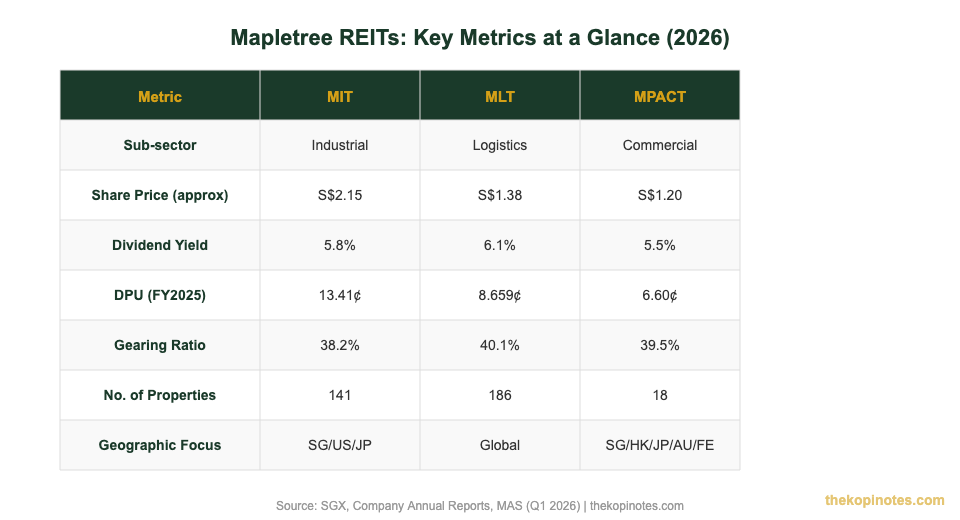
| Feature | MIT | MLT | MPACT |
|---|---|---|---|
| Best for | Data centre growth + income | Highest yield + Asia logistics | Trophy commercial + VivoCity |
| Distribution frequency | Quarterly | Semi-annual | Semi-annual |
| CPF investible | Yes (OA) | Yes (OA) | Yes (OA) |
| Key risk | USD/SGD FX, US market | China occupancy pressure | HK macro, commercial demand |
| SRS eligible | Yes | Yes | Yes |
Source: SGX, Company disclosures (Q1–Q2 2026). Prices are approximate and change daily.
Dividend Yield Deep Dive
Yield is the number most investors look at first — and for good reason. For Mapletree REITs, yields range from 5.5% (MPACT) to 6.1% (MLT) as at mid-2026. To put that in context: a 10-year Singapore Government Security (SGS) bond yields around 2.9%. The yield spread — the extra income you earn for taking on REIT risk — is healthy at 2.6–3.2 percentage points.
MIT: DPU has been relatively stable, supported by long-lease data centre income. The shift toward more data centre assets should support DPU growth over the next 3–5 years as hyperscaler demand continues.
MLT: DPU faced modest pressure in FY2025 due to China vacancies and higher borrowing costs. Management has been active in recycling weaker assets. If China occupancy stabilises, DPU could recover — giving you both income and potential capital uplift.
MPACT: DPU was impacted by post-merger integration costs and HK office weakness. VivoCity’s retail performance has been robust and should continue to anchor overall income.
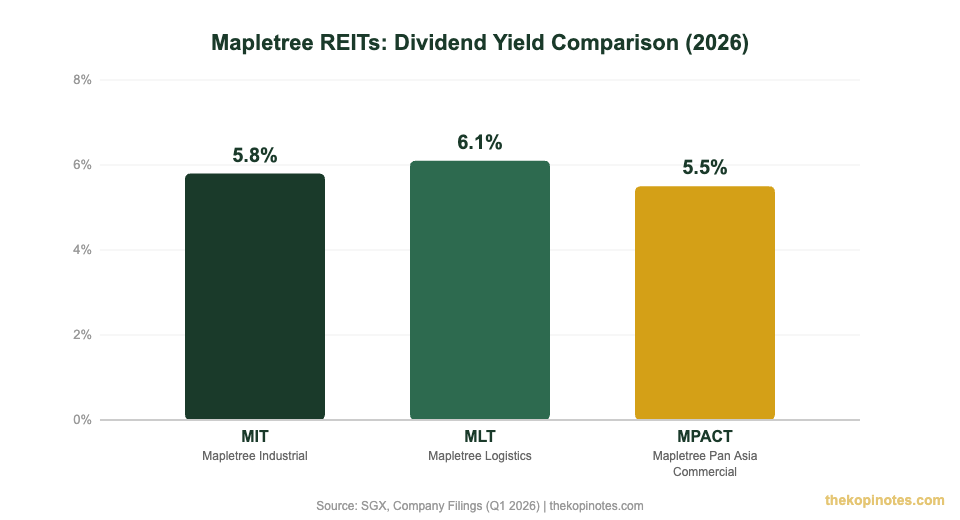
For investors building a passive income portfolio in Singapore, holding all three Mapletree REITs gives you a blended yield of roughly 5.8% — diversified across industrial, logistics, and commercial property types, and across Singapore, Japan, Hong Kong, Australia, and beyond.
Risks Every Investor Should Know
Mapletree REITs are among the higher-quality S-REITs available. But “high quality” doesn’t mean “no risk”. Here are the key risks to understand before you invest.
Interest rate risk: REITs borrow money to buy properties. When interest rates rise, borrowing costs go up and DPU can fall. All three Mapletree REITs have been managing this through interest rate hedging, but it remains the single biggest macro risk for the sector.
Currency risk: MIT earns USD income from its US data centres. MLT earns income in RMB, JPY, AUD, and other currencies. MPACT earns HKD and JPY. A strong SGD reduces the SGD value of overseas distributions. All three actively hedge FX exposure, but hedging is never complete.
Gearing limits: Singapore REITs can borrow up to 45% of their asset value. MLT at 40.1% and MPACT at 39.5% have limited headroom. If asset values fall, gearing could breach limits and force asset sales.
Geopolitical risk: MLT’s China exposure and MPACT’s Hong Kong assets carry geopolitical tail risk. These are low-probability but high-impact scenarios. That said, Mapletree’s Temasek parentage gives investors confidence that governance is sound and rescue capital is available in extreme stress scenarios.
For a broader view of S-REIT risks and opportunities, see our Singapore REIT ETF guide.
How to Buy Mapletree REITs in Singapore
All three Mapletree REITs are listed on the SGX. You can buy them through any Singapore brokerage with a CDP-linked account. Here are the most popular options for retail investors in 2026:
| Broker | SGX Commission | Min. Commission | Best For |
|---|---|---|---|
| moomoo SG | 0.03% | S$0.99 | Lowest fees, beginners |
| IBKR | 0.08% | S$2.50 | Global multi-asset investors |
| FSMOne | 0.08% | S$10.00 | Fund + REIT combo investors |
| Syfe Trade | 0.06% | S$1.98 | Mobile-first investors |
Source: Broker websites (June 2026). Commissions exclude GST and exchange fees.
You can also invest in Mapletree REITs via CPF OA — all three are CPFIS-OA approved. For robo-advisor investors, both Endowus (code: 2V343) and Syfe (code: SRPRFFFCD) offer S-REIT portfolio options. If you prefer self-directed trading, check out the FSMOne referral code for discounted brokerage on your first trade.
If you want to use your SRS account, all three Mapletree REITs are SRS-eligible. SRS investments allow you to defer income tax on the amount invested — an extra benefit for higher earners. Use our Singapore retirement planning calculator to model how Mapletree REIT income fits into your overall retirement strategy.
Ready to Start Investing in S-REITs?
Use our tools to plan your REIT income strategy.
Frequently Asked Questions
Which Mapletree REIT has the highest dividend yield?
Are Mapletree REITs safe investments?
Can I buy Mapletree REITs with my CPF?
What is the difference between MIT, MLT, and MPACT?
Which Mapletree REIT should I buy in 2026?
How often do Mapletree REITs pay dividends?
Disclaimer: This article is for informational and educational purposes only. It does not constitute financial advice. All investment decisions involve risk, including the possible loss of capital. Please consult a licensed financial advisor before making investment decisions. The Kopi Notes may earn referral fees from broker links on this page.
This article was researched with the help of AI. While we strive to keep all information accurate and up to date, there may be errors. If you notice any discrepancies, please contact us.