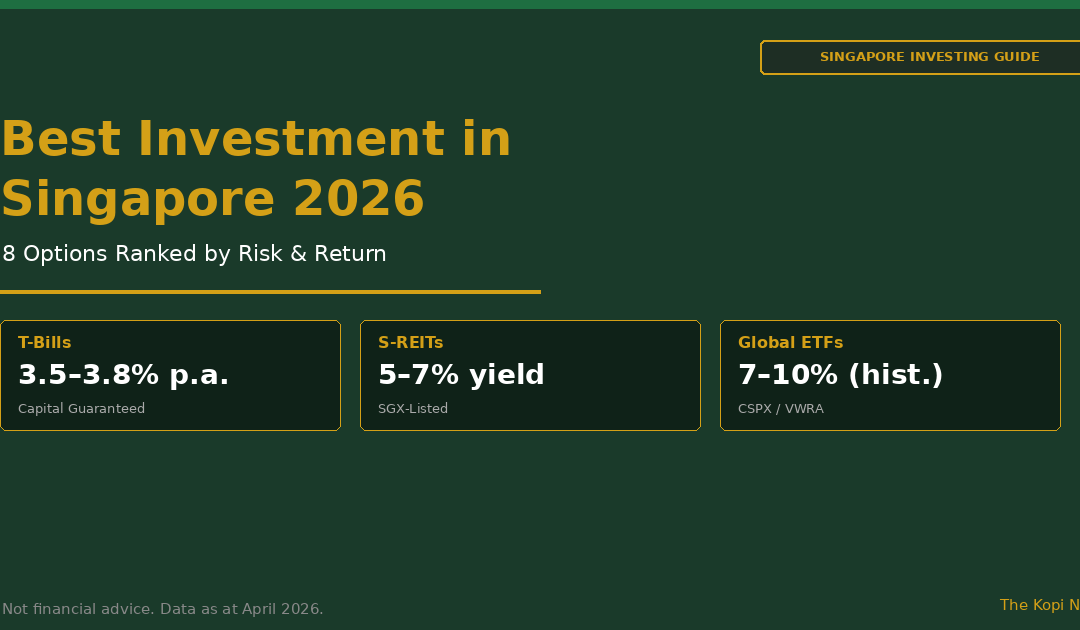
Best Investment in Singapore 2026: 8 Proven Options Ranked by Risk & Return
From capital-guaranteed T-bills to 6%+ yielding S-REITs — here's where Singapore investors are putting their money in 2026.
The best investment in Singapore in 2026 depends on your risk appetite and time horizon — but for most retail investors, a combination of Singapore T-bills (3.5–3.8% p.a., capital guaranteed), S-REITs (5–7% dividend yield), and global ETFs like CSPX or VWRA offers the strongest risk-adjusted returns. CPF top-ups and Singapore Savings Bonds round out a diversified, tax-efficient portfolio accessible to any Singapore resident.
Not financial advice. All figures are for educational reference only. Data as at April 2026 unless noted.
Table of Contents
Contents — Click to expand
- Quick Comparison: 8 Best Investments at a Glance
- 1. Singapore T-Bills — Safest Short-Term Return
- 2. Singapore Savings Bonds (SSBs) — Flexible & Government-Backed
- 3. S-REITs — Highest Dividend Yield
- 4. Global ETFs (CSPX / VWRA) — Long-Term Wealth Builder
- 5. CPF Voluntary Top-Up — Guaranteed 4% + Tax Relief
- 6. Robo-Advisors (Syfe / Endowus) — Hands-Off Investing
- 7. Fixed Deposits — Simple, No Risk
- 8. SRS Account Investing — Tax-Advantaged Retirement
- How to Choose the Right Investment for You
- FAQ
Quick Comparison: 8 Best Investments at a Glance
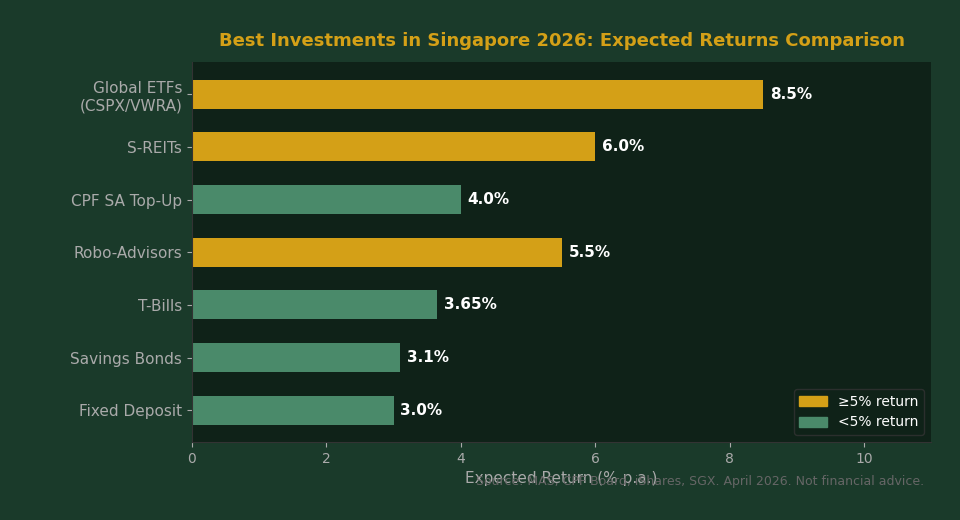
Before diving deep, here's how the top investment options in Singapore compare on the metrics that matter most — expected return, risk level, minimum investment, and liquidity.
| Investment | Expected Return (p.a.) | Risk | Min. Investment | Liquidity |
|---|---|---|---|---|
| Singapore T-Bills | 3.5–3.8% | None (govt guaranteed) | S$500 | 6-month lock-up |
| Singapore Savings Bonds | 2.9–3.3% | None (govt guaranteed) | S$500 | Redeem any month |
| S-REITs | 5–7% dividend yield | Medium | ~S$200–500 (1 lot) | High (SGX-listed) |
| Global ETFs (CSPX/VWRA) | 7–10% (historical avg) | Medium | ~S$120–140 (1 share) | High (LSE-listed) |
| CPF Voluntary Top-Up | 4% (SA/RA), 2.5% (OA) | None | S$1 | Locked until 55+ |
| Robo-Advisors (Syfe/Endowus) | 4–8% (varies by portfolio) | Low–Medium | S$1 | T+3 to T+5 |
| Fixed Deposits | 2.5–3.5% | None (up to S$75k SDIC) | S$1,000–S$10,000 | Low (lock-up penalty) |
| SRS Investing | Varies (+ tax savings) | Low–High (choice-based) | S$1 | Locked until retirement age |
Source: MAS, CPF Board, SGX, bank websites. Data as at April 2026.
1. Singapore T-Bills — Safest Short-Term Return
Singapore Treasury Bills (T-bills) are 6-month or 1-year government securities issued by the Monetary Authority of Singapore (MAS). They are the safest investment in Singapore — backed by the Singapore Government with AAA credit rating — and currently yield around 3.5–3.8% per annum as at Q2 2026.
T-bills are sold at a discount and redeemed at face value. For example, a S$10,000 T-bill at 3.7% p.a. (6-month) would cost you approximately S$9,815 and return S$10,000 six months later — a clean S$185 gain with zero credit risk.
Who should buy T-bills? Investors with cash sitting idle who want a guaranteed return better than any savings account, and don't need the money for 6 months. You can apply via DBS/POSB, OCBC, UOB iBanking or ATMs, or through CPF OA funds if you meet the balance criteria.
T-Bill Auction Yields — Recent History (2026)
| T-Bill Type | Frequency | Q1 2026 Cut-off Yield | Q2 2026 (Apr) Cut-off |
|---|---|---|---|
| 6-Month T-Bill | Bi-weekly | ~3.75% | ~3.57% |
| 1-Year T-Bill | Monthly | ~3.80% | ~3.62% |
Source: MAS T-bill auction results, April 2026. Past yields do not guarantee future results.
Read our full Singapore T-bills 2026 guide for step-by-step application instructions, CPF OA eligibility, and how to maximise your allocation.
2. Singapore Savings Bonds (SSBs) — Flexible & Government-Backed
Singapore Savings Bonds offer a unique combination of government safety and flexibility that T-bills can't match: you can redeem them at any month with no penalty. Interest steps up over time — starting around 2.9% in year 1 and reaching up to 3.3% if held to the full 10-year term (April 2026 issuance).
Maximum holding per person: S$200,000. Applications open monthly via DBS/POSB, OCBC, UOB or the SGX CDP platform. SSBs are ideal for emergency funds you still want to earn interest on, or as a bond allocation in a balanced portfolio.
SSB vs T-Bill: If you need flexibility, SSBs win. If you need maximum yield for a 6-month horizon, T-bills win. Many Singapore investors hold both.
For more, see our comprehensive Singapore Savings Bonds guide covering application steps, interest rate history, and how SSBs compare to fixed deposits.
3. S-REITs — Highest Dividend Yield Among Singapore Investments
Singapore Real Estate Investment Trusts (S-REITs) are the cornerstone of many Singapore income portfolios, and for good reason: they are legally required to distribute at least 90% of taxable income as dividends, producing yields of 5–7% per annum — roughly double what T-bills offer, with the added benefit of potential capital appreciation.
S-REITs are listed on the SGX and trade like stocks. Unlike direct property investment, you can start with as little as S$200–500 for one lot. Singapore residents pay zero withholding tax on S-REIT distributions — a significant advantage over foreign real estate or foreign dividend stocks.
Top S-REITs by yield (April 2026):
| REIT | SGX Ticker | Sector | Indicative Yield | Gearing |
|---|---|---|---|---|
| Parkway Life REIT | C2PU | Healthcare | ~4.2% | ~36% |
| Frasers Centrepoint Trust | J69U | Suburban Retail | ~5.5% | ~38% |
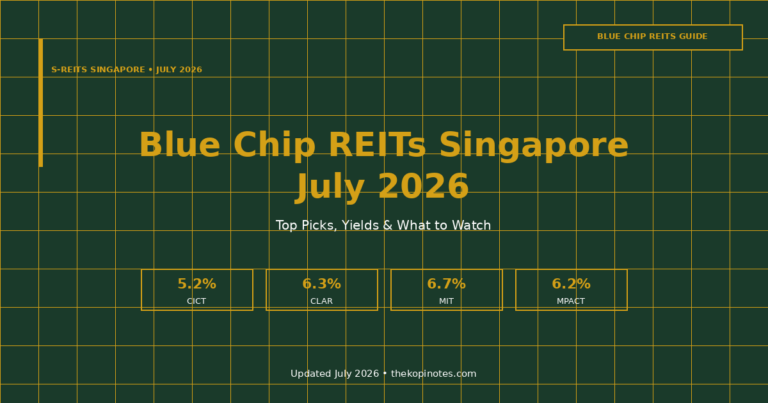
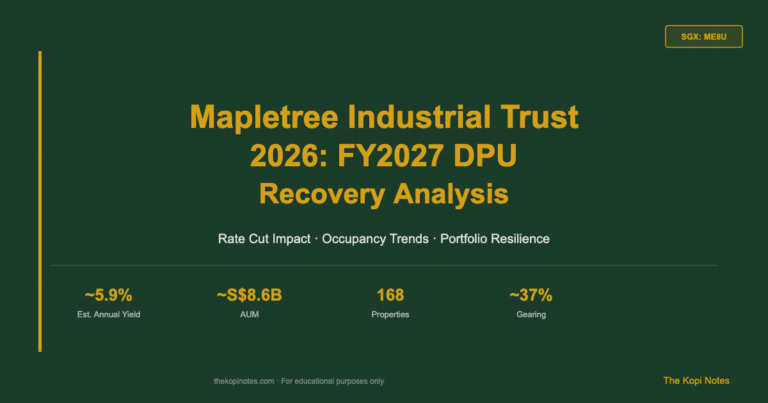
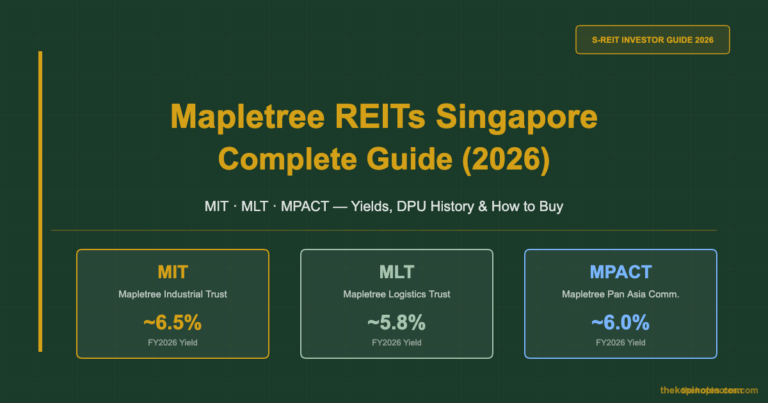
| Mapletree Industrial Trust | ME8U | Industrial/Data Centre | ~6.1% | ~39% |
| Keppel DC REIT | AJBU | Data Centres | ~4.8% | ~37% |
| CapitaLand Integrated Commercial Trust | C38U | Office + Retail | ~5.4% | ~40% |
Source: SGX, company filings. Indicative yield based on last 4 DPU distributions / current unit price. As at April 2026. Not financial advice.
For a deep-dive comparison, see our guide to the best S-REITs in Singapore 2026. If you're looking to build passive income in Singapore, S-REITs are typically the highest-yielding listed option available.
You can buy S-REITs through any SGX brokerage. For a fee-comparison, see our moomoo Singapore review — it has one of the lowest commissions for SGX trading.
4. Global ETFs (CSPX / VWRA) — Best Long-Term Wealth Builder
For long-term wealth accumulation, few instruments beat a low-cost global ETF. Singapore investors predominantly favour UCITS ETFs listed on the London Stock Exchange (LSE) — specifically the iShares Core S&P 500 UCITS ETF (CSPX) and the Vanguard FTSE All-World UCITS ETF (VWRA). Why LSE and not US-listed ETFs like VOO or VTI? Two reasons: no US estate tax exposure (applies to US-domiciled funds above US$60,000) and no 30% US dividend withholding tax for Singapore residents.
CSPX tracks the S&P 500, delivering ~10.5% annualised returns over the past 20 years (including dividends, in USD). VWRA provides broader global diversification across 3,700+ companies in developed and emerging markets.
Cost comparison: CSPX vs VWRA vs STI ETF
| ETF | TER | Dividend Treatment | # Holdings | Approx Price/share |
|---|---|---|---|---|
| CSPX (S&P 500, acc) | 0.07% | Accumulating | 500 | ~US$560 |
| VWRA (All-World, acc) | 0.22% | Accumulating | 3,700+ | ~US$110 |
| SPDR STI ETF (local) | 0.30% | Distributing | 30 | ~S$3.50 |
Source: iShares factsheet (Q1 2026), Vanguard fund page, SGX. TER = Total Expense Ratio.
Both CSPX and VWRA can be purchased through IBKR Singapore, or through Syfe and Endowus which offer fractional investing and CPF/SRS integration. Use our Singapore retirement calculator to model how monthly DCA into CSPX or VWRA grows your portfolio over 10–30 years.
5. CPF Voluntary Top-Up — The Best Risk-Free 4% Return in Singapore
Before you invest anywhere else, consider this: the CPF Special Account (SA) or Retirement Account (RA) currently pays 4% per annum — fully guaranteed by the Singapore Government, compounded monthly, with an additional extra 1% interest on the first S$60,000 of combined CPF balances. For a 35-year-old with S$30,000 in CPF SA, that works out to 5% effective interest on that tranche.
Voluntary top-ups under the Retirement Sum Topping-Up (RSTU) scheme offer a tax relief of up to S$8,000 per year for self top-ups (and another S$8,000 for topping up a parent or spouse's account). For someone in the 11.5% tax bracket, S$8,000 of top-up saves S$920 in income tax immediately — that's a guaranteed ~11.5% first-year return before the 4% interest even kicks in.
The catch: CPF funds are illiquid until age 55 (for OA/SA) or retirement age. This makes CPF top-ups ideal for your retirement allocation — not emergency funds. Explore our CPF investment strategy guide for a detailed breakdown of when to top up vs invest via CPFIS.
6. Robo-Advisors (Syfe / Endowus) — Best Hands-Off Investment in Singapore
If you want market-level returns without picking individual stocks or ETFs, Singapore's robo-advisors offer a compelling solution. Syfe and Endowus are the two most popular MAS-licensed platforms, each offering distinct advantages.
Syfe (use a Syfe referral code for a fee waiver on your first few months) is known for its REIT+ portfolio (Singapore REITs, ~5–6% yield), Income+ (dividend-focused bonds & REITs, ~5–6% p.a.), and its popular Cash+ account (currently ~3.6% p.a., capital preserved). No minimum investment; automatic rebalancing.
Endowus (use an Endowus referral code for a fee rebate) is the only platform that accepts CPF OA/SA and SRS funds for investment in low-cost unit trusts and Dimensional funds. Both platforms charge 0.25–0.65% p.a. in management fees — significantly cheaper than traditional wealth management.
See our Singapore REIT ETF guide to understand how robo-advisors' REIT portfolios differ from buying S-REITs directly on SGX.
7. Fixed Deposits — Simple, No Risk, Lower Return
Fixed deposits at Singapore banks offer guaranteed returns of around 2.5–3.5% p.a. depending on tenure and bank promotions in 2026. They're insured by the Singapore Deposit Insurance Corporation (SDIC) up to S$75,000 per institution — so risk is effectively zero for amounts below that threshold.
The downside: breaking a fixed deposit early typically forfeits all interest. Compared to T-bills (which often yield more), fixed deposits are usually not the optimal choice for the same lock-up period. However, fixed deposits are simpler to set up (no CDP account required), and some banks offer promotional rates for new deposits.
When fixed deposits make sense: When T-bill applications are oversubscribed, when you prefer bank-held cash over MAS-managed instruments, or when a bank promotional rate temporarily exceeds current T-bill yields.
8. SRS Account Investing — Tax-Advantaged Retirement Boost
The Supplementary Retirement Scheme (SRS) is a voluntary government scheme that lets Singapore Citizens and Permanent Residents contribute up to S$15,300 per year (foreigners: S$35,700) and receive a full tax deduction on contributions. Withdrawals at or after statutory retirement age are 50% taxable — meaning only half of what you withdraw counts as income for tax purposes.
The real power of SRS is what you do with the money inside the account. Unlike leaving it as cash (which earns just 0.05% p.a. in the SRS account itself), you can invest SRS funds in SGX stocks, ETFs, S-REITs, unit trusts, Singapore Savings Bonds, and T-bills. For a 40-year-old in the 15% tax bracket contributing S$15,300, the first-year tax saving is S$2,295. Invested in S-REITs returning 6% p.a. for 20 years, that initial S$15,300 grows to ~S$49,100 — all within a tax-efficient wrapper.
How to Choose the Best Investment in Singapore for Your Situation
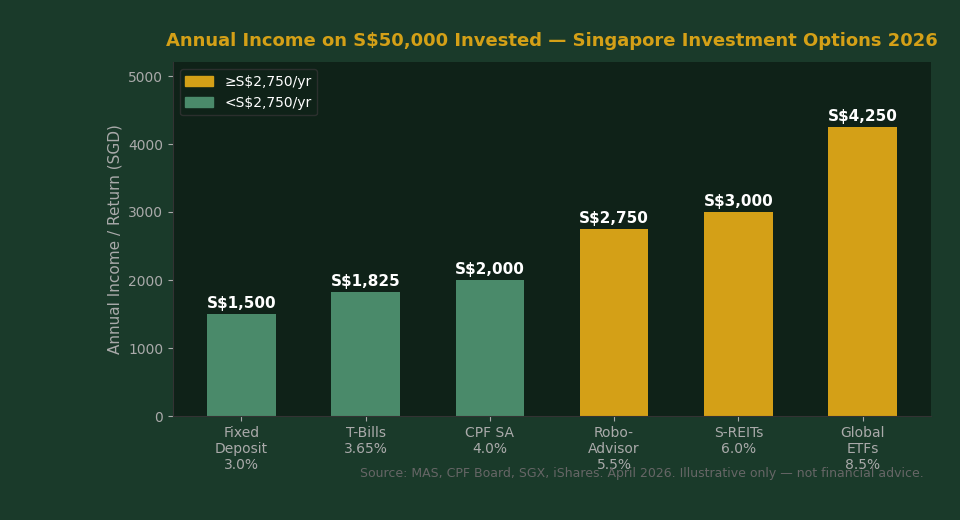
There is no single “best” investment — the right answer depends on your time horizon, risk tolerance, and income tax bracket. Here is a framework used by many Singapore retail investors:
Step 1 — Emergency fund first. Keep 3–6 months of expenses in a high-yield savings account or Singapore Savings Bonds. Never invest emergency funds.
Step 2 — Max out CPF top-up (if applicable). If you're in the 7%+ tax bracket and have under S$198,800 in your CPF SA/RA, topping up to the Full Retirement Sum gives you a guaranteed 4% + tax relief — unbeatable risk-adjusted return.
Step 3 — Deploy into T-bills for cash allocation. Roll idle cash (above your emergency fund) into 6-month T-bills at 3.5–3.8% p.a. Set a calendar reminder to re-apply every 6 months.
Step 4 — Invest long-term savings in global ETFs. Money you won't need for 10+ years belongs in CSPX or VWRA via IBKR, Syfe Trade, or FSMOne. Dollar-cost average monthly.
Step 5 — Add S-REITs for income. If you want quarterly dividend income, allocate 20–30% of your invested portfolio to S-REITs. Focus on well-capitalised REITs with gearing below 40%.
Step 6 — SRS top-up for tax savings. Once you have the above in order, contribute to SRS up to the annual limit (S$15,300 for Singapore Citizens/PRs) — invest the SRS funds in SSBs, T-bills, or ETFs inside the account.
Start Investing in Singapore Today
Open an account with one of Singapore's top investment platforms and start putting your money to work.
Frequently Asked Questions
What is the best investment in Singapore for beginners?
For beginners, Singapore T-bills and Singapore Savings Bonds are the safest starting points — no market risk, government-backed, and easy to apply via internet banking. Once comfortable, add a low-cost global ETF like VWRA via IBKR or Syfe for long-term growth. Avoid picking individual stocks or sector ETFs until you understand the basics.
How much money do I need to start investing in Singapore?
As little as S$500 for Singapore T-bills or SSBs, and S$1 for robo-advisors like Syfe or Endowus. For global ETFs listed on the LSE, you need the cost of one share — VWRA is around US$110 (~S$145), making it the most accessible option. S-REITs can be bought for as little as S$200–500 for one lot on SGX.
Is it better to invest in S-REITs or ETFs in Singapore?
It depends on your goal. S-REITs provide immediate dividend income (5–7% yield) with Singapore-specific real estate exposure — ideal for income investors. Global ETFs like CSPX offer higher long-term capital growth (historical 7–10% p.a.) with global diversification. Most Singapore investors combine both: ETFs for growth, S-REITs for income.
Are Singapore T-bills better than fixed deposits?
In most market conditions, yes. T-bills typically yield 0.2–0.5% more than equivalent-tenure fixed deposits and carry zero credit risk (backed by the Singapore Government vs. SDIC deposit insurance). The trade-off is that T-bills require a CDP account and the application process is slightly more involved than opening a bank FD online.
Can I invest using my CPF in Singapore?
Yes, but with restrictions. CPF OA funds can be invested via the CPF Investment Scheme (CPFIS-OA) in approved instruments including SGX-listed stocks, ETFs, unit trusts, and T-bills. You can only invest CPF OA funds above S$20,000 (the required OA minimum). Endowus is the only robo-advisor that accepts CPF OA and SA for investment in funds.
What is the safest investment in Singapore?
The safest investments in Singapore are Singapore Government Securities — T-bills, Singapore Savings Bonds, and SGS bonds — backed by the full faith and credit of the Singapore Government (AAA-rated). CPF balances are equally safe and earn higher rates (2.5–5% depending on account type). Fixed deposits at licensed banks are safe up to S$75,000 per institution under SDIC insurance.
Is investing in Singapore stocks a good idea?
SGX-listed stocks (including S-REITs and the STI ETF) offer solid income-generating investments, but Singapore's stock market is relatively small and concentrated in financials, REITs, and property. For growth, most Singapore investors complement local holdings with global ETFs (CSPX/VWRA) for broader market exposure. Avoid putting all capital into SGX-only equities — global diversification materially reduces portfolio risk.
Disclaimer: This article is for educational purposes only and does not constitute financial advice. Past performance is not indicative of future returns. All investments carry risk. Please conduct your own due diligence or consult a licensed financial adviser before making investment decisions. The Kopi Notes may earn referral fees from links on this page.
This article was researched with the help of AI. While we strive to keep all information accurate and up to date, there may be errors. If you notice any discrepancies, please contact us.