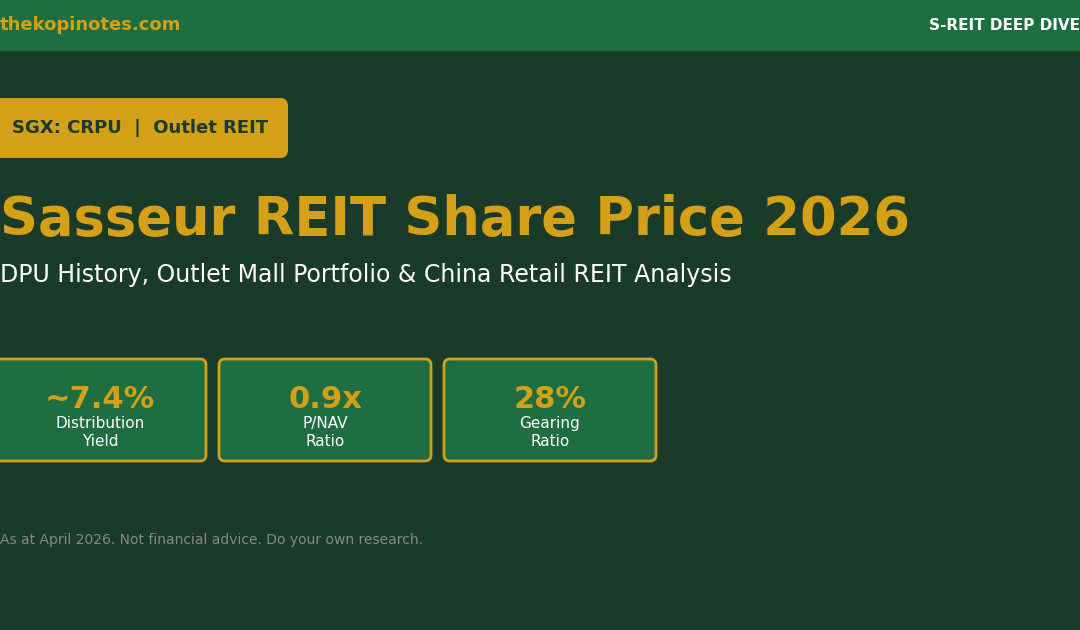
Sasseur REIT Share Price 2026 (SGX: CRPU): DPU History, ~7% Yield & Outlet Mall Portfolio Analysis
Sasseur REIT is Singapore’s only listed outlet mall REIT, giving retail investors exposure to China’s booming outlet retail sector through four premium outlet malls. With a forward yield of approximately 7.4% and a unique Entrusted Management Agreement (EMA) income structure, it offers one of the highest distribution yields on the SGX — but comes with distinct risks. This guide examines Sasseur REIT’s share price, DPU history, portfolio quality, and how it stacks up against Singapore’s other retail and commercial REITs. As at April 2026. This is not financial advice — do your own research.
Table of Contents
Contents — Click to expand
- What is Sasseur REIT?
- Share Price Performance 2026
- DPU History & Distribution Yield
- Understanding the EMA Income Structure
- Portfolio: Four Outlet Malls in China
- Financial Health: Gearing, ICR & NAV
- Yield Comparison vs Peer REITs
- Key Risks: RMB, China Retail & Concentration
- Who Should Invest in Sasseur REIT?
- Frequently Asked Questions
What is Sasseur REIT?
Sasseur REIT (SGX: CRPU) is Singapore’s first and only listed outlet mall REIT, listed on the Singapore Exchange in March 2018. It owns four premium outlet malls across China, managed under a unique Entrusted Management Agreement (EMA) structure that provides unitholders with a more stable, blended income stream compared to conventional variable rental REITs.
The REIT is sponsored by Sasseur Cayman Holding Limited, the largest outlet mall operator in China by number of malls. All four Sasseur properties are located in China’s fast-growing Tier 1.5 and Tier 2 cities — Chongqing (2 malls), Hefei, and Kunming — giving investors access to China’s fast-growing outlet retail market.
Key facts (as at April 2026):
- SGX Ticker: CRPU
- Listed: March 2018
- Sector: Retail (Outlet Malls), China
- Currency: Distributions in SGD (underlying assets in RMB)
- Market Cap: ~SGD 750–800 million
- Forward Yield: ~7.4% (approximate, April 2026)
- P/NAV: ~0.9x
For investors exploring Singapore’s listed REIT universe, Sasseur REIT represents a differentiated play — higher yield than most domestic REITs, but with significant China macro and currency risk exposure. See our Best S-REITs 2026 guide for a full comparison of the Singapore REIT market.
DPU History & Distribution Yield
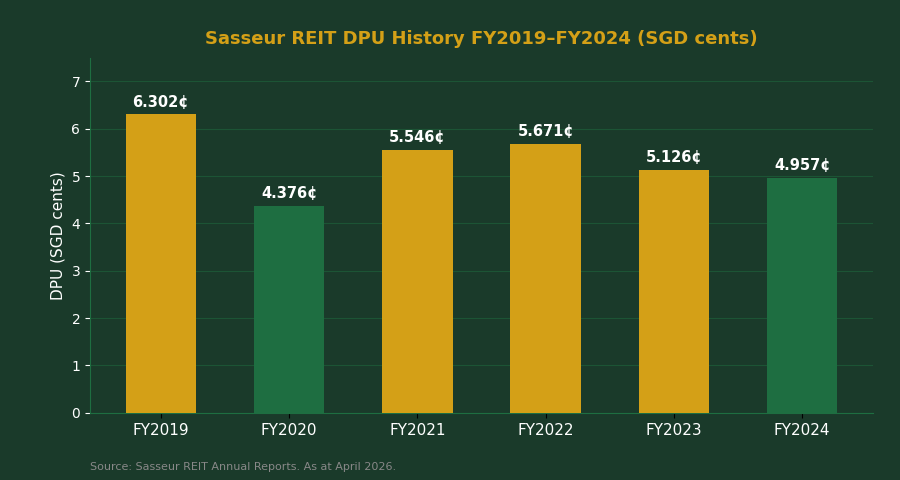
Sasseur REIT pays distributions semi-annually. Its DPU (distribution per unit) is denominated in SGD but derived from RMB-denominated outlet sales and EMA payments. The RMB/SGD exchange rate is therefore a key variable in every distribution cycle.
| Financial Year | DPU (SGD cents) | YoY Change | Key Note |
|---|---|---|---|
| FY2019 | 6.302¢ | — | First full year post-IPO |
| FY2020 | 4.376¢ | -30.6% | COVID-19 mall closures |
| FY2021 | 5.546¢ | +26.7% | Recovery in outlet sales |
| FY2022 | 5.671¢ | +2.3% | RMB remained relatively stable |
| FY2023 | 5.126¢ | -9.6% | RMB depreciation impact |
| FY2024 | 4.957¢ | -3.3% | China consumer uncertainty |
Distribution frequency: Semi-annual (typically March and August). Sasseur REIT has maintained consistent semi-annual distributions since IPO, with no full distribution suspension even during COVID — the EMA structure provided a minimum income floor that supported payouts.
At a share price of SGD 0.67 and an estimated forward DPU of ~4.9–5.0¢, the implied distribution yield is approximately 7.3–7.5%. This places Sasseur among the highest-yielding S-REITs on the SGX, though the risk premium is warranted given China and RMB exposure.
To calculate your potential income from Sasseur REIT, try our Dividend Portfolio Yield Calculator or our REITs Dividend Yield Calculator.
Understanding the EMA Income Structure
Sasseur REIT’s income model is unique among Singapore-listed REITs. Rather than collecting fixed base rent from tenants directly, the REIT receives payments under an Entrusted Management Agreement (EMA) from the Sasseur sponsor group.
The EMA payment has two components:
- Fixed component (EMA Fixed Rent): A guaranteed minimum payment regardless of mall performance. This provides downside protection — even if outlet sales are weak, Sasseur REIT receives a baseline income.
- Variable component (EMA Variable Rent): A percentage of each mall’s total outlet sales. This gives investors upside participation when China’s outlet retail market performs well.
In practice, the EMA payment is calculated as the higher of: (a) the fixed rent floor, or (b) a percentage of total outlet sales. This creates a “floor with upside” income profile that differentiates Sasseur from pure variable-rent retail REITs.
Why does this matter for investors? The EMA structure means that during downturns (like COVID-19 in 2020 or weak China consumer spending in 2023), the REIT has some income cushion. However, it also means investors are exposed to the sponsor’s ability to honour the EMA — so sponsor credit quality is an important risk factor.
Portfolio: Four Outlet Malls in China
Sasseur REIT’s portfolio consists of four outlet malls, all located in China’s fast-growing interior cities. Unlike coastal gateway cities (Beijing, Shanghai), these Tier 1.5 and Tier 2 locations have seen rapid middle-class growth and relatively lower outlet mall saturation — a key part of Sasseur’s investment thesis.
| Property | City | GFA (sq m) | Committed Occupancy |
|---|---|---|---|
| Sasseur Chongqing Liangjiang Outlet Mall | Chongqing | ~102,000 | ~96% |
| Sasseur Chongqing Bishan Outlet Mall | Chongqing | ~86,000 | ~94% |
| Sasseur Hefei Outlet Mall | Hefei | ~110,000 | ~95% |
| Sasseur Kunming Outlet Mall | Kunming | ~85,000 | ~92% |
Portfolio highlights:
- Total portfolio GFA: approximately 383,000 sq m across 4 properties
- All four malls maintained above 90% occupancy even during COVID-19 recovery
- Chongqing Liangjiang is the flagship and largest asset, contributing ~40% of total EMA income
- The malls carry a mix of international luxury brands (Gucci, Prada, Coach, Burberry) and fast fashion anchor tenants — a resilient, diversified tenant mix
China’s outlet mall market has historically been less penetrated compared to the US or Europe, giving Sasseur’s Tier 2 city locations structural growth tailwinds as domestic consumption and middle-class spending increase. That said, the concentration risk — all four assets in a single country — is a key consideration for Singapore investors used to geographically diversified REITs.
Financial Health: Gearing, ICR & NAV
Sasseur REIT’s balance sheet is relatively conservative compared to many of its S-REIT peers. The REIT’s gearing ratio (total debt to total assets) has consistently remained well below the MAS regulatory limit of 50%, providing headroom for future acquisitions or to weather a portfolio devaluation without triggering a breach.
| Metric | FY2024 (Approximate) | Benchmark |
|---|---|---|
| Aggregate Leverage (Gearing) | ~28% | MAS limit: 50% |
| Interest Coverage Ratio (ICR) | ~3.5–4.0x | MAS minimum: 1.5x |
| Net Asset Value per Unit | ~SGD 0.75–0.78 | — |
| Price-to-NAV | ~0.88–0.92x | Peer avg: ~0.85–1.0x |
| Weighted Average Debt Maturity | ~2.5 years | — |
The P/NAV below 1.0x suggests Sasseur units are trading at a discount to the appraised value of the underlying assets — which income investors may view as a margin of safety, though it also reflects the market pricing in China/RMB risk. For investors wanting to analyse gearing in detail, try the S-REIT Gearing Ratio & ICR Calculator or the S-REIT Yield vs SGS Bond Spread Calculator.
Yield Comparison vs Peer REITs
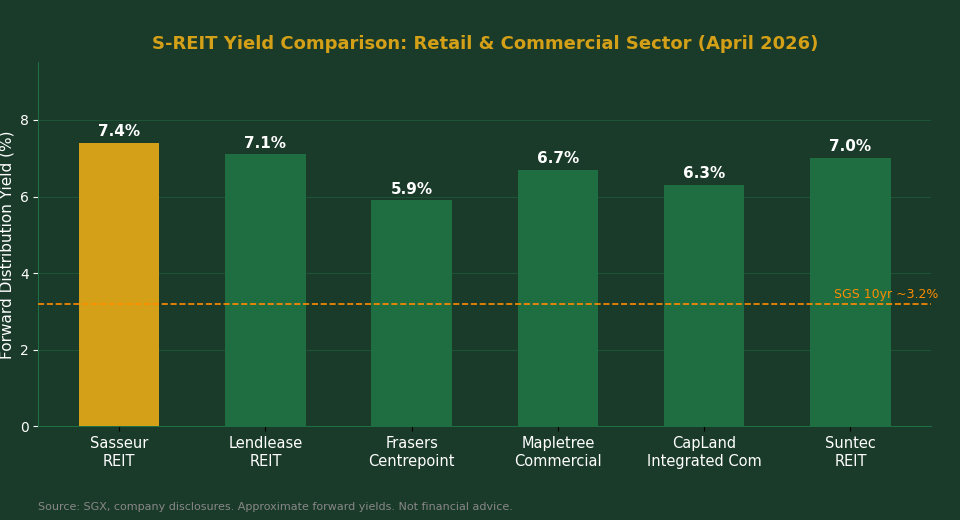
How does Sasseur REIT’s ~7.4% yield stack up against other Singapore retail and commercial REITs? The chart below shows approximate forward distribution yields as at April 2026:
| REIT | SGX Ticker | Sector | Approx. Forward Yield (Apr 2026) | Geography |
|---|---|---|---|---|
| Sasseur REIT | CRPU | Outlet Retail | ~7.4% | China |
| Suntec REIT | T82U | Office + Retail | ~7.0% | SG + AU + UK |
| Lendlease Global REIT | JYEU | Retail | ~7.1% | SG + SK + IT |
| Mapletree Pan Asia Commercial Trust | N2IU | Office + Retail | ~6.7% | Pan-Asia |
| CapitaLand Integrated Commercial Trust | C38U | Retail + Office | ~6.3% | SG + AU + DE |
| Frasers Centrepoint Trust | J69U | Suburban Retail | ~5.9% | Singapore |
Note: Yields are approximate and based on market prices and analyst estimates as at April 2026. Yields change daily with unit price movements. Not financial advice.
Sasseur REIT offers the highest yield in this peer group, but it is also the only pure China-market REIT in the list. Investors should weigh the yield premium against the concentration risk, currency risk, and governance considerations unique to China-listed assets managed under an EMA structure.
For context on how to build a diversified Singapore dividend income portfolio with REITs, explore the Singapore REIT ETF Guide — a useful complement if you prefer diversified REIT exposure rather than single-REIT risk.
Key Risks: RMB, China Retail & Concentration
Sasseur REIT carries a distinct risk profile compared to most S-REITs. Singapore-based investors should carefully evaluate the following before investing:
1. RMB/SGD Currency Risk
All underlying income is generated in Chinese Renminbi (RMB). When the RMB depreciates against the Singapore dollar, Sasseur REIT’s SGD distributions fall — even if outlet mall performance is stable. In FY2023, RMB weakness was the primary reason DPU declined despite reasonable operating results. This is arguably the biggest ongoing risk for Singapore unitholders.
2. Single-Country Concentration Risk
Unlike diversified S-REITs with assets in multiple countries, all of Sasseur’s properties are in China. Any adverse macroeconomic development in China — from property sector contagion to consumption slowdowns — directly impacts the entire portfolio. The 2025 US-China tariff escalation has added further uncertainty to China’s consumer economy.
3. EMA Sponsor Counterparty Risk
The EMA structure relies on Sasseur Cayman Holding Limited (the sponsor entity) making EMA payments to the REIT. If the sponsor faces financial distress, the REIT’s income — particularly the variable component — could be at risk. Investors should monitor the sponsor’s financial health as a key risk indicator.
4. China Regulatory and Governance Risk
As a China-focused asset, Sasseur REIT is subject to Chinese regulations on real estate, retail operations, and capital flows. Changes in tax policy, foreign ownership rules, or restrictions on profit repatriation could impact distributions. The MAS regulatory framework provides some investor protection at the Singapore listed entity level, but underlying asset governance follows Chinese law.
5. Outlet Mall Sector Cyclicality
Outlet malls are a relatively nascent format in China compared to traditional retail malls. While they have shown strong growth, they remain susceptible to changes in consumer spending patterns, e-commerce competition, and the broader health of China’s discretionary retail market.
Who Should Invest in Sasseur REIT?
Sasseur REIT is best suited to income-focused investors who are comfortable with China market exposure and understand currency risk. It is not a defensive, low-risk holding — the DPU volatility and RMB sensitivity make it unsuitable as a core retirement income holding for conservative investors.
That said, for investors who:
- Want exposure to China’s consumption growth story through a Singapore-regulated, SGX-listed vehicle
- Are comfortable with the EMA structure and its nuances
- Seek a yield premium (7%+) relative to domestic Singapore REITs (typically 5–7%)
- Are portfolio-diversifying beyond Singapore property assets
…Sasseur REIT can play a satellite role in a well-diversified S-REIT portfolio.
For most Singapore retail investors building a passive income portfolio, we’d suggest pairing Sasseur with more stable, Singapore-anchored REITs like Frasers Centrepoint Trust or a REIT ETF for stability. Consider using the Retirement Planning Calculator to model how different yield scenarios affect your retirement income projections.
If you’re investing via a robo-adviser or fund platform, check out our referral pages for Endowus and Syfe — both platforms offer REIT-focused portfolios for Singapore investors.
Frequently Asked Questions
What is Sasseur REIT's current share price?
As at April 2026, Sasseur REIT (SGX: CRPU) trades at approximately SGD 0.65–0.70 per unit. Share prices change daily — check the SGX website or your brokerage platform for the live price. The REIT has traded between roughly SGD 0.52 and SGD 0.86 since its 2018 IPO.
What is Sasseur REIT's dividend yield?
Based on an estimated forward DPU of approximately 4.9–5.0 SGD cents and a unit price around SGD 0.67, Sasseur REIT’s implied distribution yield is approximately 7.3–7.5% as at April 2026. This makes it one of the highest-yielding S-REITs on the SGX. The yield is variable and changes with both the unit price and the RMB/SGD exchange rate.
How often does Sasseur REIT pay dividends?
Sasseur REIT pays distributions semi-annually — typically in March (for the second half of the previous financial year) and August (for the first half of the current financial year). The financial year ends on 31 December.
What is the EMA structure and how does it work?
The Entrusted Management Agreement (EMA) is Sasseur REIT’s unique income structure. Instead of collecting rent directly from mall tenants, the REIT receives EMA payments from the Sasseur sponsor. These payments have a fixed floor (guaranteed minimum) plus a variable component linked to actual outlet sales. The higher of the two is paid each period. This provides some downside protection but also means the REIT’s income is tied to the sponsor’s performance and creditworthiness.
Is Sasseur REIT a good investment in 2026?
This is not financial advice. Sasseur REIT offers an attractive yield (~7.4%) and trades below NAV, but carries significant risks including RMB currency exposure, single-country concentration in China, and EMA sponsor counterparty risk. It may suit income-focused investors comfortable with China market risk as a satellite holding, but is not recommended as a core defensive position. Do your own research and consider consulting a financial adviser.
Can I use CPF to buy Sasseur REIT?
Sasseur REIT (CRPU) is listed on the SGX Mainboard and is generally eligible for CPF Investment Scheme (CPFIS) purchases, subject to your CPF OA balance limits and your broker’s CPF trading capabilities. Check with your broker (DBS, OCBC, UOB, Tiger, Moomoo etc.) for current CPFIS-eligible securities. Note that CPF funds have opportunity costs — explore the CPF investment strategy guide before investing.
How does Sasseur REIT compare to Frasers Centrepoint Trust?
Frasers Centrepoint Trust (FCT, SGX: J69U) and Sasseur REIT are both retail REITs but with very different risk profiles. FCT owns suburban Singapore shopping malls (Northpoint City, Causeway Point, Waterway Point etc.) with stable SGD-denominated rents and domestic consumer exposure. Its yield is lower (~5.9%) but significantly more predictable. Sasseur REIT offers a higher yield (~7.4%) with China/RMB risk. FCT is a core defensive retail REIT; Sasseur is a higher-risk, higher-yield satellite holding. Read the Frasers Centrepoint Trust guide for a full FCT deep dive.
Explore More Singapore REIT & Investing Tools
Ready to build your Singapore dividend income strategy? Check out these resources:
This article was researched with the help of AI. While we strive to keep all information accurate and up to date, there may be errors. If you notice any discrepancies, please contact us.