Best Savings Plan Singapore 2026: Complete Comparison Guide
Endowment, CPF, SSB, T-Bills, robo-advisors & high-yield savings — compared
The best savings plan in Singapore in 2026 depends on your goal, risk tolerance, and time horizon. For guaranteed returns with capital protection, endowment plans (3.25–4.75% illustrated) and CPF SA (4% guaranteed) are top picks. For flexibility, Singapore Savings Bonds (2.2–2.5%) and T-Bills (3.5% June 2026) let you exit anytime. For long-term market-linked growth, robo-advisors and ETFs offer higher potential at more risk. No single plan beats all others — you need the right mix for your situation.
Not financial advice. All figures are for educational reference only. Data as at July 2026 unless noted.
- Guaranteed + capital-safe: CPF SA (4% p.a.) is unbeatable; endowment plans (3.25–4.75% illustrated) add life cover
- Flexible + liquid: SSB (2.2%) and T-Bills (3.5%) let you exit with no penalties; bank high-yield accounts (2.5–3%) for emergency funds
- Long-term growth: robo-advisors (4–6% estimated) and global ETFs beat endowments over 15+ years but carry market risk
Table of Contents
Jump to section
- 8 Types of Savings Plans in Singapore
- Returns Comparison Table (2026)
- Endowment Plans: Capital-Protected Savings
- CPF as a Savings Plan (OA, SA & RA)
- SSB & T-Bills: Safe and Flexible
- Robo-Advisors: Higher-Growth Savings
- High-Yield Bank Savings Accounts
- SRS Tax Strategy for Savings Plans
- How to Choose the Right Savings Plan
- Frequently Asked Questions
8 Types of Savings Plans Available in Singapore
Singapore offers a wide range of savings plans. Understanding the category first helps you narrow down your options before comparing specific products.
| Type | Returns (2026) | Capital Safe? | Liquidity | Min. Investment |
|---|---|---|---|---|
| Endowment Plan | 3.25–4.75% illustrated | Generally yes (maturity) | Low — penalties for early exit | S$100–500/mth |
| CPF SA / RA | 4.0% guaranteed | Yes (govt-backed) | Very low — locked until retirement | Any amount |
| CPF OA | 2.5% guaranteed | Yes (govt-backed) | Low — housing / education use | Payroll-linked |
| Singapore Savings Bonds | ~2.2–2.5% p.a. | Yes (AAA) | High — redeem any month | S$500 |
| T-Bills (6-month) | ~3.5% p.a. (Jun 2026) | Yes (govt-backed) | Medium — 6-month lock-in | S$1,000 |
| Fixed Deposit | 2.5–3.0% p.a. | Yes (SDIC S$100k) | Medium — 3–12 month lock | S$1,000–10,000 |
| Robo-Advisor | 4–6% estimated (variable) | No — market risk | High — withdraw anytime | S$1–100 |
| High-Yield Savings Account | 2.5–3.5% (with conditions) | Yes (SDIC S$100k) | Very high — instant access | S$0 |
Source: MAS, CPF Board, SGX, DBS/OCBC/UOB product pages, Endowus, Syfe; July 2026
No single savings plan category wins on all dimensions. The right plan depends on whether you prioritise returns, capital safety, liquidity, or tax efficiency — or a combination of all four.
Returns Comparison: Which Savings Plan Pays the Most in 2026?
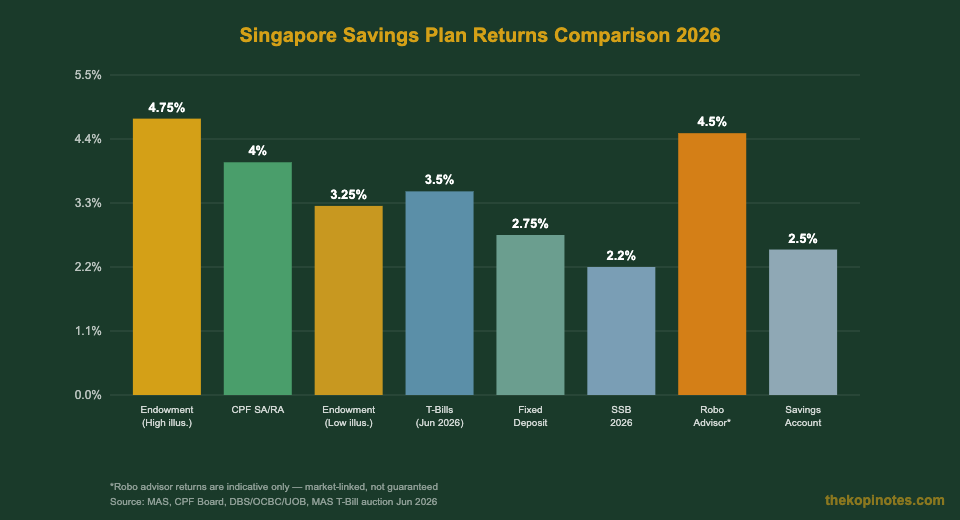
Here is a consolidated returns comparison for all major savings plans available to Singapore residents in 2026. All figures are annualised and reflect actual or publicly declared rates as at July 2026.
Source: MAS, CPF Board, MAS T-Bill auction, DBS/OCBC/UOB, Endowus, Syfe; July 2026. Robo-advisor returns are estimated, not guaranteed.
The chart shows that CPF SA (4% guaranteed) and endowment plans (up to 4.75% illustrated) lead on stated returns. However, CPF SA comes with major restrictions — you cannot access it until age 55, and the money is automatically used to meet your Full Retirement Sum (FRS). For liquid savings with near-CPF returns, T-Bills at 3.5% are the closest alternative in 2026.
Robo-advisors show a wide return band because performance depends on asset allocation and market conditions. A 100% global equity portfolio (e.g. on Syfe or Endowus) may return 7–10% in a bull year and -15% in a bear year. The 4–6% estimate assumes a balanced portfolio over a full market cycle.
Endowment Plans: Best for Capital-Protected Savings with Life Cover
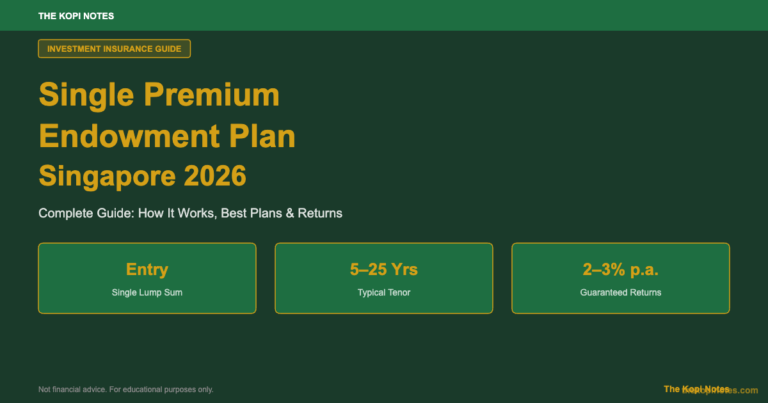
An endowment plan is the classic Singapore savings plan. You pay regular premiums — monthly or yearly — over a fixed term (typically 5–25 years). At the end of the term, you receive a maturity payout that includes a guaranteed amount plus non-guaranteed bonuses.
Endowment plans are not pure savings instruments. They include a life insurance component: if you die during the policy term, your beneficiaries receive the sum assured (typically 101–105% of total premiums paid). For young families, this bundled protection is a key selling point.
How Endowment Plan Returns Work
MAS requires insurers to illustrate returns at two scenarios: 3.25% p.a. and 4.75% p.a. These are the low and high par fund assumptions. The 4.75% figure is not a promise — it is the upper illustration. Actual returns depend on how the insurer’s participating (par) fund performs over the policy term.
In practice, major Singapore insurers’ par funds have averaged 3.5–4.5% p.a. over the past decade, according to MAS data. Your actual return also depends on how long you hold the policy: endowment plans are heavily back-loaded, meaning most bonuses are earned in later years. Surrendering early can result in a loss.
| Insurer & Plan | Tenor | Illustrated Return | SRS-Eligible | Best For |
|---|---|---|---|---|
| NTUC Income Gro Saver Flex Pro | 10–25 yr | 3.25–4.75% | Yes | Long-term wealth building |
| Etiqa eEndowment 5 | 5 yr | ~3.0–3.5% | Yes | Short-term, low commitment |
| Manulife ReadyBuilder II | 10–20 yr | 3.0–4.50% | Yes | Flexible premium options |
| AIA Saver with Booster | 15–25 yr | 3.25–4.75% | Yes | Long-term SRS strategy |
| Great Eastern GREAT Wealth Advantage | 15–25 yr | 3.0–4.75% | Yes | Family legacy planning |
| DBS Savvy Endowment / Singlife | 3–5 yr | ~3.0–3.8% | Yes | Short-term capital parking |
Source: Insurer product summaries and MAS illustration rates; July 2026. Non-guaranteed bonuses are not a promise.
For a deep-dive on endowment plans specifically, see our Endowment Plan Singapore 2026 guide.
CPF as a Savings Plan: Singapore’s Best Guaranteed Returns
Your CPF is the most underrated savings plan available to Singaporeans. The Ordinary Account (OA) earns a guaranteed 2.5% p.a. The Special Account (SA) earns a guaranteed 4.0% p.a. — better than most fixed deposits and short-term endowment plans, risk-free and government-backed.
The catch: CPF money is locked up. You cannot freely withdraw it. OA funds can be used for housing and approved investments; SA funds are locked until 55. Once you turn 55, your SA is used to meet the Full Retirement Sum (FRS), and any excess moves into your CPF Retirement Account (RA) earning 4%.
Voluntary CPF Top-Ups as a Savings Strategy
If you are not near your Full Retirement Sum, you can make voluntary top-ups to your SA under the Retirement Sum Top-Up Scheme (RSTU). This earns 4% guaranteed — better than most savings plans — while also giving you a dollar-for-dollar income tax relief (up to S$8,000/year for self-top-ups + S$8,000 for topping up family members).
However, voluntary top-ups to SA are irreversible. The money stays in CPF until retirement. Only top up if you have a sufficient emergency fund and stable cash flow. Use our Compound Interest Calculator to model how S$10,000 grows at 4% over 20 years (answer: S$21,911 — nearly 2.2x your money).
SSB & T-Bills: Safe, Government-Backed and Flexible
If you want government-backed safety with better liquidity than CPF, Singapore Savings Bonds (SSB) and Treasury Bills (T-Bills) are your best options.
Singapore Savings Bonds (SSB)
SSBs are issued by the Singapore government (AAA-rated) and earn a step-up interest rate that averages around 2.2–2.5% p.a. over 10 years in 2026. The key advantage: you can redeem them any month with full capital return and no penalties. The interest rate is lower than T-Bills but you get maximum flexibility. You can invest from S$500 up to a maximum of S$200,000 total across all SSB issues.
For the full guide, see our Singapore Savings Bonds guide 2026.
Treasury Bills (T-Bills)
T-Bills are 6-month or 1-year government securities sold at a discount. The June 2026 6-month T-Bill cut-off yield was approximately 3.5% p.a. — significantly higher than SSBs. The trade-off: you are locked in for 6 months (for 6-month T-Bills) or 12 months (for 1-year T-Bills). You can sell on the secondary market before maturity, but prices vary.
T-Bills are ideal for cash parking: if you know you will not need money for 6 months and want a meaningful return above bank savings rates. You can apply via CPF OA, SRS, or cash through your bank’s internet banking.
For full T-Bill yield data and auction results, see our T-Bill Auction Results Singapore 2026.
Robo-Advisors: Higher-Growth Savings Plans for Long-Term Goals
Robo-advisors are digital investment platforms that automatically invest your money into a diversified portfolio of ETFs. They are not traditional “savings plans” — there is no guaranteed return. But for a 10–20 year goal (retirement, children’s education), robo-advisors have historically outperformed endowment plans significantly on total returns.
The key robo-advisor platforms available to Singapore residents in 2026:
| Platform | CPF/SRS | Min. Investment | Annual Fee | Best For |
|---|---|---|---|---|
| Endowus | CPF OA + SRS ✅ | S$1,000 | 0.25–0.60% | CPF/SRS investing, fund selection |
| Syfe | SRS ✅ | S$0 | 0.35–0.65% | REIT+, Core Equity, Income portfolios |
| StashAway | SRS ✅ | S$0 | 0.20–0.80% | Risk-adjusted ETF portfolios |
| FSMOne | SRS ✅ | S$100 | 0.50% (funds) | Fund selection + RSP flexibility |
Source: Platform websites; fees as at July 2026. Fees exclude underlying fund TERs.
For CPF OA investing, Endowus (referral code 2V343) is the only robo-advisor approved for CPF OA and SRS funds. Syfe (code SRPRFFFCD) and FSMOne referral code are strong alternatives for SRS and cash savings.
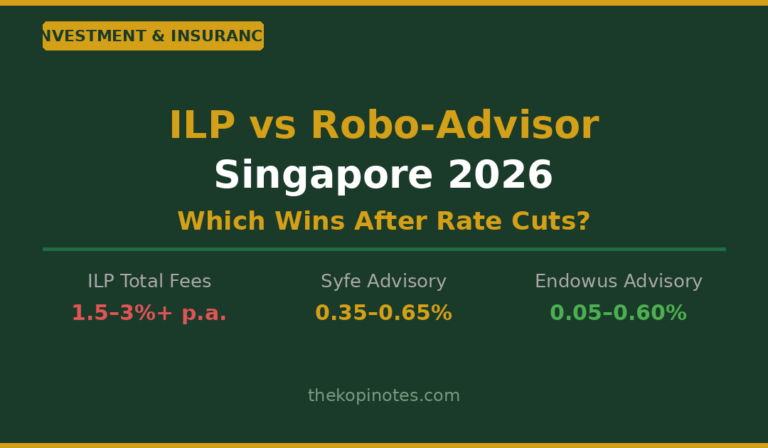
The big advantage of robo-advisors over endowment plans: no lock-in, lower fees, and historically higher returns over 15+ years. The risk: market downturns can temporarily reduce your portfolio value — unlike endowment plans which guarantee a minimum payout.
High-Yield Bank Savings Accounts: Best for Your Emergency Fund
High-yield bank savings accounts in Singapore offer 2.5–3.5% p.a. with bonus interest when you meet salary credit, spend, or bill payment conditions. These are not “savings plans” in the traditional sense — they are demand deposits. But they serve a critical role: your emergency fund (3–6 months of expenses) should always be in a high-yield savings account, not tied up in an endowment or T-Bill.
| Account | Best Interest Rate (2026) | Key Condition | SDIC Insured? |
|---|---|---|---|
| DBS Multiplier | Up to 4.1% p.a. | Salary credit + spend/invest | Yes (up to S$100k) |
| OCBC 360 | Up to 4.65% p.a. | Salary + grow + save + insure | Yes |
| UOB One | Up to 7.8% p.a.* | Salary + card spend S$500/mth | Yes |
| MariBank Save | Up to 3.88% p.a. | Minimum balance S$200 | Yes |
| GXS Flex Saver | 2.68% base; 3.48% boost | Set monthly savings target | Yes |
*UOB One 7.8% applies to first S$75k with all bonus conditions met. Source: Bank websites, July 2026.
The headline rates for DBS, OCBC, and UOB require multiple conditions. The effective rate for most users who only meet 1–2 conditions is closer to 2.5–3.5%. New digital banks like MariBank and GXS offer simpler, condition-light rates that are easier to maintain.
SRS Tax Strategy: How to Boost Returns on Any Savings Plan
The Supplementary Retirement Scheme (SRS) is a voluntary savings account offered by DBS, OCBC, and UOB. Every dollar you contribute to SRS reduces your taxable income by S$1, up to S$15,300 per year for Singapore citizens and PRs.
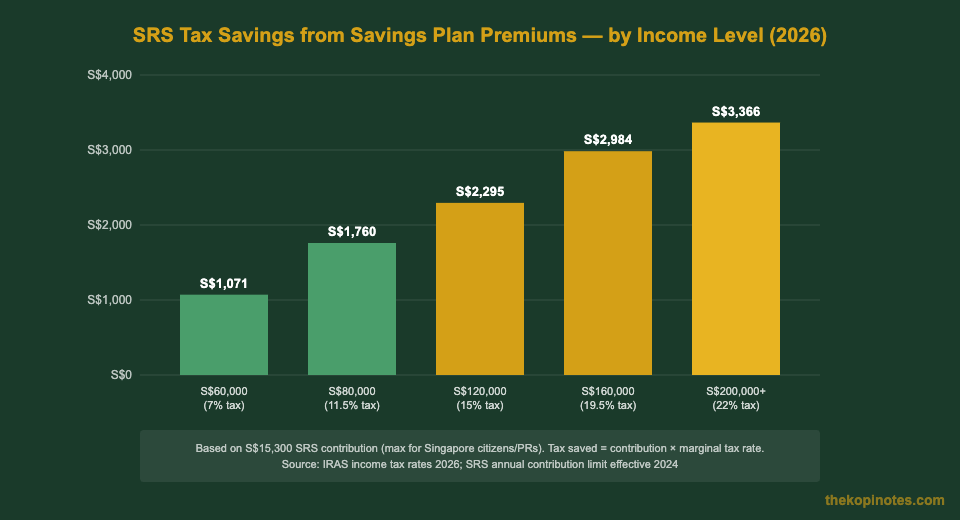
Here is the key insight: the tax savings you get from SRS contributions act as an instant return on your investment — before your money even earns a single dollar in interest.
Source: IRAS income tax rates 2026; SRS annual contribution cap S$15,300 (Singapore citizens/PRs)
If you earn S$120,000 and contribute S$15,300 to SRS, you save S$2,295 in tax. That is a guaranteed 15% instant return on your contribution — before interest. Then, whatever you invest inside SRS (T-Bills, unit trusts, endowment plans) earns additional returns on top.
SRS funds can be invested in: endowment plans (most insurers accept SRS premium payments), unit trusts via FSMOne, Endowus or StashAway, T-Bills, and Singapore government bonds.
SRS withdrawal at retirement: When you withdraw from SRS at or after statutory retirement age (63 in 2026), only 50% of the withdrawn amount is taxable. This means your effective tax on withdrawal is very low — especially if your income drops in retirement.
To maximise SRS: contribute the full S$15,300 each January, invest immediately (idle SRS cash earns only 0.05% p.a.), and use Endowus (code 2V343) or Syfe (code SRPRFFFCD) to invest in a diversified ETF portfolio for long-term growth.
How to Choose the Right Savings Plan: A Practical Framework
Use this decision framework to find your best savings plan mix in Singapore 2026. Most people end up using 2–3 different savings vehicles for different goals:
| Your Situation | Best Savings Plan | Why |
|---|---|---|
| Emergency fund (3–6 months expenses) | High-yield savings account | Instant access, no lock-in, 2.5–3.5% |
| Short-term goal (6–12 months) | T-Bills or fixed deposits | 3–3.5% with defined maturity |
| Medium-term (1–5 years) | SSB + short-term endowment | Capital safe, decent returns, some flexibility |
| Retirement savings (10+ years) | CPF SA top-up + robo-advisor via SRS | 4% guaranteed + market upside + tax relief |
| Child’s education fund (15+ years) | Endowment plan OR global ETF via robo | Structured maturity date; life cover option |
| Tax reduction + savings (income S$80k+) | SRS + endowment / T-Bills / unit trusts | S$1,760–S$3,366/year tax savings |
| Long-term wealth building (20+ years) | Global ETFs (CSPX/VWRA) via IBKR/moomoo | Lowest cost, highest long-term historical return |
Source: TKN analysis; CPF Board; MAS; July 2026
The golden rule: Never put all your savings into one plan. A typical Singapore saver in their 30s–40s should have: (1) 3–6 months emergency fund in a high-yield savings account, (2) voluntary CPF SA top-ups maximised, (3) SRS maxed out and invested in low-cost ETFs via Endowus or Syfe, and (4) residual cash in T-Bills or short-term endowments for medium-term goals.
Use our Singapore Retirement Calculator to model how different savings plan combinations affect your retirement goal.
Start Your Savings Plan Today
Use referral codes to maximise bonuses when opening these accounts:
Frequently Asked Questions
What is the best savings plan in Singapore in 2026?
Which savings plan gives the highest returns in Singapore?
Is an endowment plan better than CPF SA?
Can I use SRS to invest in savings plans?
How much should I save per month in Singapore?
Is my money safe in an endowment plan?
What is the difference between a savings plan and a savings account?
What is the minimum amount to start a savings plan in Singapore?
Where can I open an SRS account in Singapore?
Should I use CPF or SRS for my savings plan?
Get Free Insurance Advice
Speak with a licensed insurance advisor. No obligation, no cost.
By submitting this form, you agree to our Privacy Policy.
This article was researched with the help of AI. While we strive to keep all information accurate and up to date, there may be errors. If you notice any discrepancies, please contact us.