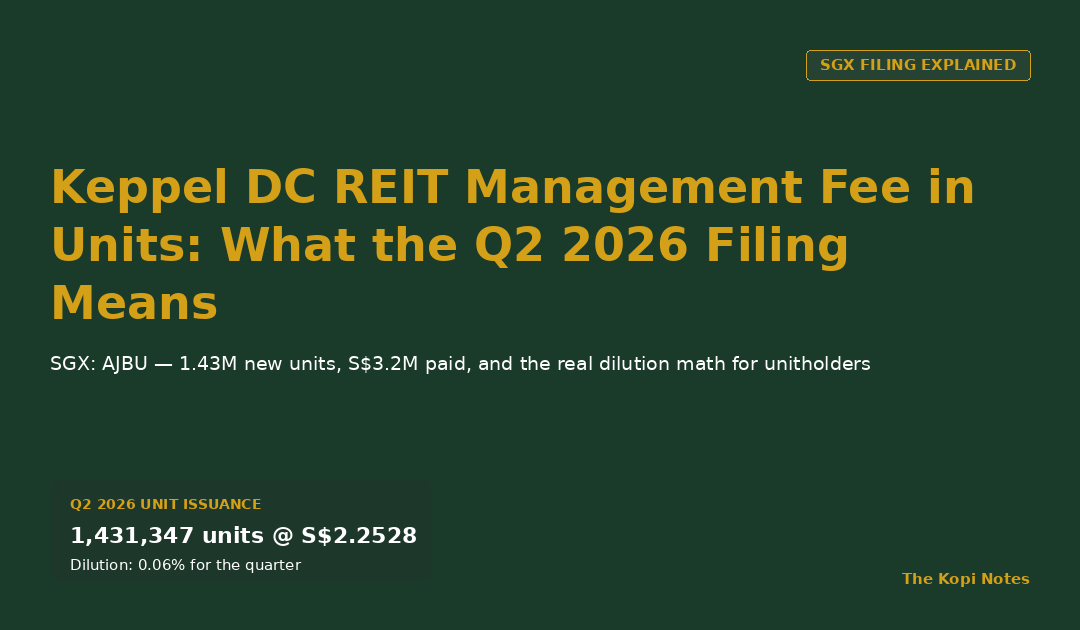
Keppel DC REIT Management Fee in Units: What the Q2 2026 SGX Filing Means for You
SGX: AJBU quietly issued 1.43 million new units to pay its manager — here’s the real dilution math, and why it barely matters next to DPU growth.
Keppel DC REIT (SGX: AJBU) issued 1,431,347 new units at S$2.2528 each — about S$3.2 million — to pay its manager’s base fee for Q2 2026, instead of paying cash. This is standard practice for Singapore REITs and slightly dilutes existing unitholders. But the dilution is tiny: roughly 0.06% for the quarter, versus 11.3% DPU growth over the same half-year.
Not financial advice. All figures are for educational reference only. Data as at August 2026 unless noted.
- Keppel DC REIT paid its Q2 2026 base management fee in 1,431,347 new units (S$3.2 million) instead of cash — a routine SGX filing, not a red flag.
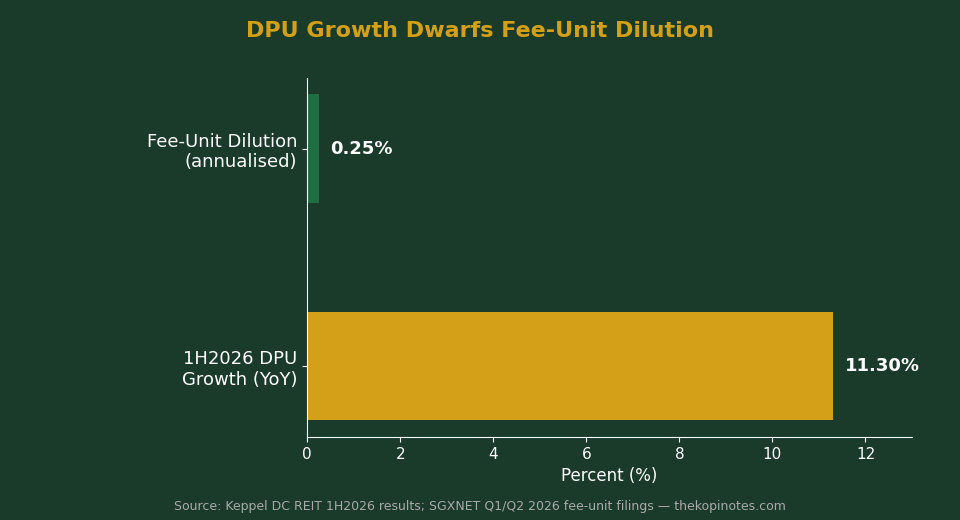
- Combined H1 2026 fee-unit dilution was about 0.13%, or roughly 0.25% annualised — tiny next to the REIT’s 11.3% DPU growth over the same period.
- The manager now holds 36.4 million units (1.49% of the REIT), up from 1.43% in Q1 — its interests grow more aligned with yours each quarter.
Table of Contents
Contents — Click to expand
- What Happened: The Q2 2026 SGX Filing
- Key Facts at a Glance
- Why S-REIT Managers Get Paid in Units, Not Just Cash
- The Dilution Math: What This Actually Costs You
- How This Fits Into Keppel DC REIT’s Strong 2026
- Keppel DC REIT vs Peer Data Centre REITs: Fee Alignment
- Should Unitholders Be Concerned?
- Frequently Asked Questions
What Happened: The Q2 2026 SGX Filing
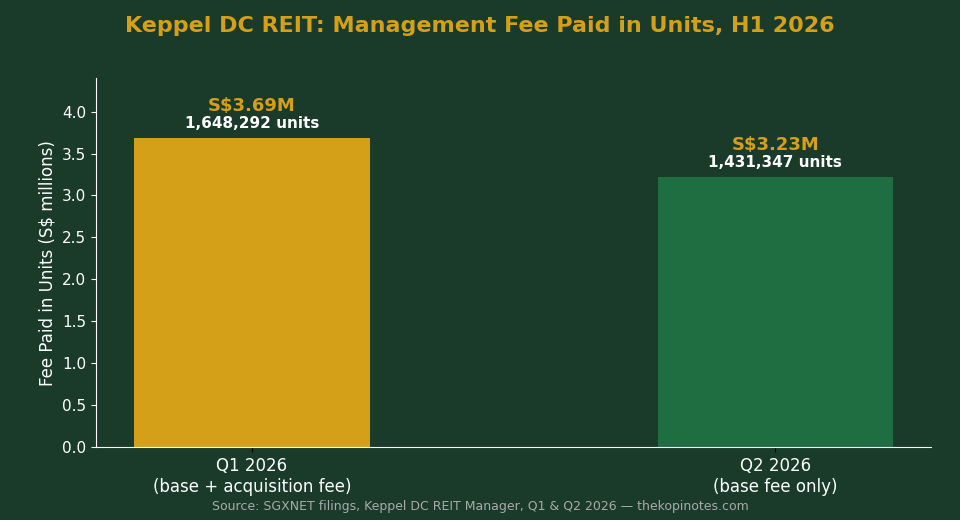
On its SGXNET announcement covering the period 1 April to 30 June 2026, Keppel DC REIT’s manager disclosed it had received a portion of its base management fee in units rather than cash. The manager issued 1,431,347 new units at an average price of S$2.2528, worth roughly S$3.22 million.
This followed a larger issuance in Q1 2026, when the manager received 1,648,292 units at S$2.2364 — about S$3.69 million — covering both a base fee component and an acquisition fee tied to Keppel DC REIT’s purchase of the remaining stakes in Keppel DC Singapore 3 and 4.
Neither filing is unusual. You’ll find similar SGXNET notices every quarter from almost every Singapore REIT. What matters for you as a unitholder is the size of the dilution and what it buys in return — which is exactly what this deep-dive breaks down.
Key Facts at a Glance
| Metric | Detail |
|---|---|
| Ticker | SGX: AJBU |
| Sector | Data centre REIT (Asia’s first pure-play) |
| Q2 2026 fee-unit issuance | 1,431,347 units @ S$2.2528 (~S$3.22M) |
| Q1 2026 fee-unit issuance | 1,648,292 units @ S$2.2364 (~S$3.69M) |
| Total units outstanding (post-Q2) | 2,447,605,207 |
| Manager’s unit holding | 36,373,101 units (~1.49% of the REIT) |
| 1H2026 DPU | 5.714 cents, up 11.3% year-on-year |
| 1H2026 distributable income | Up approximately 19% year-on-year |
| Share price (mid-Aug 2026) | ~S$2.20–S$2.29 |
Source: SGXNET filings via Keppel DC REIT Manager, Q1 & Q2 2026; Keppel DC REIT 1H2026 results.
Why S-REIT Managers Get Paid in Units, Not Just Cash
Every Singapore REIT’s trust deed lets the manager elect to receive some or all of its fees in units instead of cash. Keppel DC REIT’s manager regularly chooses this option for its base fee — the recurring fee tied to the value of properties it manages.
Here’s why this matters to you. If the manager took its fee entirely in cash, that cash would otherwise have gone toward property expenses, debt repayment, or your distributions. Paying in units keeps more cash inside the REIT.
The trade-off is dilution. Every new unit issued to the manager slightly increases the total unit count, which spreads the REIT’s income across more units. In theory, this shaves a sliver off your per-unit distribution — unless income grows faster than the unit count, which is exactly what has been happening at Keppel DC REIT.
There’s also an alignment argument. When a REIT manager holds a growing stake in units instead of cash, its own returns depend on the REIT’s unit price and distributions performing well — the same things you care about as a unitholder.
The Dilution Math: What This Actually Costs You
Let’s do the actual calculation instead of guessing. Before the Q1 2026 issuance, Keppel DC REIT had 2,444,525,568 units outstanding. Two fee-unit issuances later, it has 2,447,605,207 — an increase of 3,079,639 units, or about 0.126% over the first half of 2026.
Table 2 below breaks the two quarters apart. Notice the Q1 issuance was larger in unit count and value — it covered both the base fee and a one-off acquisition fee for the Keppel DC Singapore 3 and 4 stake purchase. Q2 was base fee only, and both smaller and cheaper on a per-unit basis, since the fee amount is roughly fixed in dollar terms while the unit price ticked slightly higher.
| Quarter | Units Issued | Avg. Price | Value | Dilution |
|---|---|---|---|---|
| Q1 2026 (base + acquisition fee) | 1,648,292 | S$2.2364 | ~S$3.69M | 0.067% |
| Q2 2026 (base fee only) | 1,431,347 | S$2.2528 | ~S$3.22M | 0.058% |
| H1 2026 combined | 3,079,639 | — | ~S$6.91M | 0.126% |
Source: thekopinotes.com calculation from SGXNET Q1 & Q2 2026 fee-unit filings, Keppel DC REIT Manager.
For a Singapore investor holding, say, 10,000 units of Keppel DC REIT, this dilution works out to a rounding error — a fraction of a cent per unit per quarter. It is not the kind of number that should change your buy, hold, or sell decision on its own.
How This Fits Into Keppel DC REIT’s Strong 2026
Here’s the context that matters most. Keppel DC REIT’s 1H2026 results, reported in July, showed DPU of 5.714 cents — up 11.3% from a year earlier — while distributable income rose approximately 19%. That growth came from AI-driven data centre demand, positive rental reversions, and full contributions from newly acquired assets.
Compare that to the roughly 0.25% annualised dilution from fee-unit issuances. DPU growth outpaced fee-related dilution by more than 40 times over the same period. In practice, the manager’s decision to take fees in units has had a negligible drag on your actual per-unit income growth this year.
That said, this comparison shouldn’t be read as “dilution never matters.” If Keppel DC REIT’s income growth ever stalled or reversed while it kept issuing fee units at the same pace, the dilution would start to bite more visibly into DPU. As at August 2026, that isn’t the situation — but it’s worth tracking each results season, not assuming it forever.
Keppel DC REIT vs Peer Data Centre REITs: Fee Alignment
Paying management fees partly in units is standard across Singapore’s data centre REIT peer group, not a Keppel DC REIT quirk. Here’s how the practice compares across the three SGX-listed pure-play data centre trusts.
| REIT | Ticker | Fee-in-Units Practice | 1H/1Q 2026 DPU Trend |
|---|---|---|---|
| Keppel DC REIT | AJBU | Base fee regularly paid in units, quarterly | Up 11.3% YoY (1H2026) |
| Digital Core REIT | DCRU | Manager fee structure includes unit-based elections | Flat at 1.80 cents (1H2026) |
| NTT DC REIT | NTDU | Newly listed; fee structure disclosed in prospectus | Beat IPO forecast by 10.6% (1Q FY2027) |
Source: Respective REIT managers’ SGXNET filings and results announcements, 2026.
You can read the full head-to-head on Keppel DC REIT vs NTT DC REIT if you’re weighing which data centre S-REIT deserves your capital. The short version: all three use unit-based fee elements, so this isn’t a factor that should tip the decision either way.
Should Unitholders Be Concerned?
Short answer: not because of this filing specifically. A quarterly fee-unit issuance under 0.1% of the unit base is routine, disclosed, and dwarfed by Keppel DC REIT’s current DPU growth trajectory, detailed further in our Keppel DC REIT 1H2026 results breakdown.
What’s worth watching instead: whether AI-driven data centre demand, covered in our Keppel DC REIT 2H2026 outlook, keeps supporting rental reversions and occupancy. That’s the bigger lever on your future DPU, not a few million dollars of fee units each quarter.
If you’re deciding whether to buy, hold, or add to a Keppel DC REIT position, our Keppel DC REIT share price target 2026 piece rounds up what analysts are currently forecasting, alongside the valuation context this fee-unit filing sits within.
For broader portfolio context, see our best S-REITs in Singapore 2026 comparison if you’re weighing Keppel DC REIT against other blue-chip options for passive income.
Frequently Asked Questions
Why did Keppel DC REIT issue new units in Q2 2026?
Keppel DC REIT’s manager elected to receive part of its base management fee for the quarter ending 30 June 2026 in units rather than cash. It issued 1,431,347 new units at S$2.2528 each, worth about S$3.22 million, under an SGXNET announcement.
Does paying management fees in units hurt my dividends?
Only slightly. The Q2 2026 issuance diluted existing unitholders by about 0.06% for the quarter. Over the full first half of 2026, combined fee-unit dilution was roughly 0.13%, versus 11.3% DPU growth over the same period — a negligible drag in the current environment.
Is it normal for S-REIT managers to be paid in units?
Yes. Nearly every Singapore REIT’s trust deed allows the manager to elect part or all of its base fee in units instead of cash. This conserves cash inside the REIT and gives the manager a growing stake, aligning its interests with unitholders.
How many units does Keppel DC REIT's manager now hold?
Following the Q2 2026 issuance, the manager holds 36,373,101 units, or about 1.49% of Keppel DC REIT’s 2,447,605,207 total units outstanding — up from roughly 1.43% after the Q1 2026 issuance.
How does Keppel DC REIT's fee structure compare to other data centre REITs?
Keppel DC REIT, Digital Core REIT, and NTT DC REIT all include unit-based elements in their manager fee structures, a standard feature across Singapore-listed REITs. It’s a sector-wide practice, not something specific to Keppel DC REIT.
Should I sell Keppel DC REIT because of this dilution?
Not based on this filing alone. The dilution is small, disclosed, and currently outpaced by strong DPU and distributable income growth. Your investment decision should weigh the broader outlook — occupancy, rental reversions, and AI-driven data centre demand — over a routine quarterly fee filing.
Want to Build Your Own S-REIT Income Portfolio?
Open a brokerage account and start investing in Singapore REITs today. Use our referral links for exclusive sign-up bonuses.
This article was researched with the help of AI. While we strive to keep all information accurate and up to date, there may be errors. If you notice any discrepancies, please contact us.