Keppel DC REIT 2H2026 Outlook: AI Data Centre Demand, DPU Trajectory & Acquisition Pipeline (SGX: AJBU)
A forward-looking read on what the AI and hyperscaler leasing wave means for Keppel DC REIT DPU, gearing and acquisition pipeline through the rest of 2026.
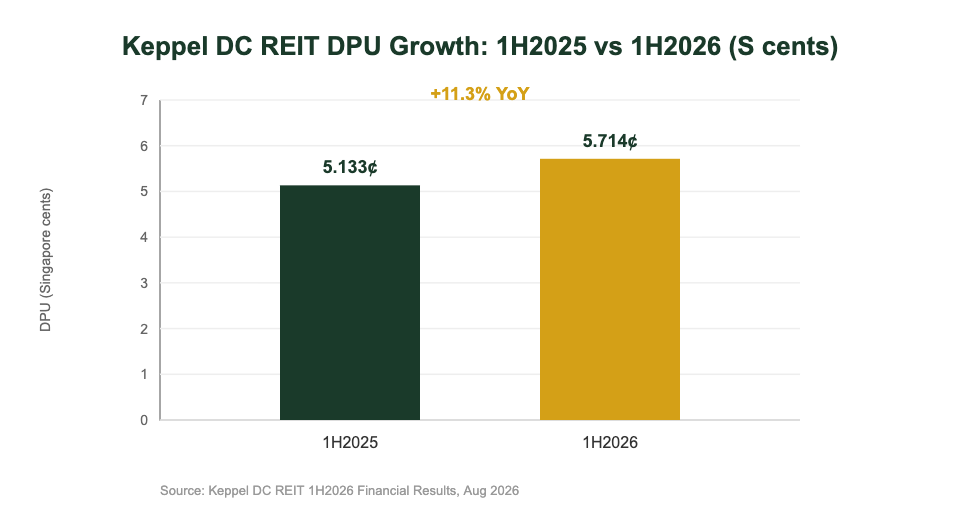
Keppel DC REIT enters 2H2026 riding an AI-driven data centre demand wave, after 1H2026 DPU rose 11.3% to 5.714 cents on 14.5% revenue growth. With gearing steady at 34.0% and S$673 million in debt headroom, the REIT is positioned to fund further AI-ready hyperscale acquisitions while hyperscaler leasing demand keeps rental reversions positive across its Singapore-anchored portfolio.
Not financial advice. All figures are for educational reference only. Data as at August 2026 unless noted.
TL;DR
- 1H2026 DPU rose 11.3% YoY to 5.714 cents, keeping Keppel DC REIT among the highest-yielding data centre S-REITs on SGX.
- A S$1.38 billion deal for two AI-ready hyperscale data centres at Keppel Data Centre Campus is expected to be 8.1% DPU-accretive.
- Gearing sits at a healthy 34.0% with S$673 million of debt headroom, giving room for more acquisitions without a rights issue.
Table of Contents
What Happened in 1H2026: The Springboard for 2H
The AI and Hyperscaler Demand Tailwind
One useful lens here is WALE, or weighted average lease expiry, a measure of how long the REIT\u2019s leases run on average, weighted by rental income. A longer WALE with hyperscaler tenants gives you more visibility into future income, because these tenants tend to sign multi-year commitments once a facility is built out for their specific power and cooling needs. As Keppel DC REIT\u2019s AI-ready asset share grows, you should expect its overall WALE profile to lengthen rather than shorten.
DPU Trajectory: Can Growth Continue Into 2H2026?
Gearing and the Acquisition Pipeline
Risks to Watch in 2H2026
What Analysts Are Saying: Price Targets
How You Can Get Exposure to Keppel DC REIT
FAQ
What Happened in 1H2026: The Springboard for 2H
Before looking ahead, you need the 1H2026 baseline. Keppel DC REIT posted gross revenue and net property income (NPI) growth of 14.5% and 15.1% year-on-year respectively, driven by positive rental reversions, built-in rent escalations, and contributions from recent acquisitions.
Distribution per unit (DPU) — the cash payout each unitholder receives per unit held — rose 11.3% to 5.714 cents. That growth held even though occupancy dipped slightly on a vacancy at one Cardiff data centre, showing the rest of the portfolio more than offset a single asset drag. For the full breakdown of segment performance, see our Keppel DC REIT 1H2026 results breakdown.
| Metric | 1H2026 | YoY Change |
|---|---|---|
| Gross Revenue | Up 14.5% | ▲ Positive |
| Net Property Income (NPI) | Up 15.1% | ▲ Positive |
| DPU | 5.714 cents | ▲ +11.3% |
| Aggregate Leverage (Gearing) | 34.0% | Improved |
| Cost of Debt | 2.7% | Stable |
| Debt Headroom | S$673 million | — |
Source: Keppel DC REIT 1H2026 Financial Results, Aug 2026.
The AI and Hyperscaler Demand Tailwind
The single biggest story for Keppel DC REIT in 2H2026 is not a single lease or a single building. It is the structural shift in how much computing capacity the world needs. Cloud providers and AI companies are racing to secure data centre space, and Singapore remains one of the most sought-after hubs in Asia for this demand.
Hyperscalers — the very large cloud and AI companies that lease entire data centre buildings — need facilities that can support higher power density for AI training and inference workloads. Keppel DC REIT has responded by adding AI-ready hyperscale data centres to its portfolio rather than older, lower-power facilities. This matters to you as an investor because AI-ready buildings typically command longer leases and stronger rental reversions than legacy space.
The REIT also continues to reduce its historical China exposure in favour of Singapore-anchored assets. That shift lowers regulatory and currency risk while aligning the portfolio with where hyperscaler demand is strongest. If this demand trend holds through 2H2026, you should expect continued positive rental reversions when leases come up for renewal.
DPU Trajectory: Can Growth Continue Into 2H2026?
DPU growth of 11.3% in 1H2026 is a strong number for a REIT of Keppel DC REIT size. The question for 2H2026 is whether that pace holds. Three factors support continuation: rent escalations already contracted into existing leases, a full-period contribution from assets acquired partway through 1H2026, and the potential for the pending S$1.38 billion Singapore acquisition to complete and add to distributable income before year-end.
Working against faster growth is the base effect: each additional half-year makes an 11%-plus YoY jump harder to repeat. You should also watch occupancy at the Cardiff facility that dragged on 1H2026 — a full re-let there would be a modest but real tailwind for 2H2026 DPU.
Gearing and the Acquisition Pipeline
Gearing (also called aggregate leverage) measures total debt as a percentage of total assets. At 34.0%, Keppel DC REIT sits comfortably below the regulatory ceiling of 50% set by the Monetary Authority of Singapore (MAS) for S-REITs, leaving room to gear up for acquisitions without immediately needing to raise new equity.
The REIT has proposed acquiring two AI-ready hyperscale data centres within the Keppel Data Centre Campus in Singapore from a Keppel joint venture for S$1.38 billion, a deal management expects to be 8.1% DPU-accretive. Beyond this deal, further sponsor pipeline assets are expected to stabilise only in 2028/29, meaning the next wave of inorganic growth is more of a 2027-28 story than an immediate 2H2026 catalyst. Read the official announcement on the Keppel corporate newsroom.
| Deal | Asset Type | Price | Expected DPU Impact |
|---|---|---|---|
| Keppel Data Centre Campus (2 assets) | AI-ready hyperscale, Singapore | S$1.38 billion | +8.1% accretive |
| Sponsor pipeline (future) | AI-ready hyperscale | Not yet disclosed | Stabilising 2028/29 |
Source: Keppel corporate announcements, Aug 2026.
It also helps to compare this deal structure to how Keppel DC REIT has grown historically. Earlier acquisitions were often smaller, single-asset deals funded through a mix of debt and private placements. The current pipeline is different in scale: a single S$1.38 billion transaction is roughly comparable to a meaningful slice of the REIT\u2019s existing asset base, which is why the 8.1% DPU accretion figure matters so much to the 2H2026 and FY2026 growth story. If completion slips into 2027, the near-term DPU benefit would slip with it.
Risks to Watch in 2H2026
No REIT outlook is complete without the risks. First, interest rate moves still matter — even at a low 2.7% cost of debt, any refinancing done at higher rates would compress distributable income. Second, concentration risk remains: a large share of income still comes from a relatively small number of buildings and tenants, so any hyperscaler downsizing would be felt quickly.
Third, currency risk persists from overseas assets, and fourth, the AI capex cycle itself could slow if hyperscalers pause expansion plans. None of these risks are unique to Keppel DC REIT, but they are the specific factors that could derail the 2H2026 DPU growth story described above.
What Analysts Are Saying: Price Targets
Sell-side research has turned more constructive on the AI data centre theme. OCBC Investment Research has set a target price near S$2.86, while Maybank has pointed to around S$2.60, both citing data centre demand tailwinds as the core driver. For the full list of analyst targets and how they compare, see our Keppel DC REIT share price target 2026 guide.
Keep in mind analyst targets are forecasts, not guarantees. Treat them as one data point alongside the fundamentals covered above, not as a reason to buy or sell on their own.
How You Can Get Exposure to Keppel DC REIT
If the AI data centre demand story appeals to you, Keppel DC REIT trades on SGX and is accessible through most Singapore brokerages, as well as robo-advisor and investment platforms that support direct SGX stock purchases. Before adding any single S-REIT to your portfolio, it helps to see how it stacks up against other options — our guide to the best S-REITs in Singapore 2026 is a useful starting point, and our passive income Singapore guide covers how REIT dividends fit into a broader income strategy.
If you are opening a new brokerage account to buy SGX-listed S-REITs, Syfe is one platform that supports SGX trading alongside its other portfolios. You can also model how REIT income contributes to your retirement number using our Singapore retirement planning calculator before deciding how much to allocate.
Diversified brokers also matter if you plan to build a broader S-REIT portfolio around this theme rather than a single-counter bet. Platforms like FSMOne and Interactive Brokers (IBKR) both support direct SGX purchases and let you combine Keppel DC REIT with other data centre or diversified S-REITs without concentrating your entire portfolio in one counter.
FAQ: Keppel DC REIT 2H2026 Outlook
What is Keppel DC REITu2019s DPU trend heading into 2H2026?
What does gearing mean for a REIT like Keppel DC REIT?
How does AI demand actually affect Keppel DC REITu2019s income?
Is the S$1.38 billion acquisition already reflected in the share price?
What is WALE and why does it matter here?
What are the main risks to the 2H2026 outlook?
Zooming out, the AI data centre theme is still early. Singapore\u2019s land constraints mean supply growth is slower than demand growth, which is exactly the setup that has historically supported rental reversions for well-located data centre landlords. Keppel DC REIT\u2019s 2H2026 is less about a single catalyst and more about whether this multi-year demand backdrop keeps translating into contracted, escalating rents.
The Bottom Line
Keppel DC REIT heads into 2H2026 with the fundamentals in place for continued, if likely more moderate, DPU growth: an AI-driven demand backdrop, contracted rent escalations, manageable gearing, and a DPU-accretive acquisition in the pipeline. The base effect from a strong 1H2026 means 2H2026 growth may not match 11.3%, but the underlying demand story remains intact.
As always, treat this as one input into your own research, not a buy or sell signal. Not financial advice.
This article was researched with the help of AI. While we strive to keep all information accurate and up to date, there may be errors. If you notice any discrepancies, please contact us.