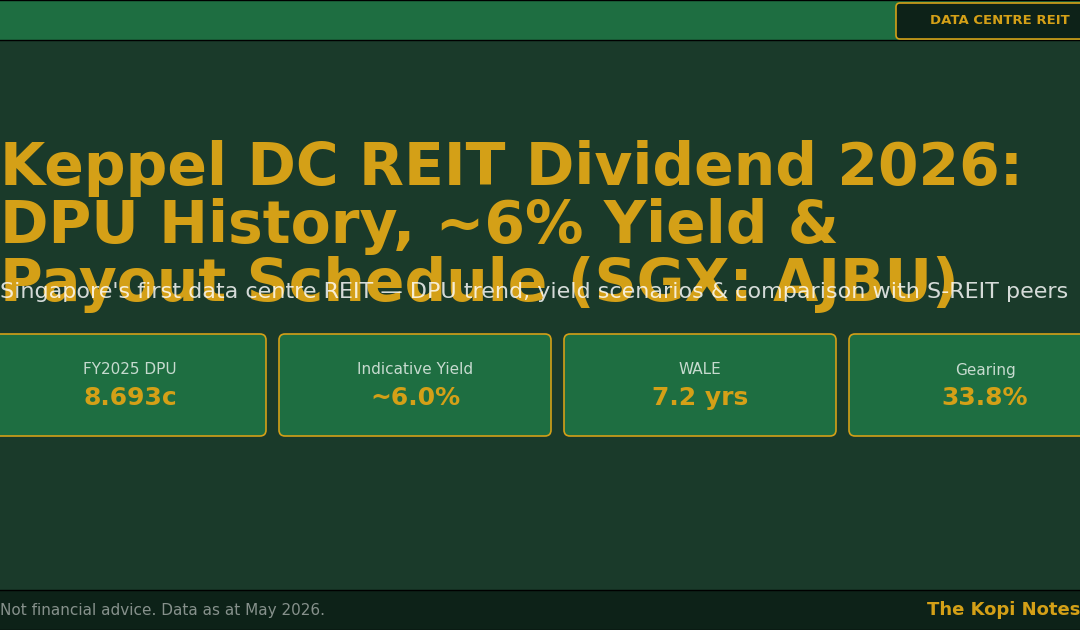
Keppel DC REIT Dividend 2026: DPU History, ~6% Yield & Payout Schedule (SGX: AJBU)
The definitive guide to Keppel DC REIT dividends — DPU trends, payout dates, yield analysis, and how this Singapore data centre REIT compares to peers.
Keppel DC REIT (SGX: AJBU) is Singapore’s first and largest pure-play data centre REIT, currently offering a distribution yield of approximately 5.8–6.2% based on its 2025 full-year DPU of 8.693 cents and a unit price near SGD 1.40–1.50. The REIT distributes semi-annually — typically in March and September — and has maintained a relatively stable DPU track record since its 2014 IPO, underpinned by long-term leases with blue-chip hyperscale tenants including Microsoft, Singtel, and NTT. For Singapore investors seeking data centre exposure with regular income, Keppel DC REIT remains one of the most liquid and well-researched S-REITs on SGX.
Not financial advice. All figures are for educational reference only. Data as at May 2026 unless noted.
Table of Contents
Contents — Click to expand
- Keppel DC REIT Overview (SGX: AJBU)
- DPU History 2015–2025
- Yield Analysis & Current Distribution Rate
- Payout Schedule & Ex-Dividend Dates
- What Drives Keppel DC REIT DPU?
- Peer Comparison: Data Centre REITs vs S-REIT Sector
- Portfolio Overview & Tenant Mix
- Key Risks to the Dividend
- How to Buy Keppel DC REIT for Dividends
- Frequently Asked Questions
Keppel DC REIT Overview (SGX: AJBU)
Keppel DC REIT was listed on SGX in December 2014, making it the first data centre REIT in Asia. Managed by Keppel DC REIT Management (a wholly-owned subsidiary of Keppel Ltd), the REIT owns and operates 23 data centre assets across 9 countries — Singapore, Australia, Germany, the UK, Ireland, Italy, the Netherlands, Malaysia, and China — with an aggregate lettable area (ALA) of approximately 489,000 sqm as at end-2025.
The REIT focuses on mission-critical data centre infrastructure leased on a long-term basis, typically 5–15 year initial terms with renewal options. Its tenant base includes global hyperscalers, enterprise IT firms, and telecommunications companies, giving it a highly defensive income stream relative to traditional commercial or retail S-REITs.
| Key Metric | Value (as at May 2026) |
|---|---|
| SGX Ticker | AJBU |
| Asset Class | Data Centres (Pure-Play) |
| Number of Assets | 23 data centres, 9 countries |
| Total AUM | ~SGD 3.9 billion |
| Gearing Ratio | ~33.8% (FY2025) |
| WALE | ~7.2 years (by rental income) |
| Occupancy Rate | ~97.9% |
| Distribution Frequency | Semi-annual (H1 + H2) |
| FY2025 DPU | 8.693 cents per unit |
| Indicative Yield (May 2026) | ~5.8–6.2% (at SGD 1.40–1.50) |
Source: Keppel DC REIT FY2025 Annual Report, SGX disclosures. Data as at May 2026.
DPU History 2015–2025
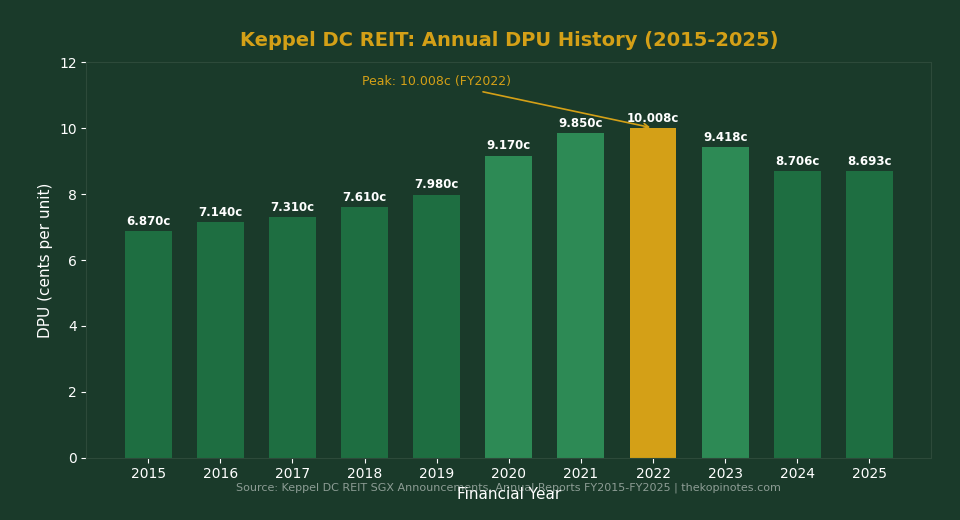
Keppel DC REIT has grown its DPU from 6.87 cents in FY2015 to a peak of 10.008 cents in FY2022, before moderating in FY2023–2025 due to higher financing costs and the reversal of non-recurring items. The long-term DPU trajectory remains broadly positive, underpinned by rental escalations and asset enhancement initiatives (AEIs) across its portfolio.
Below is the full annual DPU history since listing. Each year’s figure represents the total distributions declared for that financial year (two semi-annual tranches combined):
| Financial Year | Total DPU (cents) | YoY Change | Key Driver |
|---|---|---|---|
| FY2015 | 6.87 | — | First full year post-IPO |
| FY2016 | 7.14 | +3.9% | Portfolio expansion, S11 Alibaba acquisition |
| FY2017 | 7.31 | +2.4% | Stable occupancy, rental step-ups |
| FY2018 | 7.61 | +4.1% | First European acquisitions (Gore Hill completed) |
| FY2019 | 7.98 | +4.9% | Acquisitions in Netherlands & UK; full-year revenue uplift |
| FY2020 | 9.17 | +14.9% | COVID-19 demand surge; DC assets classified essential services |
| FY2021 | 9.85 | +7.4% | Portfolio growth; hyperscaler lease renewals at higher rents |
| FY2022 | 10.008 | +1.6% | Peak DPU; included one-off gains from divestments |
| FY2023 | 9.418 | -5.9% | Higher interest costs; reversal of FY2022 one-off items; China AEI |
| FY2024 | 8.706 | -7.6% | Rising debt costs, China asset impairment, rights issue dilution |
| FY2025 | 8.693 | -0.1% | DPU stabilising; hyperscaler demand recovery, Singapore AEI completed |
Source: Keppel DC REIT SGX announcements, Annual Reports FY2015–FY2025. DPU figures represent total distributions for each financial year.
The DPU moderation from FY2022 onward reflects three headwinds: (1) higher floating-rate debt costs as central banks raised rates aggressively in 2022–2023; (2) the impairment of Chinese data centre assets and associated revenue write-downs; and (3) mild dilution from the 2023 rights issue that raised SGD 514.6 million to strengthen the balance sheet. Encouragingly, FY2025 DPU stabilised at near-FY2024 levels, suggesting the trough may be behind the REIT as rate cuts emerge and the China situation is ring-fenced.
Yield Analysis & Current Distribution Rate
At Keppel DC REIT’s FY2025 DPU of 8.693 cents, the distribution yield varies meaningfully with price. Here is how the yield stacks up at different unit price levels — a key reference point for investors deciding whether to accumulate or wait:
| Unit Price (SGD) | Indicative Yield (FY2025 DPU) | Context |
|---|---|---|
| SGD 1.20 | 7.24% | 52-week low territory (early 2024) |
| SGD 1.35 | 6.44% | Attractive accumulation zone |
| SGD 1.45 | 5.99% | Near current price (May 2026) |
| SGD 1.55 | 5.61% | Fair value range (consensus) |
| SGD 1.70 | 5.11% | 52-week high range (late 2023) |
| SGD 1.90 | 4.57% | Pre-rate-hike peak price range |
Source: The Kopi Notes calculations based on Keppel DC REIT FY2025 DPU of 8.693 cents. Yield is gross before personal tax considerations.
For context, Singapore individual investors pay zero tax on REIT distributions (S-REITs are exempt from withholding tax for individual unitholders resident in Singapore). This makes the gross yield equivalent to the net yield — an important edge over dividend stocks, which are paid from post-tax corporate earnings. A Singapore investor holding 50,000 units of Keppel DC REIT at SGD 1.45 (cost: SGD 72,500) would receive approximately SGD 4,347 per year in distributions at FY2025 DPU levels — equivalent to SGD 2,174 per semi-annual payout.
Investors focused on passive income Singapore strategies often pair Keppel DC REIT with other high-yield S-REITs. See our full analysis at passive income Singapore for a broader portfolio framework.
Payout Schedule & Ex-Dividend Dates
Keppel DC REIT distributes twice a year — for the first half (H1: January–June) and the second half (H2: July–December) of each financial year. The typical timeline from results announcement to distribution payment runs about 8–10 weeks:
| Period | Results Announcement | Ex-Dividend Date | Payment Date |
|---|---|---|---|
| H1 FY2025 (Jan–Jun) | July 2025 | Late July / Early Aug 2025 | September 2025 |
| H2 FY2025 (Jul–Dec) | January 2026 | Late Jan / Early Feb 2026 | March 2026 |
| H1 FY2026 (Jan–Jun) | July 2026 (est.) | Late July 2026 (est.) | September 2026 (est.) |
Source: Keppel DC REIT SGX announcements. Future dates are estimates based on historical pattern. Always verify on SGX before trading.
Key rule for investors: You must hold units on or before the ex-dividend date (books closure date) to qualify for the distribution. Buying on the ex-dividend date itself does not qualify you. The exact books closure date is announced alongside the financial results — check SGX company announcements for the official date when results are released.
Keppel DC REIT also offers a Distribution Reinvestment Plan (DRP) from time to time, allowing unitholders to receive new units in lieu of cash distributions at a slight discount to the market price. Whether the DRP is active in any given period is announced at the same time as the distribution declaration.
What Drives Keppel DC REIT DPU?
Understanding the key levers behind Keppel DC REIT’s DPU helps investors assess whether the payout is likely to grow, stabilise, or come under pressure in the years ahead. Five factors dominate the DPU equation:
1. Rental Income & Escalations
The bulk of Keppel DC REIT’s income comes from long-term leases with built-in annual rental escalations — typically 1–3% per year, or CPI-linked in European markets. As existing leases renew (often at higher market rates given the structural undersupply of data centre capacity), rental income grows organically. The weighted average lease expiry (WALE) of ~7.2 years means near-term lease rollover risk is low, with most renewals clustered in the 2028–2032 window.
2. Interest Rate Environment
Keppel DC REIT’s gearing of ~33.8% means that roughly a third of its asset base is debt-funded. With ~60–70% of its debt at fixed rates (hedged via interest rate swaps), the impact of rate changes is partially cushioned. However, when the unhedged floating-rate tranche reprices — or when fixed-rate swaps roll off — financing costs change. The 2023–2024 DPU decline was partly a function of refinancing at higher rates. As the Federal Reserve and ECB cut rates in 2025–2026, Keppel DC REIT’s interest costs should gradually ease, supporting DPU recovery.
3. Occupancy & Asset Performance
At ~97.9% occupancy, Keppel DC REIT is effectively fully leased. The primary occupancy risk is concentrated in its China portfolio — specifically the Guangdong and Yangtze River Delta data centres, which faced demand challenges in 2023–2024. The management has taken impairments and is actively working to re-lease or reposition these assets. Excluding China, the global portfolio occupancy is near 100%.
4. Currency Exposure
With approximately 41% of revenue in USD, 28% in EUR, 18% in AUD, and 13% in SGD (approximate FY2025 breakdown), Keppel DC REIT has meaningful foreign exchange exposure. Its distributions are paid in SGD after conversion, which means a strong SGD against the USD/EUR/AUD erodes the income translated back. The manager hedges forward FX positions on a rolling 12-month basis to reduce near-term volatility, but long-term currency trends remain a structural factor.
5. Acquisitions & Asset Recycling
Keppel DC REIT has historically grown DPU through yield-accretive acquisitions — most notably the 2019 European expansion and the 2021 hyperscaler-leased acquisitions in Singapore. Future acquisitions from Keppel Ltd’s data centre pipeline (sponsor ROFR) or third-party deals could add incremental DPU. Conversely, dilutive rights issues (as seen in 2023) temporarily reduce DPU per unit until the deployed capital generates income.
Peer Comparison: Keppel DC REIT vs S-REIT Sector
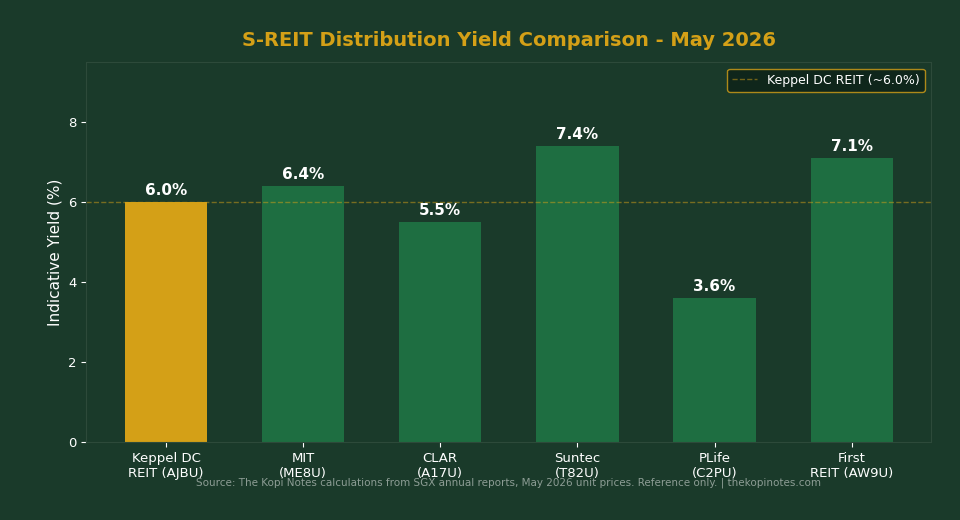
How does Keppel DC REIT’s dividend profile compare against other S-REITs and the broader sector? The table below benchmarks it against key peers across asset classes — useful for investors deciding where to allocate within the S-REIT universe for income:
| REIT (Ticker) | Asset Class | FY DPU (cents) | Indicative Yield | Gearing | WALE |
|---|---|---|---|---|---|
| Keppel DC REIT (AJBU) | Data Centre | 8.693 | ~6.0% | 33.8% | 7.2 yrs |
| Mapletree Industrial Trust (ME8U) | Industrial / DC | 13.52 | ~6.4% | 37.6% | 4.2 yrs |
| CapitaLand Ascendas REIT (A17U) | Industrial | 15.19 | ~5.5% | 37.5% | 4.0 yrs |
| Suntec REIT (T82U) | Commercial / Retail | 6.70 | ~7.4% | 42.1% | 2.8 yrs |
| Parkway Life REIT (C2PU) | Healthcare | 14.90 | ~3.6% | 35.9% | 8.7 yrs |
| First REIT (AW9U) | Healthcare | 2.50 | ~7.1% | 35.6% | 8.5 yrs |
Source: The Kopi Notes compilation from SGX annual reports and company announcements. Yields calculated at respective May 2026 unit prices. For reference only.
Within the comparison, Keppel DC REIT occupies a middle ground — offering higher yields than defensive healthcare REITs (Parkway Life) but lower than higher-gearing commercial REITs (Suntec). Its competitive advantage lies in its ultra-long WALE (7.2 years), low gearing relative to peers, and the structural tailwind of AI-driven data centre demand. For investors building a best S-REITs in Singapore 2026 portfolio, Keppel DC REIT is typically positioned as the growth-income hybrid — less income than retail or commercial REITs today, but with stronger long-term DPU recovery potential.
Investors seeking a broader S-REIT ETF approach (rather than single-REIT selection) may also consider the Singapore REIT ETF guide for a passive alternative that captures sector-wide exposure.
Portfolio Overview & Tenant Mix
The stability and growth trajectory of Keppel DC REIT’s dividend is inseparable from the quality of its portfolio. Here is a snapshot of the key characteristics that support (or stress) its income stream:
Singapore Assets (Highest Quality, ~29% of Portfolio Value)
Keppel DC REIT owns multiple data centres in Singapore — including KDC SGP 1 through SGP 7 — leased to hyperscalers and enterprise clients on triple-net or shell & core lease structures. Singapore’s moratorium on new data centre builds (2019–2022) created structural scarcity, pushing rents higher upon lease renewals. The SG assets generate stable SGD-denominated income with no FX risk and benefit from Singapore’s Tier-1 data centre hub status in Southeast Asia.
European Assets (Germany, Netherlands, UK, Ireland, Italy — ~38% of Portfolio)
European assets are typically leased on CPI-linked escalations, providing real income growth in inflationary environments. Germany and the Netherlands are mature, high-demand data centre markets. European regulations on data sovereignty are also driving enterprise demand for EU-based data centre capacity, supporting occupancy and rental growth.
Australia (Gore Hill, ~11% of Portfolio)
Gore Hill Data Centre in Sydney is a carrier-neutral colocation facility with multiple long-term tenants. The AUD-denominated income provides currency diversification, though AUD strength/weakness relative to SGD creates near-term noise in translated DPU figures.
China Assets (Guangdong, Yangtze — ~9% of Portfolio)
The China assets have been the most problematic segment. Revenue recognition issues and tenant defaults led to impairments in 2023–2024. The manager is working through recovery actions; these assets are now a contained risk rather than a growing concern. Until fully resolved or divested, China-related uncertainties remain a modest headwind to DPU predictability.
Top tenants by income contribution include Singtel, NTT, Microsoft, and several other investment-grade global corporations — providing a high-quality, financially robust tenant base that underpins dividend sustainability.
Key Risks to the Dividend
While Keppel DC REIT’s income profile is more defensive than most S-REITs, dividend investors should be aware of the key risks that could pressure future DPU:
Interest Rate Risk: If rates stay elevated longer than expected, or if the REIT needs to refinance debt at materially higher rates, DPU could face further headwinds. The next major refinancing cycle is in 2026–2027. Watch the manager’s borrowing cost disclosures at each results announcement.
China Asset Resolution: The Guangdong and Yangtze River Delta assets carry residual uncertainty. A further impairment or a forced divestment at below-book value would weigh on NAV and potentially trigger a one-off DPU cut. The manager’s progress on resolving these assets is the single most important near-term risk monitor.
Hyperscaler Lease Concentration: A large portion of revenue is tied to a handful of hyperscale tenants. While these are investment-grade counterparties, any major lease non-renewal (especially in Singapore or Europe) would create a significant income gap — data centres take 12–24 months to re-lease to alternative tenants.
Currency Volatility: A sustained strengthening of SGD relative to USD, EUR, and AUD would reduce the translated SGD value of offshore income, creating DPU headwinds even if underlying asset performance is healthy.
Acquisition Dilution: Future acquisitions funded by equity issuance (rights issues or private placements) dilute the unit count. If acquisitions are not immediately income-accretive, DPU per unit can dip temporarily. The 2023 rights issue is a historical example of this dynamic.
Despite these risks, Keppel DC REIT’s long WALE, low gearing, and high-quality tenant base give it a more resilient income base than the broader S-REIT sector average. For a comprehensive view of current S-REIT risks and opportunities, see the S-REIT Outlook 2026 article.
How to Buy Keppel DC REIT for Dividends
Keppel DC REIT (SGX: AJBU) is listed on the Singapore Exchange and can be purchased through any SGX-connected brokerage account. Here is a practical guide for Singapore investors looking to build a position for dividend income:
Step 1: Open a CDP-Linked Brokerage Account
Keppel DC REIT units are held in the Central Depository (Pte) Limited (CDP) system. You need a brokerage account linked to a CDP account to receive the distributions directly. Popular options include moomoo Singapore, Syfe Trade, FSMOne, and DBS Vickers. See the moomoo Singapore review for a detailed comparison of costs.
Step 2: Use SRS or CPF-OA (if eligible)
Keppel DC REIT is eligible for investment under the CPF Investment Scheme (CPFIS-OA) and the Supplementary Retirement Scheme (SRS). Using SRS allows you to invest pre-tax dollars and defer taxation on distributions until withdrawal — a powerful strategy for higher-income earners. For a framework on CPF investment decisions, visit the CPF investment strategy guide.
Step 3: Buy Before the Ex-Dividend Date
Confirm the exact ex-dividend (books closure) date from the SGX announcement when H1 or H2 results are released. You must be a registered unitholder by the books closure date to receive the upcoming distribution.
Step 4: Monitor the DPU Trend
Rather than chasing yield at any price, track the DPU trend over consecutive half-year results. A declining DPU trend warrants caution; stabilising or recovering DPU at a reasonable yield entry point suggests value. Use the Singapore retirement calculator to model how Keppel DC REIT distributions at current yields could contribute to your long-term passive income target.
New to brokerage accounts for REIT investing? Some platforms offer cash bonuses for new account sign-ups — check the Syfe referral code and sign-up bonus and FSMOne referral code for current promotions that can offset your first few months of brokerage fees.
Frequently Asked Questions
How often does Keppel DC REIT pay dividends?
What is Keppel DC REIT's current dividend yield?
Has Keppel DC REIT ever cut its dividend?
Is Keppel DC REIT dividend tax-free for Singapore investors?
What is Keppel DC REIT's DPU forecast for 2026?
Can I use CPF to buy Keppel DC REIT?
How does Keppel DC REIT compare to investing in a data centre ETF?
Disclaimer: This article is for informational and educational purposes only and does not constitute financial advice. Past DPU performance is not a guarantee of future distributions. Investing in REITs involves risks including potential loss of principal. Always do your own research and consult a licensed financial adviser before making investment decisions. Data accurate as at May 2026.
This article was researched with the help of AI. While we strive to keep all information accurate and up to date, there may be errors. If you notice any discrepancies, please contact us.