S-REIT Outlook 2026: Yield Comparison, Rate Cuts & Best Picks for Singapore Investors
Updated May 2026 | 8 min read | S-REITs & Dividends
The S-REIT sector in 2026 is at an inflection point. With the US Federal Reserve having delivered two rate cuts since late 2025 and Singapore’s 10-year government bond yield settling around 2.8–3.0%, Singapore REITs now offer a compelling yield spread of 200–300 basis points — the widest in over two years. Sector distribution yields range from 5% (large-cap diversified REITs) to over 7% (smaller industrial and retail REITs), and most S-REITs are trading at or near their post-2022 recovery highs. For Singapore investors seeking passive income, 2026 is shaping up as one of the more favourable entry windows since 2020.
Not financial advice. All figures are for educational reference only. Data as at May 2026 unless otherwise noted. Always consult a licensed financial adviser before investing.
📋 Table of Contents — Click to expand
Macro Backdrop: Why 2026 Is Different for S-REITs
The story of S-REITs from 2022 to 2024 was essentially a rate shock story. The Fed hiked rates from near-zero to 5.25–5.5% between March 2022 and July 2023, compressing REIT valuations as risk-free rates rose. Most S-REITs fell 20–35% from peak prices, and distribution per unit (DPU) growth stalled as higher floating-rate debt costs ate into distributable income.
By 2026, the landscape has shifted materially. The Fed delivered its first cut in September 2024 and followed with a further 50 basis points of cuts through 2025. As at May 2026, the federal funds rate sits in the 4.0–4.25% range, with market pricing suggesting one to two additional cuts by year-end. For Singapore REITs — which finance significant portions of their debt at floating rates benchmarked to SORA or USD LIBOR equivalents — every 25bps cut in borrowing costs flows directly to DPU.
The Singapore 10-year government bond yield has settled around 2.85–3.0%, down from its 2023 peak of ~3.5%. With the iEdge S-REIT Index offering an aggregate distribution yield of approximately 5.5–6.0% as at May 2026, the sector delivers a yield spread of roughly 250–300 basis points over the risk-free rate — historically a compelling entry level for long-term income investors.
Three additional tailwinds are worth noting for 2026:
- Occupancy recovery: Singapore office and retail occupancies remain strong (office ~94%, Orchard retail ~98%), underpinning stable rental income.
- Data centre demand: Industrial REITs with data centre exposure (Keppel DC REIT, Mapletree Industrial Trust) continue to benefit from AI-driven infrastructure investment.
- Active portfolio management: Several S-REITs completed AEIs (asset enhancement initiatives) in 2024–2025 that are now contributing to higher NPI, boosting DPU outlooks heading into FY2026.
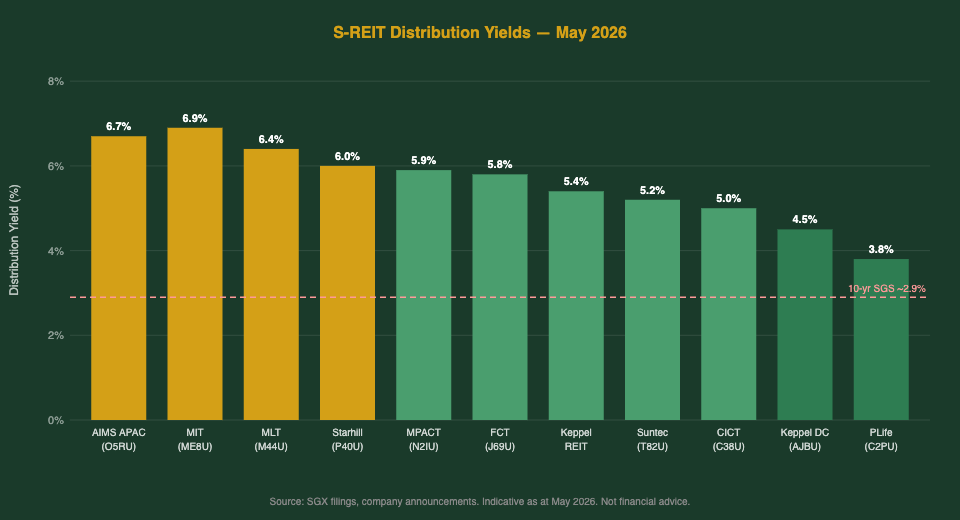
S-REIT Sector Yield Comparison Table (May 2026)
The table below summarises the indicative distribution yield, gearing ratio and interest coverage ratio (ICR) for major S-REITs across sectors as at May 2026. Yields are based on annualised DPU divided by share price — they will fluctuate with price movements.
| REIT (SGX Ticker) | Sector | Dist. Yield | Gearing | ICR |
|---|---|---|---|---|
| CapitaLand Ascendas REIT (A17U) | Industrial | ~5.5% | 38.2% | 3.8× |
| Mapletree Industrial Trust (ME8U) | Industrial | ~6.9% | 39.7% | 3.5× |
| Keppel DC REIT (AJBU) | Data Centre | ~4.5% | 36.8% | 5.1× |
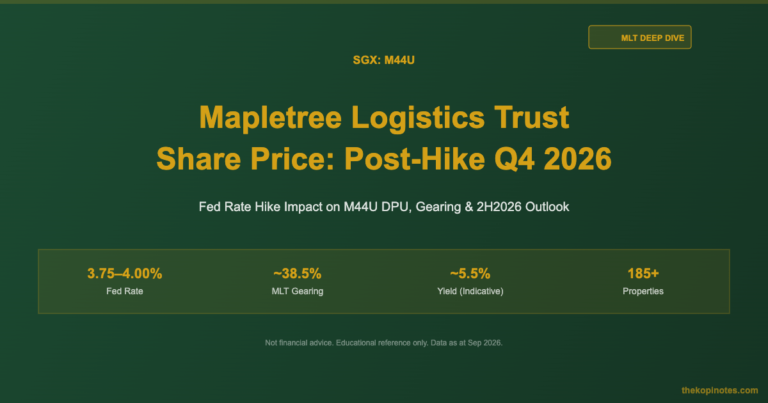
| Mapletree Logistics Trust (M44U) | Logistics | ~6.4% | 40.1% | 3.2× |
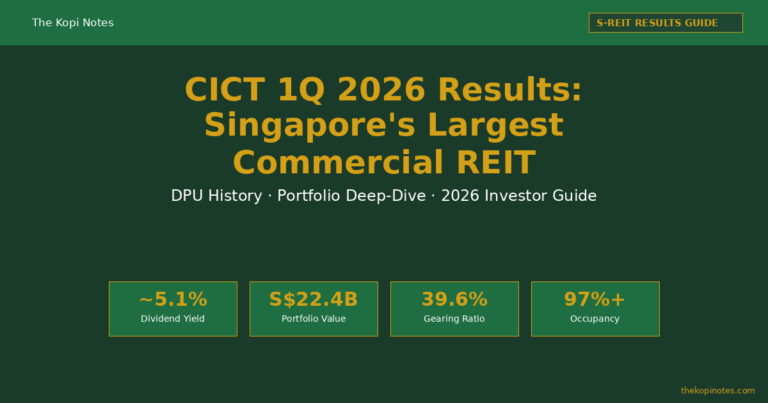
| CapitaLand Integrated Commercial (C38U) | Retail/Office | ~5.0% | 37.5% | 4.0× |
| Frasers Centrepoint Trust (J69U) | Retail | ~5.8% | 39.8% | 3.4× |
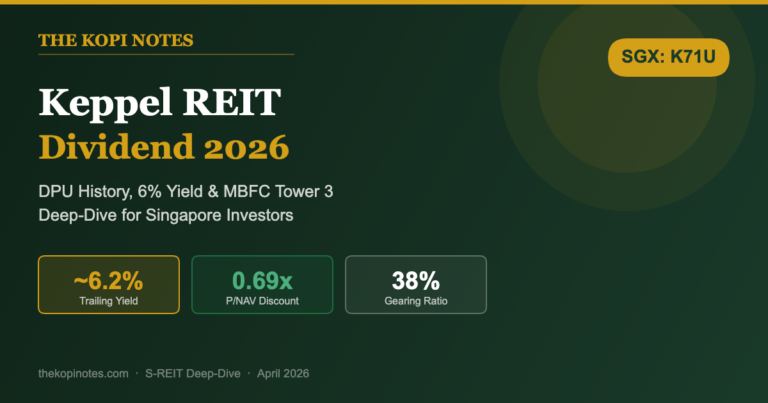
| Keppel REIT (K71U) | Office | ~5.4% | 40.6% | 3.1× |
| Suntec REIT (T82U) | Retail/Office | ~5.2% | 42.3% | 2.9× |
| Mapletree Pan Asia Comm. Trust (N2IU) | Retail/Office | ~5.9% | 36.5% | 3.6× |
| AIMS APAC REIT (O5RU) | Industrial | ~6.7% | 33.2% | 4.8× |
| ParkwayLife REIT (C2PU) | Healthcare | ~3.8% | 35.4% | 8.4× |
Source: SGX filings, company announcements, iEdge S-REIT Index. Indicative yields based on annualised DPU ÷ share price as at May 2026. Gearing = total debt ÷ total assets. ICR = interest coverage ratio. Not financial advice.
Sector-by-Sector Breakdown
Industrial REITs — The 2026 Standout
Industrial REITs remain the most compelling sector for yield-plus-growth investors in 2026. Singapore’s industrial property market is underpinned by three structural drivers: data centre buildout (driven by AI infrastructure demand), cold chain logistics (e-commerce and food supply chains), and high-spec business parks (life sciences and semiconductor-adjacent tenants).
Mapletree Industrial Trust (SGX: ME8U) exemplifies this theme — roughly 35% of its portfolio by AUM is in data centres, generating above-market rent reversions. Its FY2025/26 DPU of approximately 13.3 Singapore cents per unit translates to a yield of ~6.9% at current prices, with gearing at 39.7% — comfortably below MAS’s 50% regulatory cap. For income-seeking investors, MIT delivers one of the best risk-adjusted yield profiles in the index.
AIMS APAC REIT (SGX: O5RU) is the small-cap industrial pick: ~6.7% yield, conservative 33.2% gearing, and strong 9M FY2026 DPU growth of +2.5% YoY driven by positive rent reversions across its Singapore portfolio. Low gearing gives it the capacity to make accretive acquisitions if opportunities arise. Read our complete AIMS APAC REIT investor guide for the full DPU history and portfolio analysis.
Retail REITs — Resilient But Selective
Singapore retail REITs have proven more resilient than expected. Tourist arrivals have recovered to near pre-pandemic levels and suburban malls continue to post healthy tenant retention rates of 95%+. Frasers Centrepoint Trust (SGX: J69U), with its portfolio of heartland suburban malls (Causeway Point, Northpoint City North Wing, Waterway Point), benefits from the essential-services-heavy tenant mix that keeps foot traffic consistent regardless of economic cycles. FCT’s FY2025 DPU of approximately S$0.122 per unit implies a yield of ~5.8%.
Starhill Global REIT (P40U) offers 6.0% yield with Wisma Atria and Ngee Ann City as anchor assets on Orchard Road — benefiting from Singapore’s robust luxury retail recovery. See our Starhill Global REIT investor guide for the latest DPU and portfolio data.
Office REITs — Rate Sensitive, Watch Closely
Office REITs are the most rate-sensitive S-REIT sub-sector given their longer lease durations and higher average debt costs. Suntec REIT (T82U) and Keppel REIT (K71U) both carry gearing above 40%, meaning they are among the most leveraged in the index. As rate cuts proceed, these REITs stand to see the largest proportional DPU improvement — but their near-term distributions remain exposed to refinancing risk if rates stay higher for longer. CICT (C38U) is the safer office/retail hybrid: 21 properties across Singapore and overseas, 37.5% gearing, and a consistent DPU track record making it the go-to core holding.
Healthcare REITs — Low Yield, High Safety
ParkwayLife REIT (C2PU) is the gold standard of defensive income in Singapore. Its DPU has grown every single year since 2008 — 17 consecutive years of distribution growth — backed by long-term master lease agreements with IHH Healthcare. The trade-off: a yield of only ~3.8%, below the sector average. For investors who prioritise DPU stability over absolute yield, ParkwayLife is the anchor. Read our ParkwayLife REIT complete guide for the full DPU growth history.
How Rate Cuts Flow Through to S-REIT DPUs
Not all S-REITs benefit equally from rate cuts. The transmission mechanism depends on two factors: (1) the proportion of floating-rate debt, and (2) the weighted average debt maturity profile. A REIT with 60% floating-rate debt and S$2 billion in total debt would see approximately S$3 million in annual interest cost savings per 25 basis point cut — which at a unit base of 3 billion units translates to roughly S$0.001 per unit in additional annual DPU. Compounding across 100–150bps of cuts adds up: a REIT could see 5–10% DPU improvement over the next two years from rate normalisation alone.
| REIT | % Floating Debt | Total Debt (S$B) | Est. DPU Uplift (+100bps cut) |
|---|---|---|---|
| Suntec REIT | ~55% | S$4.5B | +4–6% |
| Keppel REIT | ~50% | S$4.8B | +4–5% |
| Mapletree Logistics Trust | ~45% | S$6.0B | +3–4% |
| CICT | ~35% | S$8.4B | +2–3% |
| ParkwayLife REIT | ~20% | S$0.8B | +1–2% |
Source: SGX filings, company annual reports Q1 2026. Estimates only. Not financial advice.
Gearing & Interest Cover Ratios — Who’s Most Resilient?
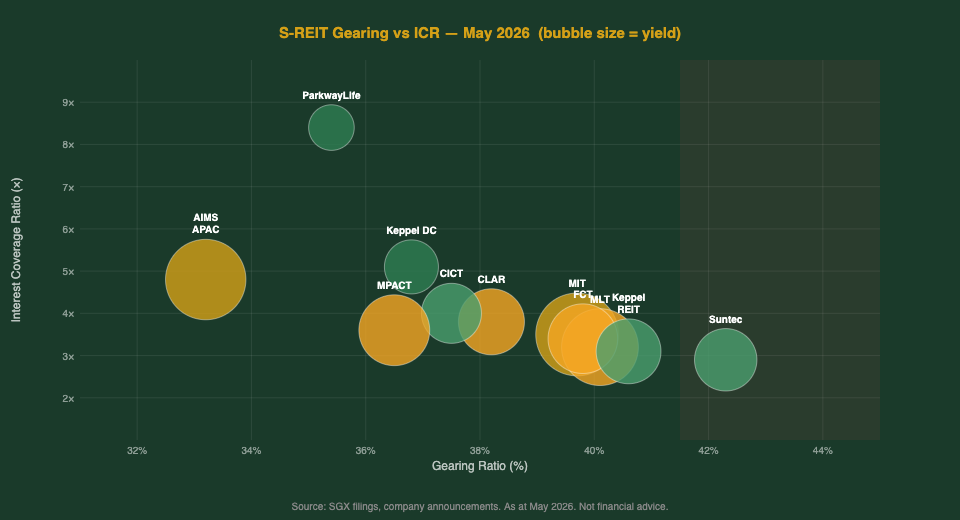
Under MAS regulations, S-REITs are capped at a 50% aggregate leverage ratio (gearing). REITs above 45% must maintain an interest coverage ratio of at least 1.5×. In practice, well-managed S-REITs target gearing of 35–42% to preserve headroom for acquisitions without approaching the regulatory ceiling. As at May 2026, the sector’s aggregate gearing is approximately 38–40%, slightly elevated versus the 2019 pre-pandemic average of ~35% but well within safe territory.
AIMS APAC REIT (33.2% gearing, 4.8× ICR) and ParkwayLife REIT (35.4% gearing, 8.4× ICR) stand out as the most conservatively financed S-REITs. Among larger REITs, CapitaLand Ascendas REIT (38.2% gearing, 3.8× ICR) offers a strong combination of scale, diversification and balance sheet health. For investors building a portfolio of S-REITs, pairing a lower-gearing anchor (e.g. CLAR or CICT) with a higher-yield, slightly higher-gearing name (e.g. MIT or AIMS APAC REIT) optimises income. Use the S-REIT yield vs bond spread calculator to model different portfolio weightings.
Best S-REIT Picks for 2026: Yield, Safety & Growth
No single S-REIT is optimal for every investor. The right picks depend on whether you prioritise current yield, DPU stability, or growth potential from rate cuts. Below is our educational framework across three objectives — not personalised financial advice.
For Highest Sustainable Yield
AIMS APAC REIT (O5RU) — ~6.7% yield. Low gearing (33.2%), strong ICR (4.8×), consistent DPU growth, Singapore-focused industrial portfolio with positive rent reversions.
Mapletree Industrial Trust (ME8U) — ~6.9% yield. Data centre exposure gives it a structural growth story. The best pick if you want a REIT that benefits from both the AI infrastructure boom and the rate cut cycle.
For Defensive Income & DPU Stability
ParkwayLife REIT (C2PU) — ~3.8% yield, 17 consecutive years of DPU growth. If you are building a retirement income stream and want a REIT you can hold through any market cycle, ParkwayLife is the gold standard.
CapitaLand Integrated Commercial Trust (C38U) — ~5.0% yield. Singapore’s largest REIT by market cap. Diversified retail + office income from 21 properties, conservative gearing, consistent DPU — the core anchor for most S-REIT portfolios. Check our guide to the best S-REITs in Singapore 2026 for a broader comparison.
For Rate-Cut Upside
Suntec REIT (T82U) — ~5.2% yield, highest leverage. The most interest-rate-sensitive large S-REIT. If rate cuts accelerate in H2 2026, Suntec’s DPU could recover meaningfully. Singapore office occupancy at 98.8% is a positive. But 42.3% gearing and a recent history of DPU volatility mean this is for investors with a higher risk tolerance. Our Suntec REIT investor guide covers the 1Q26 DPU turnaround in detail.
How to Invest in S-REITs in Singapore
Singapore investors have several routes to S-REIT exposure. The most direct is buying individual REITs on the SGX via a brokerage account. For diversified exposure, the Singapore REIT ETF guide covers all listed options including the Lion-Phillip S-REIT ETF (SGX: CLR) which offers ~30 S-REITs in a single fund with CPF/SRS eligibility.
- Individual REITs via SGX: Use a platform like FSMOne or IBKR. Minimum lot size is 100 units. Use an FSMOne referral code for reduced fees.
- Syfe REIT+ Portfolio: Managed S-REIT exposure with automatic rebalancing. No minimum, 0.4–0.65% p.a. fee. Use a Syfe referral code for a fee waiver on your first S$30,000.
- Endowus via CPF or SRS: For CPF-OA or SRS investors, Endowus gives access to REIT funds with your retirement savings. Use an Endowus referral code to start with S$10,000 fee-free.
Use the S-REIT total return calculator to model long-term compounded returns from different entry yields and DPU growth rates before committing capital. For retirement planning context, the Singapore retirement calculator can show how S-REIT income fits your long-term financial plan.
Key Risks to Watch in 2026
- Rate cut delays or reversals: If US inflation re-accelerates and the Fed pauses or reverses its cutting cycle, S-REIT valuations (especially high-gearing names) would come under pressure again.
- Geopolitical and trade tariff risk: US tariff escalation could dampen Singapore’s GDP growth and reduce demand for industrial/logistics space. Logistics and export-oriented industrial REITs have some tariff sensitivity. Our passive income Singapore 2026 guide covers how to position defensively.
- Currency risk: Several S-REITs have significant overseas assets priced in AUD, JPY, EUR, GBP or USD. Currency movements can materially impact Singapore-dollar DPU.
- Refinancing risk: Several S-REITs have large debt tranches maturing in 2026–2027. Wider credit spreads or higher rates at rollover could compress DPU unexpectedly.
- Dilutive rights issues: A REIT that issues new units to fund acquisitions dilutes existing holders if the placement price is below NAV.
Disclaimer: All data is indicative and for educational purposes only as at May 2026. Past DPU performance is not a guarantee of future distributions. Consult a licensed financial adviser before making any investment decisions.
Frequently Asked Questions
What is the average S-REIT yield in 2026?
Which S-REIT has the highest yield in 2026?
Are S-REITs safe to invest in 2026?
How does the Fed rate cut affect S-REITs?
Can I invest in S-REITs using CPF or SRS?
What is a good gearing ratio for S-REITs?
What is the S-REIT yield spread and why does it matter?
Should I invest in individual S-REITs or an S-REIT ETF?
Is this article financial advice?
Start Building Your S-REIT Income Portfolio
Use our free tools and referral bonuses to start earning passive income from Singapore REITs today.
This article was researched with the help of AI. While we strive to keep all information accurate and up to date, there may be errors. If you notice any discrepancies, please contact us.