Suntec REIT (SGX: T82U): Complete Investor Guide 2026
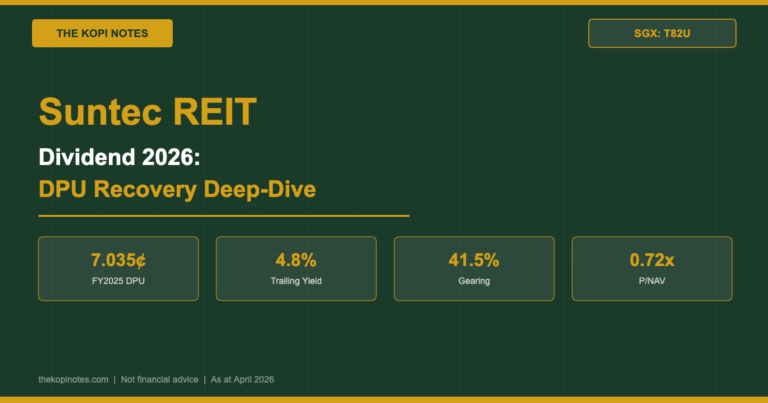
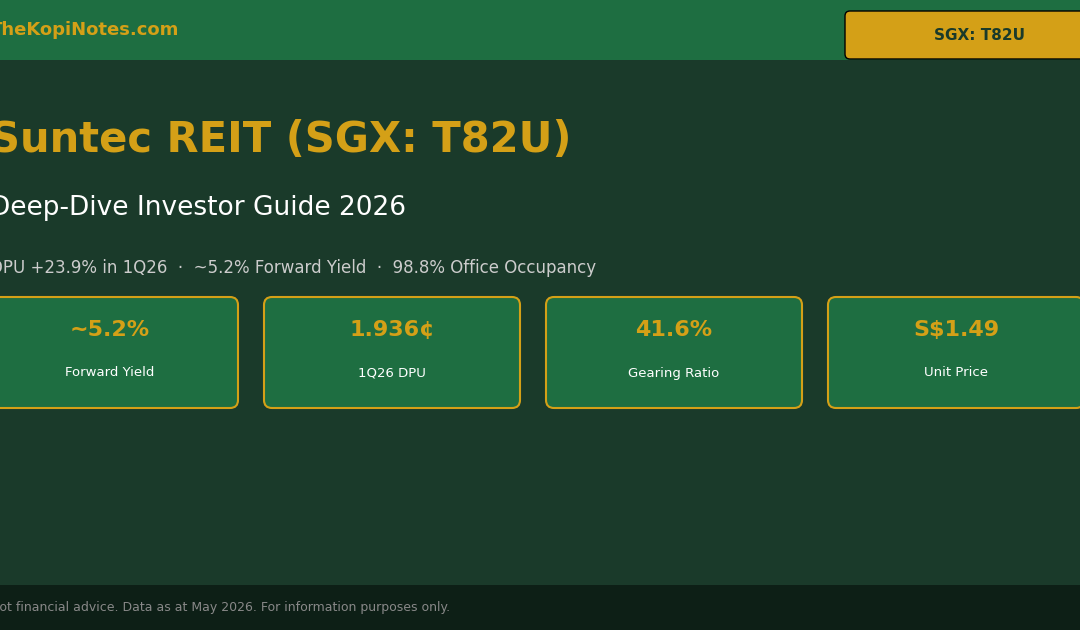
Suntec REIT just delivered its strongest quarterly result in years — DPU surged 23.9% year-on-year in 1Q 2026 to 1.936 Singapore cents, driven by Singapore’s near-fully-occupied office and retail portfolio and materially lower financing costs. With a ~5.2% forward yield, analyst consensus target of S$1.61 (8% upside), and fresh 1Q26 results confirming the recovery thesis, is Suntec REIT worth adding to your Singapore income portfolio? This deep-dive covers everything you need to know.
Not financial advice. Data as at May 2026. Always do your own research before investing.
1. Suntec REIT Overview
Suntec REIT (SGX: T82U) is one of Singapore’s largest and most diversified commercial REITs, owning a portfolio of prime office and retail properties valued at approximately S$12.2 billion as at 31 March 2026. Listed on the Singapore Exchange since 2004, Suntec REIT is managed by ARA Trust Management (Suntec) Limited.
The portfolio is anchored by Singapore’s iconic Suntec City — a landmark integrated development comprising Suntec City Mall, four Grade A office towers, and a one-third interest in the Suntec Singapore Convention & Exhibition Centre. Beyond Suntec City, the REIT holds interests in two of Singapore’s most prestigious Grade A office addresses: One Raffles Quay (ORQ) and Marina Bay Financial Centre (MBFC) Towers 1 and 2 and Marina Bay Link Mall.
| Metric | Value (as at May 2026) |
|---|---|
| SGX Ticker | T82U |
| Unit Price | ~S$1.49 |
| Market Capitalisation | ~S$4.4 billion |
| Portfolio Value | ~S$12.2 billion |
| Gearing Ratio | 41.6% |
| Cost of Debt | 3.56% |
| 1Q26 DPU | 1.936 Singapore cents (+23.9% YoY) |
| Forward Yield (est.) | ~5.2% (annualised 1Q26 DPU) |
| Analyst Consensus Target | S$1.61 (8.1% upside) |
2. DPU & Distribution History
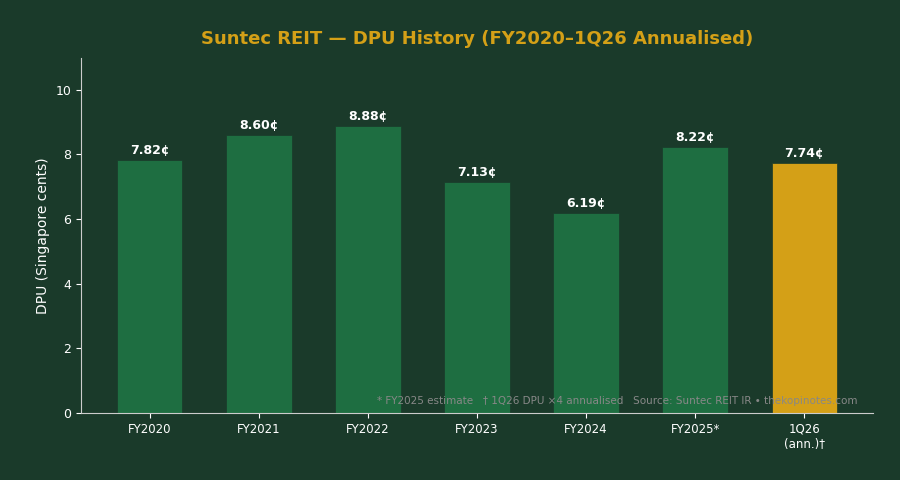
Suntec REIT distributes quarterly, making it a relatively dependable income stream compared to semi-annual distributors. The REIT’s DPU trajectory has been volatile over the past five years — peaking at 8.885 cents in FY2022, then declining to a trough of 6.192 cents in FY2024 due to elevated interest costs and challenging overseas markets. The sharp recovery in 1Q26 (+23.9% YoY) signals the turn has arrived.
| Period | DPU (Singapore cents) | YoY Change |
|---|---|---|
| FY2020 | 7.82¢ | — |
| FY2021 | 8.60¢ | +10.0% |
| FY2022 | 8.885¢ | +3.3% |
| FY2023 | 7.135¢ | -19.7% |
| FY2024 | 6.192¢ | -13.2% |
| FY2025 (est.) | ~8.22¢* | ~+32.8%* |
| 1Q26 DPU (ann.†) | 7.744¢ | +23.9% YoY |
* FY2025 estimated. † 1Q26 DPU of 1.936¢ × 4 for illustrative annualisation only — actual full-year DPU will vary. Source: Suntec REIT IR, SGX filings.
The FY2023–2024 decline was driven by two main forces: rising SORA-based borrowing costs (which peaked above 3% before falling) and the absence of capital distributions that had inflated FY2023 payouts. Now that Singapore SORA has normalised lower and the Singapore portfolio is firing on all cylinders, the DPU recovery looks sustainable rather than a one-off.
Investors seeking deeper context on the interest rate environment should read our SORA rate Singapore REIT impact analysis and our broader Best S-REITs Singapore 2026 guide.
3. 1Q 2026 Financial Highlights
Suntec REIT released its 1Q FY2026 Business Update on 23 April 2026, followed by full 1Q26 results on 30 April 2026. The headline numbers were impressive across the board.
| Metric | 1Q 2026 | 1Q 2025 | YoY Change |
|---|---|---|---|
| Distributable Income | S$57.3M | S$45.9M | +24.8% |
| DPU | 1.936¢ | 1.562¢ | +23.9% |
| SG Office Occupancy | 98.8% | ~97.5% | +0.6 ppt QoQ |
| SG Office Rental Reversion | +9.5% | — | — |
| Suntec Mall Occupancy | 99.0% | ~98.5% | Stable |
| Retail Rental Reversion | +14.3% | — | — |
| Australia Occupancy | 90.7% | ~90.6% | +0.1 ppt |
| Cost of Debt | 3.56% | ~3.9% | Declined |
The standout performance at ORQ (+13.2% office reversion) and Suntec City Mall (+15.0% retail reversion) confirms that Singapore’s CBD office and prime retail markets remain tight. The REIT’s management has guided for continued positive reversions through FY2026, supported by limited new Grade A office supply in the core CBD.
The one soft spot remains the Australian portfolio — occupancy of 90.7% masks a drag from 55 Currie Street in Adelaide (66% occupied) and Southgate Complex in Melbourne (86.8%). These assets are likely weighing on valuations, but they represent less than 28% of portfolio value by geography.
4. Portfolio & Key Properties
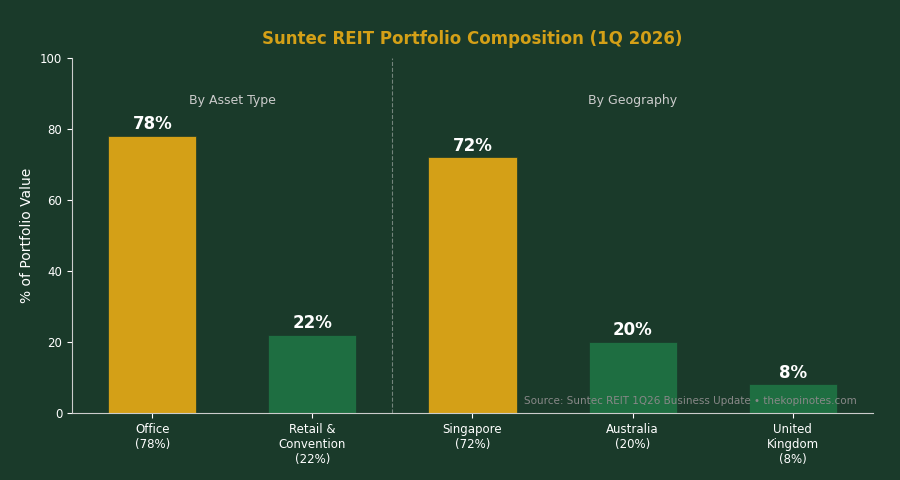
Suntec REIT’s S$12.2 billion portfolio is 78% office and 72% Singapore by value — a deliberate concentration in Singapore’s most liquid and sought-after commercial precinct, the Marina Bay / Raffles Place core CBD. Here is a breakdown of the key assets:
| Property | Location | Type | Suntec REIT Interest |
|---|---|---|---|
| Suntec City Office Towers 1–4 | Temasek Blvd, SG | Grade A Office | 100% |
| Suntec City Mall | Temasek Blvd, SG | Retail | 100% |
| Suntec Singapore Conv. Centre | Temasek Blvd, SG | Convention / F&B | 66.3% |
| One Raffles Quay (ORQ) | Marina Bay, SG | Grade A Office | 33.3% |
| MBFC Towers 1 & 2 + MBLM | Marina Bay, SG | Grade A Office + Retail | 33.3% |
| 177 Pacific Highway | Sydney, Australia | Premium Office | 50% |
| 477 Collins Street | Melbourne, Australia | Premium Office | 50% |
| 55 Currie Street | Adelaide, Australia | Office | 100% |
| Southgate Complex | Melbourne, Australia | Office + Retail | 100% |
| Nova Properties | London, UK | Mixed Use (Office + Retail) | Majority |
The Singapore core — Suntec City, ORQ, and MBFC — represents the highest-quality slice of Singapore’s commercial market. These properties benefit from irreplaceable locations, strong tenant covenants (major financial institutions, law firms, tech MNCs), and structurally tight supply: no significant new Grade A CBD office supply is expected before 2028.
For a broader view of Singapore’s commercial REIT landscape, see our Best S-REITs Singapore 2026 comparison and the S-REIT Dividend Yield Calculator to model your own income projections.
5. Peer Yield Comparison
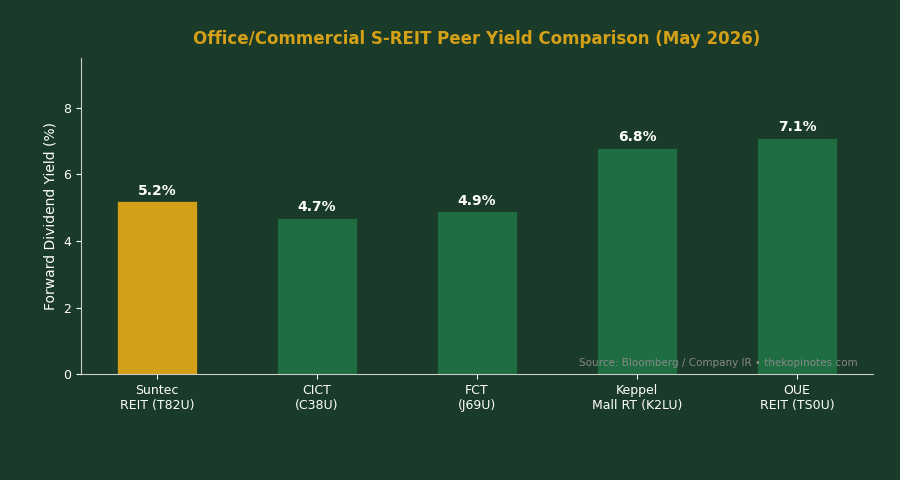
Among Singapore’s office and commercial REITs, Suntec REIT occupies an interesting middle ground — offering a higher yield than pure-quality plays like CICT, but with better asset quality and CBD concentration than higher-yielding peers like OUE REIT.
| REIT | Ticker | Forward Yield (est.) | Gearing | Primary Focus |
|---|---|---|---|---|
| Suntec REIT | T82U | ~5.2% | 41.6% | SG + AU office/retail |
| CapitaLand Integrated CT | C38U | ~4.7% | ~39% | SG diversified commercial |
| Frasers Centrepoint Trust | J69U | ~4.9% | ~39% | SG suburban retail |
| Keppel Mall REIT Trust | K2LU | ~6.8% | ~44% | SG suburban retail |
| OUE REIT | TS0U | ~7.1% | ~40% | SG office + hospitality |
Forward yield estimates based on annualised latest DPU at prevailing unit prices, May 2026. Not a buy/sell recommendation.
Suntec REIT’s ~5.2% forward yield sits above CICT and FCT — two of the most liquid and high-quality commercial S-REITs — suggesting the market is pricing in some risk premium for the overseas assets and the DPU volatility of recent years. If the Singapore recovery trajectory continues into FY2026, the yield gap to peers could compress, which would imply capital appreciation on top of distributions.
You can track your own S-REIT yield-versus-bond spread in real time using our S-REIT Yield vs SGS Bond Spread Calculator.
6. Key Risks to Consider
No investment is without risk. Suntec REIT carries several specific risk factors that Singapore investors should evaluate carefully.
Interest rate exposure: Despite declining from its peak, Suntec REIT’s cost of debt is expected to nudge back up to ~3.7% in FY2026 as low-cost AUD interest rate swaps entered in 2020 (sub-0.5%) expire. With 41.6% gearing, any prolonged re-pricing of floating-rate debt could erode distributable income. Investors can model sensitivity using our S-REIT Yield vs Bond Spread Calculator.
Australia occupancy drag: The Australian portfolio sits at 90.7% overall occupancy — acceptably high for a diversified portfolio, but 55 Currie Street at just 66% occupied is a meaningful dilution. Post-pandemic Australian office demand, particularly in secondary CBDs like Adelaide, has been slower to recover than Singapore’s. Any further lease departures at these properties could weigh on NPI.
Convention centre seasonality: The Suntec Singapore Convention & Exhibition Centre contributes event-driven, lumpy income that does not follow the steady residential or office rental income pattern. Poor event calendars in any given quarter can temporarily depress distributions.
Currency risk: With ~28% of portfolio value in Australia and the UK, Suntec REIT is exposed to AUD and GBP fluctuations against SGD. A strengthening SGD reduces the SGD-equivalent income from overseas assets.
Concentration risk: Despite geographic diversification, Suntec City itself accounts for a large share of Singapore NPI. Any significant decline in occupancy at Suntec City Mall or the office towers — whether from economic slowdown or changing office-use patterns — would materially impact distributions.
For broader risk context, read our Mid-Cap S-REIT Singapore 2026 comparison and the S-REIT Gearing Ratio & ICR Calculator.
7. Investment Thesis 2026
The bull case for Suntec REIT in 2026 rests on three pillars:
1. Singapore office-retail cycle at its strongest in years. Singapore’s CBD Grade A office market is structurally tight — limited pipeline, high-quality tenant demand from financial services, tech, and professional services sectors, and strong reversions (+9.5% at ORQ and MBFC) pointing to continued organic growth. Suntec City Mall at 99% occupancy with +15% retail reversions reinforces the retail thesis.
2. Financing cost tailwind. The REIT’s cost of debt fell from a peak of ~4%+ to 3.56% in 1Q26, and remains well below the level that pressured FY2023–24 DPUs. Even with the expected modest uptick to ~3.7% as older AUD swaps expire, the net direction is structurally supportive compared to the FY2023 trough.
3. Valuation re-rating potential. At S$1.49, analysts price a consensus target of S$1.61 (8% upside). If overseas occupancy recovers and DPU sustains above ~7.5¢ annually, the implied forward yield of ~5.2% compares favourably to SGS 10-year yields (~3.3–3.5%), offering a ~170–190 basis point REIT spread — historically attractive for Singapore investors.
The bear case: Australian occupancy remains a long tail; higher-than-expected interest costs could limit DPU recovery; and any macro shock causing Singapore office vacancy to rise (remote work structural shift, financial sector layoffs) would hit Suntec harder than suburban retail REITs.
On balance, Suntec REIT appears well-positioned as a core Singapore office and commercial income play — best suited for investors comfortable with moderate gearing (41.6%) and multi-year recovery timelines. It pairs well with a diversified S-REIT portfolio including industrial and healthcare names. Compare it against other choices in our Best S-REITs Singapore 2026 guide.
8. How to Invest in Suntec REIT in Singapore
Suntec REIT units (T82U) trade on the Singapore Exchange and can be purchased through any SGX-connected brokerage. For Singapore investors, the cheapest and most convenient options are typically online platforms like FSMOne, Syfe, or Endowus depending on your portfolio strategy.
- If you want direct SGX access and low commissions, FSMOne and similar brokerages work well for direct unit purchases.
- If you prefer a diversified S-REIT exposure (rather than single-REIT concentration), platforms like Syfe REIT+ give you basket exposure to multiple S-REITs including office names.
- CPF-eligible investors can check whether T82U is on the CPF Investment Scheme (CPFIS) approved list via the CPFIS Calculator.
9. Frequently Asked Questions (FAQ)
What is Suntec REIT's current dividend yield?
As at May 2026, Suntec REIT’s forward dividend yield is approximately 5.2%, based on annualising the 1Q26 DPU of 1.936 Singapore cents at a unit price of ~S$1.49. Actual full-year DPU will depend on quarterly performance. Suntec REIT distributes quarterly, which is one of its key attractions for income investors.
Is Suntec REIT a good investment in 2026?
Suntec REIT’s 1Q26 results — DPU +23.9% YoY, Singapore office at 98.8% occupancy, Suntec Mall at 99% — mark a strong recovery from the FY2024 trough. With analyst consensus at S$1.61 (8% upside from S$1.49), a ~5.2% forward yield, and limited new CBD office supply expected until 2028, the near-term thesis is supported. Key risks include Australian occupancy drag, residual interest rate sensitivity, and macro uncertainty. This is not financial advice — do your own due diligence.
What are Suntec REIT's main properties?
Suntec REIT’s flagship Singapore assets include: Suntec City (4 Grade A office towers + Suntec City Mall + 66.3% of Suntec Singapore Convention Centre), One Raffles Quay (33.3% interest), and Marina Bay Financial Centre Towers 1 & 2 and Marina Bay Link Mall (33.3% interest). Overseas, the REIT holds premium office properties in Sydney (177 Pacific Highway), Melbourne (477 Collins Street, Southgate Complex), Adelaide (55 Currie Street), and London (Nova Properties).
What is Suntec REIT's gearing ratio?
As at 1Q 2026, Suntec REIT’s aggregate leverage (gearing ratio) stands at 41.6%, with a cost of debt of 3.56%. The MAS regulatory gearing limit for Singapore REITs with credit ratings is 50%. At 41.6%, Suntec REIT has adequate headroom, though it is above the S-REIT sector average of approximately 38–40%. Use our Gearing Ratio Calculator to model leverage sensitivity.
Does Suntec REIT pay quarterly dividends?
Yes. Suntec REIT distributes quarterly, which differentiates it from many S-REITs that pay semi-annually. Quarterly distribution payments provide more regular income cash flow for investors. Distribution dates typically fall 2–3 months after the end of each quarter. Confirm exact distribution dates on the Suntec REIT Investor Relations calendar.
How does Suntec REIT compare to CICT?
CapitaLand Integrated Commercial Trust (CICT, C38U) and Suntec REIT are both major Singapore office/retail REITs, but differ in scale, diversification, and yield. CICT is larger (~S$24B AUM), more diversified (21+ Singapore properties + overseas), and trades at a slightly lower forward yield (~4.7%) reflecting its premium quality rating. Suntec REIT offers a ~5.2% yield with concentrated CBD exposure, higher overseas weighting, and quarterly distributions. For income investors seeking a higher yield with CBD office exposure, Suntec REIT offers more upside potential; CICT suits those prioritising stability and size.
Can I buy Suntec REIT with CPF?
Suntec REIT (T82U) may be eligible under the CPF Investment Scheme (CPFIS-OA) — check the current approved securities list on the CPF Board website, as eligibility is reviewed periodically. If eligible, you can use your CPF Ordinary Account savings to purchase T82U through an approved brokerage. Use our CPFIS Calculator to see how CPF investment can supplement your retirement income.
This article was researched with the help of AI. While we strive to keep all information accurate and up to date, there may be errors. If you notice any discrepancies, please contact us.