
CPF Investment Scheme (CPFIS) Calculator Singapore 2026
Calculate how much CPF OA you can invest, project your returns vs the 2.5% floor rate, and see if CPFIS makes sense for you — free calculator with real-time SGD results.
Your CPF Details
📊 CPFIS Projection
Understanding CPFIS for Singapore Investors
The CPF Investment Scheme (CPFIS) allows Singapore citizens and Permanent Residents to invest their CPF Ordinary Account (OA) savings in approved investments — including STI ETFs, unit trusts, Singapore Government Securities, and more. The key question every investor faces: is the potential upside worth the risk when your CPF OA already earns a guaranteed 2.5% per annum (with the first S$20,000 earning an extra 1%)?
As at Q1 2026, CPF members collectively hold over S$500 billion in CPF savings, yet CPFIS participation remains selective. MAS and CPF Board data suggest that many investors underperform the risk-free 2.5% OA floor after fees — making it critical to understand break-even return requirements before committing funds. This calculator helps you model both scenarios side-by-side, in SGD, with your actual figures.
Not financial advice. All projections are for educational reference only. CPF contribution rates and CPFIS rules may change. Data as at Q1 2026 unless noted. Always verify current rules with the CPF Board at cpf.gov.sg.
The 20% Reserve Rule
CPFIS has a critical constraint: you can only invest up to 80% of your investable OA savings. The remaining 20% must stay in your OA as a mandatory reserve — this is your safety buffer. So if you have S$100,000 in your OA, your maximum investable amount is S$80,000. This calculator automatically applies the 80% rule to your inputs, giving you a realistic investable figure rather than the headline OA balance.
Which Investments Are CPFIS-Approved?
CPFIS-OA allows investment in a range of MAS-licensed products including STI-tracking ETFs (e.g. SPDR STI ETF, Nikko AM STI ETF), selected unit trusts from fund houses like Lion Global and Nikko AM, Singapore Government Securities and T-Bills, endowment plans and annuities from approved insurers, and selected shares listed on SGX. Notably, direct investment in overseas stocks and most cryptocurrency products are not permitted under CPFIS. The full approved product list is maintained on the CPF Board website and is updated periodically.
How to Use This CPFIS Calculator
- Enter your age: CPFIS is available up to age 54. At 55, your OA savings are used to meet the CPF Retirement Sum, so investing timelines change significantly beyond this age.
- Enter your CPF OA balance: Find this on your CPF statement via my.cpf.gov.sg. The calculator automatically applies the 80% investable cap, so only enter your total OA balance.
- Enter your monthly OA contribution: This is the CPF OA allocation from your monthly CPF contributions. For workers aged 35–45 earning above S$6,000/month, this is typically S$600–S$900/month.
- Set your target return: This is the annualised return you expect from your CPFIS investments. Singapore STI ETFs have historically returned ~7–8% p.a. over long periods. Be conservative — include projected management fees (0.3–1% p.a.).
- Set your investment horizon: How many years until you plan to draw down this money (e.g. age 65 retirement).
The calculator instantly shows your investable amount, projected portfolio value, what you’d have if you left funds in CPF at 2.5%, and the extra gain (or loss) from investing. The break-even rate is always shown as the CPF OA floor (2.5%) — you need to consistently beat this after fees to justify using CPFIS.
Pro tip: Combine this with our CPF LIFE Payout Calculator to model your full retirement income picture — including what your SA balance contributes to CPF LIFE payouts.
What Is CPFIS?
The CPF Investment Scheme (CPFIS) is a government-administered programme that lets Singapore CPF members invest a portion of their Ordinary Account (OA) and Special Account (SA) savings in approved financial products, with the aim of potentially earning returns higher than the guaranteed CPF interest rates. CPFIS-OA covers investment from the OA (guaranteed 2.5% p.a.) while CPFIS-SA covered SA investments (guaranteed 4% p.a.), though the CPF Board restricted new CPFIS-SA investments from 1 October 2023 to encourage members to keep their SA savings for retirement.
CPFIS was introduced in 1986 to give CPF members more control over their retirement savings and access to equity market growth. Over the decades, the scheme has been refined — most notably in 2018, when CPF raised the investment literacy requirements and tightened the list of approved products, after studies showed many members underperforming the floor rate after fees. As of Q1 2026, CPFIS-OA remains open to all eligible CPF members aged 18–54, subject to meeting the minimum investable sum threshold.
The fundamental question CPFIS raises is: can you consistently beat a guaranteed 2.5% risk-free return — after fees, taxes (if applicable), and market volatility — over your investment horizon? This calculator helps you model exactly that comparison with your own numbers. You can also use our CPF OA/SA/MA Allocation Calculator to understand how your monthly contributions are split across your CPF accounts.
How CPFIS Works: The Maths Behind the Decision
The break-even logic is straightforward. Your CPF OA earns 2.5% per annum, compounded. If you invest via CPFIS and earn a rate r, you come out ahead only when r > 2.5% after all costs. The challenge is that investment management fees (typically 0.3%–1.5% p.a. for unit trusts, 0.2%–0.5% for ETFs), transaction costs, and market risk all erode returns.
The calculator projects two scenarios: (1) you invest 80% of your OA balance via CPFIS, contributing new monthly OA inflows and earning your target rate; (2) you leave everything in the OA at 2.5% with the same monthly contributions. The difference between scenario 1 and scenario 2 is your investing alpha — the actual dollar benefit (or cost) of using CPFIS.
Consider this worked example. A 35-year-old with S$80,000 in OA, contributing S$800/month, and expecting 6% p.a. over 20 years:
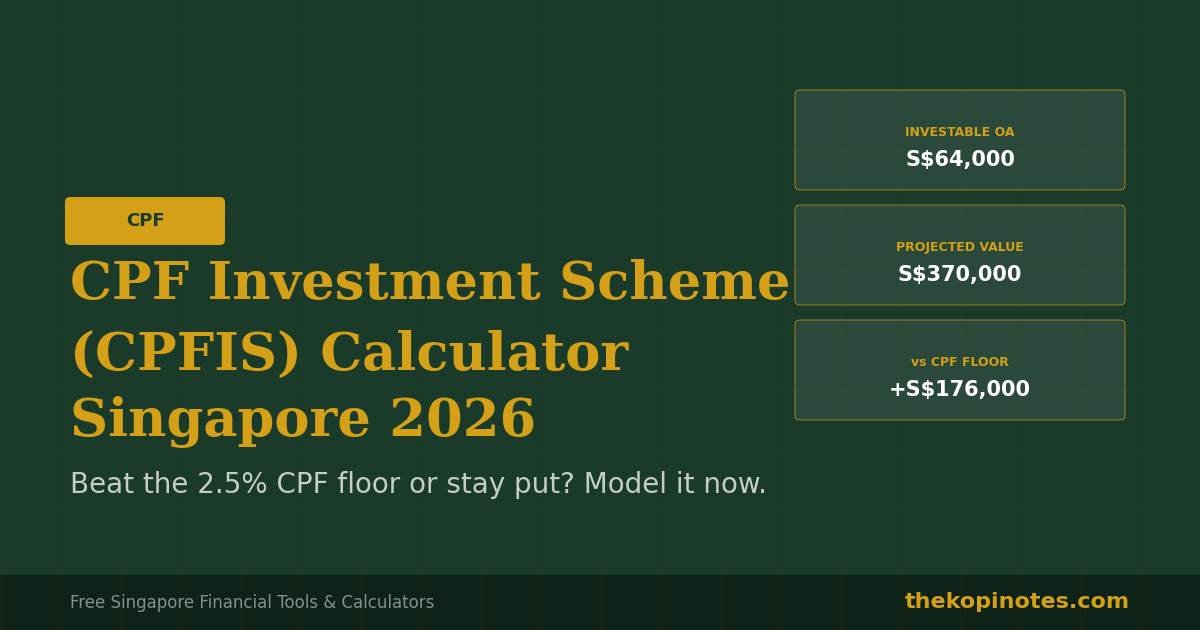
- Investable via CPFIS: S$64,000 (80% of S$80,000)
- CPFIS projected value (6% p.a. over 20 years): ~S$370,000
- CPF OA at 2.5% (same period): ~S$194,000
- Extra gain from investing: ~S$176,000
The extra S$176,000 is the prize — but it requires consistently achieving 6% p.a. after fees, through market ups and downs. A diversified STI ETF portfolio has historically achieved this over long periods, but past performance does not guarantee future results. Compare investment platforms using our Brokerage Fee Calculator to find the lowest-cost way to invest your CPFIS funds.
CPFIS vs Leaving Money in CPF OA
The “CPFIS vs CPF OA” debate is one of the most common in Singapore personal finance. Here’s a side-by-side breakdown to help frame the decision:
| Factor | Leave in CPF OA | Invest via CPFIS |
|---|---|---|
| Return | Guaranteed 2.5% p.a. | Variable; depends on investments |
| Risk | Zero (government-guaranteed) | Market risk; can lose principal |
| Liquidity | OA usable for housing, education | Investments locked until sold; proceeds return to OA |
| Fees | None | Brokerage, management fees (0.2%–1.5% p.a.) |
| Housing use | Yes — OA can fund HDB or private property | Invested funds cannot be used for housing until sold |
| Upside potential | Capped at 2.5% (3.5% on first S$20K) | Uncapped — STI ETF historically ~7–8% p.a. |
The verdict: CPFIS makes most sense for investors with a long time horizon (10+ years), who can tolerate short-term losses, and who choose low-cost index ETFs rather than high-fee unit trusts. For those within 5–10 years of 55, the guaranteed 2.5% and the flexibility of OA for retirement sum funding often makes leaving funds in CPF the safer choice.
Best CPFIS-Approved Investments in Singapore
If you decide CPFIS is right for you, product selection matters enormously. High-fee unit trusts have historically been the main culprit behind CPFIS underperformance — some charge annual management fees of 1%–1.5%, meaning you need to consistently earn 3.5%–4% just to match the CPF OA floor rate. Low-cost index ETFs are widely considered the better CPFIS vehicle.
The two most popular CPFIS-OA index ETFs are the SPDR Straits Times Index ETF (ES3) and the Nikko AM Singapore STI ETF (G3B), both tracking the STI and charging around 0.2%–0.3% p.a. in total expense ratio. These can be purchased through CPF-approved brokers including DBS Vickers, OCBC Securities, and UOB Kay Hian. You can also use Endowus, which offers curated CPFIS-approved funds with fee rebates that bring total costs closer to ETF-level pricing. FSMOne also supports CPFIS purchases with a competitive fee structure.
For fixed income exposure within CPFIS, Singapore Government Securities and T-Bills are approved products. Compare T-Bill yields using our T-Bill, SSB & Fixed Deposit Calculator. As at Q1 2026, 6-month T-Bill yields have moderated to the 3.0%–3.5% range, making them a viable CPFIS-OA option that beats the 2.5% floor with lower risk than equities.
CPFIS Eligibility & Rules in Singapore (2026)
To use CPFIS-OA in 2026, you must be a Singapore citizen or Permanent Resident aged 18–54, with an OA balance of at least S$20,000 (you must maintain S$20,000 in your OA at all times — this is separate from the 20% reserve rule). You must also pass the Customer Account Review (CAR) if investing in higher-risk products, and open a CPF Investment Account with a CPF-approved agent bank (DBS, OCBC, or UOB).
Key rules to note for 2026: (1) You can invest a maximum of 80% of investable savings — the remaining 20% stays in OA. (2) CPFIS-SA is closed to new investments as of October 2023 — existing CPFIS-SA holdings can be held but no new SA funds can flow into investments. (3) All investment proceeds, dividends, and capital gains must be returned to your CPF account. (4) You cannot withdraw CPFIS investment gains as cash before age 55 — all returns accumulate within CPF.
The CPF Board reviews and updates the approved product list periodically. Always check the official CPF website before making investment decisions, as products can be added or removed from the approved list. For retirement sum planning, use our CPF Retirement Sum Calculator to understand how your OA balance affects your retirement sum requirements at 55.
CPFIS as a Retirement Strategy
CPFIS sits within a broader retirement planning framework for Singapore investors. The decision to use CPFIS should be made in the context of your overall retirement income plan — not in isolation. Key interactions to consider: (1) investing your OA via CPFIS reduces the OA balance available for CPF LIFE premium funding, which could affect your monthly CPF LIFE payouts at 65; (2) OA funds used for CPFIS cannot simultaneously be used for housing loan repayments if you own a property; (3) if your CPFIS investments underperform and you reach 55 with a lower OA balance, you may need to top up with cash to meet the Basic Retirement Sum (BRS) or Full Retirement Sum (FRS).
For most Singapore investors, a pragmatic approach is to use CPFIS for a portion of OA savings — say, 50%–70% of the investable amount — in low-cost STI ETFs, while leaving the remainder in OA as a buffer for housing and retirement sum requirements. Use our Retirement Planning Calculator to model your full picture including CPF contributions, investment returns, SRS savings, and projected retirement drawdown. For passive income strategies beyond CPF, see our Passive Income in Singapore 2026 guide covering S-REITs, dividend stocks, and Endowus Income portfolios.
Frequently Asked Questions
How much CPF OA can I invest via CPFIS?
You can invest up to 80% of your investable CPF OA savings. The CPF Board requires you to maintain a minimum of S$20,000 in your OA at all times (this S$20,000 is not investable). On top of that, 20% of the remaining balance must stay as a mandatory reserve. So if you have S$100,000 in OA, your investable amount is S$80,000 x 80% = S$64,000. Use this calculator to find your exact investable sum based on your current OA balance.
Is CPFIS worth it in Singapore in 2026?
CPFIS can be worth it if you invest in low-cost index ETFs (like the STI ETF at ~0.2% p.a. fees), have a long time horizon of 10+ years, and can tolerate short-term market volatility. The CPF OA floor rate of 2.5% is a tough hurdle — after fees, many actively managed unit trusts historically failed to beat it. However, the STI ETF has returned ~7–8% p.a. over long periods, making it a strong CPFIS candidate. CPFIS is generally not recommended for investors within 5–10 years of 55, or those who need OA funds for housing.
What is the minimum OA balance to use CPFIS?
You must have at least S$20,000 in your CPF OA to start investing via CPFIS. This S$20,000 minimum must always remain in your OA and cannot be invested. Additionally, you need to open a CPF Investment Account with one of the three approved agent banks: DBS, OCBC, or UOB. There is no annual fee for maintaining a CPFIS account, but individual investment products may have their own minimum investment amounts.
What return should I target in the CPFIS calculator?
A conservative but realistic target for a Singapore STI ETF portfolio is 6%–8% p.a. over a 10–20 year horizon, based on historical performance. You should subtract your expected fees (0.2%–0.3% for ETFs, up to 1.5% for unit trusts) to get your net return assumption. For a blended CPFIS portfolio mixing STI ETF and T-Bills, a 4%–5% net return is a reasonable conservative estimate. Avoid assuming returns above 8%–10% p.a. — these require significant equity risk and are not guaranteed.
Can I use CPFIS to invest in S-REITs or overseas stocks?
Directly purchasing individual S-REIT units via CPFIS is possible if the REIT is on the CPF Board’s approved list. However, most S-REITs are not individually approved for CPFIS. You can gain S-REIT exposure through CPFIS-approved unit trusts that hold REITs, or through the SPDR STI ETF (which has some REIT exposure). Direct investment in overseas stocks is not permitted under CPFIS-OA. See our Best S-REITs 2026 guide for more on S-REIT investing outside of CPF.
What happens to my CPFIS investments when I turn 55?
At age 55, CPF will set aside the Retirement Sum (Basic, Full, or Enhanced — you choose) from your OA and SA into a Retirement Account (RA). If you have CPFIS investments, you may need to liquidate them to meet your chosen Retirement Sum if your combined OA + SA cash balance is insufficient. Any proceeds from selling CPFIS investments flow back into your OA first. It is wise to start reducing CPFIS equity exposure 5–10 years before 55 to avoid being forced to sell during a market downturn. Use our CPF Withdrawal at 55 Calculator to plan ahead.
Can I use Endowus or Syfe for CPFIS investing?
Endowus is a CPF Board-approved platform that allows you to invest your CPF OA savings via CPFIS into their curated fund portfolios (including ESG, income, and global equity options). Endowus rebates all trailer fees from the fund houses, which meaningfully reduces your total cost of investing. Syfe does not currently offer CPFIS investing — it is a cash-only platform. For CPFIS, your main options are Endowus, DBS Vickers, OCBC Securities, UOB Kay Hian, and FSMOne.
How does CPFIS affect my CPF LIFE payouts?
CPF LIFE payouts are based primarily on your Retirement Account (RA) balance at age 65. Your RA is funded from your SA (and OA if SA is insufficient) at age 55. If you have been investing via CPFIS and your investments have underperformed the 2.5% CPF floor, your OA balance at 55 could be lower than if you had left funds in the OA — reducing the amount available for your RA. Conversely, if CPFIS investments outperform, you may have a larger RA and higher CPF LIFE payouts. Use our CPF LIFE Payout Calculator to model different RA balance scenarios.
What is the difference between CPFIS-OA and CPFIS-SA?
CPFIS-OA allows you to invest your CPF Ordinary Account savings (guaranteed 2.5% floor) in a wide range of approved products including stocks, ETFs, unit trusts, and bonds. CPFIS-SA allowed investment of Special Account savings (guaranteed 4% floor), but new CPFIS-SA investments have been closed since 1 October 2023. If you opened a CPFIS-SA before that date, your existing investments can continue, but no new SA funds can flow into investments. The CPF Board closed CPFIS-SA to encourage members to keep their SA savings in CPF for the guaranteed 4% p.a. return and for CPF LIFE funding.
Plan Your Full CPF Retirement Picture
CPFIS is just one piece of the puzzle. Use our free tools and referral bonuses to optimise every part of your retirement plan.