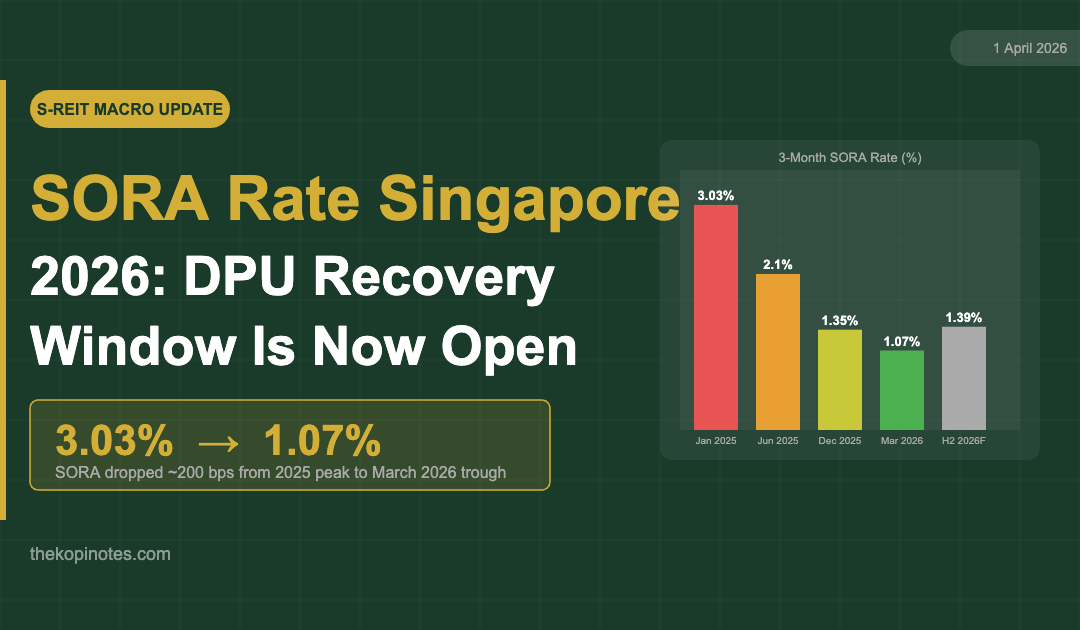
The 3-month compounded SORA rate has fallen to 1.07% as of March 2026 — down from a peak of 3.03% in early 2025. That is a drop of nearly 200 basis points in just over a year. For Singapore REIT investors, this is the single biggest DPU tailwind the S-REIT sector has seen in three years, and the window to benefit from it may be shorter than you think.
Forecasters at UOB expect SORA to bottom out near 1.00% in Q2 2026 before drifting back up to approximately 1.39% by year-end. That means right now — April 2026 — is likely the trough. REITs that lock in cheap refinancing now will see those savings flow directly into distributable income over the next 12–18 months. Investors who position ahead of that DPU uptick stand to benefit most.
What Is SORA and Why Does It Matter for S-REITs?
SORA — the Singapore Overnight Rate Average — is the benchmark interest rate that most Singapore REITs use to price their floating-rate debt. When SORA rises, REITs pay more interest on borrowings, which eats into distributable income per unit (DPU). When SORA falls, interest costs drop and DPU recovers.
Most S-REITs carry total debt levels of S$1–6 billion, with 40–60% typically on floating rates. The rest is fixed for a defined tenor. As the fixed-rate tranches mature and get refinanced at today’s lower rates, the interest savings stack up across the entire debt book — quarter by quarter, distribution by distribution.
To put it in concrete terms: a large-cap REIT with S$4 billion in debt and 50% floating exposure saves roughly S$4–8 million per year in interest costs for every 50 basis points SORA falls. At 200 bps of reduction, that compounds into a meaningful DPU uplift for unitholders.
What the SORA Drop Means for S-REIT Investors in 2026
Gearing, ICR and Refinancing: The Numbers That Matter
Singapore REITs are regulated to maintain gearing (total debt/total assets) below 50%, with most large-caps operating in the 35–42% range. As SORA falls, the interest coverage ratio (ICR) — net property income divided by interest expense — improves. A higher ICR gives REIT managers more headroom to distribute income rather than conserve cash, and it also unlocks capacity to pursue acquisitions on an accretive basis.
The refinancing calendar is the key watchpoint in 2026. REITs with a significant portion of debt maturing this year or in 2027 are poised to capture the most savings. Based on current market forecasts, refinancing a 3-year fixed tranche today could save up to 200 bps compared with debt locked in during the 2022–2024 rate cycle.
Sector Breakdown: Who Benefits Most?
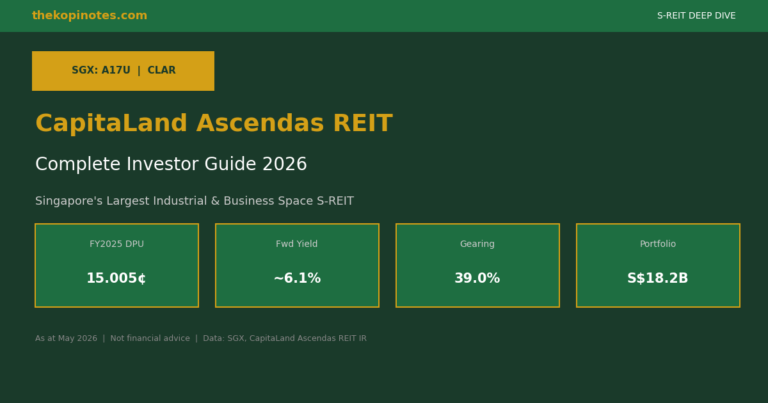
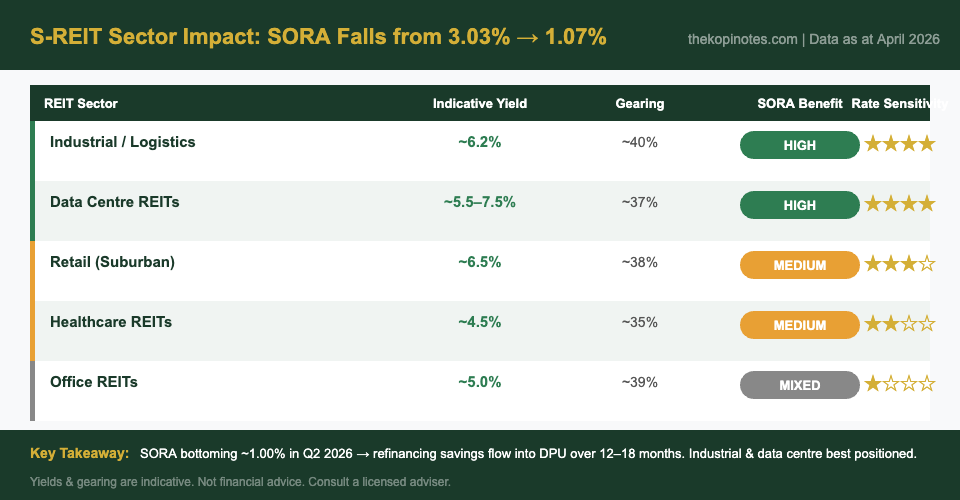
Industrial and Logistics REITs are best positioned. Names like CapitaLand Ascendas REIT (gearing ~39%, yield ~5.8%) and Mapletree Industrial Trust (gearing ~40%, yield ~6.2%) carry large, diversified debt books. As they refinance maturing tranches this year, savings flow directly to unitholders. Both benefit from structural demand tailwinds — hi-tech industrial and data centre demand driven by AI infrastructure spending in Singapore and broader APAC.
Data Centre REITs are a standout sub-sector. Keppel DC REIT (gearing ~37%, yield ~5.5%) and the newly listed NTT Global Data Center REIT (initial yield 7.5%, 2.5x oversubscribed at IPO) are benefiting from both falling rates and surging demand for colocation space from AI workloads.
Retail REITs offer moderate upside. Frasers Centrepoint Trust (gearing ~38%, yield ~6.5%) benefits from falling rates while riding Singapore’s resilient domestic consumption story. Suburban malls — Causeway Point, Northpoint City — continue to deliver stable NPI, making FCT one of the more defensive choices.
Office REITs are the most mixed picture. Falling rates help reduce interest costs, but some office REITs face ongoing vacancy headwinds as hybrid work norms persist. Scrutinise occupancy trends alongside rate sensitivity here.
Healthcare and Hospitality REITs also benefit from lower SORA, though the DPU uplift tends to be more modest. Parkway Life REIT and CDL Hospitality Trusts are worth monitoring for positive distribution revisions in upcoming results.
What About CPF Investors?
CPF Ordinary Account interest remains fixed at 2.5% per annum, while the Special Account pays 4.0%. These rates are guaranteed and risk-free — the baseline every Singapore investor should benchmark against.
With SORA-driven S-REIT yields now sitting at 5.5–7% for quality names, the spread above CPF OA has widened meaningfully. An investor deploying CPFIS funds into a well-diversified S-REIT ETF today is picking up roughly 300–450 basis points of additional yield over the risk-free CPF rate — the widest spread in several years.
CPFIS investors should always remember that S-REIT unit prices fluctuate and past yields do not guarantee future distributions. For a framework on CPF and S-REIT allocation, our CPF investment strategy guide is a good starting point.
The Risk Factor: US Tariffs and the Section 301 Probe
No macro article in April 2026 would be complete without acknowledging the tariff overhang. The US Office of the Trade Representative launched a Section 301 investigation into Singapore on March 11, 2026, citing alleged excess capacity production. Under Section 301, tariffs of up to 100% can be imposed — though the probe may take months before any concrete action.
For S-REIT investors, the concern is indirect: a global trade slowdown would dampen logistics volumes (affecting industrial REITs), reduce business confidence (pressuring office and retail footfall), and potentially soften Singapore’s GDP growth trajectory. Singapore’s government has flagged a potential growth forecast downgrade and raised the Business Adaptation Grant to cover up to 70% of qualifying costs.
Our view: the rate tailwind is more immediate and more quantifiable for S-REIT DPU in 2026. The tariff risk is real but plays out more slowly and depends heavily on diplomatic developments. Monitor, but do not let it override the rate recovery thesis for quality S-REITs with strong domestic income streams.
Our Take
SORA is at a near-bottom and the DPU recovery window for S-REITs is open right now. Industrial, data centre, and suburban retail REITs with manageable gearing and near-term debt maturities are best placed to translate falling rates into higher distributions over the next 12–18 months. The window is real — but not indefinite. SORA is expected to tick back up in H2 2026, so REITs that lock in refinancing now will have a structural cost advantage over those that wait.
Frequently Asked Questions
How much has SORA fallen and why does it matter for S-REITs?
The 3-month compounded SORA has dropped from a peak of approximately 3.03% in early 2025 to around 1.07% as of March 2026 — nearly 200 basis points. Because most Singapore REITs price 40–60% of their debt at floating rates tied to SORA, this translates directly into lower interest expenses and higher DPU. The effect flows through gradually as loans are repriced or refinanced.
Which S-REIT sectors benefit most from falling SORA?
Industrial and data centre REITs benefit most, combining falling rates with strong structural demand from AI-driven data centre growth and hi-tech manufacturing. Retail REITs like Frasers Centrepoint Trust also benefit meaningfully. Office REITs see interest cost savings too, but face occupancy headwinds. Healthcare and hospitality REITs benefit more modestly.
Is now a good time to buy S-REITs given the SORA outlook?
SORA is at a near-trough and forecast to rise again in H2 2026 — the window for the most significant rate-driven DPU recovery is relatively short. Valuations for quality S-REITs remain reasonable at 5.5–7% yields. However, US tariff and global trade risks add macroeconomic uncertainty. A diversified S-REIT ETF or portfolio of large-cap names with strong domestic income reduces concentration risk.
How does the current SORA rate affect CPF investors using CPFIS?
CPF OA remains fixed at 2.5% and CPF SA at 4.0%. With S-REIT yields at 5.5–7%, the spread above CPF OA is 300–450 bps — the widest in years. CPFIS investors can access S-REITs via selected ETFs such as the CSOP iEdge S-REIT Leaders ETF or Lion-Phillip S-REIT ETF. Remember that CPFIS investments carry market risk, unlike guaranteed CPF interest.
What is the risk if SORA rises faster than expected?
If SORA rises faster than forecast — due to resurging global inflation or a Fed hawkish pivot — S-REITs with high floating-rate exposure and upcoming maturities would face renewed DPU pressure. REITs with lower gearing (below 35%), longer fixed-rate tenors, and strong operating income are more resilient. Always check a REIT’s weighted average debt maturity and fixed-rate percentage before investing.
What to Read Next
- Compare top S-REITs by yield and gearing: Best S-REITs Singapore 2026
- Invest via an ETF: Singapore REIT ETF Guide
- Use CPF wisely: CPF Investment Strategy Guide
- Low-fee robo-advisors: Endowus referral code | Syfe referral code
Disclaimer: This is not financial advice. Data as at 1 April 2026. SORA rates sourced from MAS and market forecasts. Please consult a licensed financial adviser before making investment decisions. Past distributions do not guarantee future income.
This article was researched with the help of AI. While we strive to keep all information accurate and up to date, there may be errors. If you notice any discrepancies, please contact us.