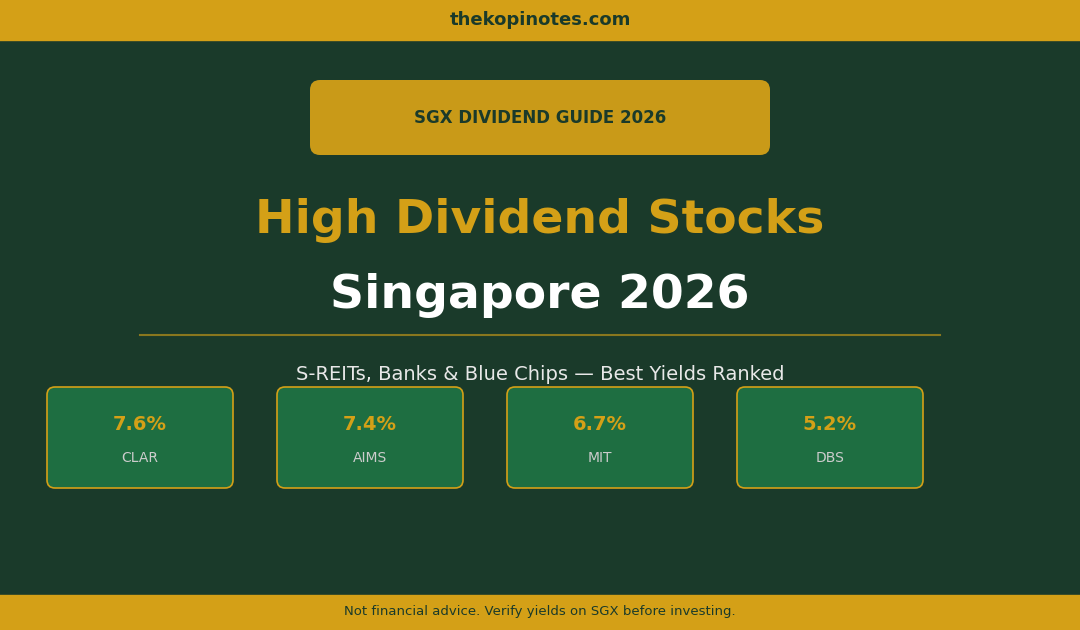
Looking for high dividend stocks in Singapore that generate reliable passive income? Singapore’s SGX is home to one of Asia’s richest dividend ecosystems — from blue-chip banks like DBS, OCBC and UOB yielding 4–6%, to S-REITs distributing 6–8% annually, all with zero dividend withholding tax for individual investors.
In this guide, we rank the best high dividend stocks in Singapore for 2026, covering yield, payout history, financial health, and suitability for both regular brokerage accounts and the CPF Investment Scheme (CPFIS). Whether you’re building passive income, supplementing your retirement, or simply beating the CPF OA’s 2.5% floor rate — this comparison table is your starting point.
📋 Table of Contents
Jump to Section
- Why Singapore Dividend Stocks Stand Out
- Top High Dividend Stocks Singapore 2026 (Comparison Table)
- Singapore Bank Dividend Stocks (DBS, OCBC, UOB)
- S-REIT Dividend Stocks: Highest Yields 2026
- Other Blue-Chip Dividend Stocks (Telcos, Infrastructure)
- Dividend Investing via CPF OA (CPFIS)
- How to Pick a High Dividend Stock in Singapore
- Risks of Chasing High Dividend Yields
- FAQ
Why Singapore Dividend Stocks Stand Out
Singapore offers one of the most investor-friendly dividend environments in the world. Here’s why high-dividend stocks in Singapore deserve a place in every income investor’s portfolio:
- Zero dividend withholding tax: Under Singapore’s one-tier corporate tax system, dividends paid by SGX-listed companies are tax-free in the hands of individual investors. What you receive is what you keep.
- CPF compatibility: Many SGX blue chips and all S-REITs can be held via the CPF Investment Scheme (CPFIS), letting you deploy idle CPF OA funds earning 2.5% into higher-yielding assets.
- Regulatory stability: Singapore’s MAS framework ensures REITs distribute at least 90% of taxable income annually to maintain tax-exempt status — providing income predictability.
- S-REIT universe: With 40+ S-REITs listed on SGX, Singapore investors have access to commercial offices, industrial parks, data centres, logistics warehouses, retail malls, healthcare facilities, and hospitality assets — all paying quarterly or semi-annual distributions.
- SGS benchmark spread: S-REITs currently trade at yield spreads of 3–4% above 10-year Singapore Government Securities (SGS) bonds, making them attractively priced on a risk-adjusted basis versus CPF-adjacent instruments.
For a deeper dive into building income via CPF, see our CPF Investment Strategy Guide.
Top High Dividend Stocks Singapore 2026 — Comparison Table
Below is a ranked comparison of Singapore’s highest dividend-yielding stocks as of May 2026, covering blue-chip banks, S-REITs, and telcos. Yields are approximate trailing 12-month figures and change with unit/share price movements.
| Stock / REIT | SGX Code | Type | Div Yield (TTM) | Payout Freq | CPFIS Eligible |
|---|---|---|---|---|---|
| CapitaLand Ascendas REIT | A17U | Industrial REIT | 7.6% | Semi-annual | ✅ Yes |
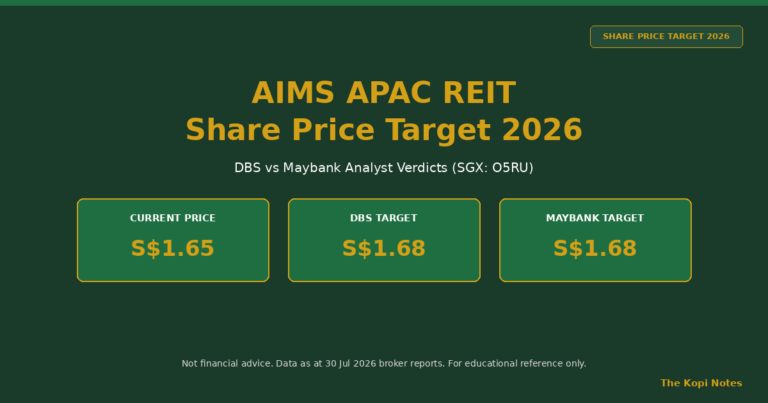
| AIMS APAC REIT | O5RU | Industrial REIT | 7.4% | Quarterly | ✅ Yes |
| Mapletree Industrial Trust | ME8U | Industrial REIT | 6.7% | Quarterly | ✅ Yes |
| Frasers Logistics & Commercial Trust | BUOU | Industrial REIT | 6.5% | Semi-annual | ✅ Yes |
| Mapletree Logistics Trust | M44U | Logistics REIT | 6.3% | Quarterly | ✅ Yes |
| Suntec REIT | T82U | Commercial REIT | 6.2% | Semi-annual | ✅ Yes |
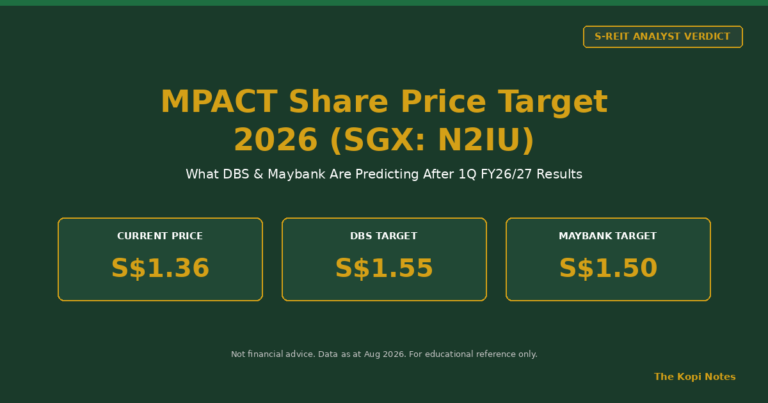
| Mapletree Pan Asia Commercial Trust | N2IU | Commercial REIT | 5.5% | Quarterly | ✅ Yes |
| DBS Group | D05 | Bank | 5.2% | Quarterly | ✅ Yes |
| CapitaLand Integrated Commercial Trust | C38U | Retail/Commercial REIT | 5.0% | Semi-annual | ✅ Yes |
| UOB | U11 | Bank | 4.2% | Semi-annual | ✅ Yes |
| OCBC | O39 | Bank | 3.9% | Semi-annual | ✅ Yes |
| Singtel | Z74 | Telco | 3.8% | Semi-annual | ✅ Yes |
*Yields are approximate trailing 12-month figures as of May 2026. Always verify current yields on SGX or your brokerage platform. Not financial advice.
Singapore Bank Dividend Stocks: DBS, OCBC & UOB
Singapore’s three local banks are the cornerstone of every income investor’s portfolio. They offer a rare combination of dividend growth, balance sheet resilience, and CPFIS eligibility — making them suitable for both regular brokerage accounts and CPF OA deployment.
DBS Group (SGX: D05) — Yield ~5.2%
DBS is Singapore’s largest bank and Asia’s leading digital bank. For FY2025, DBS declared a total dividend of S$3.06 per share, representing a trailing yield of approximately 5.2% — above its five-year average of 4.5%. DBS adopted quarterly dividends in 2024, improving income regularity for investors. Its diversified earnings model spanning retail banking, wealth management, and institutional finance supports dividend sustainability even in slower macro environments.
OCBC (SGX: O39) — Yield ~3.9%
OCBC paid a total dividend of S$0.99 per share for FY2025, with a trailing yield of 3.9%. While below its five-year average of 4.7%, OCBC’s dividend is backed by diversified income from banking, wealth management (Bank of Singapore), and insurance (Great Eastern Holdings). OCBC is known for conservative capital management and maintains one of the strongest Common Equity Tier 1 (CET1) ratios among Asian banks.
UOB (SGX: U11) — Yield ~4.2%
UOB declared S$1.56 per share in FY2025 dividends, yielding approximately 4.2%. UOB’s Southeast Asia franchise — particularly its presence across Thailand, Malaysia, Indonesia, and Vietnam — positions it well for long-term dividend growth as regional GDP expands. The bank remains one of Singapore’s most consistent dividend payers.
💡 Tip: Bank dividends tend to be more stable but grow slowly. For investors seeking higher current yield, pairing bank stocks with high-yield S-REITs provides both stability and income maximisation. Use our Dividend Portfolio Yield Calculator to model your blended portfolio income.
S-REIT Dividend Stocks: Highest Yields in 2026
S-REITs are the engine of Singapore’s dividend investing universe. By law, REITs must distribute at least 90% of their taxable income to maintain tax-exempt status — making distributions highly predictable and frequent (most pay quarterly or semi-annually).
The average S-REIT yield in early 2026 stands at approximately 6.0–6.5% — roughly 3.5–4 percentage points above Singapore Government Securities (SGS) bonds, and more than double the CPF OA floor rate of 2.5%.
Best High-Yield S-REITs 2026
CapitaLand Ascendas REIT (SGX: A17U) — ~7.6% yield
Singapore’s largest industrial REIT with a portfolio spanning Singapore, Australia, the UK/Europe, and the US. CLAR owns business parks, logistics facilities, data centres, and suburban offices — offering sector diversification within a single vehicle. Its FY2025 DPU was stable, supported by strong occupancy and data centre demand. See our Best S-REITs comparison for how CLAR ranks overall.
AIMS APAC REIT (SGX: O5RU) — ~7.4% yield
A pure-play industrial REIT with assets in Singapore and Australia. AIMS APAC pays quarterly distributions, one of only a handful of S-REITs to do so. Its Singapore portfolio includes flatted factories, business parks, and logistics hubs in Jurong, Toa Payoh, and Changi. High yield with moderate gearing (below 40%) makes it a compelling income pick.
Mapletree Industrial Trust (SGX: ME8U) — ~6.7% yield
MIT’s portfolio spans data centres in North America, hi-tech buildings, business parks, and flatted factories in Singapore. Data centres now represent over 50% of its portfolio AUM, providing growth exposure alongside income. Quarterly distributions and a well-covered DPU make MIT one of the most consistent S-REIT dividend stocks.
Frasers Logistics & Commercial Trust (SGX: BUOU) — ~6.5% yield
FLCT holds industrial and logistics properties in Australia, Germany, the Netherlands, Singapore, and the UK. European logistics assets provide geographic diversification and euro/AUD-denominated income. FLCT’s focus on modern, large-format warehouses positions it well against e-commerce-driven demand.
Mapletree Logistics Trust (SGX: M44U) — ~6.3% yield
MLT is one of Asia’s largest logistics REITs, with assets across Singapore, Hong Kong, China, Japan, South Korea, Vietnam, India, Malaysia, and Australia. Its quarterly distribution policy and pan-Asia diversification make it a core holding for dividend investors with regional exposure appetite. Read our dedicated Mapletree Logistics Trust guide for full DPU history.
For a deep-dive yield comparison across all S-REITs, see our Singapore REIT ETF Guide — including how the Lion-Phillip S-REIT ETF lets you access the entire sector in one trade.
Other Blue-Chip Dividend Stocks (Telcos & Infrastructure)
Singtel (SGX: Z74) — ~3.8% yield
Singtel is Singapore’s largest telco and a holding company with associate stakes in Optus (Australia), AIS (Thailand), Bharti Airtel (India), Globe Telecom (Philippines), and Telkomsel (Indonesia). Its dividend recovery from FY2022 lows has been gradual — the FY2025 total dividend included both core and value realisation components. Singtel’s regional telco associates provide upside exposure to Asia’s growing middle class.
Keppel (SGX: BN4) — ~4.5% yield
Following its strategic restructuring, Keppel has transformed into an asset management and connectivity solutions company, with data centres, infrastructure funds, and real estate as its key pillars. Its recurring fee income stream supports a stable dividend, while data centre expansion provides long-term growth.
ComfortDelGro (SGX: C52) — ~4.0% yield
Singapore’s dominant public transport operator and a global land transport player. ComfortDelGro’s regulated bus and rail contracts in Singapore provide steady cash flows that underpin its dividend. Exposure to Australia, the UK, and Southeast Asia bus markets offers geographic diversification.
These non-REIT blue chips offer lower yields than S-REITs but come with greater capital appreciation potential and lower mandatory payout constraints — making them suitable for investors seeking a balanced income + growth mix.
Dividend Investing via CPF OA (CPFIS)
Singapore citizens and PRs can invest up to S$35,000 of CPF Ordinary Account savings in approved SGX-listed stocks and unit trusts via the CPF Investment Scheme (CPFIS). The rationale is straightforward: if a dividend stock reliably yields 5–7%, it meaningfully outperforms the CPF OA’s guaranteed 2.5% floor rate.
Key CPFIS Rules for Dividend Stocks
- Only SGX-listed stocks on the CPFIS Included Investment Products list are eligible
- The first S$20,000 in your CPF OA cannot be invested (CPF retains this as a floor)
- All three local banks (DBS, OCBC, UOB) and all major S-REITs are CPFIS-eligible
- Dividends received are credited to your CPFIS account and can be reinvested or left as cash
- Capital losses are borne by the investor — there’s no CPF guarantee on the principal
💡 Use our CPFIS Calculator to model whether investing S$35,000 of your CPF OA into a 6% yield REIT portfolio outperforms leaving it at 2.5% over 10–20 years. You may also want to explore our Retirement Planning Calculator to project total retirement income from combined CPF, dividends, and savings.
How to Pick a High Dividend Stock in Singapore
Not all high-yield stocks are equal. Here’s the framework we use at The Kopi Notes to evaluate dividend stocks:
1. Dividend Yield (Current vs. Historical Average)
Compare the current yield against the stock’s 3–5 year historical average. If the current yield is significantly above the historical mean, it may signal a price decline (value opportunity) or a genuine DPU cut risk (avoid). Use the S-REIT Dividend Yield Calculator to stress-test different yield scenarios.
2. DPU/EPS Coverage & Payout Sustainability
For REITs, compare Distributable Income Per Unit (DPU) against cash flow from operations. For banks, track earnings per share (EPS) versus declared dividends. A payout ratio above 100% is a red flag — the company is distributing more than it earns.
3. Gearing / Debt Level
For S-REITs, the MAS cap on aggregate leverage is 50%. REITs with gearing above 40% have less headroom for acquisitions and are more sensitive to interest rate increases. Use our S-REIT Gearing Ratio & ICR Calculator to analyse any REIT’s leverage position.
4. Occupancy Rate & Lease Expiry Profile
For REITs, high occupancy (above 93%) and a well-spread Weighted Average Lease Expiry (WALE) above 3 years indicates income stability. Concentrated lease expiry in a single year is a risk factor.
5. Sponsor Quality
S-REITs with strong sponsors (CapitaLand, Mapletree, Keppel, Frasers, GIC-linked) have better access to deal flow, preferential acquisition pipelines, and financial backing in downturns. Sponsor-backed REITs tend to be more conservative with gearing and more reliable on dividend maintenance.
6. Distribution Frequency
Quarterly distributors (AIMS APAC, Mapletree Logistics, Mapletree Industrial, CLAR) are preferred by income investors who rely on regular cash flow. Semi-annual payers are common but require managing a lumpy income schedule.
Risks of Chasing High Dividend Yields in Singapore
High dividend yields are attractive but come with specific risks that every Singapore investor should understand:
- Yield traps: A very high yield (above 8–9%) can signal the market pricing in a coming DPU cut. Always check whether the distribution is covered by underlying cash flows — not just retained cash from asset disposals.
- Interest rate sensitivity: S-REITs are sensitive to rising interest rates — higher rates increase borrowing costs (compressing DPU) and make fixed-income alternatives more competitive (lowering unit prices). The 2022–2023 rate cycle reminded investors of this dynamic sharply.
- Currency risk: REITs with overseas assets (Mapletree Logistics in China, FLCT in Europe) are exposed to foreign exchange movements. A strengthening SGD can reduce DPU when foreign income is repatriated.
- Concentration risk: Over-allocating to a single REIT or sector (e.g., 80% commercial office) amplifies sector-specific downturns. The hybrid work trend post-Covid structurally impaired office REIT DPUs.
- Capital loss risk: Dividend income does not protect against unit price declines. A 7% dividend yield combined with a 15% price decline results in a net loss for the year. Total return — not just yield — is the correct performance metric.
For a risk-adjusted framework, see our S-REIT Yield vs SGS Bond Spread Calculator — it quantifies whether current S-REIT yields compensate for the equity risk premium above risk-free bonds.
Start Investing in Singapore Dividend Stocks
To start building your Singapore dividend stock portfolio, you’ll need a brokerage account. We recommend these platforms for Singapore investors — with referral bonuses that help offset your first few commissions:
Frequently Asked Questions: High Dividend Stocks Singapore
What is the highest dividend yield stock in Singapore?
Are Singapore dividends taxed?
Can I invest in high dividend stocks using CPF?
What is a good dividend yield in Singapore?
What is the difference between dividend yield and DPU?
How do I invest in S-REITs in Singapore?
This article was researched with the help of AI. While we strive to keep all information accurate and up to date, there may be errors. If you notice any discrepancies, please contact us.