Lion-Phillip S-REIT ETF (CLR): Complete Singapore Guide 2026
The Lion-Phillip S-REIT ETF (SGX: CLR) is Singapore’s only locally-listed ETF that tracks the Morningstar Singapore REIT Yield Focus Index, giving you diversified exposure to 20+ S-REITs in a single trade. As at April 2026, it yields approximately 5.5–6.0% per annum, carries a total expense ratio (TER) of 0.60% p.a., and pays distributions twice yearly. It’s best suited for passive investors who want broad S-REIT exposure without picking individual REITs.
Not financial advice. All figures are for educational reference only. Data as at April 2026 unless noted.
Table of Contents
What Is the Lion-Phillip S-REIT ETF (CLR)?
The Lion-Phillip S-REIT ETF is managed by Lion Global Investors and was listed on the Singapore Exchange (SGX) in October 2017 — making it Singapore’s first SGD-denominated REIT ETF. It tracks the Morningstar Singapore REIT Yield Focus Index, a rules-based index that selects S-REITs based on dividend yield, financial health, and liquidity.
Unlike buying individual S-REITs such as CapitaLand Integrated Commercial Trust or Mapletree Industrial Trust, CLR gives you automatic diversification across sectors — retail, industrial, office, hospitality, healthcare, and data centres — in a single SGX-listed unit. You can buy it exactly like a stock through any Singapore brokerage.
The ETF is physically replicated (it actually holds the underlying S-REITs, not synthetic derivatives), which provides transparency and avoids counterparty risk. If you want passive exposure to the best S-REITs in Singapore 2026 without researching each individual REIT, CLR is the most direct route.
Who Should Consider CLR?
CLR suits investors who:
- Want S-REIT exposure without stock-picking individual REITs
- Prefer a simple “buy and hold” passive income strategy
- Are building a CPF Investment Scheme (CPFIS) portfolio — CLR is CPFIS-eligible
- Have smaller portfolios (SGD 5,000–20,000) where diversifying across 20 individual REITs is impractical
It is less suitable for experienced investors who prefer to overweight specific S-REITs (e.g., going heavy on data centre REITs like Keppel DC REIT) or who want to optimise yield beyond what the index provides.
Key Facts & Fund Details 2026
Here is a full snapshot of the Lion-Phillip S-REIT ETF as at April 2026:
| Field | Details |
|---|---|
| SGX Ticker | CLR (SGD counter) |
| Full Name | Lion-Phillip S-REIT ETF |
| Manager | Lion Global Investors |
| Index Tracked | Morningstar Singapore REIT Yield Focus Index |
| Listed Date | 30 October 2017 |
| Total Expense Ratio (TER) | 0.60% p.a. |
| Distribution Frequency | Semi-annual (February & August) |
| Dividend Yield (approx.) | ~5.5–6.0% p.a. (as at April 2026) |
| Number of Holdings | ~20–25 S-REITs |
| Replication Method | Physical (full replication) |
| Currency | SGD |
| CPFIS-Eligible | Yes (OA funds) |
| SRS-Eligible | Yes |
| Exchange | Singapore Exchange (SGX) |
Source: Lion Global Investors fund factsheet, April 2026. Yield is approximate and based on trailing distributions divided by unit price.
What Does the Morningstar Singapore REIT Yield Focus Index Track?
The index uses a rules-based methodology to select S-REITs that score highly on dividend yield while meeting minimum thresholds for liquidity (average daily trading volume) and financial health (gearing ratio and interest coverage). It is rebalanced quarterly, which means CLR’s portfolio is refreshed every three months to stay aligned with the highest-yielding, financially sound S-REITs.
This yield-focus methodology is both a strength and a caveat: it tilts the portfolio towards high-yield sectors (industrial, retail, office) and may underweight growth-oriented S-REITs trading at lower yields even if their long-term total return potential is higher.
Top Holdings & Sector Breakdown
CLR’s portfolio is concentrated in Singapore’s largest and most liquid S-REITs. Below are the approximate top 10 holdings as at Q1 2026 (weights shift with quarterly rebalancing):
| # | REIT Name | SGX Code | Sector | Approx. Weight |
|---|---|---|---|---|
| 1 | CapitaLand Integrated Commercial Trust | C38U | Retail & Office | ~10–12% |
| 2 | CapitaLand Ascendas REIT | A17U | Industrial / Logistics | ~9–11% |
| 3 | Mapletree Pan Asia Commercial Trust | N2IU | Retail & Office | ~7–9% |
| 4 | Mapletree Industrial Trust | ME8U | Industrial / Data Centres | ~7–8% |
| 5 | Mapletree Logistics Trust | M44U | Logistics / Industrial | ~6–8% |
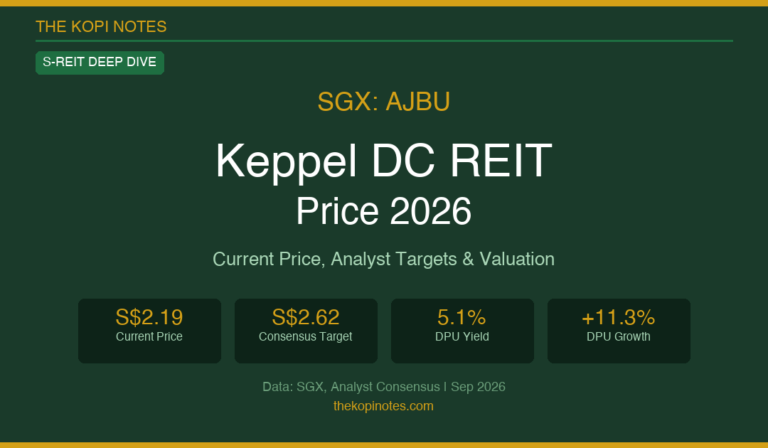
| 6 | Keppel DC REIT | AJBU | Data Centres | ~5–7% |
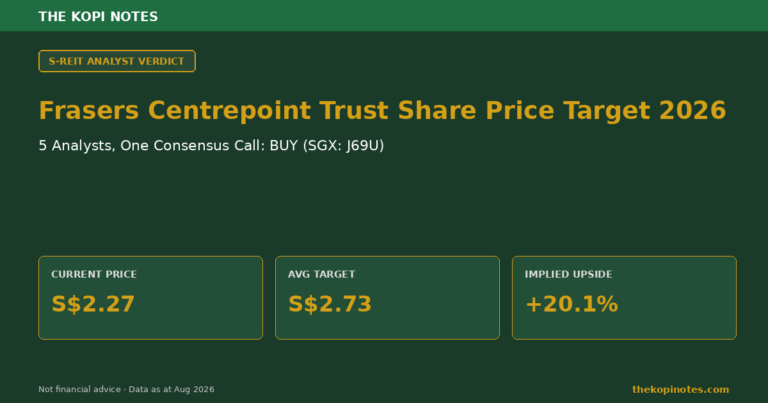
| 7 | Frasers Centrepoint Trust | J69U | Retail | ~5–6% |
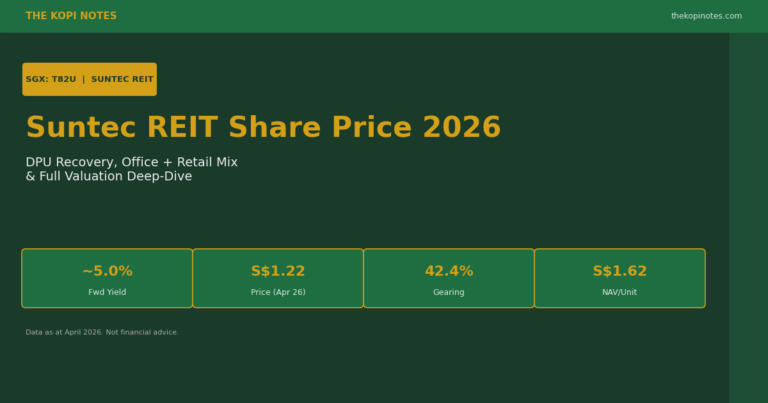
| 8 | Suntec REIT | T82U | Office & Retail | ~4–5% |
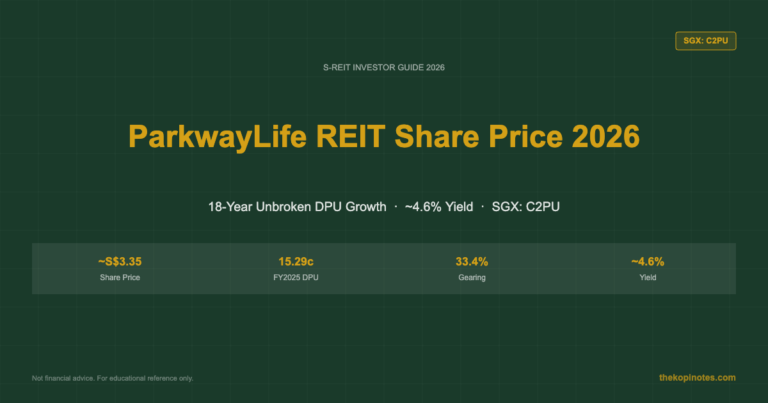
| 9 | ParkwayLife REIT | C2PU | Healthcare | ~4–5% |
| 10 | AIMS APAC REIT | O5RU | Industrial | ~3–4% |
Source: Lion Global Investors, approximate portfolio weights as at Q1 2026. Weights are rounded and change with quarterly rebalancing. Always verify the current factsheet before investing.
Sector Allocation
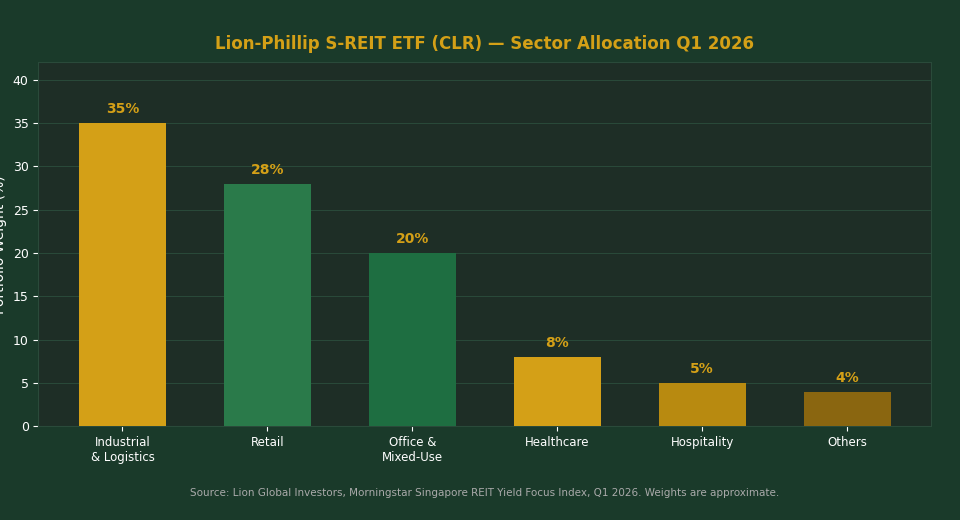
CLR’s Morningstar index methodology tilts towards the highest-yielding sectors of the S-REIT market. As at Q1 2026, the approximate sector breakdown is: Industrial & Logistics ~35%, Retail ~28%, Office & Mixed-Use ~20%, Healthcare ~8%, Hospitality ~5%, and Others ~4%. The industrial-heavy tilt reflects the yield-focus methodology: industrial S-REITs tend to offer higher DPU yields and lower gearing than office or hospitality REITs. For investors seeking passive income in Singapore, this allocation provides stable, recurring distributions backed by hard assets.
Dividend Yield & Distribution History
CLR distributes income twice yearly — typically in February and August, reflecting the underlying S-REITs’ own semi-annual distribution cycles. Below is the recent distribution-per-unit (DPU) history:
| Distribution Period | DPU (SGD cents) | Payment Date | Notes |
|---|---|---|---|
| H2 2025 | ~2.8–3.0¢ | Feb 2026 | Stable; resilient amid rate plateau |
| H1 2025 | ~2.7–2.9¢ | Aug 2025 | Slight compression from higher financing costs |
| H2 2024 | ~2.8¢ | Feb 2025 | Recovery as rate-hike cycle peaked |
| H1 2024 | ~2.6–2.7¢ | Aug 2024 | Pressure from elevated debt refinancing costs |
| H2 2023 | ~2.7¢ | Feb 2024 | Rate-hike peak: S-REIT DPUs broadly compressed |
Source: Lion Global Investors distribution announcements via SGX. DPU figures are approximate for reference. Always check the SGX announcement page for exact figures before investing.
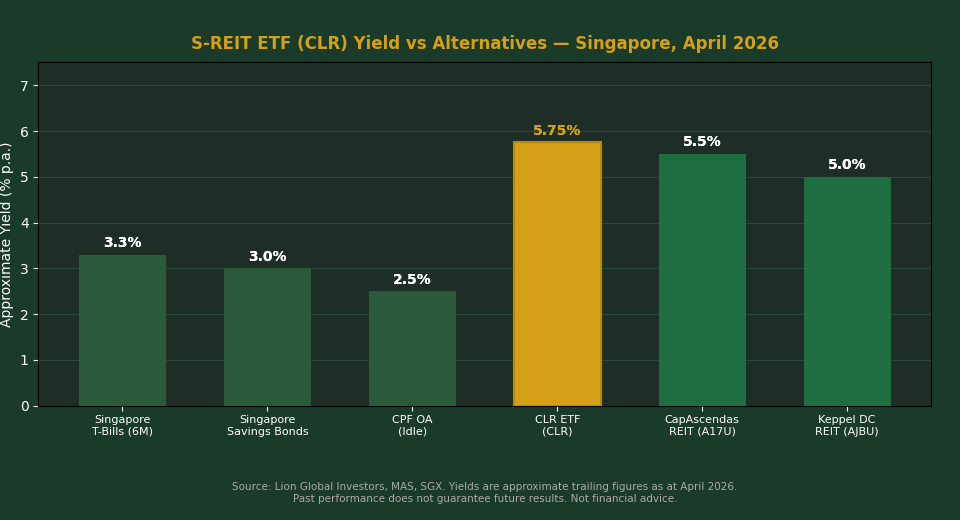
At a unit price of approximately SGD 0.92–0.98 (as at April 2026), the trailing 12-month yield works out to roughly 5.5–6.0% p.a. For a Singapore investor holding SGD 30,000 in CLR, the expected annual distribution income is approximately SGD 1,650–1,800 before fees. S-REIT distributions are tax-transparent for Singapore individual investors — no tax forms to file, no withholding tax complications.
If you are comparing this against Singapore T-bills or Singapore Savings Bonds, note that CLR carries price risk (NAV can fall) while T-bills and SSBs guarantee principal. CLR is an equity instrument — suitable for the higher-risk portion of your income portfolio.
CLR Performance vs Alternatives
CLR’s total return since listing in October 2017 has broadly tracked the Singapore REIT market. The 2022–2023 rate-hike cycle weighed heavily, with CLR’s NAV declining alongside the broader S-REIT sector. 2024–2026 has seen a gradual recovery as rate conditions stabilise.
| Investment Option | Approx. 3Y Total Return | Current Yield | Risk Level |
|---|---|---|---|
| Lion-Phillip S-REIT ETF (CLR) | -5% to +5% (rate cycle dependent) | ~5.5–6.0% | Medium |
| CapitaLand Ascendas REIT (A17U) | +2% to +8% | ~5.2–5.8% | Medium |
| Keppel DC REIT (AJBU) | +5% to +20% | ~4.5–5.5% | Medium-High |
| Singapore T-Bills (6M) | +3.0–3.6% p.a. (guaranteed) | ~3.0–3.6% | Very Low |
| CPF OA (if invested via CPFIS) | 2.5% floor (opportunity cost) | 2.5% p.a. (risk-free) | Zero |
Source: SGX, Lion Global Investors. Returns are approximate and depend on entry/exit price. Past performance does not guarantee future results. Data as at April 2026.
CLR’s yield-focus methodology means it does not include all S-REITs. Higher-growth names that trade at lower yields may not make the index cut. If you believe in the long-term growth story of a specific sub-sector, a direct REIT investment may offer better returns. For a comprehensive view on which individual S-REITs to pair alongside CLR, see our best S-REITs in Singapore 2026 analysis, or use our Singapore retirement calculator to model how different yield rates affect your long-term income projections.
How to Buy the Lion-Phillip S-REIT ETF (CLR) in Singapore
Since CLR is listed on the SGX, you can buy it through any Singapore-licensed brokerage in the same way you buy a stock. The minimum entry cost is approximately SGD 92–98 (100 units × ~SGD 0.92–0.98 per unit as at April 2026).
Step-by-Step: Buying CLR
- Open a brokerage account — any SGX-connected broker works. For lowest commission, consider Syfe Trade (zero commission) or FSMOne (0.08%, min SGD 8.80).
- Search for ticker “CLR” — this is the SGD counter on SGX.
- Place a limit order — enter quantity (minimum 100 units) and your desired price.
- Confirm and settle — SGX trades settle on T+2. Units appear in your CDP/brokerage account after settlement.
- Receive distributions automatically — dividends are credited to your brokerage account in February and August each year.
Buying CLR via CPFIS or SRS
CLR is CPFIS-eligible (OA funds), meaning you can deploy your CPF Ordinary Account savings to invest in it. CPF OA earns only 2.5% p.a. if left idle — CLR’s ~5.5–6.0% yield represents a meaningful potential uplift, though you bear market risk. To buy CLR with CPF: open a CPFIS-linked brokerage account (DBS Vickers, Phillip Securities, or OCBC Securities). For a detailed framework on deploying CPF savings, see our CPF investment strategy guide. CLR is also SRS-eligible for tax-deferred investing. For context on how moomoo Singapore compares to FSMOne and Syfe for ETF and REIT investing, see our broker review.
Brokerage Fee Comparison for Buying CLR
| Broker | SGX Commission | Min. Fee | CPFIS? |
|---|---|---|---|
| Syfe Trade | 0% (unlimited free trades) | Nil | No |
| FSMOne | 0.08% | SGD 8.80 | Yes |
| MooMoo | 0.03% (promo periods) | SGD 0.99 | No |
| DBS Vickers | 0.18% | SGD 25 | Yes |
| OCBC Securities | 0.18% | SGD 25 | Yes |
Source: Broker websites, April 2026. Fees may change — always check the broker’s current schedule before trading.
CLR ETF vs Buying S-REITs Directly: Which Is Better?
| Factor | CLR ETF | Direct S-REITs |
|---|---|---|
| Diversification | Instant (20+ REITs) | Requires manual building (5+ REITs) |
| Yield Potential | ~5.5–6.0% (index-average) | 5–8% (cherry-pick high yielders) |
| Management Cost | 0.60% TER p.a. | One-time brokerage commissions only |
| Research Required | Minimal — buy and hold | High — monitor each REIT’s financials |
| Control Over Holdings | None — index decides | Full — overweight favourites |
| CPFIS-Eligible | Yes | Yes (most S-REITs are CPFIS-eligible) |
| Minimum Investment | ~SGD 92–100 (1 lot) | ~SGD 200–500 per REIT (1 lot) |
| Distribution Frequency | Semi-annual | Quarterly or semi-annual (varies) |
Source: TKN analysis. Figures as at April 2026. TER for CLR from Lion Global Investors factsheet.
The 0.60% TER Cost Drag: Does It Matter?
On SGD 50,000 invested, you pay approximately SGD 300 per year in fund management costs. A direct portfolio of 5 S-REITs with zero ongoing management costs avoids this drag. For portfolios below SGD 30,000, CLR’s convenience wins — brokerage commissions on 5+ positions can quickly exceed the ETF’s TER. For portfolios above SGD 50,000–100,000, the economics increasingly favour direct REIT ownership. For a deeper analysis on REIT selection and the Singapore REIT ETF landscape, see our Singapore REIT ETF guide.
Pros and Cons of the Lion-Phillip S-REIT ETF
Pros
- Instant diversification: Exposure to 20+ S-REITs across all sectors in a single SGD trade.
- Low entry barrier: ~SGD 92–100 per lot — one of the most accessible S-REIT investment options for beginners.
- CPFIS and SRS eligible: Can be purchased with CPF OA funds and SRS funds.
- SGD-denominated: No FX risk, no US estate tax exposure, no withholding tax complications.
- Quarterly rebalancing: Automatically rotates into higher-yielding, healthier REITs each quarter.
- Physical replication: You own actual S-REIT units — no derivatives or counterparty risk.
Cons
- 0.60% TER: Higher than global equity ETFs; erodes net yield on larger portfolios.
- Semi-annual distributions only: Quarterly income investors may prefer individual REITs.
- Yield-focus, not total return: High-growth REITs with lower current yields may not make the index.
- Singapore-only exposure: No geographic diversification into global real estate.
- Rate sensitivity: CLR NAV is sensitive to Singapore interest rate movements — rising rates compress S-REIT valuations.
Start Investing in S-REITs Today
Open a brokerage account with a referral bonus and start building your S-REIT income portfolio.
Frequently Asked Questions
What is the Lion-Phillip S-REIT ETF (CLR)?
What is the current dividend yield of CLR?
Is CLR eligible for CPF Investment Scheme (CPFIS)?
How does CLR compare to buying S-REITs directly?
What are the top holdings of the Lion-Phillip S-REIT ETF?
What is the expense ratio (TER) of CLR?
Can I use SRS funds to buy CLR?
What is the minimum investment for CLR?
This article was researched with the help of AI. While we strive to keep all information accurate and up to date, there may be errors. If you notice any discrepancies, please contact us.