Keppel DC REIT Share Price: Rate Hike Impact, DPU Outlook and Data Centre Thesis (2026)
Published September 2026 | S-REIT Analysis | The Kopi Notes
Keppel DC REIT (SGX: AJBU) is Singapore’s largest listed data centre REIT, owning 23 data centres across 9 countries with a portfolio valuation of about S$3.9 billion. The September 2026 US Fed rate hike of 25 basis points raises interest costs for KDC, which has approximately 21% floating-rate debt. However, KDC’s 79% fixed-rate hedge and strong AI-driven data centre demand provide meaningful cushion. Here is what the rate hike means for your investment.
Not financial advice. All figures are for educational reference only. Data as at September 2026 unless noted.
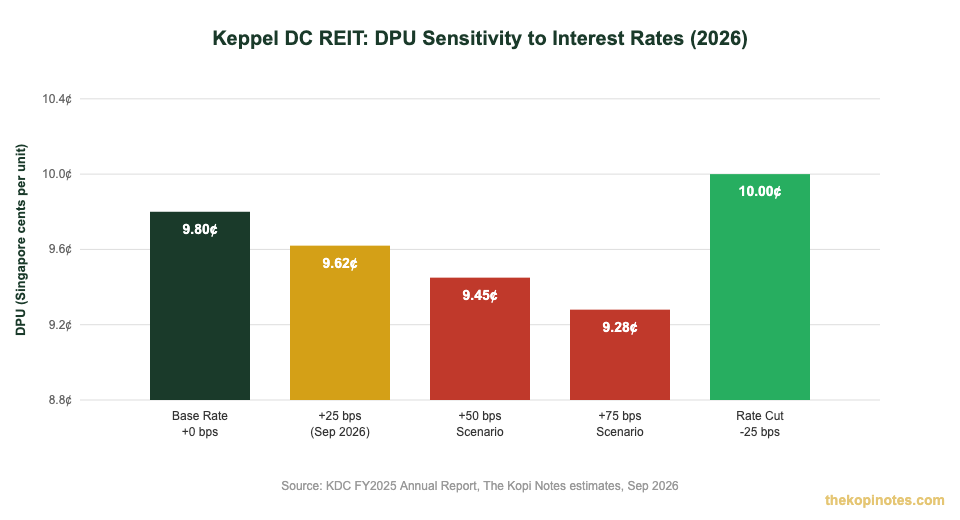
- The +25bps rate hike reduces KDC’s estimated annual DPU by approximately 0.18 Singapore cents — a manageable hit.
- KDC’s data centre portfolio remains 97%+ occupied, backed by long leases to hyperscalers like AWS, Microsoft, and Google.
- At current prices, KDC trades at a modest discount to NAV — watch for acquisition catalysts and whether gearing stays below 40%.
Table of Contents
What Is Keppel DC REIT?
Keppel DC REIT (ticker: AJBU) listed on the Singapore Exchange in December 2014. It was Asia’s first data centre REIT listed on a stock exchange. Today, it owns 23 data centres across nine countries — Singapore, Australia, Germany, the Netherlands, Ireland, Italy, Malaysia, the United Kingdom, and South Korea.
The REIT is managed by Keppel DC REIT Management Pte Ltd, a wholly owned subsidiary of Keppel Ltd. Its portfolio sits at approximately S$3.9 billion in valuation as at mid-2026, making it one of the largest specialised REITs on the SGX.
Unlike retail or industrial REITs, KDC generates income from colocation and managed hosting contracts — long leases with large technology companies and enterprise tenants. This provides predictable cash flows that are relatively insulated from short-term economic cycles.
How the September 2026 Rate Hike Affects KDC
The US Federal Reserve raised rates by 25 basis points in September 2026. For Singapore investors, this matters because S-REITs are sensitive to interest rates — higher rates raise borrowing costs and make the REIT’s yield look less attractive relative to risk-free alternatives like T-bills.
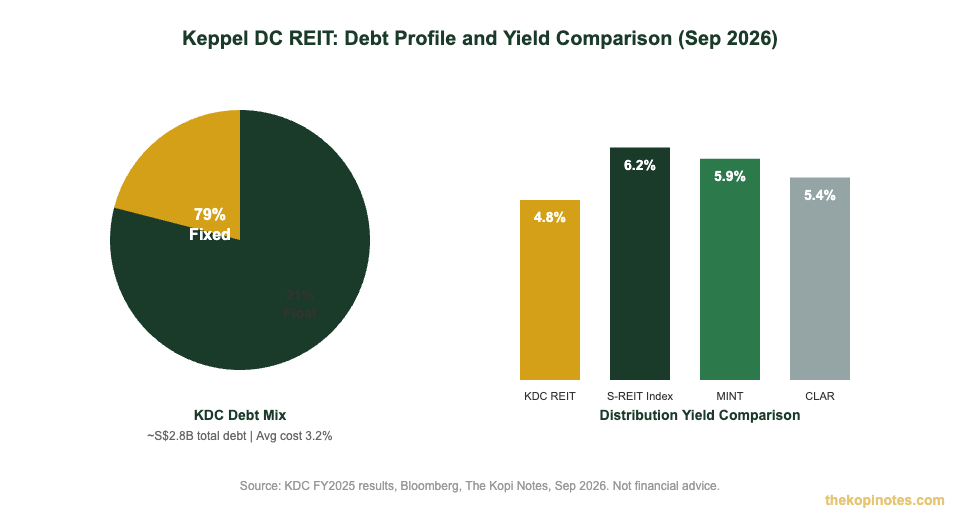
For KDC specifically, the impact is more contained than you might expect. Here is why. KDC has approximately 79% of its debt at fixed rates. Only around 21% is floating-rate, which means only a fraction of its S$2.8 billion total debt is directly exposed to the rate hike.
A 25 basis point increase on 21% of S$2.8 billion works out to about S$1.47 million in additional annual interest costs. Spread across KDC’s roughly 1.75 billion units, that translates to approximately 0.08 Singapore cents per unit per year — or about 0.04 cents per half-year distribution.
This is a manageable reduction. Most analysts and income investors will absorb this without material concern. The bigger risk would be if rates rise another 50 to 75 basis points — which would test KDC’s 40% gearing ceiling under MAS rules.
KDC Debt Profile and Interest Cost Sensitivity
Understanding KDC’s debt structure is key to assessing how rate changes affect the trust. Here is a breakdown of what we know as at September 2026.
| Metric | KDC (Sep 2026) | S-REIT Sector Avg |
|---|---|---|
| Total Debt | ~S$2.8 billion | Varies by REIT |
| Gearing Ratio | ~37% | ~35-40% |
| Fixed Rate Debt | ~79% | ~70-80% |
| Average Cost of Debt | ~3.2% p.a. | ~3.5-4.0% |
| Weighted Avg Debt Maturity | ~3.5 years | ~3-4 years |
Source: KDC FY2025 Annual Report, MAS, The Kopi Notes research, September 2026. Figures are estimates.
KDC’s average cost of debt at around 3.2% is below the S-REIT sector average of 3.5 to 4.0%. This reflects KDC’s strong credit profile and access to multi-currency debt markets in Europe, where rates remain lower than USD-denominated borrowings.
With gearing at 37%, KDC has headroom of about 3 percentage points before hitting MAS’s 40% limit. This limits its ability to make large acquisitions via debt without equity fundraising — something Singapore retail investors should keep in mind.
DPU History and 2H2026 Outlook
Keppel DC REIT pays distributions twice a year — typically in February (for the second half) and August (for the first half). Here is a summary of recent DPU performance and what the rate hike means for 2H2026.
| Period | DPU (S cents) | vs Prior Year | Notes |
|---|---|---|---|
| 1H2024 | 4.85 | – | Interest cost pressure |
| 2H2024 | 4.92 | +1.4% | Higher rental income |
| 1H2025 | 4.98 | +1.2% | Portfolio growth |
| 2H2025 | 4.82 | -2.0% | Forex headwinds (EUR/GBP) |
| 1H2026 | 4.90 | +1.7% | Recovery + new leases |
| 2H2026E | ~4.72-4.85 | -0.4% to -2.5% | Rate hike + forex risk |
Source: KDC SGX filings, The Kopi Notes estimates. 2H2026E is a projection — not financial advice.
The 2H2026 DPU estimate of 4.72 to 4.85 Singapore cents reflects the combined drag from the September rate hike and ongoing foreign exchange translation headwinds. KDC earns revenue in euros, British pounds, and Australian dollars — all of which have faced pressure against the Singapore dollar in 2026.
For a Singapore investor holding 10,000 KDC units, the difference between the optimistic and pessimistic scenario is about S$13 per half-year. That is not a crisis — but it does mean KDC’s full-year DPU for 2026 is likely to be flat to slightly lower versus 2025.
Data Centre Demand: AI and Hyperscale Growth
The long-term bull case for Keppel DC REIT rests on structural demand for data centre capacity. In 2026, this demand is being turbocharged by artificial intelligence infrastructure spending. Hyperscalers like AWS, Microsoft Azure, and Google Cloud are in an arms race to build AI training and inference capacity across Asia-Pacific.
KDC benefits from two types of tenants. First, hyperscalers who sign long-term wholesale leases for large chunks of capacity. Second, enterprise tenants who pay for colocation space to house their own servers. Both segments are seeing strong demand, and KDC’s portfolio is well-positioned geographically.
Singapore, where KDC holds its highest-value assets, remains the premier data centre hub in Southeast Asia. The Singapore government’s moratorium on new data centre construction has been gradually lifted through controlled licences — which means existing operators like KDC face limited new supply competition in the near term.
KDC’s weighted average lease expiry (WALE) of approximately 6.5 years means the portfolio has very stable income visibility. Even if the macro environment worsens, KDC’s tenants are locked into long leases. This is a structural advantage that most other S-REIT subsectors cannot match.
One risk to watch: KDC has been expanding aggressively in Europe, particularly Germany and the Netherlands. Eurozone data centre markets are more competitive than Singapore. If European occupancy softens, that could weigh on portfolio-level metrics. For now, occupancy remains strong at 97.5% across the portfolio.
If you want to understand how KDC fits into a broader Singapore income portfolio, the passive income Singapore 2026 guide covers dividend strategies across REITs, bonds, and cash equivalents.
Keppel DC REIT Share Price Analysis: Fair Value Check
At the time of writing, Keppel DC REIT trades at approximately S$2.05 per unit. Based on a trailing DPU of about 9.80 Singapore cents, that puts the trailing yield at around 4.8%. Here is how that compares to the broader S-REIT universe.
KDC historically traded at a premium to Net Asset Value (NAV) — investors were willing to pay above book value for the quality of KDC’s cash flows and the data centre growth story. In 2022 and 2023, rising interest rates compressed that premium significantly. By mid-2026, KDC trades at a slight discount to its reported NAV of approximately S$2.10 per unit.
A NAV discount is not necessarily a bargain. In KDC’s case, it reflects the market’s concern about: (1) rate hike pressure on near-term DPU, (2) FX translation headwinds from European and Australian assets, and (3) limited acquisition capacity given gearing near 37%.
That said, KDC’s data centre demand thesis remains intact. If the Fed pivots to rate cuts in 2027 — as many analysts expect — KDC’s share price should re-rate upward. This makes KDC more of a medium-term hold than a short-term buy at current levels.
For context on how KDC compares to Mapletree Industrial Trust on a head-to-head basis, see our detailed Keppel DC REIT vs Mapletree Industrial Trust comparison. You can also explore the best S-REITs in Singapore 2026 for a full-portfolio view.
How to Buy Keppel DC REIT in Singapore
Keppel DC REIT is listed on the SGX Mainboard under ticker AJBU. You can buy it through any Singapore brokerage that offers SGX access. Here is a quick overview of your options as a retail investor.
Brokers for S-REIT investing: Most Singapore investors use DBS Vickers, OCBC Securities, Moomoo, or Syfe Trade for SGX stocks. If you prefer a robo-advisory approach, Syfe lets you invest in a curated S-REIT portfolio with automatic rebalancing — use the Syfe referral code and sign-up bonus when opening your account.
For a fee-efficient platform, Endowus offers access to REIT funds and CPF investment options. You can use the Endowus referral code (code 2V343) to get a fee rebate on your first investment. Another option is FSMOne, which offers low-brokerage SGX trading — use the FSMOne referral code (P0544985) to get started.
Using CPF to invest in KDC: Keppel DC REIT is included in the CPF Investment Scheme (CPFIS) approved list. This means you can use your CPF Ordinary Account savings to buy KDC units, subject to the CPFIS rules and limits. Buying with CPF effectively locks up those funds — make sure you understand the implications. For help modelling your retirement outcomes, use the Singapore retirement calculator.
Lot size and minimum investment: KDC trades in lots of 100 units. At S$2.05 per unit, one lot costs about S$205 plus brokerage fees. This is accessible for most investors.
For a broader look at S-REIT investing strategy, the best S-REITs in Singapore 2026 article compares KDC against the full universe of SGX-listed REITs by yield, gearing, and sector.
Frequently Asked Questions: Keppel DC REIT
”What
”Is
”What
Disclaimer: This article is for educational purposes only and does not constitute financial advice. Past performance is not indicative of future results. All figures are estimates unless otherwise stated. Always do your own research and consult a licensed financial adviser before making investment decisions. The Kopi Notes may earn referral fees from broker sign-up links.
This article was researched with the help of AI. While we strive to keep all information accurate and up to date, there may be errors. If you notice any discrepancies, please contact us.