TribeCar + FSMOne + GXS + Trust Bank + IBKR: Racing the SRS Year-End Deadline (2026)
Skip car ownership and you free up roughly S$900 a month. Split that between GXS Boost Pocket and Trust Bank Flex all year, then sweep the total into an FSMOne SRS contribution before 31 December, and you bank the full S$15,300 tax relief. Whatever’s left over goes to IBKR, which has no deadline and no cap.
Not financial advice. All figures are for educational reference only. Data as at September 2026 unless noted.
- TribeCar frees up roughly S$900 a month by cutting COE, insurance, petrol and parking.
- GXS Boost Pocket and Trust Bank Flex both earn interest on that cash while you build toward the S$15,300 SRS cap.
- The SRS deadline is 31 December, not a soft target. Miss it and that year’s relief is gone for good.
Table of Contents
Why five platforms, not one
TribeCar: where the S$900 a month comes from
GXS Boost Pocket and Trust Bank Flex, side by side
Why 31 December is a hard wall, not a suggestion
FSMOne: turning the pool into SRS relief
IBKR: what happens after the cap is hit
The full 12-month routing table
FAQ
Why five platforms, not one
Four earlier combos on this site ranked platforms by real return, by certainty, or by purpose. This one is different. It’s built around a date, not a rate.
SRS relief only counts if the money lands in your SRS account by 31 December. Every other platform here earns interest while you wait for that date. Only FSMOne turns the waiting into a tax outcome, and only once a year.
Route TribeCar’s freed-up car money into two savings accounts at once. Watch the running total against S$15,300. Sweep it into FSMOne before the year ends. Send anything left over to IBKR, where there’s no deadline pressure at all.
TribeCar: where the S$900 a month comes from
Owning a small car in Singapore easily runs S$1,000 to S$1,500 a month once you count COE, insurance, petrol, parking and servicing. Renting a TribeCar for the handful of trips a month you actually need a car for costs a fraction of that.
A commuter who drives twice a week for groceries and the occasional trip typically frees up around S$900 a month by giving up the car. That number is the entire engine behind this system. Nothing downstream works if this first step doesn’t happen.
GXS Boost Pocket and Trust Bank Flex, side by side
Most of the combos on this site pick one account, then another, in sequence. This one runs two accounts in parallel from day one. That spreads your SDIC coverage across two banks and lets you hit two different bonus conditions at the same time, instead of waiting for one ladder rung before starting the next.
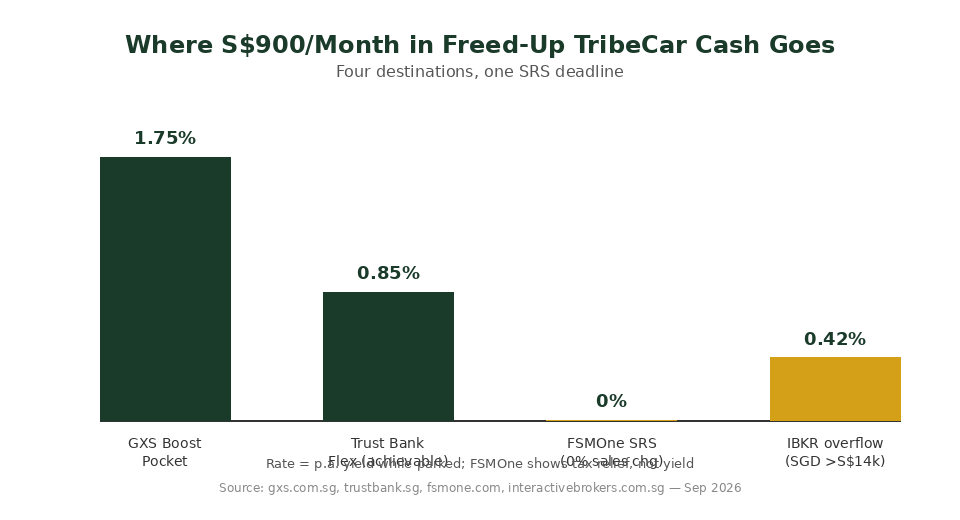
GXS Boost Pocket pays a base rate of 0.88% p.a., rising to as much as 1.75% p.a. if you lock a tranche for 12 months and let it run to maturity. Break it early and you lose the bonus portion, so only lock money you’re confident you won’t need before the SRS sweep.
Trust Bank’s Flex plan advertises up to 2.40% p.a., but that headline needs S$20,000 in TrustInvest or a S$100,000 average balance. What’s actually achievable with three no-cost scoops, salary GIRO, five card spends of S$30 or more, and PayNow, works out to 0.85% p.a. if you’re a union member, 0.75% p.a. if you’re not.
Neither rate is exciting on its own. Together, spread across two banks, they’re simply where the money sits while it waits for December.
| Account | Achievable rate | Condition |
|---|---|---|
| GXS Boost Pocket | Up to 1.75% p.a. | 12-month lock, min S$100 |
| Trust Bank Flex (union) | 0.85% p.a. | 3 scoops: GIRO, 5 card spends, PayNow |
| Trust Bank Flex (non-union) | 0.75% p.a. | Same 3 scoops |
Source: gxs.com.sg, trustbank.sg, September 2026
Why 31 December is a hard wall, not a suggestion
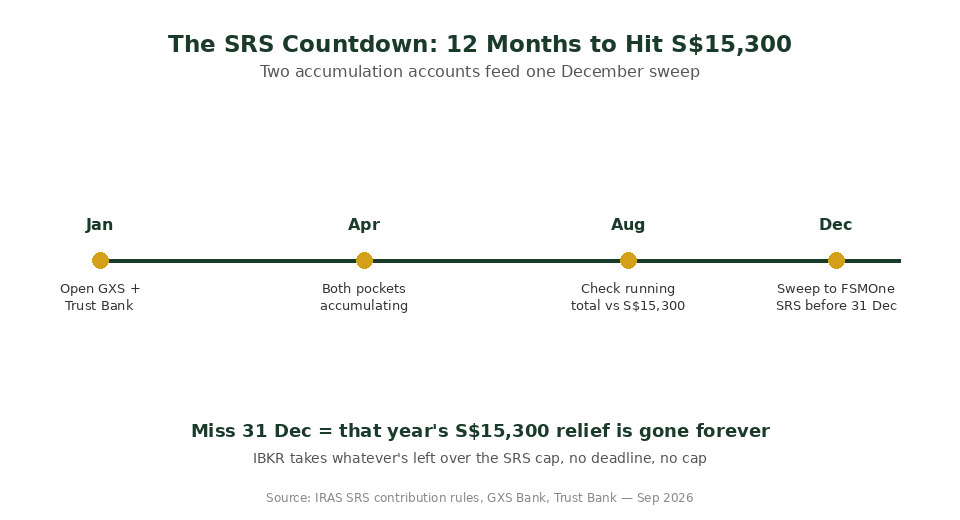
The Supplementary Retirement Scheme lets you contribute up to S$15,300 a year as a Singaporean or PR, and every dollar reduces your taxable income for that year. But the cap resets on 1 January. There’s no carrying forward an unused allowance into next year.
That makes this system different from a savings ladder you can walk away from and resume later. If you’ve only put in S$8,000 by 31 December, you’ve permanently lost the tax relief on the remaining S$7,300 for that year. It doesn’t roll over.
Treat 1 December as your real deadline, not 31 December. Bank transfers to SRS providers can take a few working days to process, and FSMOne’s own SRS contribution window has occasionally been backed up in the final week of December in past years.
FSMOne: turning the pool into SRS relief
FSMOne charges 0% sales charge on SRS unit trusts, and its ETF fee sits at 0.08% with a S$8.80 minimum. Neither number is a yield. What matters here is that FSMOne is simply the account that receives your SRS contribution and invests it, so the tax relief locks in the moment the money lands, regardless of what it’s invested in afterward.
By early December, add up what’s sitting in GXS Boost Pocket and Trust Bank Flex combined. If it’s above S$15,300, transfer exactly S$15,300 into your SRS account at FSMOne and invest the rest of this year’s pool as ordinary cash savings. If it’s below S$15,300, transfer the full amount and top up the shortfall from your regular pay if you can, since a partial SRS contribution still gets partial relief, just not the full S$15,300 worth.
You don’t need to invest the SRS money the same day it lands. The relief is earned on contribution, not on investment. Take your time choosing a fund once the year-end deadline pressure is off.
IBKR: what happens after the cap is hit
Once the SRS cap for the year is used up, extra TribeCar savings have nowhere useful left to go inside the SRS system. That’s where IBKR comes in, as an uncapped, no-deadline overflow account for ordinary investing.
One thing worth knowing before you send cash there: IBKR pays 0% interest on SGD balances below S$14,000 and 0% on USD balances below US$10,000. Idle cash below those thresholds earns nothing while it sits, so don’t let overflow cash accumulate uninvested at IBKR the way it can in GXS or Trust Bank. Put it to work in a globally diversified fund shortly after it arrives, or route it through IBKR only once you’re ready to invest, not before.
The full 12-month routing table
| Month | Action | Platform |
|---|---|---|
| Jan | Open both accounts, start splitting freed-up cash | GXS + Trust Bank |
| Feb – Jul | Keep depositing monthly, let bonuses accrue | GXS + Trust Bank |
| Aug | Check running total against S$15,300 | Both accounts |
| Sep – Nov | Top up shortfall from pay if you’re tracking below cap | GXS + Trust Bank |
| Early Dec | Transfer up to S$15,300 to SRS | FSMOne |
| Dec | Send anything above the cap to invest | IBKR |
Source: IRAS SRS contribution rules, September 2026
Related reading
This is the fourth 5-platform combo on this site. The first ranked money by purpose in a purpose-bucket system across TribeCar, MariBank, FSMOne, GXS and Syfe. The second built a next-dollar decision tree across five platforms. The third ranked platforms by real return after inflation. If you’d rather size your emergency fund first, see how much you actually need in the Singapore retirement calculator.
FAQ
What happens if I don't hit the S$15,300 SRS cap by 31 December?
Why split money between GXS and Trust Bank instead of using just one?
Can I contribute to SRS more than once a year?
Does locking money in GXS Boost Pocket for 12 months conflict with the December SRS deadline?
What if my freed-up TribeCar savings are less than S$900 a month?
Is my IBKR cash safe while it earns 0% interest below the threshold?
The SRS deadline doesn’t move for anyone. Whichever two accounts you use to build toward it, put a reminder on your calendar for 1 December, not 31 December, so a slow bank transfer doesn’t cost you a year’s worth of tax relief.
This article was researched with the help of AI. While we strive to keep all information accurate and up to date, there may be errors. If you notice any discrepancies, please contact us.