5 Platforms, 4 Purpose Buckets: The TribeCar Cash System (2026)
TribeCar + MariBank + GXS + FSMOne + Syfe, tagged by what each dollar is for, not by whichever pays the highest rate.
Not financial advice. This is one way to organise five accounts, not a recommendation for your situation.
Skip car ownership with TribeCar and you free up roughly S$1,000 to S$1,500 a month once you count COE, insurance, petrol, parking and servicing. Singapore’s Category A COE hit a record S$133,009 in the first September 2026 bidding round, so that gap keeps widening. This combo asks a different question than the six 4-way combos before it. Not which platform pays the most, but what job each dollar is doing.
Six 4-way combos already exist on this site, ranked by bonus placement, SDIC protection, tax-relief caps, liquidity tiering, trade-size fees and achievable rates. This is the first 5-way combo. Instead of ranking destinations against each other, it tags every dollar with a purpose first, then sends it to whichever platform does that job best.
Table of Contents
Contents u2014 Click to expand
Why purpose beats rate-chasing
A rate table tells you which account pays the most. It doesn’t tell you whether that account is the right place for money you might need next month, money you’re saving for a goal next year, or money you won’t touch for decades.
Behavioural finance calls this mental accounting: people naturally sort money into buckets by purpose, even when a spreadsheet says every dollar is interchangeable. This combo works with that instinct instead of against it. Four buckets, four jobs, four platforms.
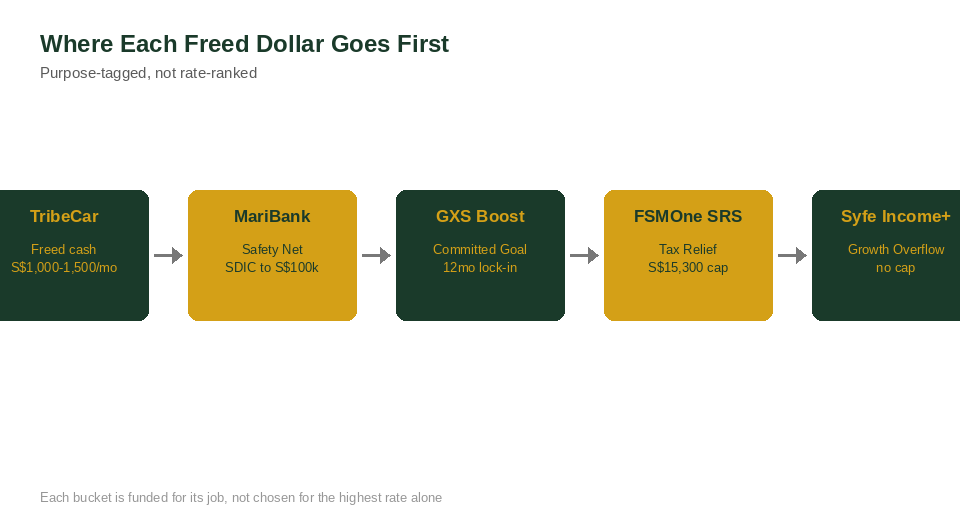
Here’s the order. Safety Net first, because emergencies don’t wait. Committed Goal second, because a locked 12-month rate only helps once you already know you won’t need that cash sooner. Tax Relief third, because Singapore’s SRS cap resets every calendar year. Growth Overflow last, because it’s the only bucket with no cap and no schedule.
A worked example: routing S$1,200 a month
Say skipping car ownership frees up S$1,200 a month. Month one, all S$1,200 goes to MariBank, because the Safety Net bucket starts empty. Once MariBank holds three months of expenses, say S$9,000 for a typical single-income household, new deposits stop going there and start flowing to GXS Boost Pocket instead.
From month four onward, S$700 a month might go to GXS Boost Pocket toward a 12-month renovation goal, while S$300 a month tops up FSMOne SRS until the S$15,300 annual cap is reached, usually around month 22 to 24 at that pace. The remaining S$200 a month goes straight to Syfe Income+ from month four, since Growth Overflow has no cap to wait for.
The split shifts as each bucket fills. Early months skew almost entirely toward Safety Net. Later months skew toward Growth Overflow, once the first three jobs are already funded. The buckets do not need equal amounts each month, they need to be funded in the right order.
Bucket 1: MariBank \u2014 the Safety Net
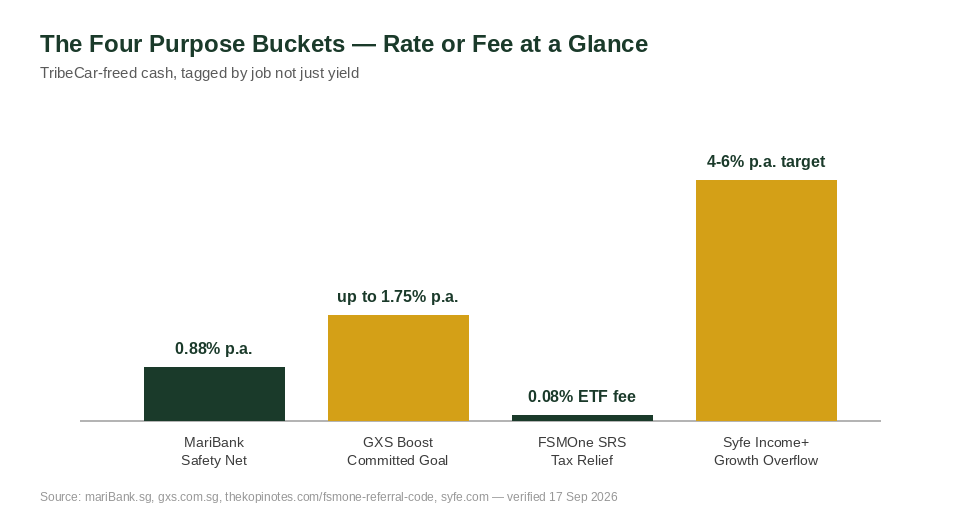
Every freed dollar starts here until you’ve built three to six months of expenses. MariBank pays 0.88% p.a. on your savings balance, with no lock-in and instant access through PayNow or GIRO. Deposits are SDIC-insured up to S$100,000, the same protection level as any full bank in Singapore.
This bucket isn’t about the rate. It’s about money you might need tomorrow: a car repair, a medical bill, a month between jobs. If GXS Boost Pocket paid double, it still wouldn’t belong here, because Boost Pocket locks your cash away.
Bucket 2: GXS Boost Pocket \u2014 the Committed Goal
Once your Safety Net is full, the next dollar goes toward whatever you’re saving for on a fixed timeline: a wedding, a home renovation, a downpayment 12 months out. GXS Boost Pocket pays 0.88% p.a. base plus up to 0.87% p.a. in maturity bonus, for up to 1.75% p.a. if you hold the full 12-month tenor.
That extra 0.87% p.a. is the reward for certainty. You’re telling GXS, and yourself, that this money has a date attached. Break that commitment early and you lose the bonus, which is exactly why it shouldn’t hold money that might get pulled forward.
Bucket 3: FSMOne SRS \u2014 the Tax Relief
The third bucket isn’t really about yield at all. Every dollar you contribute to your Supplementary Retirement Scheme account, up to S$15,300 a year for citizens and PRs, cuts your chargeable income by that same dollar. FSMOne lets you invest that SRS cash into unit trusts at a permanent 0% sales charge, or into ETFs at 0.08% per trade with an S$8.80 minimum fee.
This bucket has a deadline the other three don’t. The S$15,300 cap resets every calendar year and doesn’t carry forward. Contribute S$8,000 this year instead of the full cap and you only get relief on the S$8,000. The unused S$7,300 is gone for good. That’s why it comes third here, funded only once your safety net and committed goal are already covered.
On a S$70,000 income with typical personal reliefs, maxing the S$15,300 SRS cap through FSMOne can cut roughly S$1,600 to S$1,900 off your annual tax bill, depending on your other reliefs. That is a fixed outcome the moment you file. Whatever Cash Smart, a money market fund, or an ETF you hold inside the SRS account does afterward is a separate, unguaranteed return on top.
Bucket 4: Syfe Income+ \u2014 the Growth Overflow
Whatever’s left after the first three buckets are full goes to Syfe Income+, a globally diversified dividend portfolio with no minimum investment and no lock-in. It charges a tiered management fee of 0.35% to 0.65% p.a. and targets a 4% to 6% p.a. yield, though that target isn’t guaranteed and moves with markets.
This is the only bucket with no cap and no schedule. Add S$50 or S$5,000 whenever you have spare cash, and withdraw whenever you need to, though withdrawing defeats the point of a growth bucket. It’s also the riskiest of the four. Unlike MariBank, GXS or FSMOne’s SRS relief, nothing here is insured, locked-in, or tax-advantaged. It’s just market return.
The four buckets in one table
| Bucket | Platform | What it protects | Rate or fee |
|---|---|---|---|
| 1. Safety Net | MariBank | Instant access, SDIC to S$100,000 | 0.88% p.a. |
| 2. Committed Goal | GXS Boost Pocket | Locked 12mo tenor, fixed timeline | Up to 1.75% p.a. |
| 3. Tax Relief | FSMOne SRS | S$15,300/yr relief cap | 0% sales charge / 0.08% ETF fee |
| 4. Growth Overflow | Syfe Income+ | No cap, no lock-in | 0.35-0.65% fee, 4-6% p.a. target |
How this compares to the six 4-way combos
The Fed raised its target range by 25 basis points to 3.75%-4.00% on 17 September 2026, the latest move in a cycle that has kept savings and cash-management rates moving all year. None of the four buckets here are fixed for life. MariBank, GXS and Syfe all reprice with the broader rate environment, which is one more reason to check current figures before moving money.
Six 4-way combos already live on this site: a floor-vs-flex bonus mechanic (Trust Bank + GXS + FSMOne), an SDIC protection waterfall (MariBank + Syfe + IBKR), a tax-relief cap sequence (Endowus + FSMOne + IBKR), months-of-expense liquidity tiering (GXS + Endowus + Syfe), a trade-size fee threshold (FSMOne + GXS + Syfe), and an achievable-rate funding ladder (Trust Bank + Endowus + IBKR). This is the first combo with five platforms, and the first that sorts money by purpose before it looks at rate at all.
Referral codes for this combo
FAQ
Why does MariBank come before GXS Boost Pocket if Boost Pocket pays more?
What happens if I withdraw from GXS Boost Pocket early?
Can I skip the Safety Net bucket and put everything into Syfe Income+ for the higher target yield?
Does the S$15,300 SRS cap carry forward if I do not use it all in one year?
Is Syfe Income+'s 4% to 6% p.a. target guaranteed?
Do I need all five platforms, or can I run this with fewer accounts?
This is not financial advice. Rates, caps and thresholds change; verify current figures directly with MariBank, GXS, FSMOne, Syfe and TribeCar before acting. Figures in this article were verified against maribank.sg, gxs.com.sg, secure.fundsupermart.com and syfe.com on 17 September 2026.
This article was researched with the help of AI. While we strive to keep all information accurate and up to date, there may be errors. If you notice any discrepancies, please contact us.