TribeCar + GXS + Endowus + Syfe: The Liquidity-Tier Cash System (2026)
Match freed-up car money to how soon you would actually need it back.
Giving up a car and using TribeCar instead usually frees up S$800 to S$1,500 a month. Most guides tell you which single platform to put it in. That is the wrong question. The right one is how many months you would need each dollar back if your car-share bill, a medical bill, or a job gap hit tomorrow.
This is not financial advice. It is one way to think about parking freed-up cash across four platforms by how soon you would need it, not by which one has the highest headline rate. Four tiers, four platforms: GXS for same-day access, Endowus Cash Smart for the one-to-six-month buffer, and Syfe Income+ for money you genuinely will not touch for six months or more.
Table of Contents
Contents — Click to expand
- Why tier by months of expenses, not by platform
- Tier 1 (0 to 1 month): GXS Main Account and Saving Pocket
- Tier 2 (1 to 3 months): Endowus Cash Smart Secure
- Tier 3 (3 to 6 months): Endowus Cash Smart Core and Ultra
- Beyond 6 months: Syfe Income+ overflow
- A worked example: S$1,000 a month, four tiers
- FAQ
Why tier by months of expenses, not by platform
Financial planners size an emergency fund in months of expenses, not in dollars. Three months covers a short job gap. Six months covers a longer one plus a few surprises. The mistake most TribeCar-to-savings guides make is treating that whole reserve as one pool and picking one winner platform for it.
A single platform cannot serve every horizon well. GXS pays daily interest with same-day access, but its Boost Pocket bonus needs a lock-in to hit its top rate. Endowus Cash Smart has no lock-up at all, and its higher tiers pay more because the underlying funds take on slightly longer settlement. Syfe Income+ pays the most, but it is a market-linked bond and REIT portfolio, not a deposit, so its value can dip on a bad week.
Splitting the same reserve across four tiers by how soon you would need it lets each platform do the job it is actually built for.
You could use a fixed deposit or T-bill instead of GXS or Endowus for part of this reserve. Both work, but both lock your money for a fixed tenor, and breaking a fixed deposit early usually forfeits the interest. The four platforms here were chosen because every tier stays either instantly liquid or, at worst, a few business days away, which matters more than an extra 0.2% when the whole point is having cash ready.
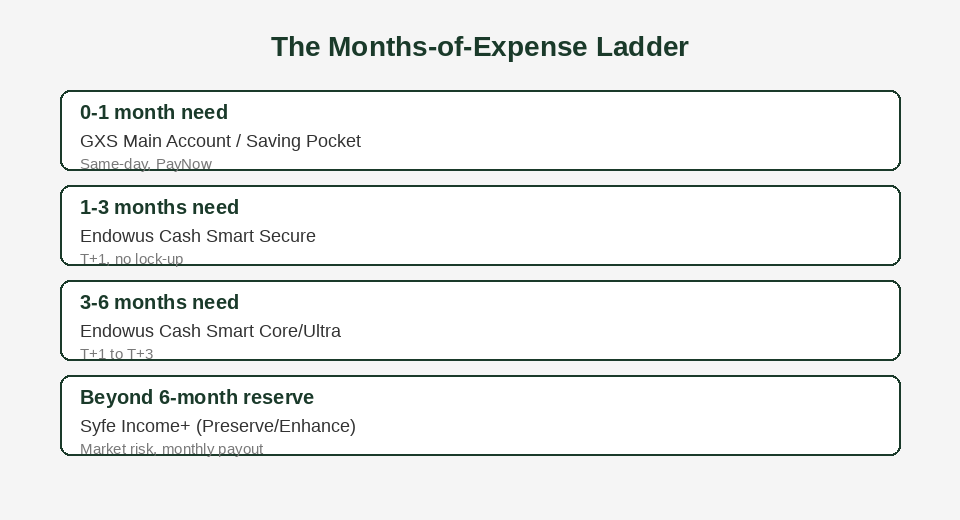
Tier 1 (0 to 1 month): GXS Main Account and Saving Pocket
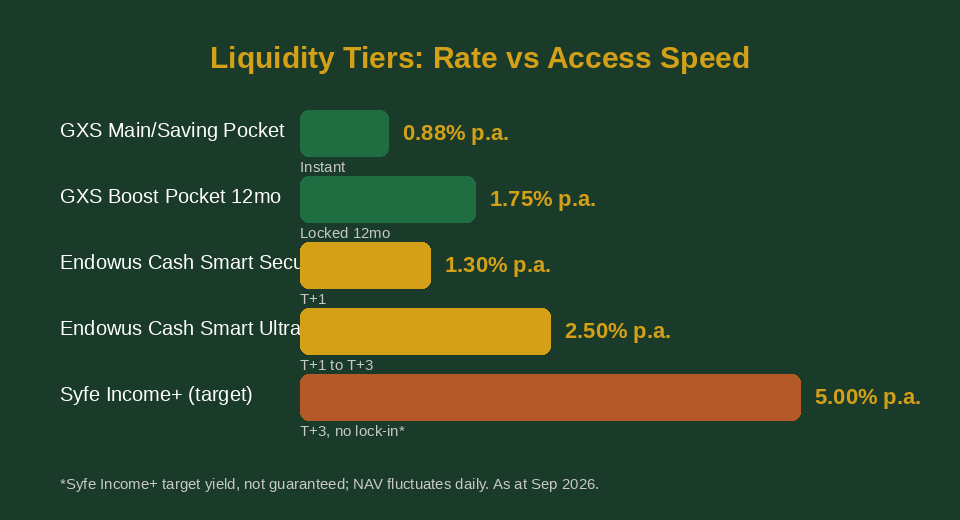
This tier is the money you would need within a day: a surprise TribeCar excess, a vet bill, a broken phone. GXS Main Account pays 0.88% p.a., credited daily, with no minimum spend or salary crediting. GXS Saving Pockets currently run a limited-time promo rate around 1.2% p.a., still with no lock-in and PayNow-speed withdrawals, and you can open up to eight of them to name by purpose.
Do not use GXS Boost Pocket for this tier. Boost Pocket locks your money for 1, 3, 4, 8 or 12 months to earn its bonus interest, up to 1.75% p.a. combined at 12 months. That belongs in a later tier, not the one-day-access bucket.
Tier 2 (1 to 3 months): Endowus Cash Smart Secure
Once your one-month buffer is full, the next dollars go to Endowus Cash Smart Secure, the most conservative of its three cash portfolios. It targets about 1.3% p.a. net of fees, invested in short-duration money market funds, with no lock-up and next-business-day access.
It beats GXS Main Account slightly while staying liquid enough for a one-to-three-month need, like a car repair on your own vehicle-free budget or a slow month of freelance income.
Tier 3 (3 to 6 months): Endowus Cash Smart Core and Ultra
Money you would only need after three months, but still want fully liquid, moves up to Cash Smart Core, targeting about 2.1% p.a., or Cash Smart Ultra, targeting about 2.5% p.a. Both stay same fund family as Secure, just longer average duration, and both settle within a few business days rather than instantly.
This is the tier that absorbs most of a six-month emergency fund once the fast-access layers are topped up. It still is not locked in. You can step back down to Secure or out to GXS if your circumstances change.
Beyond 6 months: Syfe Income+ overflow
Only money beyond your full emergency reserve, cash you are not counting as a safety net at all, goes to Syfe Income+. It is a PIMCO-powered bond and REIT portfolio paying monthly, with Preserve, Enhance and Defensive options targeting a mid-single-digit yield and a tiered management fee of roughly 0.35% to 0.65% depending on the amount invested.
There is no lock-in and you can withdraw anytime, but the unit price moves with the underlying bond and REIT market. A bad quarter can dip your balance below what you put in. Treat this tier as overflow income, not as part of the reserve you are protecting.
The three Income+ options differ mainly in how much equity and REIT exposure they carry alongside the bonds. Preserve leans most conservative, Enhance adds more growth assets, and Defensive sits between the two. Pick based on how much monthly payout variability you can tolerate, not on which name sounds safest.
A worked example: S$1,000 a month, four tiers
Say selling your car and switching to TribeCar frees up S$1,000 a month, and your monthly expenses run about S$2,500. A full six-month reserve is S$15,000.
| Tier | Target amount | Platform | Rate |
|---|---|---|---|
| 1 (0-1 month) | S$2,500 | GXS Main/Saving Pocket | 0.88-1.2% p.a. |
| 2 (1-3 months) | S$5,000 | Endowus Cash Smart Secure | ~1.3% p.a. |
| 3 (3-6 months) | S$7,500 | Endowus Cash Smart Core/Ultra | ~2.1-2.5% p.a. |
| 4 (beyond reserve) | Every dollar after | Syfe Income+ | 4-6% target, not guaranteed |
At S$1,000 a month, filling tiers 1 through 3 takes about 15 months. From month 16, every freed-up dollar goes straight into Syfe Income+ instead of sitting idle in a fully-funded reserve.
Two mistakes this system avoids
The first is locking your entire reserve into GXS Boost Pocket for the headline 1.75% rate. That rate needs a 12-month hold. If your car-share costs spike mid-tenure, you either break the lock or scramble elsewhere, which defeats the point of an emergency fund.
The second is chasing Syfe Income+’s higher yield with money you would need within a year. A bond and REIT portfolio can sit underwater for months at a time. Reserve money that might get pulled out at the wrong moment does not belong there, no matter how good the target yield looks on the homepage.
FAQ
Why not just put everything in Syfe Income+ for the higher rate?
Is GXS or Endowus covered by SDIC?
What if I do not have a car to sell?
How often should I re-check these rates?
Can I skip a tier if I already have savings elsewhere?
Referral codes for this system
TribeCar referral code zZDeg · GXS Bank referral code YONG477 · Endowus referral code 2V343 · Syfe referral code SRPRFFFCD
Related: TribeCar + GXS + Endowus: The Goal-Bucket System and TribeCar + Trust Bank + GXS + FSMOne: The Two-Bank Split.
Sources: GXS Bank savings account page, Endowus Cash Smart page, Syfe Income+ page, SDIC. Rates checked live, 14 September 2026.
This article was researched with the help of AI. While we strive to keep all information accurate and up to date, there may be errors. If you notice any discrepancies, please contact us.