DIGITAL BANKS & ROBO-ADVISORS · 3-WAY COMBO #7
TribeCar + GXS + Endowus: The Goal-Bucket Savings & Investing System (2026)
Skip car ownership with TribeCar, and you’re suddenly sitting on S$1,000–S$1,500 a month you used to burn on COE depreciation, insurance, parking and petrol. The mistake most people make is dumping all of it into one savings account. This guide shows a genuinely different approach: split that money across named GXS Save Pockets by time horizon, then route whatever isn’t needed within 12 months into Endowus — choosing between CPF OA and SRS based on which one actually has lower fees for your situation.
Table of Contents
1. Why TribeCar + GXS + Endowus Is a Genuinely Different Combo
2. Step 1: TribeCar — What You Actually Save by Skipping Car Ownership
3. Step 2: GXS — Naming and Sizing Your Save Pockets
4. Step 3: Endowus — Routing the Overflow to CPF OA or SRS
5. The Full Monthly Allocation Worked Example
6. How This Compares to the Other 6 TribeCar Combos
7. Risks and What Could Go Wrong
8. Referral Codes for This Combo
9. FAQ
Why TribeCar + GXS + Endowus Is a Genuinely Different Combo
We’ve now published six other TribeCar 3-way combos on this site — sequential pipelines, buffer-then-invest, tax-cap sequencing, liquidity ladders, an SDIC insurance barbell, and a rate-literacy piece on Trust Bank’s headline vs. achievable interest. This is the seventh, and it’s built around a mechanic none of those used: naming your goals and matching each one to the right account, not just the right time horizon.
GXS is the only one of the six digital banks/brokerages in this series that lets you create up to 5 separate, individually-labelled Save Pockets inside one account — each with its own balance, its own optional lock-in (Boost Pocket), and its own progress bar. That’s structurally different from a single savings account with mental “buckets” you have to track yourself in a spreadsheet. And Endowus is the only platform here where the fee you pay depends on which account type you invest through — Cash and SRS pay the Endowus access fee only, while CPF OA pays that same fee plus a separate agent bank charge from DBS, UOB or OCBC. Most guides gloss over that CPF OA/SRS fee gap. This one routes your money around it.
Step 1: TribeCar — What You Actually Save by Skipping Car Ownership
The starting math hasn’t changed across this series, so we’ll keep it brief: owning even a modest car in Singapore (COE depreciation, insurance, parking, petrol, servicing) runs S$1,200–S$1,800 a month once you annualise COE and insurance. TribeCar’s pay-per-use model (from roughly S$8–S$12/hour plus mileage on most car classes) covers occasional trips — groceries, weekend outings, airport runs — for a fraction of that, especially if you drive fewer than 3–4 times a week. New users get a referral bonus on top.
| Cost item | Owning a car (monthly) | TribeCar (occasional use) |
|---|---|---|
| COE + depreciation | ~S$700–S$1,000 | S$0 |
| Insurance | ~S$150–S$250 | Included per booking |
| Parking + petrol + servicing | ~S$300–S$400 | Pay only when booked |
| Estimated monthly total | ~S$1,150–S$1,650 | ~S$150–S$300 (occasional trips) |
Freed-up monthly cash used in this guide’s worked example: S$1,200. Adjust up or down based on your own driving frequency.
Step 2: GXS — Naming and Sizing Your Save Pockets
GXS Bank lets you split one Savings Account into up to 5 named Save Pockets, each shown as a separate card in the app with its own balance and (optionally) its own progress bar toward a target amount. Two pocket types matter here:
- Save Pocket — instant access, currently earning 1.08% p.a. (revised down from 1.18% p.a. in March 2026), no lock-in, no minimum balance or salary crediting required.
- Boost Pocket — you lock funds for a fixed tenure (1, 3, 4, 8 or 12 months) at a higher, guaranteed rate for that whole tenure. The 12-month Boost Pocket currently pays up to 1.60% p.a., guaranteed for the full year once created.
The account cap is S$95,000 total across all pockets, which is more than enough headroom for this strategy.
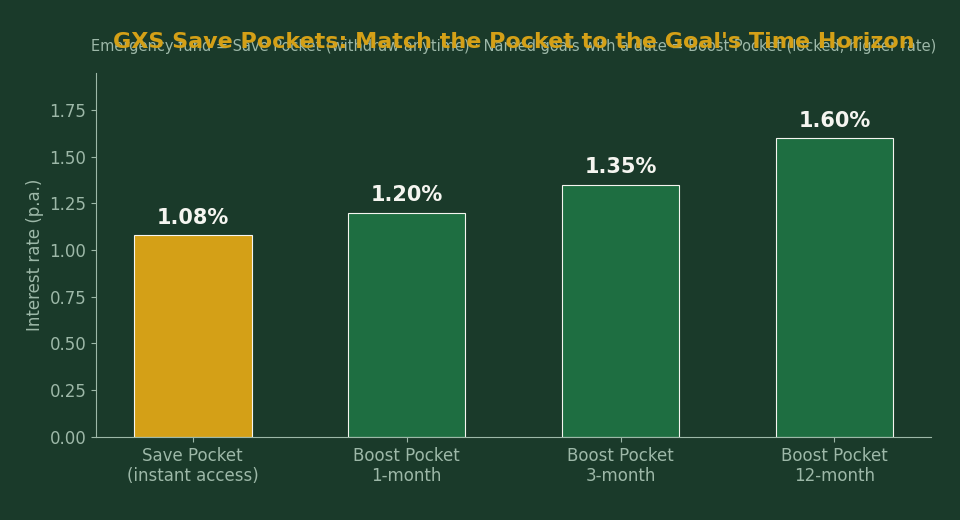
GXS Save Pocket and Boost Pocket rates, 2026. Rates are variable and subject to change — always check the GXS app for the current published rate before locking funds.
Suggested pocket setup for a TribeCar switcher
| Pocket name | Pocket type | Target | Monthly inflow |
|---|---|---|---|
| “Emergency Fund” | Save Pocket (1.08% p.a.) | 3–6 months expenses | S$400 |
| “Car-Free Cash Buffer” | Boost Pocket 12-mo (up to 1.60% p.a.) | 1 year’s TribeCar budget | S$400 |
| Overflow → Endowus | N/A (leaves GXS entirely) | Long-term growth | S$400 |
The logic: money you might need at short notice (emergency fund) stays fully liquid. Money you know you won’t touch for a year (a car-free cash buffer, sized to a full year of TribeCar bookings) goes into a Boost Pocket for the higher guaranteed rate. Everything beyond that has a time horizon long enough to leave cash altogether.
Step 3: Endowus — Routing the Overflow to CPF OA or SRS
Once your GXS pockets are funded, the remaining monthly surplus is long-horizon money. Endowus gives access to 400+ funds with 0% sales charge and no switching fees, charging instead an all-in access fee of 0.25% p.a. on the first S$200,000 and 0.20% p.a. beyond that (before GST, excluding each fund’s own embedded TER). That fee structure is identical whether you invest via Cash, SRS or CPF OA — except CPF OA carries one extra layer: your CPF agent bank (DBS, UOB or OCBC) charges its own separate annual fee on top of the Endowus fee. SRS investments have no such agent bank fee.
What this means in practice: if you’re deciding between topping up idle CPF OA funds or maxing your SRS contribution first, the SRS route is the cheaper one on a pure fee basis — on top of the SRS tax relief you get when you contribute. The trade-off is liquidity: SRS withdrawals before the statutory retirement age are taxable and penalised, while CPF OA funds you invest can generally be sold back to cash (subject to CPF investment rules) more flexibly for approved uses.
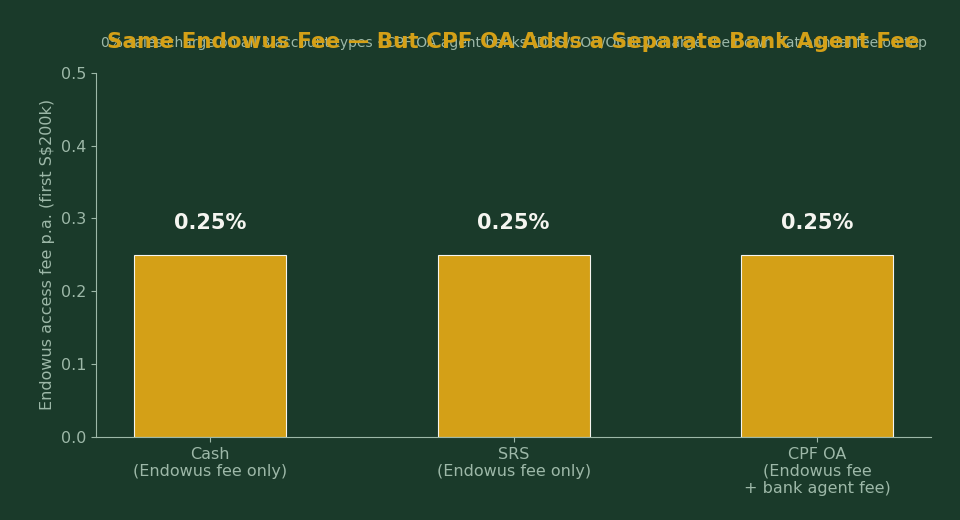
Endowus access fee is identical across account types; CPF OA alone adds a separate bank agent fee. Figures accurate as of September 2026 — verify current rates on Endowus before investing.
| Account | Endowus fee | Extra fee | 2026 annual cap |
|---|---|---|---|
| Cash | 0.25% (first S$200k) | None | No cap |
| SRS | 0.25% (first S$200k) | None | S$15,300 (citizens/PRs) |
| CPF OA | 0.25% (first S$200k) | + agent bank fee (DBS/UOB/OCBC) | Subject to CPFIS rules |
The Full Monthly Allocation Worked Example
Putting all three steps together, here’s how S$1,200/month in freed-up car-ownership costs could be split:
| Destination | Monthly amount | Purpose |
|---|---|---|
| GXS “Emergency Fund” (Save Pocket) | S$400 | Instant-access buffer, 1.08% p.a. |
| GXS “Car-Free Cash Buffer” (Boost Pocket, 12-mo) | S$400 | 1-year TribeCar budget, up to 1.60% p.a. |
| Endowus SRS | S$400 | Long-term growth + tax relief; fills the S$15,300 SRS cap in ~3.2 years at this pace, or top up faster from other savings to hit it within the same tax year |
Once the emergency fund pocket hits your target (typically 3–6 months of expenses), redirect that S$400/month into Endowus SRS or a second Boost Pocket goal instead — don’t let it keep growing past what you actually need liquid.
How This Compares to the Other 6 TribeCar Combos
| Combo | Mechanic |
|---|---|
| TribeCar + Trust Bank + Endowus | 3-step sequential pipeline |
| TribeCar + GXS + Syfe | Buffer-then-invest sequencing |
| TribeCar + FSMOne + IBKR | Tax-cap sequencing (SRS first, then taxable) |
| TribeCar + MariBank + Endowus | 3-tier liquidity-horizon ladder |
| TribeCar + MariBank + Syfe | SDIC insurance barbell |
| TribeCar + Trust Bank + FSMOne | Rate literacy (headline vs. achievable rate) |
| TribeCar + GXS + Endowus (this guide) | Named goal-buckets + CPF OA/SRS fee-aware routing |
Related reading: GXS Boost Pocket Review 2026 and Endowus SRS Account 2026 guide go deeper on each platform individually.
Risks and What Could Go Wrong
- Rates are variable. GXS Save Pocket and Boost Pocket rates are not fixed for the life of the account (only for the tenure of an already-created Boost Pocket) and have been revised downward before (1.18% → 1.08% in March 2026). Check the live rate in-app before creating a new pocket.
- SRS is illiquid. Withdrawals before the statutory retirement age attract tax on 100% of the withdrawn amount plus a 5% penalty, with limited exceptions. Only commit money to SRS that you genuinely won’t need before retirement age.
- Fund investments can lose value. Endowus portfolios are market-linked; unlike GXS pocket balances, they are not capital-guaranteed.
- TribeCar availability varies by location and time slot, especially during peak periods or public holidays — budget a buffer for occasional taxi/ride-hail top-ups.
- SDIC coverage on GXS balances is capped at S$100,000 per depositor per Scheme member bank — well above what this strategy typically holds, but worth knowing if you’re combining pockets with other savings at GXS.
This article is for general informational purposes and does not constitute financial advice. Rates, fees and tax rules cited are accurate as of September 2026 and are subject to change — always verify current terms directly with TribeCar, GXS Bank, Endowus, IRAS and CPF Board before acting.
Referral Codes for This Combo
Sign up to all three with the codes below to get started:
FAQ
How many Save Pockets can I create in GXS?
What's the difference between a Save Pocket and a Boost Pocket?
Is it better to invest via CPF OA or SRS through Endowus?
Does GXS charge any fees for Save Pockets or Boost Pockets?
What if I need money locked in a Boost Pocket early?
Does Endowus charge a sales charge on top of the access fee?
How is this different from the other TribeCar + GXS combo already on this site?
This article was researched with the help of AI. While we strive to keep all information accurate and up to date, there may be errors. If you notice any discrepancies, please contact us.