TribeCar + MariBank + Syfe: The SDIC Insurance Barbell Strategy (2026)
Cap your MariBank balance at the S$75,000 SDIC insurance limit, then route every dollar beyond it into Syfe Cash+ Enhanced for a materially higher projected yield — without taking on meaningfully more risk on the money that matters most.
Not financial advice. Rates and figures below are accurate as at 30 August 2026 and sourced directly from MariBank’s and Syfe’s official rate pages — always re-check current rates before acting, as digital bank and cash-management rates change without notice.
If you’ve swapped car ownership for TribeCar’s pay-per-use model, you’re likely freeing up somewhere around $1,250 a month that used to disappear into loan instalments, insurance premiums, parking, and depreciation — a figure we’ve used consistently across our TribeCar savings-redirection series. The question every time is the same: where should that freed-up cash actually go?
This guide covers a mechanic we haven’t used in this series before: a barbell allocation, borrowed from bond-portfolio theory. Instead of sequencing your savings by time horizon (park cash first, invest later) or by tax cap (SRS first, taxable account second), you split your money by deposit-insurance coverage — keeping exactly as much as Singapore’s Deposit Insurance Scheme (SDIC) actually protects in a bank account, and routing everything past that ceiling into a higher-yielding cash-management fund that was never going to be insured anyway.
Table of Contents
Contents — Click to expand
- What TribeCar, MariBank and Syfe Each Do
- Why S$75,000 Is the Line That Matters
- The SDIC Insurance Barbell Strategy Explained
- MariBank vs Syfe Cash+ Rate Comparison
- Worked Example: $1,250/Month Over 5, 10 and 20 Years
- How to Set This Up Step by Step
- How This Differs From Our Other TribeCar Combos
- Risks and Disclaimers
- Frequently Asked Questions
What TribeCar, MariBank and Syfe Each Do
TribeCar is the source of the cash. Swapping car ownership for TribeCar’s car-sharing model frees up an estimated $1,250/month once you net off loan instalment, insurance, parking, road tax, and depreciation against TribeCar’s pay-per-use fees for someone with a typical Singapore commuting pattern. That freed-up cash is the “savings” this whole strategy is built around — sign up with code zZDeg.
MariBank is the safety sleeve. Its Mari Savings Account pays a flat 0.88% p.a. on all balances (effective as at 18 Aug 2026, per MariBank’s own rates page) — no tiers, no salary-crediting requirement, no minimum spend. As a full bank licensed by MAS, deposits are covered by Singapore’s Deposit Insurance Scheme (SDIC) up to S$75,000 per depositor. Referral code 2DCT80WQ.
Syfe Cash+ is the yield sleeve. Syfe is a Capital Markets Services Licence holder (CMS100837) regulated by MAS, and its Cash+ range are managed portfolios — not bank deposits — investing in money-market and short-duration bond funds. Cash+ Enhanced currently projects 3.0% p.a. (SGD, after all fees, no lock-in), well above both MariBank’s flat rate and Cash+ Flexi’s 1.6% p.a. or Cash+ Guaranteed’s 1.25% p.a. Referral code SRPRFFFCD.
None of these three products competes with the others for the same job. That’s exactly why they combine well.
Why S$75,000 Is the Line That Matters
Every full bank in Singapore — including digital banks like MariBank — is a member of the Deposit Insurance Scheme run by the Singapore Deposit Insurance Corporation (SDIC). If the bank fails, SDIC guarantees repayment of your deposits up to S$75,000 per depositor, per Scheme member bank, combining all your accounts at that one bank.
Here’s the part most savers never think through: the 75,001st dollar you keep at any single bank gets zero extra protection. Whether that marginal dollar sits in MariBank, DBS, or under your mattress, SDIC’s guarantee stops at exactly the same number. So once your balance at one bank crosses S$75,000, you are holding uninsured cash whether you like it or not — the only question is whether you’re being paid a competitive rate for taking that (small, but real) counterparty risk.
MariBank pays a flat 0.88% p.a. whether you have $500 or $500,000 sitting there. Once you’re past the $75,000 insured ceiling, that flat rate no longer buys you anything extra in protection — so it’s worth comparing it against options that are honest about not being insured, but pay meaningfully more for it. That’s the whole logic of the barbell.
The SDIC Insurance Barbell Strategy Explained
A “barbell” in portfolio construction means concentrating your allocation at the two extremes — maximum safety on one end, maximum (acceptable) yield on the other — and deliberately avoiding the messy, low-conviction middle. Applied to TribeCar’s freed-up cash:
- Safety end — MariBank, up to S$75,000. Every dollar of TribeCar savings goes here first, earning a flat 0.88% p.a. with full SDIC protection, until the balance reaches the insured ceiling.
- Yield end — Syfe Cash+ Enhanced, everything beyond S$75,000. Once MariBank is at (or near) the cap, new monthly contributions redirect to Cash+ Enhanced, projecting 3.0% p.a. — more than 3x MariBank’s flat rate — in exchange for giving up the SDIC guarantee on that specific slice of money (which, as shown above, wasn’t going to be insured at MariBank either past the cap).
At $1,250/month with MariBank compounding at 0.88% p.a., the $75,000 SDIC ceiling is reached in roughly 4.9 years (about 59 months) — calculated directly from MariBank’s published rate, not assumed. Every dollar saved after that point goes straight to the yield end of the barbell instead of sitting idle at the (now capped-out) safety end.
MariBank vs Syfe Cash+ Rate Comparison (as at 30 Aug 2026)
| Product | Rate (SGD) | SDIC-Insured? | Lock-in | Best For |
|---|---|---|---|---|
| MariBank Savings | 0.88% p.a. flat | Yes, up to $75,000 | None | Safety-sleeve cash, up to the cap |
| Syfe Cash+ Guaranteed | 1.25% p.a. guaranteed | No | 1/3/6 months | Capital-guaranteed short-term parking |
| Syfe Cash+ Flexi | 1.6% p.a. projected | No | None | Fully liquid, low-risk cash parking |
| Syfe Cash+ Enhanced | 3.0% p.a. projected | No | None | Barbell yield-sleeve, above the SDIC cap |
Sources: MariBank Interest Rates & Fees page (effective 18 Aug 2026); Syfe Cash+ product comparison page (live as at 30 Aug 2026). Syfe Cash+ returns are projected, not guaranteed (except Cash+ Guaranteed), and are net of fund-level fees and Syfe’s management fee.
Worked Example: $1,250/Month Over 5, 10 and 20 Years
Assumptions: $1,250 saved and deposited monthly, MariBank compounding at 0.88% p.a. (monthly), Syfe Cash+ Enhanced compounding at 3.0% p.a. (monthly) once the $75,000 MariBank balance is reached (around month 59). All figures computed directly from these rates, not estimated.
| Horizon | All-MariBank (no barbell) | Barbell: MariBank + Syfe Enhanced | Extra From Barbell |
|---|---|---|---|
| Year 5 | $76,646 | $76,646 ($75,396 MariBank + $1,250 Syfe) | ~$0 (cap just reached) |
| Year 10 | $156,738 | $161,046 ($78,786 MariBank + $82,260 Syfe) | +$4,308 |
| Year 20 | $327,888 | $371,706 ($86,031 MariBank + $285,675 Syfe) | +$43,817 |
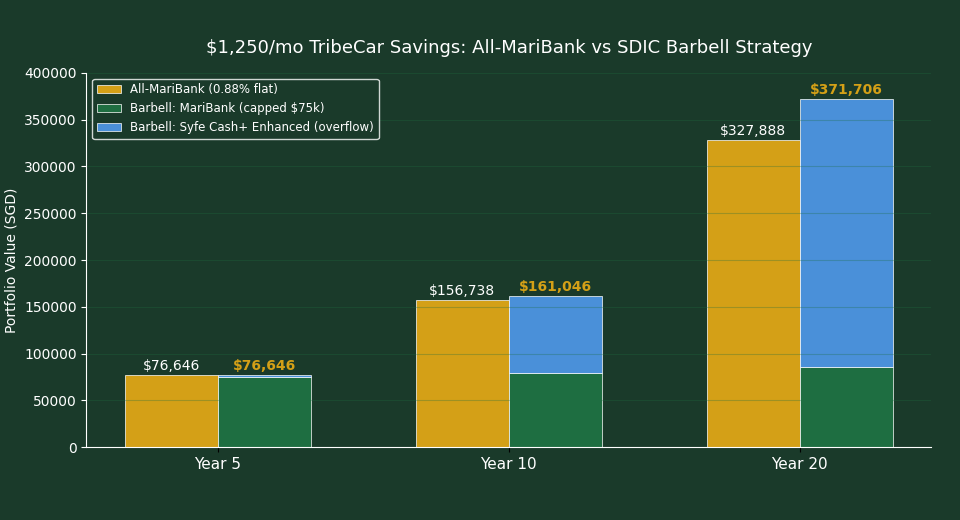
The gap compounds slowly at first (barely visible by Year 5, since the cap is only just reached) and then widens sharply — by Year 20, the barbell approach has produced roughly 13% more than parking everything in MariBank indefinitely, purely from redirecting the “already uninsured beyond the cap” money to a higher-projected-yield product.
How to Set This Up Step by Step
- Switch to TribeCar if you haven’t already, and track the actual monthly saving versus your prior car-ownership costs (loan, insurance, parking, road tax, depreciation) — $1,250/month is a reasonable Singapore benchmark, but use your own number.
- Open a MariBank Mari Savings Account (referral code 2DCT80WQ) and set up a standing instruction to transfer your monthly TribeCar savings there first.
- Track your MariBank balance against the $75,000 SDIC cap. A simple monthly check is enough — there’s no urgency until you’re within a few thousand dollars of the ceiling.
- Open a Syfe account (referral code SRPRFFFCD) ahead of time so it’s ready to receive funds — account opening and funding can take a few business days via Singpass MyInfo.
- Once MariBank approaches $75,000, redirect new monthly contributions to Syfe Cash+ Enhanced instead. You don’t need to withdraw the MariBank balance — just stop adding new principal to it.
- Re-check both rate pages every 6 months. Digital bank and cash-management rates move with MAS policy and money-market conditions — the 0.88% and 3.0% figures in this guide are current as at August 2026, not fixed.
How This Differs From Our Other TribeCar Combos
This is the fifth 3-way TribeCar platform combo we’ve published, and each one uses a genuinely different allocation mechanic rather than just swapping the platform names:
- TribeCar + Trust Bank + Endowus: a 3-step sequential pipeline (buffer, then invest, then grow).
- TribeCar + GXS + Syfe: a simple 2-step buffer-then-invest sequence.
- TribeCar + FSMOne + IBKR: tax-cap sequencing (SRS cap first, then taxable brokerage overflow).
- TribeCar + MariBank + Endowus: a 3-tier liquidity ladder, sequenced by how soon you might need the money.
- This guide (TribeCar + MariBank + Syfe): a barbell sequenced by deposit-insurance coverage, not time horizon or tax treatment — the first in the series built around the SDIC cap specifically.
If you already have a MariBank account from our TribeCar + MariBank guide, or a Syfe account from the TribeCar + GXS + Syfe pipeline, this barbell mechanic layers directly on top — you don’t need to start from scratch.
Risks and Disclaimers
Syfe Cash+ Enhanced is not a bank deposit and is not SDIC-insured — it’s a managed portfolio investing in short-duration bond funds, and its 3.0% p.a. figure is a projected return, not guaranteed. Bond fund values can fall as well as rise, even in “low-risk” short-duration strategies, and past yield estimates are not a guarantee of future performance. MariBank itself is MAS-regulated and SDIC-covered, but only up to the $75,000 cap per depositor — balances above that are not protected at any bank, not just MariBank.
This article is for general information only and does not constitute financial advice. Your own savings rate, risk tolerance, and time horizon may differ from the $1,250/month, 20-year illustration used here. Always verify current rates directly on MariBank’s and Syfe’s official websites before making a decision, and consider speaking with a licensed financial adviser for guidance specific to your situation.
Ready to Set Up the Barbell?
Open both accounts and start routing your TribeCar savings today.
Frequently Asked Questions
What is the SDIC insurance barbell strategy?
It’s an allocation approach that splits your savings by deposit-insurance coverage rather than time horizon: keep exactly S$75,000 (Singapore’s SDIC cap per depositor per bank) in an insured bank account like MariBank, then route everything beyond that into a higher-yielding, uninsured-but-low-risk cash-management fund like Syfe Cash+ Enhanced.
Why $75,000 specifically?
That’s the current SDIC (Singapore Deposit Insurance Corporation) protection limit per depositor, per Deposit Insurance Scheme member bank, combining all your accounts at that one bank. Any amount above it at a single bank is not covered, regardless of which bank it is.
Is Syfe Cash+ Enhanced safe if it's not SDIC-insured?
It invests in short-duration bond funds managed by established fund houses, which is generally lower risk than equities but not risk-free the way a guaranteed bank deposit is. Its 3.0% p.a. figure is a projected net return, not a guarantee, and bond fund values can fluctuate. It suits money you can afford to have fluctuate slightly, not your absolute emergency reserve.
What if I don't have $75,000 in savings yet?
Then you’re entirely on the safety end of the barbell for now — just keep saving into MariBank. Based on $1,250/month, this guide’s worked example shows the $75,000 cap is reached in roughly 4.9 years; your own timeline depends on your actual monthly savings rate.
Can I use a different bank instead of MariBank for the safety sleeve?
Yes — the barbell logic works with any SDIC Scheme member bank. We use MariBank because it pairs naturally with the TribeCar savings-redirection mechanic in this series and because its flat 0.88% p.a. requires no salary-crediting or spending conditions.
Can I use Syfe Cash+ Flexi or Guaranteed instead of Enhanced for the yield sleeve?
You can, but the whole point of the barbell is maximising the yield differential on the money that’s already uninsured. Cash+ Enhanced’s 3.0% p.a. projected return is meaningfully higher than Flexi’s 1.6% or Guaranteed’s 1.25%, so it’s the more logical fit for money you’ve already decided to hold outside deposit insurance.
Does this replace an emergency fund?
No. This strategy assumes your true emergency fund (3–6 months of expenses) is already accounted for within your MariBank balance or elsewhere. The barbell is about what to do with savings beyond your immediate liquidity needs, not a replacement for having liquid cash on hand.
How often should I re-check the rates in this guide?
Every 6 months at minimum. Both MariBank’s base rate and Syfe’s Cash+ Enhanced projected yield can change with MAS policy rate moves and money-market conditions — the 0.88% and 3.0% figures here are accurate as at 30 August 2026.
This article was researched with the help of AI. While we strive to keep all information accurate and up to date, there may be errors. If you notice any discrepancies, please contact us.