Syfe SRS: How to Invest Your Supplementary Retirement Scheme Funds (2026 Guide)
A plain-English walkthrough of Syfe’s SRS-eligible portfolios, fees, and how much you could be losing by leaving your SRS in the bank.
Syfe SRS lets you invest your Supplementary Retirement Scheme funds across three ready-made portfolios — Core Equity100, Income+, or Cash+ Flexi — instead of leaving them earning 0.05% a year in a bank account. You pick a portfolio in the Syfe app, and your SRS bank account funds it directly. Management fees range from 0.05% to 0.65% a year depending on your Syfe tier.
Not financial advice. All figures are for educational reference only. Data verified as at 5 August 2026 unless otherwise noted.
- Syfe SRS accepts three portfolios: Core Equity100 (high risk, ~12.3% p.a. 8-year average return), Income+ (moderately low risk, 6.7%–7.0% yield to maturity), and Cash+ Flexi SGD (very low risk, ~1.5%–1.6% p.a.)
- You pay Syfe’s tiered management fee — 0.65% down to 0.25% for managed portfolios, or 0.05%–0.15% for Cash+ Flexi — on top of small fund-level fees
- SRS contributions cut your taxable income by up to S$15,300 (citizens/PRs) or S$35,700 (foreigners) a year. Contributing and investing are two separate decisions — you can do the first without the second, but your money then earns almost nothing
Table of Contents
Contents — Click to expand
- What Is SRS and Why Investing It Matters
- Syfe’s SRS-Eligible Portfolios
- Syfe SRS Fees and Pricing Tiers
- SRS Contribution Caps and Tax Savings
- How to Invest Your SRS Funds With Syfe (Step-by-Step)
- SRS Returns: Idle Cash vs Invested
- Risks to Consider
- Who Should Invest SRS With Syfe?
- Frequently Asked Questions
What Is SRS and Why Investing It Matters
The Supplementary Retirement Scheme (SRS) is a voluntary savings scheme that sits alongside your CPF. You open an SRS bank account with DBS/POSB, OCBC, or UOB, top it up whenever you like, and every dollar you put in reduces your taxable income for that year — up to an annual cap. Investment gains inside the account are tax-free until you withdraw, and only 50% of withdrawals are taxed once you hit the statutory retirement age in force when you made your first SRS contribution.
Here’s the catch most people miss. Money sitting in your SRS bank account earns just 0.05% p.a. — the same as an ordinary savings account, and well below inflation. That means every year you leave your SRS balance uninvested, it quietly loses purchasing power. This is where platforms like Syfe come in: you can invest the funds directly out of your SRS account in Singapore into a managed portfolio, without withdrawing the cash or losing your tax relief.
Syfe is one of a handful of MAS-licensed platforms — alongside Endowus, StashAway, and brokers such as FSMOne — that let you invest SRS funds directly. However, not every Syfe portfolio is SRS-eligible. Only three are.
Syfe’s SRS-Eligible Portfolios
As at August 2026, Syfe supports SRS money in exactly three portfolios: Core Equity100, Income+ (Preserve and/or Enhance), and Cash+ Flexi (SGD). REIT+ and the thematic portfolios are not SRS-eligible.
| Portfolio | Risk Level | Target Return / Yield | Fund-Level Fee |
|---|---|---|---|
| Core Equity100 (SRS) | High | 12.3% p.a. (8-year average, before fees) | 0.15% |
| Income+ (SRS) | Moderately Low | 6.7%–7.0% p.a. yield to maturity | 0.65% (institutional funds) |
| Cash+ Flexi SGD (SRS) | Very Low | 1.5%–1.6% p.a. projected | Included in management fee |
Source: Syfe SRS Portfolios, accessed August 2026.
Core Equity100 is a 100% global equities portfolio spread across more than 5,000 stocks, built for investors with a long runway before they touch their SRS money. Income+ leans on PIMCO-managed bond funds for steadier, monthly-paid income. Cash+ Flexi is the safest of the three — it behaves like a money market fund and lets you redeem next-day, with no lock-in.
Syfe SRS Fees and Pricing Tiers
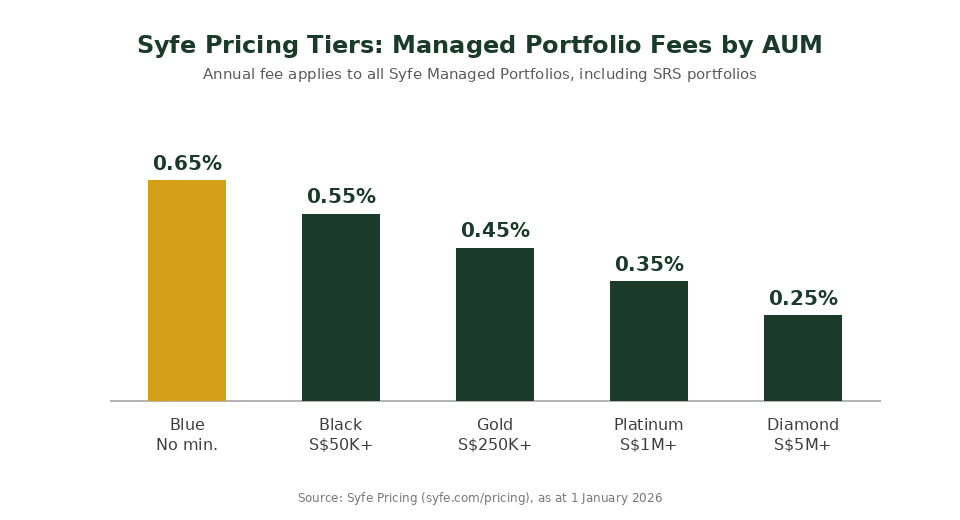
On top of the fund-level fees above, you pay Syfe’s own management fee. This is tier-based: the more you hold across all your Syfe accounts (Managed Portfolios, Cash Management, and Brokerage combined) — or the more you’ve net-deposited, whichever is higher — the lower your fee. Tier upgrades happen automatically, usually within one business day of you crossing the threshold.
| Tier | Minimum Assets | Managed Portfolio Fee (p.a.) | Cash+ Flexi SGD Fee (p.a.) |
|---|---|---|---|
| Blue | No minimum | 0.65% | 0.15% |
| Black | S$50,000+ | 0.55% | 0.10% |
| Gold | S$250,000+ | 0.45% | 0.10% |
| Platinum | S$1,000,000+ | 0.35% | 0.10% |
| Diamond | S$5,000,000+ | 0.25% | 0.05% |
Source: Syfe Pricing, as at 1 January 2026.
Most first-time SRS investors start on the Blue tier at 0.65% p.a. for managed portfolios. That’s not the cheapest robo-advisor fee in Singapore, but it’s still far better than leaving SRS funds earning 0.05%, and there’s no separate platform fee, no fund switching charge, and no minimum investment to get started.
SRS Contribution Caps and Tax Savings
Before you even think about which portfolio to pick, remember that contributing to SRS and investing what’s in it are two separate steps. The tax relief kicks in the moment you contribute — you don’t need to invest a cent to get it. But your annual contribution is capped based on your residency status.
| Residency | Annual SRS Contribution Cap | Tax Relief |
|---|---|---|
| Singapore Citizen / PR | S$15,300 | Reduces chargeable income dollar-for-dollar, up to the cap |
| Foreigner | S$35,700 | Reduces chargeable income dollar-for-dollar, up to the cap |
Source: IRAS, SRS contributions and tax relief, accessed August 2026.
To put a number on it: based on Syfe’s own SRS tax calculator, a Singapore citizen earning S$120,000 a year with S$30,000 in personal reliefs who tops up the full S$15,300 SRS cap saves about S$1,759.50 in income tax for that year alone — before their SRS money has earned a single dollar of investment return.
Contributions must be made by 31 December to count toward that year’s tax relief. Note that once you’ve built up a balance over several years, you can invest your full SRS balance even if it exceeds the current year’s contribution cap — the cap only limits new contributions, not how much of your existing balance you can put to work.
How to Invest Your SRS Funds With Syfe (Step-by-Step)
Setting up a Syfe SRS portfolio takes about ten minutes if your SRS bank account is already open and funded.
Step 1 — Open and fund your SRS bank account. If you don’t already have one, open an SRS account with DBS/POSB, OCBC, or UOB. There’s no opening fee. Contribute before 31 December to claim relief for that year of assessment.
Step 2 — Create your Syfe account. Sign up with Singpass and complete KYC — this typically takes a few minutes.
Step 3 — Add an SRS portfolio. In the Syfe app, go to “Managed Portfolios,” tap “Add Portfolio,” and select the SRS card.
Step 4 — Choose your portfolio. Pick Core Equity100, Income+ (Preserve and/or Enhance), or Cash+ Flexi (SGD) based on your risk tolerance and time horizon.
Step 5 — Fund with your SRS account. Select “SRS Account” as your funding source and submit the amount you want to invest.
Step 6 — Wait for settlement. Your SRS funds are debited from your SRS bank account and invested into your chosen portfolio within 6–7 business days.
One practical note: if you already have SRS money invested elsewhere — say, in unit trusts through another platform — you’ll need to sell down and transfer that cash back into your SRS bank account before Syfe can invest it. Syfe doesn’t accept in-specie transfers of existing SRS holdings.
SRS Returns: Idle Cash vs Invested
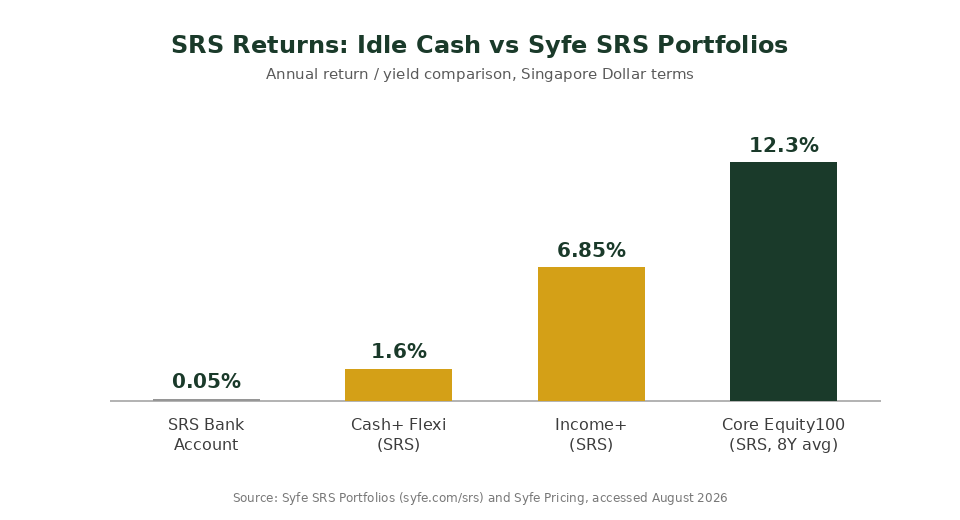
The gap is the whole point of this article. Left alone, your SRS bank account earns 0.05% p.a. — on a S$50,000 balance, that’s S$25 a year. Move the same S$50,000 into Cash+ Flexi and you’re looking at roughly S$750–S$800 a year at 1.5%–1.6% p.a., with next-day liquidity and no lock-in. Step further out on the risk curve into Income+ or Core Equity100, and the potential return climbs further — though so does the chance your balance dips in a bad year.
None of these figures are guaranteed. Core Equity100’s 12.3% p.a. is an 8-year historical average calculated before fees, not a forecast, and equity markets can and do fall. Income+’s 6.7%–7.0% is a yield to maturity on the underlying bond funds, not a promised payout. Cash+ Flexi is the only one of the three built specifically for capital preservation.
Risks to Consider
Core Equity100 is 100% equities with no capital guarantee. A downturn in the year or two before you plan to touch your SRS money could hurt more than it would in an accumulation phase decades out. Income+’s underlying PIMCO-managed bond funds carry credit and interest rate risk — yield to maturity can move as rates and credit spreads shift.
There’s also a structural risk that has nothing to do with markets: withdrawing from SRS before the statutory retirement age in force when you made your first contribution triggers a 5% penalty plus full taxation on the amount withdrawn (versus the 50% concession you’d get at retirement). Don’t invest SRS money you might need to pull out early.
Finally, fees compound. A 0.65% p.a. management fee on the Blue tier doesn’t sound like much, but over a 20-year holding period it meaningfully dents your final balance compared with the 0.25% Diamond tier. There’s no way to skip to a lower tier without building up assets first, so factor this into your expected long-run return.
Who Should Invest SRS With Syfe?
Syfe SRS works well if you have at least 5–10 years before you plan to draw down your SRS savings, you’re comfortable with your chosen portfolio’s risk level, and you’d rather not actively manage individual unit trusts or ETFs yourself. Core Equity100 suits younger investors furthest from retirement age; Income+ suits those who want the funds working but prefer smoother, income-generating returns; Cash+ Flexi suits anyone within a few years of retirement age who just wants a better rate than the bank’s 0.05%.
Consider alternatives if you want to compare across providers first — our roundup of the best robo-advisors in Singapore lines up Syfe against Endowus, StashAway, and others on fees and portfolio construction. If you’d rather manage your retirement savings holistically alongside CPF, our CPF investment strategy guide and retirement planning calculator are good next stops. And if you’re still deciding whether Syfe is right for your regular cash savings too, not just SRS, see our Syfe Singapore beginner’s guide.
Frequently Asked Questions
Is Syfe SRS safe?
Syfe Pte. Ltd. is regulated by the Monetary Authority of Singapore and holds a Capital Markets Services Licence. Your SRS funds are invested into underlying funds, not held as cash with Syfe, and Syfe is not a bank. As with any investment, your capital is at risk and returns are not guaranteed — this is different from the capital protection you get leaving cash in a bank-run SRS account.
Can I withdraw my SRS funds from Syfe anytime?
You can sell down your Syfe SRS portfolio and move the proceeds back to your SRS bank account at any time. However, withdrawing cash out of the SRS scheme itself before the statutory retirement age in force at your first contribution triggers a 5% penalty and full taxation on the withdrawn amount, regardless of which platform holds the investment.
What happens to my Syfe SRS portfolio when I reach the statutory retirement age?
Once you hit the statutory retirement age tied to your first SRS contribution, you can start withdrawing from your SRS account over a 10-year period with only 50% of each withdrawal taxed. You can choose to keep your Syfe portfolio invested during this drawdown period or liquidate it gradually as you withdraw.
How is Syfe SRS different from just leaving my SRS in the bank?
Money left in your SRS bank account earns 0.05% p.a., regardless of which bank holds it. Investing through Syfe exposes that same money to market-linked returns — historically far higher over the long run, but with the risk of loss that a bank deposit doesn’t carry. The tax relief on contributions is identical either way; investing only affects what happens to the money after it’s in the account.
Can foreigners invest SRS funds with Syfe?
Yes. Foreigners can open an SRS account and contribute up to S$35,700 a year, more than double the S$15,300 cap for citizens and PRs. The same three Syfe SRS portfolios — Core Equity100, Income+, and Cash+ Flexi — are available regardless of residency status.
What is the minimum investment for Syfe SRS?
Syfe does not impose a minimum investment amount for its SRS portfolios. You can start with whatever balance is sitting in your SRS bank account, and Syfe’s fee tier is based on your total assets and net deposits across all your Syfe accounts, not just your SRS balance.
Ready to Put Your SRS Funds to Work?
Open a Syfe account and stop letting your SRS balance sit at 0.05% a year. Use referral code SRPRFFFCD at sign-up.
This article was researched with the help of AI. While we strive to keep all information accurate and up to date, there may be errors. If you notice any discrepancies, please contact us.