CapitaLand Ascendas REIT Share Price 2026 (A17U): 2H2026 DPU Outlook, Valuation & Investor Verdict
Singapore’s Largest Diversified Industrial REIT — Is CLAR Still Worth Buying in 2H2026?
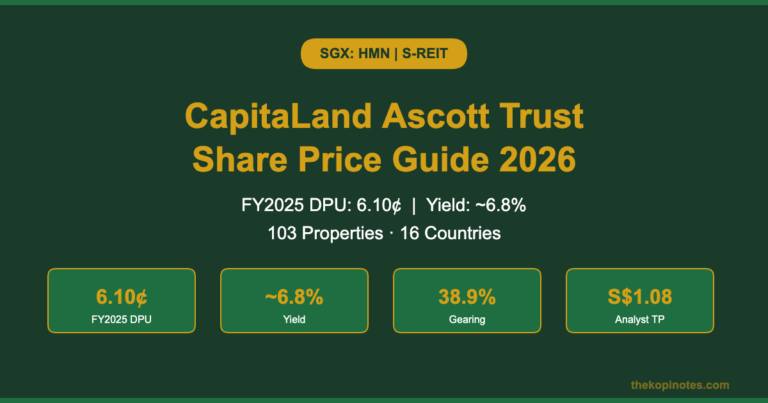
CapitaLand Ascendas REIT (SGX: A17U), Singapore’s largest diversified industrial and business park REIT with over S$12.6 billion in assets across 220+ properties in Singapore, Australia, the US, and the UK, currently trades at S$2.70–2.80, offering a forward dividend yield of approximately 5.4–5.7%. Backed by a 93% occupancy rate, positive rental reversions in Singapore, and a well-covered 2H2026 DPU, CLAR remains one of Singapore’s highest-quality income plays for investors seeking stable distributions.
Not financial advice. All figures are for educational reference only. Data as at October 2026 unless noted.
What Is CapitaLand Ascendas REIT?
CapitaLand Ascendas REIT — commonly known as CLAR and listed on SGX under the ticker A17U — is Singapore’s first and largest listed business space and industrial REIT. It was listed in 2002 and is sponsored by CapitaLand Investment (CLI), one of Asia’s largest real estate investment managers.
CLAR holds a portfolio of over 220 properties valued at approximately S$12.6 billion (as at end-2025), spread across four geographies: Singapore, Australia, the United States, and the United Kingdom and Europe. Within these markets, CLAR invests in four main asset types: business space and life sciences facilities, high-specification industrial properties, light industrial and flatted factories, and logistics and distribution centres. A small but growing share of its portfolio includes data centre-adjacent assets, which have seen increased investor focus amid the AI-driven demand surge.
With a market capitalisation of approximately S$11.8 billion, CLAR is one of the five largest S-REITs by market cap and is a core holding in the FTSE EPRA Nareit Developed Asia index. Its scale, sponsor backing, and geographic diversification make it one of the go-to S-REITs for both retail and institutional investors. If you’re building a passive income strategy in Singapore, CLAR is almost always part of the conversation.
CLAR Share Price & Valuation 2026
As at October 2026, CapitaLand Ascendas REIT’s share price has traded in the range of S$2.65 to S$2.85, recovering from the rate-hike-driven trough of around S$2.40–2.50 seen in late 2023. The recovery has been supported by the global rate-cut cycle, with the US Federal Reserve having delivered 125 basis points in cuts between September 2024 and mid-2026, reducing borrowing costs on CLAR’s floating-rate debt tranche.
From a valuation standpoint, CLAR currently trades at a price-to-NAV (P/NAV) ratio of approximately 1.15x, representing a modest premium to its book value. This is slightly above the historical average P/NAV of ~1.05–1.10x for large-cap Singapore REITs, reflecting the quality premium investors are willing to pay for CLAR’s scale and diversification. For comparison, CLAR’s implied yield of ~5.5% sits at the lower end of the S-REIT peer range — investors are paying up for safety and predictability.
| Metric | Value (Oct 2026) |
|---|---|
| SGX Ticker | A17U |
| Share Price Range (Oct 2026) | S$2.65 – S$2.85 |
| Market Capitalisation | ~S$11.8 billion |
| NAV per Unit | ~S$2.35 |
| P/NAV Ratio | ~1.15x (slight premium) |
| Forward Dividend Yield | ~5.4–5.7% |
| Aggregate Leverage (Gearing) | ~37.1% |
| Portfolio Occupancy | ~93.1% (as at 1H2026) |
| Number of Properties | 220+ across 4 countries |
| Total Assets Under Management | ~S$12.6 billion |
Source: CapitaLand Ascendas REIT 1H2026 results announcement, SGX filing, August 2026
CLAR’s gearing ratio of ~37% is comfortably below the MAS-mandated ceiling of 50%, giving it an estimated debt headroom of over S$3 billion for future acquisitions without breaching regulatory limits. This is a meaningful balance sheet advantage, especially as rate conditions remain more favourable than 2023–2024.
DPU History & 2H2026 Outlook
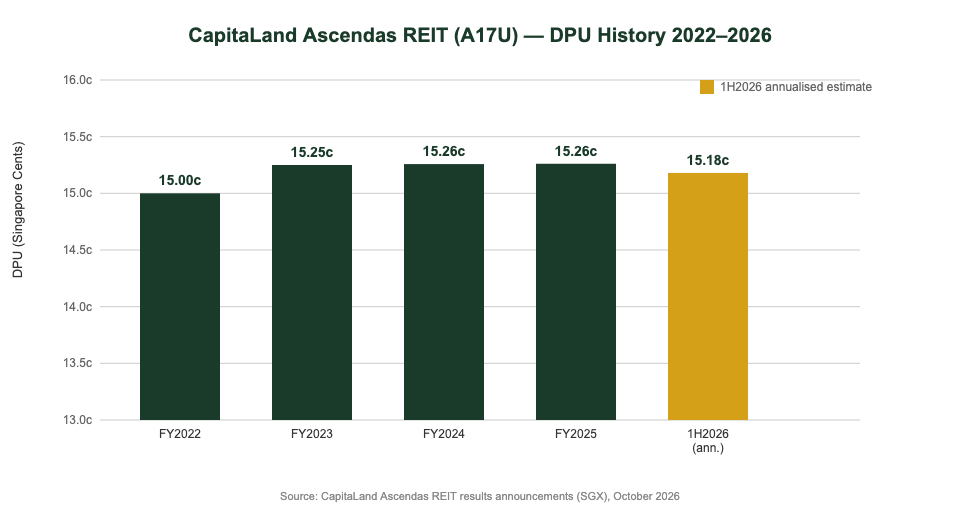
One of CLAR’s most compelling attributes for income investors is its track record of stable and gradually growing distributions. Over the past four financial years, CLAR has delivered a distribution per unit (DPU) of approximately 15.0 to 15.3 cents per year, with the trend showing steady, if modest, growth. This consistency — achieved through interest rate headwinds, currency volatility, and global macro uncertainty — reflects the quality of CLAR’s underlying rental income.
| Financial Year / Period | DPU (Singapore Cents) | YoY Change |
|---|---|---|
| FY2022 | 15.00c | +1.2% |
| FY2023 | 15.25c | +1.7% |
| FY2024 | 15.258c | +0.1% |
| FY2025 | 15.261c | flat |
| 1H2026 (announced Aug 2026) | 7.59c | +0.4% vs 1H2025 |
| 2H2026 (TKN estimate) | ~7.60c | ~flat to +0.5% |
Source: CapitaLand Ascendas REIT results announcements, SGX filings; TKN estimates for 2H2026
What’s Driving 2H2026 DPU?
Management’s 2H2026 DPU delivery is supported by three key factors:
1. Positive rental reversions in Singapore. Business park and high-specs industrial leases renewing in 2H2026 are achieving reversions of +5% to +8% above expiring rents, reflecting tight vacancy and strong tenant demand from tech and life sciences occupiers. This organic NPI growth partially offsets higher financing costs on the floating-rate debt tranche.
2. Lower interest costs on floating debt. With the Fed having cut rates by 125bp since September 2024, and CLAR’s floating-rate debt exposure at approximately 30–35% of total borrowings (~S$1.4–1.6B), the REIT benefits meaningfully from each 25bp cut. Management guided that each 25bp rate reduction adds approximately 0.1–0.15 cents to annual DPU.
3. Improved occupancy in US life sciences. CLAR’s Raleigh-Durham and Boston life sciences clusters — which had struggled with oversupply-driven vacancies in 2024 — have seen occupancy recover from ~85% to ~91% by mid-2026, adding incremental rental income in 2H2026. Investors looking to track S-REIT performance should also check out the best S-REITs in Singapore for 2026 where CLAR ranks consistently in the top tier.
Portfolio Overview: 4 Asset Classes Across 4 Countries
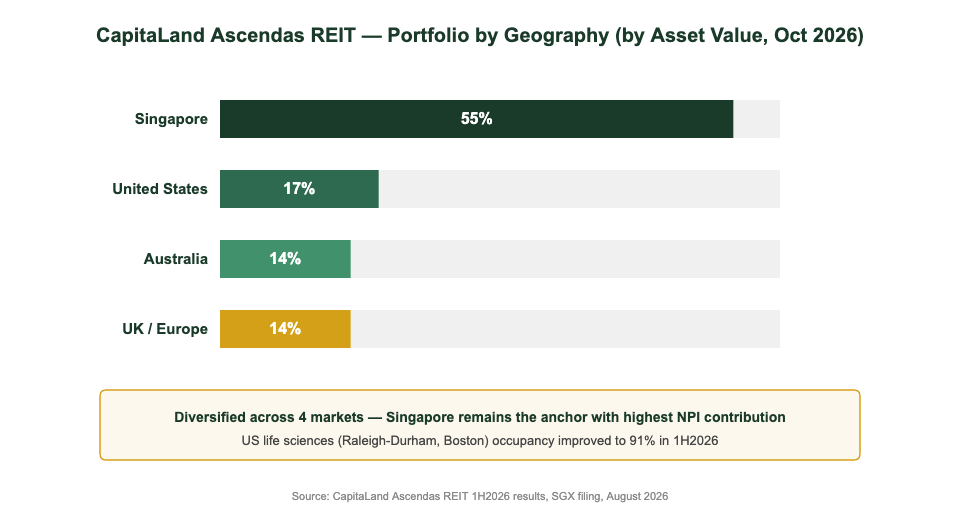
CLAR’s portfolio diversification is one of its defining features — and a key reason why the REIT has been able to maintain DPU stability through global macro cycles. Here’s a breakdown of the four geographic markets and the key asset types within each:
Singapore (~55% by asset value): The anchor market, home to CLAR’s flagship business park clusters at one-north (Fusionopolis, Biopolis), Changi Business Park, International Business Park, and various industrial estates in Jurong and Woodlands. Singapore properties contribute the majority of NPI and enjoy the highest occupancy at ~96%.
United States (~17%): CLAR’s US portfolio focuses on life sciences and business parks in innovation clusters — primarily Raleigh-Durham (North Carolina), Portland (Oregon), and Greater Boston (Massachusetts). These assets target biotech, pharmaceutical, and tech tenants. After a period of elevated vacancy, occupancy in the US cluster improved to ~91% by 1H2026.
Australia (~14%): The Australian portfolio is concentrated in Sydney, Melbourne, and Brisbane, with a mix of logistics, industrial, and suburban office assets. Occupancy is robust at ~96%, supported by Australia’s tight industrial and logistics market conditions.
UK and Europe (~14%): Properties in London, the Netherlands, and France, primarily business park and light industrial. These generate distributions in GBP and EUR, introducing foreign currency risk — but also providing exposure to the European economic recovery.
Key Risks & Catalysts for CLAR in 2H2026
Catalysts
Rate cuts tailwind: Each additional 25bp Fed rate cut reduces CLAR’s floating debt cost and directly lifts DPU by ~0.10–0.15c. With further cuts expected in late 2026, this represents a tangible earnings catalyst.
Singapore industrial rental growth: Tight land supply and strong demand from data centre-adjacent industries, logistics, and life sciences continue to push Singapore industrial rents higher. Lease renewals in 2H2026 are tracking positive reversions of +5–8%.
Data centre demand: While CLAR’s direct data centre exposure is modest within the portfolio, the AI-driven surge in data centre demand benefits adjacent assets (high-spec industrial, power-intensive business parks) and creates potential acquisition opportunities with CLI’s pipeline.
Active capital recycling: CLI’s deep pipeline of assets globally gives CLAR optionality to acquire assets at accretive yields, especially as cap rates compress in Asia-Pacific industrial markets. If you’re investing through a robo-advisor, the Syfe referral code SRPRFFFCD gives new investors access to Syfe’s REIT+ and income portfolios that include CLAR exposure.
Risks
P/NAV premium limits upside: At 1.15x P/NAV, CLAR is not cheap. A re-rating back to NAV would represent ~13% downside from current levels. Investors buying at current prices are paying for quality, not value.
US life sciences oversupply risk: While US occupancy has improved, the broader US life sciences market remains oversupplied in some sub-markets (particularly San Francisco, which CLAR does not have exposure to). Further leasing headwinds from biotech funding constraints remain a watch point.
Currency headwinds: Approximately 45% of CLAR’s portfolio is denominated in non-SGD currencies (USD, AUD, GBP, EUR). A stronger SGD vs these currencies would reduce the SGD-equivalent distributions from overseas assets.
Higher-for-longer rates in Australia / UK: While the US rate cycle has turned, Australian and UK rates may remain sticky, keeping refinancing costs elevated for properties in those markets.
Investor Verdict: Is CapitaLand Ascendas REIT Still a Buy in 2H2026?
CLAR is one of Singapore’s highest-quality REITs — but quality comes with a price. At the current share price of S$2.70–2.80, CLAR offers a forward yield of approximately 5.4–5.7% and trades at a P/NAV of ~1.15x. Here’s who it makes sense for:
Best for: Income-focused investors who prioritise distribution stability over capital upside. CLAR’s ~15.2c full-year DPU has been remarkably consistent, and the diversified portfolio reduces concentration risk. For long-term investors building a dividend income stream, CLAR anchors a portfolio well. Those investing through a CPF-OA or SRS account can buy CLAR directly through brokers like FSMOne (referral code P0544985) or Endowus (referral code 2V343) for SRS-invested fund exposure.
Less ideal for: Growth-oriented investors seeking capital appreciation. At 1.15x P/NAV, the market is already pricing in CLAR’s quality premium. Capital upside is capped unless rate cuts drive a meaningful re-rating or CLAR makes a DPU-accretive acquisition. For those comparing S-REITs, it’s worth also reading our MIT vs CapitaLand Ascendas REIT head-to-head comparison.
12-month target range: S$2.85–3.05, assuming full-year DPU of ~15.2c and a yield compression to 5.0–5.2% driven by further rate cuts. That implies ~5–12% total return (capital + distributions) over 12 months — a reasonable expectation for a quality core holding. Use our Singapore retirement calculator to model how CLAR distributions could contribute to your retirement income target.
Frequently Asked Questions (FAQ)
What is CapitaLand Ascendas REIT's ticker symbol on SGX?
What is CLAR's current dividend yield in 2026?
Is CapitaLand Ascendas REIT a good buy in 2026?
How often does CapitaLand Ascendas REIT pay dividends?
What is CLAR's gearing ratio, and is it safe?
Does CLAR have data centres in its portfolio?
Where can I buy CapitaLand Ascendas REIT in Singapore?
This article was researched with the help of AI. While we strive to keep all information accurate and up to date, there may be errors. If you notice any discrepancies, please contact us.