TribeCar + FSMOne + IBKR: The SRS-First Investing Pipeline (Singapore 2026)
Skip car ownership with TribeCar and you free up roughly $1,250 a month. Route that through FSMOne into your SRS account first — it very nearly maxes the $15,300 annual SRS cap and earns you tax relief on top of investment growth. Once SRS is capped, any extra savings go into IBKR for globally diversified investing instead.
Not financial advice. All figures are for educational reference only. Data as at August 2026 unless noted.
- Skipping car ownership for TribeCar frees up about $1,250/month ($15,000/year) — just $300 short of the full $15,300 SRS annual cap for Citizens and PRs
- Route it through FSMOne into SRS first: you get tax relief on the contribution itself, on top of whatever the investments earn
- Once you hit the SRS ceiling, IBKR is where any additional savings go — SRS money can only sit at one platform-type, and IBKR isn’t it, but it’s the cheapest way to invest what’s left over across 150+ global markets
Table of Contents
Contents — Click to expand
- Why a Three-Step Pipeline Beats Picking One Platform
- Step 1 — TribeCar: What Skipping Car Ownership Frees Up
- Step 2 — FSMOne: Route It Into SRS First
- The SRS Tax Relief Math
- Step 3 — IBKR: Where Savings Beyond the SRS Cap Go
- What the Combined Pipeline Could Grow Into
- Who This Pipeline Actually Suits
- How to Set It Up
- Frequently Asked Questions
Why a Three-Step Pipeline Beats Picking One Platform
Most TribeCar comparison guides stop at one question: where should the money you save go? This one asks a different question — in what order? That matters more than it sounds, because SRS tax relief is capped, and once you hit that ceiling, every extra dollar needs a different home.
Here’s the sequence that gets the most value out of every dollar you free up:
1. TribeCar replaces car ownership and frees roughly $1,250 a month — no COE, no insurance, no season parking.
2. FSMOne is where that money should go first, into a Supplementary Retirement Scheme (SRS) account. SRS contributions are tax-deductible up to an annual cap, and FSMOne is one of the few DIY platforms that supports SRS investing directly in unit trusts and SGX-listed instruments.
3. IBKR takes over once you’ve hit the SRS ceiling. Interactive Brokers can’t accept SRS money at all — it’s a cash-funded brokerage — but it’s the cheapest way to put any leftover savings to work across 150+ markets worldwide.
Two earlier TKN guides covered similar three-platform combos built around a cash buffer. This one is different: it’s a tax-efficiency sequence, not a buffer-then-invest mechanic. You’re not saving up cash before investing — you’re choosing which tax-advantaged account fills up first.
Step 1 — TribeCar: What Skipping Car Ownership Frees Up
Car Category A Certificate of Entitlement (COE) — the permit you need before you can register a car in Singapore — closed at $128,501 in the second August 2026 bidding exercise. Spread that over a typical 10-year lifespan and you’re already at roughly $1,071 a month, before road tax, insurance, parking, petrol or servicing.
Add those up and a light-usage owner is realistically paying around $1,673 a month for a car they might drive a handful of times a week.
TribeCar is a peer-to-peer car-sharing platform — you book by the hour through the app, drive, then return it. No COE, no insurance premium, no season parking to manage. As of 2026, TribeCar mileage rates run $0.43/km for Economy, Standard and Select vehicles. A moderate user — about 8 hours and 100km a week — lands at roughly $394 a month once you blend hourly and mileage charges.
| Cost Item | Full Ownership | TribeCar |
|---|---|---|
| COE (amortised) / mileage + hourly | $1,071 | $281 |
| Road tax + insurance | $192 | $0 (included) |
| Season parking | $130 | $0 |
| Petrol / fuel surcharge | $200 | $113 (blended) |
| Maintenance / servicing | $80 | $0 |
| Total | $1,673/month | $394/month |
Source: LTA COE Results (August 2026, 2nd bidding); TribeCar published rates; TKN estimate for light-to-moderate usage.
Step 2 — FSMOne: Route It Into SRS First
Here’s the part most “invest your savings” guides skip: where you park money changes how much of it you actually keep, before a single dollar of investment return shows up.
The Supplementary Retirement Scheme (SRS) lets Singapore Citizens and Permanent Residents contribute up to $15,300 a year and deduct that amount from their taxable income — on top of whatever the money earns once invested. Foreigners get a higher cap of $35,700, since they don’t have CPF to lean on.
FSMOne (operated by iFAST Financial, MAS-regulated) is one of the few DIY platforms that lets you invest SRS funds directly — in unit trusts at a permanent 0% sales charge, and in SGX-listed stocks and ETFs at a flat $8.80 per trade. That flat-fee structure matters here: your $1,250/month SRS contribution isn’t nibbled away by a percentage-of-trade-value fee the way it would be on some other platforms.
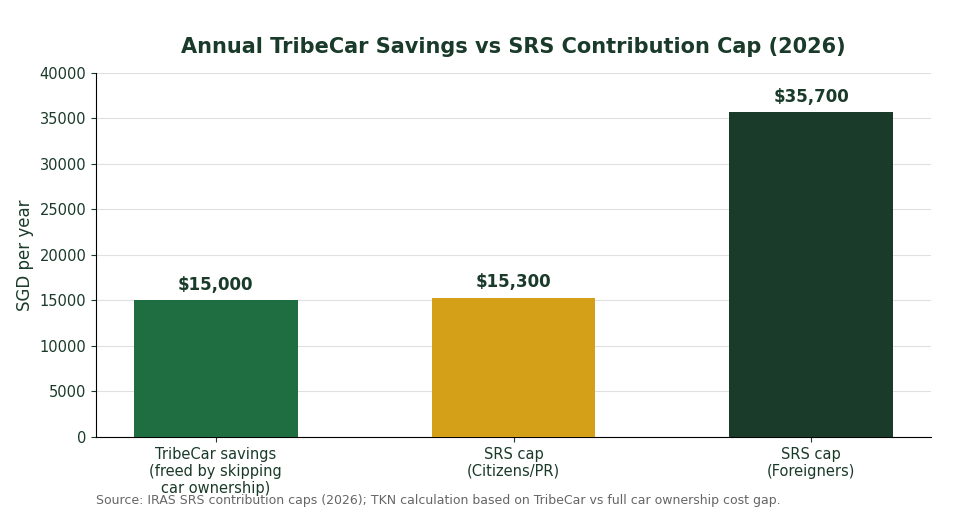
Your $1,250/month from TribeCar adds up to $15,000 a year — just $300 short of the full $15,300 SRS cap. In practice, most readers top that up easily from an annual bonus or 13th-month payment, and claim the maximum tax deduction for the year. Contributions must land in your SRS account by 31 December to count for that Year of Assessment.
The SRS Tax Relief Math
SRS relief works by lowering your chargeable income, so the value of a $15,300 contribution depends on your marginal tax bracket — the rate charged on your next dollar of income, not your average rate.
| Chargeable Income Band | Marginal Rate | Tax Saved on $15,300 |
|---|---|---|
| $80,001 – $120,000 | 11.5% | $1,760 |
| $120,001 – $160,000 | 15% | $2,295 |
| $160,001 – $200,000 | 18% | $2,754 |
Source: IRAS individual income tax rates, Year of Assessment 2026. Illustrative only — based on 2026 resident tax brackets; actual relief depends on your full tax computation.
That tax saving lands the same year you contribute — it isn’t contingent on investment performance. It’s the one part of this pipeline that’s essentially guaranteed, which is exactly why SRS comes before IBKR in the sequence, not the other way round.
The trade-off: SRS withdrawals before age 63 are penalised (a 5% early withdrawal penalty plus the full amount taxable), and even at retirement only 50% of withdrawals are taxed. It’s a long-horizon account, not a place for money you might need in three years.
Step 3 — IBKR: Where Savings Beyond the SRS Cap Go
Once you’ve maxed the $15,300 SRS cap, FSMOne’s SRS wrapper is done for the year — there’s no way to contribute more and get further relief. Any additional money you free up (a pay rise, a second income stream, or simply higher TribeCar savings in later years) needs a different home.
Interactive Brokers Singapore Pte. Ltd., MAS-regulated, is a cash-funded brokerage with no CPF or SRS integration at all — but that’s exactly why it fits here. IBKR Lite offers $0 commission on eligible US-listed stocks and ETFs, and IBKR reaches 150+ markets across 33 countries, well beyond FSMOne’s six. For a reader who’s already maximised their tax-advantaged SRS sleeve, IBKR is the cheapest way to keep building a globally diversified portfolio with what’s left.
A practical option many readers use here: Ireland-domiciled UCITS ETFs tracking global indices (like VWRA), which face a reduced 15% US dividend withholding tax under the US-Ireland treaty — versus the flat 30% rate on directly-held US stocks, on either platform.
| Feature | FSMOne (SRS sleeve) | IBKR (overflow sleeve) |
|---|---|---|
| SRS eligible | Yes | No — cash only |
| Unit trust sales charge | 0% (permanent) | Not applicable |
| SGX stock/ETF fee | Flat $8.80 | 0.08% (min $2.50) |
| US stock/ETF fee | 0.08% processing | $0 (IBKR Lite, eligible instruments) |
| Market coverage | 6 markets | 150+ across 33 countries |
Figures verified as at August 2026 against FSMOne’s and Interactive Brokers Singapore’s official pricing pages.
What the Combined Pipeline Could Grow Into
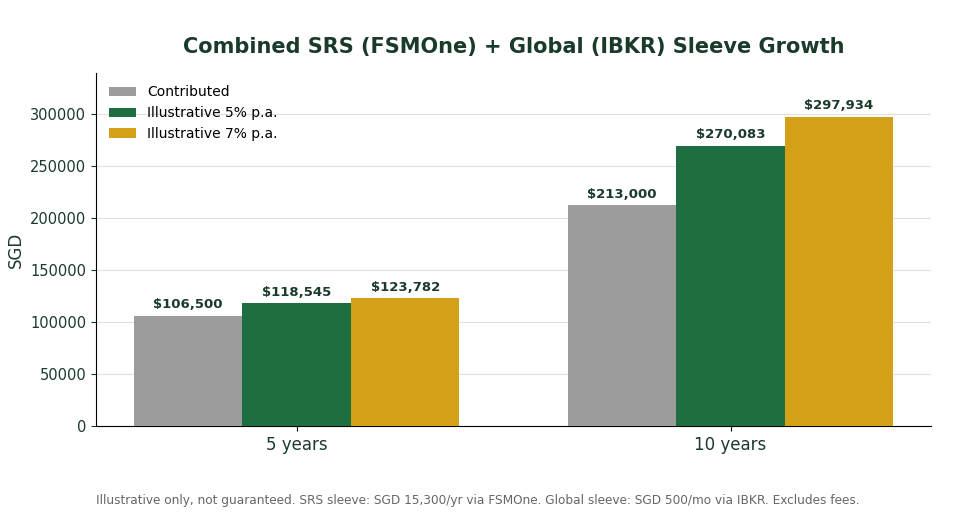
Here’s a worked example. A Singapore Citizen contributes the full $15,300 a year to SRS via FSMOne (TribeCar savings plus a small top-up), while also investing an extra $500 a month through IBKR once that SRS sleeve is topped up. Neither growth rate is guaranteed — this is a demonstration of what redirecting the money can do over time, not a return promise.
| Timeframe | Contributed | Illustrative 5% p.a. | Illustrative 7% p.a. |
|---|---|---|---|
| 5 years | $106,500 | $118,545 | $123,782 |
| 10 years | $213,000 | $270,083 | $297,934 |
Illustrative only, not guaranteed. SRS sleeve: $15,300/year via FSMOne (annual contribution). Global sleeve: $500/month via IBKR (monthly, compounded monthly). Excludes trading fees and tax on eventual SRS withdrawal for simplicity.
Who This Pipeline Actually Suits
| Profile | Fit? |
|---|---|
| Drives under ~10 hours a week, mostly short trips | Strong fit — TribeCar likely cheaper than ownership |
| Hasn’t used up this year’s SRS contribution room | Strong fit — SRS relief is the highest-value step here |
| Won’t need this money before age 63 | Strong fit — SRS carries an early-withdrawal penalty |
| Wants broad global market access beyond SGX | Strong fit — IBKR’s overflow sleeve covers 150+ markets |
| Needs a car daily for work (deliveries, client visits) | Weak fit — ownership may work out cheaper at high usage |
How to Set It Up
This takes about 20 minutes to set up, then runs on autopilot with a recurring monthly transfer.
- Download the TribeCar app and sign up using our TribeCar referral code and sign-up guide (code: zZDeg)
- Open an SRS account and link it to an FSMOne account via our referral code page (code: P0544985)
- Set a recurring monthly SRS contribution — aim for $1,275/month to hit the $15,300 annual cap, topping up from a bonus if TribeCar alone gets you close but not quite there
- Once SRS is maxed for the year, open an IBKR account via our referral code page (code: jianxiong368) and route any further savings there
Frequently Asked Questions
Why put SRS before IBKR instead of investing everything through IBKR?
How much does TribeCar actually save compared to owning a car?
What is the SRS contribution cap in 2026?
Can I withdraw my SRS savings before retirement?
Does IBKR accept CPF or SRS funds?
Is this strategy only for Singapore Citizens and PRs?
How do I get the TribeCar, FSMOne and IBKR referral bonuses?
For more on maximising CPF and SRS together, see our CPF investment strategy guide, or model your own numbers with our Singapore retirement calculator.
For official rates and figures, see the IRAS SRS contributions and tax relief page, LTA COE bidding results, and TribeCar’s official rates page.
Ready to Build Your Own SRS-First Pipeline?
Skip the car, max out SRS through FSMOne, and let IBKR handle everything beyond the cap.
This article was researched with the help of AI. While we strive to keep all information accurate and up to date, there may be errors. If you notice any discrepancies, please contact us.