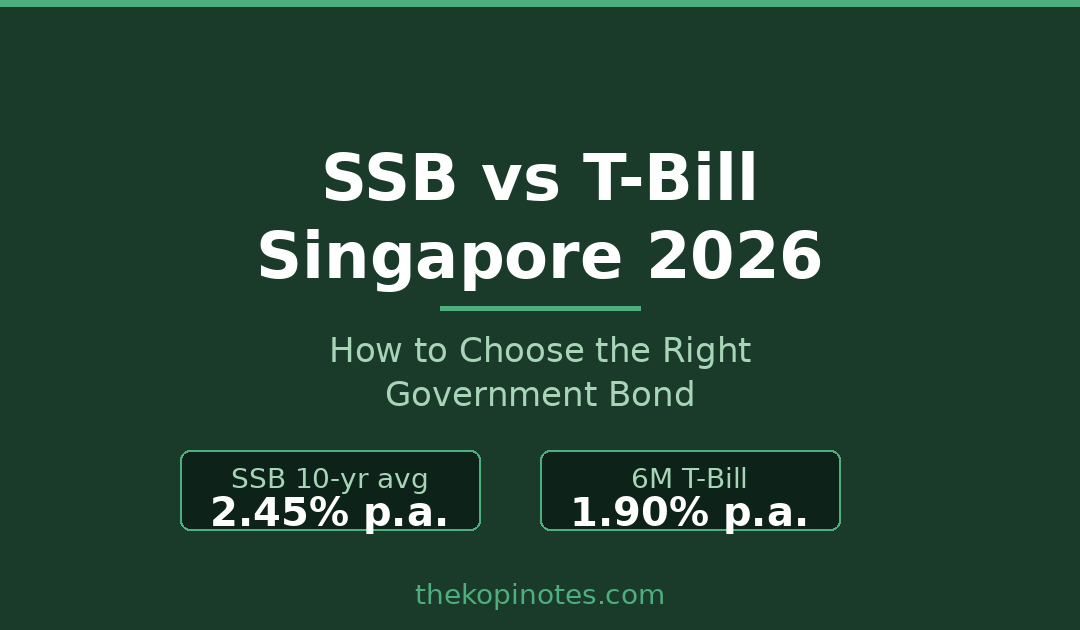
TL;DR: Both Singapore Savings Bonds (SSB) and Treasury Bills (T-bills) are backed by the Singapore government — you will not lose your principal. Right now (October 2026), the 6-month T-bill yields 1.90% p.a. while the SSB SBNOV26 pays 1.67% in Year 1, rising to a 10-year average of 2.45%. If you need the money within 6 months, the T-bill wins on rate. If you can hold for 3 years or more and want flexibility to exit early, the SSB likely wins. For SRS funds you plan to keep for a decade, SSB’s 2.45% average beats a T-bill ladder at current rates. Most Singapore savers end up using both.
Rates as at October 2026. This article is for general information only and does not constitute financial advice.
When savings deposit rates are uninspiring and fixed deposits are locked up, Singapore savers instinctively reach for two instruments: Singapore Savings Bonds and Treasury Bills. Both are issued or backed by the Singapore government. Both earn more than a typical bank account. And right now, both are delivering yields that make them worth seriously comparing.
But they work very differently. The right choice depends on how long you can wait, how quickly you might need the cash back, how much you want to invest, and whether the money is in your SRS or ordinary savings. This guide walks through every dimension with actual October 2026 figures, and ends with a concrete decision framework you can apply today.
If you are new to SSB, start with the SSB Singapore guide first. For a deeper dive into T-bills — including how competitive and non-competitive bids differ — the T-Bill Singapore Complete Guide covers the mechanics.
SSB vs T-Bill: Head-to-Head Comparison
Here are the key differences at a glance, using current October 2026 figures.
| Feature | Singapore Savings Bond (SBNOV26) | T-Bill — 6-Month (Oct 2026) | T-Bill — 1-Year |
|---|---|---|---|
| Current rate | 1.67% Yr 1 → 3.08% Yr 10 (10-yr avg 2.45%) |
1.90% p.a. (fixed) | ~1.7–1.8% p.a.* |
| Tenor | Up to 10 years (step-up) | ~6 months | ~1 year |
| Early exit | Yes — redeem any month with ~1 month notice; receive accrued interest | No — must hold to maturity | No — must hold to maturity |
| Minimum investment | S$500 | S$1,000 (non-competitive) | S$1,000 |
| Maximum holding | S$200,000 per person | No limit | No limit |
| SRS eligible | Yes | Yes | Yes |
| How to apply | DBS/OCBC/UOB internet banking, ATM or SRS operator | ATM, internet banking via CDP; or SRS operator | Same |
| Transaction cost | S$2 each for buy and redeem | No fee for non-competitive bids | No fee |
| Interest payment | Semi-annual (every 6 months) | At maturity (all at once) | At maturity |
| Issuer | MAS (Government of Singapore) | Government of Singapore (via MAS) | Government of Singapore |
*1-year T-bill auction closes 15 October 2026; cut-off yield will be published on MAS SGS website. Historical 1-year yields have run slightly below the 6-month yield in recent months.
The Returns Comparison: Step-Up vs Flat
The most important difference between SSB and T-bills is how the return is structured.
A T-bill pays a fixed cut-off yield for its entire term — 1.90% for six months, full stop. When it matures, you get your principal back and you have to decide where to reinvest, at whatever rate the next T-bill auction delivers.
An SSB works differently. It pays a step-up interest rate — the coupon increases every year you hold the bond. The longer you stay, the higher the rate. SBNOV26’s step-up schedule is:
| Year | 1 | 2 | 3 | 4 | 5 | 6 | 7 | 8 | 9 | 10 | 10-yr avg |
|---|---|---|---|---|---|---|---|---|---|---|---|
| Rate (% p.a.) | 1.67 | 1.99 | 2.17 | 2.33 | 2.47 | 2.59 | 2.72 | 2.86 | 2.97 | 3.08 | 2.45 |
Source: MAS GX26110X (SBNOV26), as at October 2026
Notice that Year 1 (1.67%) is below the current 6-month T-bill rate (1.90%). So if you only hold the SSB for one year and redeem it, you would have earned less than a T-bill investor who rolled over two 6-month T-bills at 1.90%.
The break-even point arrives around Year 3. The cumulative 3-year average for SBNOV26 is (1.67 + 1.99 + 2.17) ÷ 3 = 1.94% — just above the current 6-month T-bill rate. From Year 3 onward, assuming T-bill rates stay roughly where they are, SSB wins on a cumulative average basis. The chart below illustrates this.
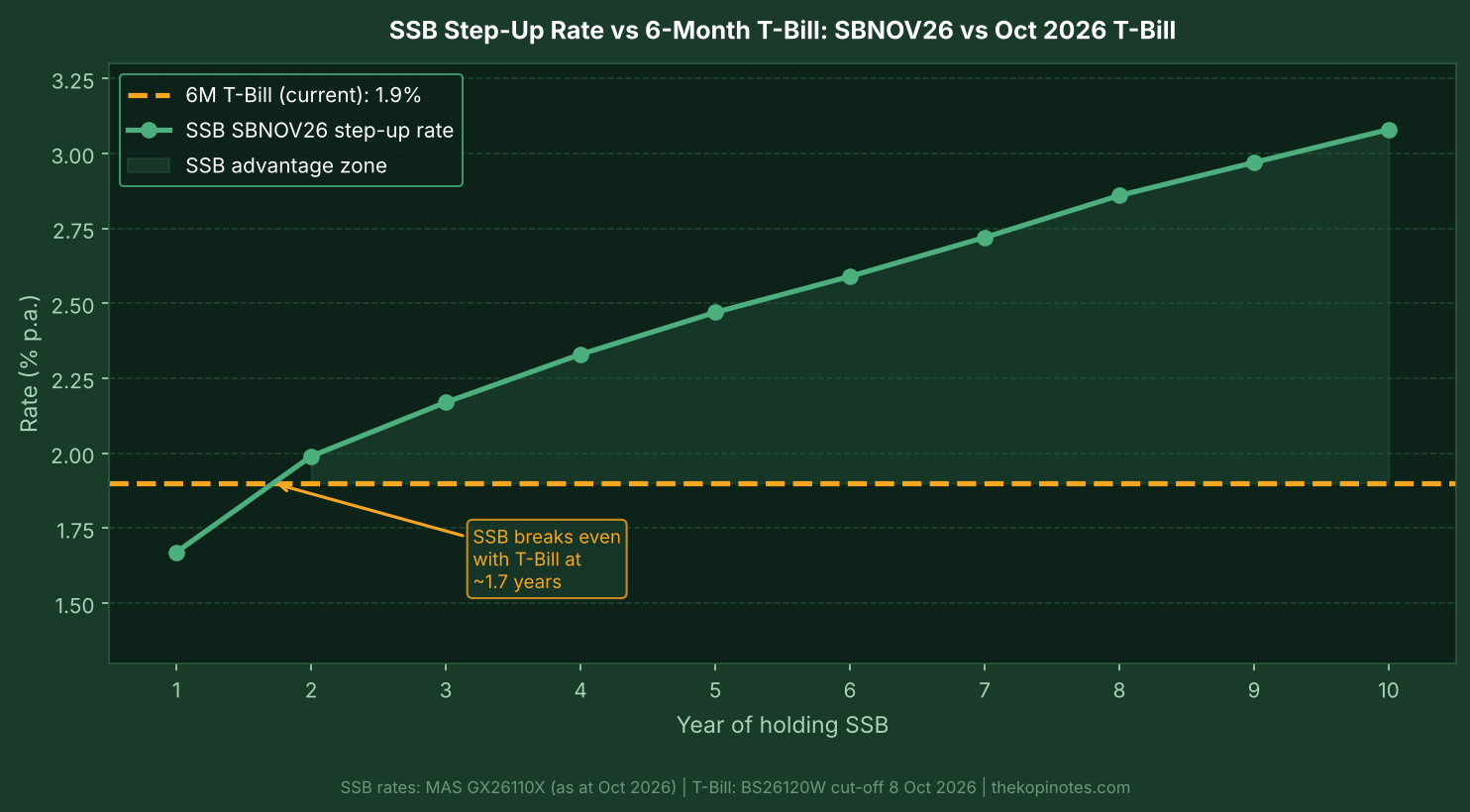
SSB step-up rates (SBNOV26) vs 6M T-Bill (1.90% flat, 8 Oct 2026 auction). The SSB’s cumulative average breaks even with the T-bill around Year 3. Source: MAS, as at October 2026.
One important caveat: T-bill rates are not fixed forever. If rates fall — say, the next 6-month T-bill cuts to 1.50% — the SSB looks much more attractive even in Year 1 because you locked in the step-up structure. If rates rise, the T-bill advantage extends. Uncertainty about future rates is itself a reason some investors prefer the SSB’s predictable step-up over repeated T-bill renewals.
Liquidity: Where SSB Has a Structural Edge
T-bills are term instruments. When you put money into a 6-month T-bill, it is locked up for six months. There is no early exit — you cannot sell a T-bill in the secondary market (unlike SGS bonds) if you need the cash unexpectedly. If something comes up — a home purchase, a renovation, a medical bill — you wait.
SSBs are different. You can submit a redemption request any month, and you will receive your money (plus accrued interest) by the end of that month. There is a S$2 transaction fee and you need to submit before the end of the month’s working days, but you are not locked in.
This makes SSB significantly more useful as a high-liquidity emergency buffer that still earns a meaningful return. Think of it as a high-interest savings account that grows on a step-up schedule — not a locked-up bond.
The S$200,000 per person cap on SSB is the main constraint. If you have more than S$200,000 to park in safe government instruments, T-bills have no holding limit and can absorb the excess.
The Decision Framework: 6 Scenarios
Use this framework to determine which instrument fits your situation best. Most people find they belong in more than one bucket — meaning both instruments have a place.
Scenario 1: You need the money within 6 months
→ T-Bill wins. At 1.90%, the 6-month T-bill delivers a higher return than the SSB’s 1.67% Year 1 rate. And since you plan to redeem soon anyway, the SSB’s long-term step-up advantage never materialises. Apply for the next T-bill auction and lock in the rate.
Scenario 2: You can hold for 3 or more years
→ SSB wins (if T-bill rates stay at current levels). The SSB’s cumulative 3-year average (1.94%) already beats the T-bill, and it only widens with time. You also benefit from the flexibility to exit early without penalty if your circumstances change — something a T-bill cannot offer.
Scenario 3: Your SRS funds won’t be touched until retirement
→ SSB is strongly preferred. If you are parking SRS funds you will not touch until age 62 or later, the SSB’s 10-year average of 2.45% far exceeds a T-bill ladder at current rates. And because SRS accounts cannot be used for ordinary spending, you are unlikely to need an early exit. Allocate up to S$200,000 via your SRS operator. See the SRS tax relief guide if you haven’t maxed your SRS contribution yet — topping up SRS saves income tax and funds your SSB at the same time.
Scenario 4: You want to deploy more than S$200,000
→ Fill SSB first, then T-bill for the rest. Max out your SSB allocation (S$200,000) for the predictability and flexibility. Route any surplus above S$200,000 into T-bills, which have no individual holding limit.
Scenario 5: You are uncertain about future interest rates
→ Split between SSB and T-bill. Splitting hedges both directions. If rates fall, your SSB locks in today’s step-up structure (which beats a future T-bill at 1.40%). If rates rise sharply, your T-bills mature every 6 months and you can roll them over at higher yields. You are not fully committed to either path.
Scenario 6: You have hit the SSB cap and want to ladder
→ T-bill ladder. Once you hold S$200,000 in SSB, T-bills are your next best option for safe government-backed savings. Build a T-bill ladder by staggering maturities — for example, applying for a 6-month T-bill and a 1-year T-bill in the same month so you have a payout at 6 months, 12 months, 18 months, and so on.
Using Both: Why It’s Not Either/Or
Most Singaporean savers who think carefully about this end up using SSB and T-bills as complementary instruments, not competing ones.
A common portfolio setup: hold S$100,000–S$200,000 in SSB as a flexible, step-up base. Use T-bills to invest surpluses you expect to deploy in the next 6–12 months (new car, renovation deposit, upcoming holiday) — the fixed term forces discipline and the yield beats a savings account. When you are confident a sum won’t be needed for 3+ years, add it to SSB instead.
If you are thinking about retirement income, the FIRE Singapore guide outlines how SSB fits into a three-bucket income strategy alongside CPF LIFE and dividend-paying S-REITs — a structure that keeps a meaningful portion of your retirement reserves both safe and flexible.
Use the TKN Retirement Planning Calculator to model how much SSB or T-bill allocation makes sense given your CPF LIFE payout projection and expected expenses.
How to Apply
Both instruments are straightforward to buy if you have an account with DBS, OCBC or UOB.
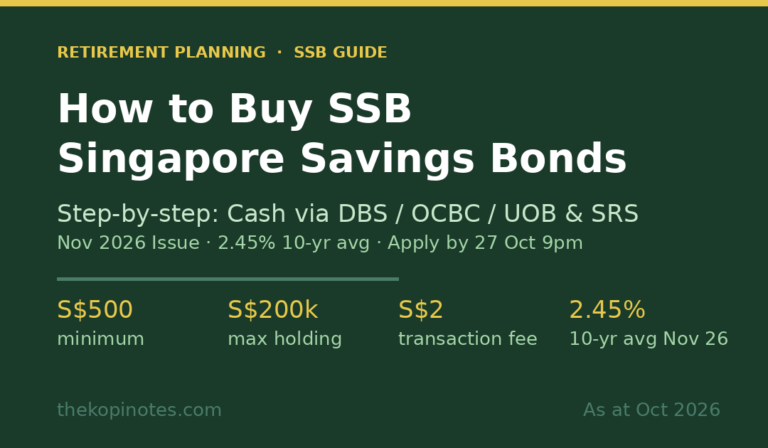
SSB: For a complete walkthrough of the SSB application process — including cash and SRS channels, CDP account requirements and the ATM steps — read How to Buy SSB Singapore. The SBNOV26 application window closes 9pm on 27 October 2026.
T-bill: Non-competitive bids are submitted through your bank’s internet banking or ATM. The next 6-month auction is typically two weeks after each closing. The 1-year T-bill auction closes 15 October 2026. Check the T-Bill Singapore Complete Guide for the auction calendar and bidding strategy.
Related Tools
- TKN Retirement Planning Calculator — model your CPF LIFE payout, savings gap and how SSB fits your income floor
- CPF Top-Up Singapore Guide — if you are choosing between topping up CPF SA/RA vs SSB/T-bill
- SRS Tax Relief Singapore — how much SRS top-ups save at every income bracket
Frequently Asked Questions
Is SSB or T-bill safer?
Can I buy SSB and T-bill with my SRS account?
What happens if I need to sell my T-bill early?
What is the S$200,000 SSB limit exactly?
If T-bill rates fall, is my SSB rate protected?
Should I redeem SSB to buy a higher-yielding T-bill?
Is there a minimum amount to invest in T-bills?
Do SSB or T-bill interest payments count as taxable income in Singapore?
Disclaimer: This article is for general informational purposes only and does not constitute financial advice. All rates and limits are as at October 2026 and subject to change. Please refer to the MAS SGS website (www.mas.gov.sg) and your bank for the most current figures. Consult a qualified financial adviser for advice specific to your situation.
This article was researched with the help of AI. While we strive to keep all information accurate and up to date, there may be errors. If you notice any discrepancies, please contact us.