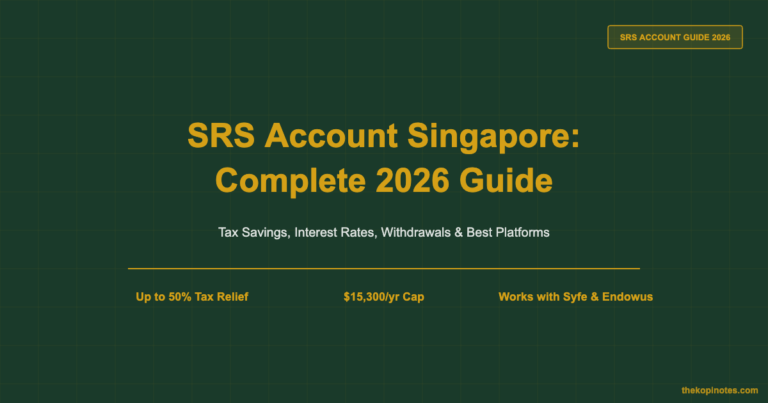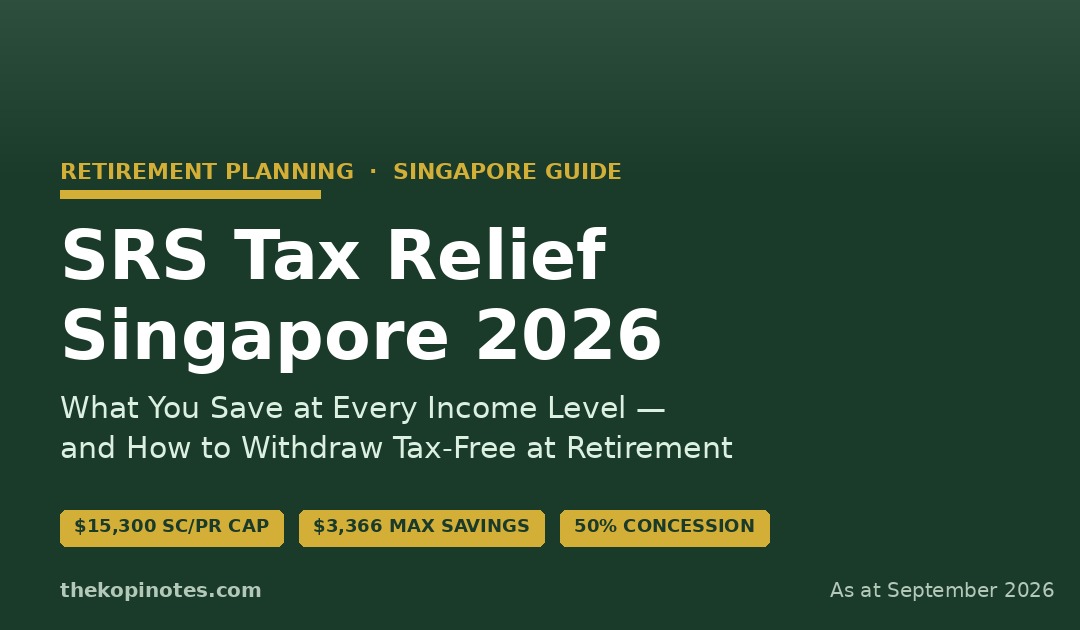
- SC/PR cap: $15,300/year into your SRS account (foreigners: $35,700)
- Tax relief: every dollar contributed reduces your chargeable income at your marginal rate
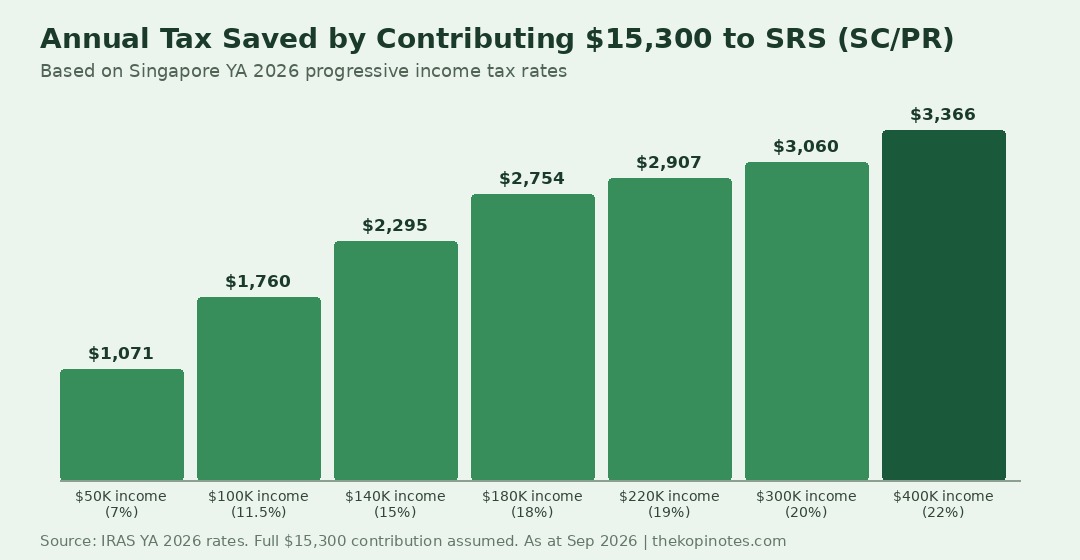
- Annual saving: $1,071 (at 7%) → $3,366 (at 22% for top earners)
- SRS retirement age: 63 if your first contribution was before 1 Jul 2026; 64 if after — locked for life at opening
- At retirement: only 50% of withdrawals is taxable; withdraw $40K/year → effectively $0 tax
- Overall cap: SRS relief counts within the $80,000 personal income tax relief ceiling
What Is SRS Tax Relief?
The Supplementary Retirement Scheme (SRS) is a voluntary, government-backed savings scheme administered by DBS, OCBC, and UOB. It runs entirely separately from CPF. When you deposit cash into your SRS account, the full amount is deducted from your chargeable income in that Year of Assessment (YA). This deduction is the SRS tax relief.
The mechanism is straightforward. Suppose you earn $120,000 and deposit $15,300 into SRS by 31 December. IRAS taxes you on $104,700 instead of $120,000. The relief is applied automatically — your SRS operator reports your contributions to IRAS and it flows through to your tax assessment. You do not need to claim it manually.
Unlike most other reliefs (CPF top-up relief, course fee relief), SRS relief requires no action from you at filing time — it is granted automatically based on operator data.
SRS Contribution Caps 2026
Your annual contribution is capped by a formula: contribution rate × $102,000 income base. The rates differ by tax residency:
| Tax Residency | Rate | Annual Cap | Monthly Equivalent |
|---|---|---|---|
| Singapore Citizen / PR | 15% | $15,300 | $1,275 |
| Foreigner (Employment Pass, etc.) | 35% | $35,700 | $2,975 |
Key rules: contributions must be in cash only (no CPF allowed); must be deposited by 31 December to count in that YA; unused cap does not roll forward to future years; and contributions can be split across your SRS account (you can only hold one SRS account per person, but you can switch banks with a transfer).
How SRS Tax Relief Is Calculated
Singapore uses a progressive income tax system. The marginal rate — the rate on your last dollar of income — is what determines how much SRS saves you. Contributing $15,300 to SRS removes $15,300 from the top of your chargeable income.
For YA 2026, the applicable resident tax rates are:
| Chargeable Income | Rate | Tax on Band |
|---|---|---|
| First $20,000 | 0% | $0 |
| $20,001 – $30,000 | 2% | $200 |
| $30,001 – $40,000 | 3.5% | $350 |
| $40,001 – $80,000 | 7% | $2,800 |
| $80,001 – $120,000 | 11.5% | $4,600 |
| $120,001 – $160,000 | 15% | $6,000 |
| $160,001 – $200,000 | 18% | $7,200 |
| $200,001 – $240,000 | 19% | $7,600 |
| $240,001 – $280,000 | 19.5% | $7,800 |
| $280,001 – $320,000 | 20% | $8,000 |
| $320,001 – $500,000 | 22% | $39,600 |
| $500,001 – $1,000,000 | 23% | $115,000 |
| Above $1,000,000 | 24% | — |
Source: IRAS, YA 2026 resident individual income tax rates.
Tax Savings at Every Income Level (SC/PR, Full $15,300 Contribution)
The table below shows the annual tax saved from a full SRS contribution at each key income band. Because Singapore’s progressive rates apply, the savings jump as you move into higher brackets:
| Gross Income (before reliefs) | Marginal Rate | Tax Saved (pa) | 10-Year Total |
|---|---|---|---|
| $40,001 – $80,000 | 7% | $1,071 | $10,710 |
| $80,001 – $120,000 | 11.5% | $1,760 | $17,595 |
| $120,001 – $160,000 | 15% | $2,295 | $22,950 |
| $160,001 – $200,000 | 18% | $2,754 | $27,540 |
| $200,001 – $240,000 | 19% | $2,907 | $29,070 |
| $240,001 – $280,000 | 19.5% | $2,984 | $29,835 |
| $280,001 – $320,000 | 20% | $3,060 | $30,600 |
| $320,001 – $500,000 | 22% | $3,366 | $33,660 |
Note: “Tax Saved” = $15,300 × marginal rate. Applies only if your income exceeds the band threshold. The 10-year figure assumes same income and same cap — actual savings compound further if SRS investments grow. Figures are indicative; actual tax depends on all reliefs and deductions taken.
The $80,000 Personal Income Tax Relief Cap
IRAS applies a $80,000 annual ceiling across all personal income tax reliefs combined. Reliefs that count toward this cap include: CPF relief, SRS relief, earned income relief, course fee relief, NSman relief, parent/grandparent relief, spouse relief, and others.
In practice, the cap rarely bites for SRS contributors unless you are also making large CPF cash top-ups and claiming multiple dependant reliefs simultaneously. CPF mandatory contributions and self-employed CPF contributions are capped separately — they do not eat into the $80,000 ceiling.
If you are already claiming close to $80,000 in other reliefs, additional SRS contributions beyond the remaining headroom give you no further tax benefit in that YA — though the SRS funds still grow tax-free inside the scheme and enjoy the 50% concession at withdrawal.
The SRS Retirement Age in 2026: 63 or 64?
The statutory minimum retirement age in Singapore changed on 1 July 2026, rising from 63 to 64 under the Retirement and Re-employment Act. This change directly affects when SRS contributors can make penalty-free withdrawals — and the SRS rules lock in the retirement age prevailing at the time of your first contribution.
| When Was Your First SRS Contribution? | SRS Withdrawal Age (penalty-free) |
|---|---|
| Before 1 July 2026 | 63 |
| On or after 1 July 2026 | 64 |
The age is fixed for life at the point of account opening. If you opened your SRS account in 2020 and contributed then, your withdrawal age is 63 even if you continue contributing through 2030. If you open a new SRS account from July 2026 onwards, your withdrawal age is 64.
Before your SRS retirement age: any withdrawal is subject to a 5% penalty and is fully taxable as income. This effectively wipes out most of the upfront tax relief and should generally be avoided.
Worked Example: $120,000 Income, Full SRS Top-Up
Wei Ling is a Singapore PR, 42, with chargeable income of $120,000 after standard deductions but before SRS. She tops up her SRS account with the full $15,300 in December 2026.
Without SRS:
- First $80,000: $200 + $350 + $2,800 = $3,350
- $80,001–$120,000 (next $40,000 at 11.5%): $4,600
- Total tax on $120,000: $7,950
With $15,300 SRS top-up (chargeable income = $104,700):
- First $80,000: $3,350 (same)
- $80,001–$104,700 ($24,700 at 11.5%): $2,840.50
- Total tax: $6,190
Annual tax saved: $1,760 — and her $15,300 continues to grow inside SRS, tax-free until withdrawal.
She also uses a SRS tax savings calculator to model different contribution amounts and check against the $80,000 cap, since she also claims parent relief.
The Withdrawal-Tax Endgame: Extracting SRS Funds Tax-Free
The real power of SRS is the asymmetry between the contribution phase and the withdrawal phase. You contribute during high-income, high-marginal-rate working years. You withdraw during retirement, when your income is low and the 50% concession slashes the taxable portion further.
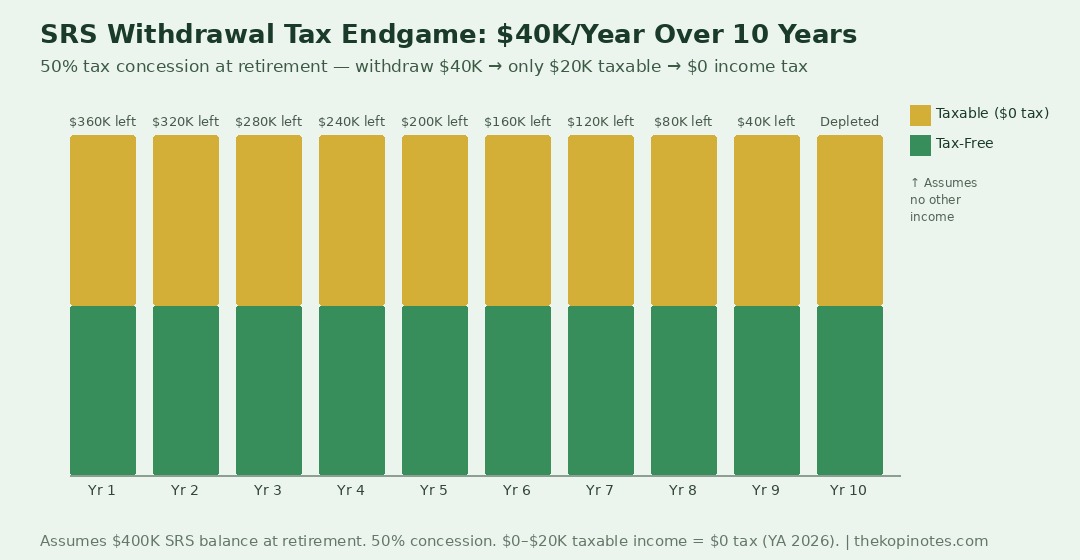
The 50% concession: at or after your SRS retirement age (63 or 64), only half of each withdrawal counts as taxable income. Withdraw $40,000 — only $20,000 goes on your tax return.
The 10-year window: from your first SRS withdrawal after retirement age, you have 10 years to draw down the account. You can spread this any way you like — fixed annual amounts, lump sums, or irregular tranches.
The zero-bracket opportunity: Singapore’s first $20,000 of chargeable income is taxed at 0%. If you withdraw $40,000 from SRS per year and have no other income (no salary, no rental income beyond exemptions), your taxable income is $20,000 — all in the zero bracket. Your effective income tax on the withdrawal is $0.
Withdraw $40,000/year for 10 years. No other income.
Taxable each year: $20,000 (50% concession). Tax: $0.
Total tax paid on $400,000 of SRS withdrawals: $0.
You contributed at 7–22% marginal rate. You withdraw at 0% effective rate.
If you have some other income in retirement — CPF LIFE payouts, dividends — the calculation shifts. SRS withdrawal strategy matters here: time your SRS drawdowns to years when other income is lowest, and consider spreading the 10-year window deliberately to stay in lower tax brackets throughout.
Who Should Maximise SRS Contributions?
SRS delivers the greatest tax relief benefit to people who are:
- In the 11.5%+ marginal band — i.e., chargeable income above $80,000. Below 11.5%, the annual saving ($1,071 or less) is real but modest; weigh it against the liquidity cost of locking up $15,300.
- Planning to retire in Singapore — the withdrawal concession assumes you remain a Singapore tax resident. Leaving permanently triggers a deemed withdrawal; see the SRS account glossary for the exit rules.
- Retirement is at least 5–10 years away — short-term contributors get less benefit from compound growth inside SRS; the tax deferral advantage needs time to compound.
- Expecting lower income in retirement than during their working years — this is the classic case where the marginal rate asymmetry is largest.
SRS is less compelling if you are already claiming close to the $80,000 relief ceiling from CPF top-ups and dependant reliefs, if you are in the 2%–3.5% bracket (too small a saving to justify illiquidity), or if you expect to retire overseas permanently and will need to make a full withdrawal at once.
SRS vs CPF Top-Up: Key Difference
Both give income tax relief, but they work differently in retirement. CPF top-up feeds your Retirement Account (RA) and comes back as CPF LIFE payouts — a fixed income stream you cannot change. SRS is fully flexible: you invest it how you like (shares, ETFs, fixed deposits, unit trusts) and draw it down any amount in any year, as long as you finish within the 10-year window.
For most residents, the ideal retirement income structure layers CPF LIFE (the floor) on top of flexible SRS drawdowns — with the SRS withdrawals sized to keep total taxable income in the lower brackets. The SRS withdrawal strategy guide covers this layering in detail.
Related Tools
- SRS Tax Savings Calculator — enter your income to see your exact annual tax saving
- SRS Withdrawal Calculator — plan your 10-year drawdown and model the tax at each level
- Retirement Planning Calculator — project your total retirement income across CPF LIFE + SRS + investments
- SRS Year-End Top-Up Guide 2026 — step-by-step: how to open an SRS account and contribute before December 31
- SRS Tax Relief Glossary — concise reference definition
Frequently Asked Questions
How much tax relief do I get from SRS as a Singapore PR?
Does the $15,300 SRS cap apply to my total income or just my employment income?
Can I contribute to SRS using CPF or SRS funds from another account?
What happens to my SRS tax relief if I exceed the $80,000 overall relief cap?
What is the SRS withdrawal age after the July 2026 retirement age change?
Can I withdraw $40,000/year from SRS and pay zero tax?
Do I still get SRS tax relief if I retire early and leave Singapore permanently?
”When
This article was researched with the help of AI. While we strive to keep all information accurate and up to date, there may be errors. If you notice any discrepancies, please contact us.