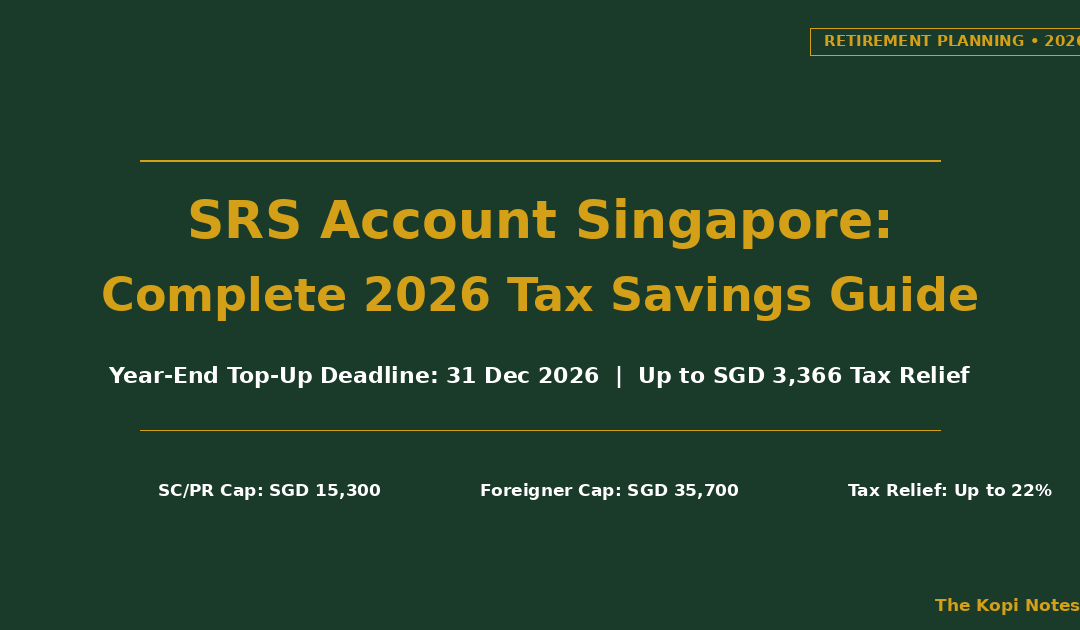
SRS Account Singapore: Complete 2026 Guide to Tax Savings & Year-End Top-Up
Maximise your tax relief before the 31 December 2026 deadline — a step-by-step guide to opening, topping up, and investing your SRS funds.
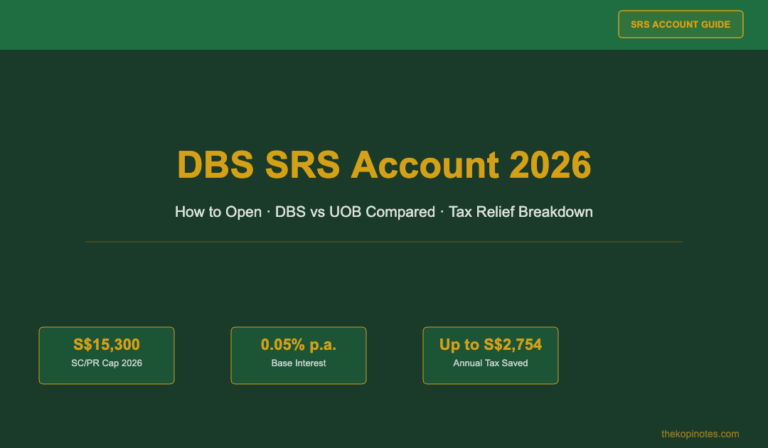
An SRS account (Supplementary Retirement Scheme) is a voluntary savings scheme run by Singapore’s Ministry of Finance that lets you contribute up to SGD 15,300 per year (for citizens and PRs) and claim dollar-for-dollar tax relief. At the 22% marginal tax rate, that’s up to SGD 3,366 in annual tax savings. Withdrawals from age 63 are only 50% taxable — making it one of the most efficient tax-deferral tools available to Singapore investors.
Not financial advice. All figures are for educational reference only. Data as at September 2026 unless noted.
Table of Contents
Contents — Click to expand
- What Is an SRS Account?
- SRS Contribution Limits 2026
- How SRS Saves You Tax (Worked Examples)
- Year-End Top-Up: The Q4 2026 Deadline
- How to Open an SRS Account
- What Can You Invest Your SRS In?
- SRS Withdrawal Rules and Tax Treatment
- SRS vs CPF: Key Differences
- Who Should Top Up SRS in 2026?
- Frequently Asked Questions
What Is an SRS Account?
The Supplementary Retirement Scheme (SRS) was launched by Singapore’s Ministry of Finance in 2001 as a voluntary, private-sector complement to the Central Provident Fund (CPF). Unlike CPF — which is mandatory and controlled by the government — SRS gives you flexibility: you choose how much to contribute (up to your annual cap), which of the three operator banks to use, and how to invest the funds within your account.
SRS is available to Singapore Citizens, Permanent Residents (PRs), and foreigners working in Singapore. All three groups benefit from the same core tax relief mechanism, though contribution limits differ significantly (SGD 15,300 for SC/PR versus SGD 35,700 for foreigners).
The three authorised SRS operator banks are DBS, OCBC, and UOB. You can hold only one SRS account at a time, but you can transfer it between operators if you wish. The funds in your SRS account are yours — they sit in a separate retirement portfolio, ring-fenced from your everyday banking.
The scheme works as a two-stage tax deferral: contributions now reduce your taxable income (lowering your current-year tax bill), and when you eventually withdraw in retirement, only 50% of each withdrawal is taxable — and at lower rates, since most retirees have significantly reduced income.
SRS Contribution Limits 2026
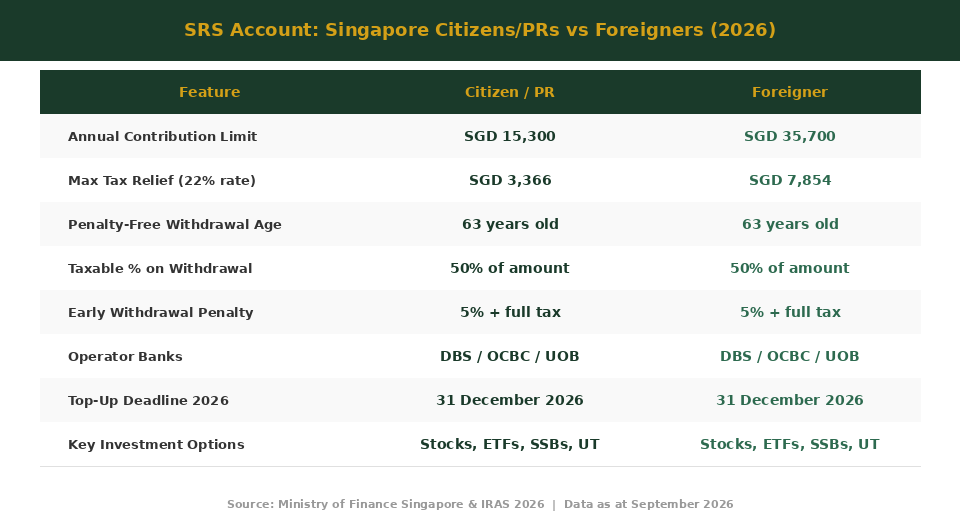
Your SRS contribution cap is determined by your tax residency status, not your actual income level. The table below shows the 2026 limits and the maximum tax relief achievable at the top marginal income tax rate:
| Category | Annual Cap | Max Tax Relief (22%) | Penalty-Free Withdrawal Age |
|---|---|---|---|
| Singapore Citizen / PR | SGD 15,300 | SGD 3,366 | 63 (current SRA) |
| Foreigner | SGD 35,700 | SGD 7,854 | 63 (current SRA) |
Source: Ministry of Finance Singapore, IRAS 2026. SRA = Statutory Retirement Age.
You do not need to contribute the maximum every year — even a partial contribution delivers proportional tax savings. For example, a Singapore Citizen contributing SGD 7,000 in 2026 at the 15% marginal rate saves SGD 1,050 in tax that year.
The deadline to make your SRS contribution and claim tax relief for Year of Assessment (YA) 2027 is 31 December 2026. Contributions made on or before this date will appear in your IRAS income tax return for YA 2027. This makes Q4 — September through December — the most critical window for SRS top-ups.
How SRS Saves You Tax (Worked Examples)
SRS contributions reduce your assessable income dollar-for-dollar. The tax saved depends on your marginal income tax rate. Singapore’s income tax is progressive, so higher earners capture the most immediate benefit from maxing out their SRS.
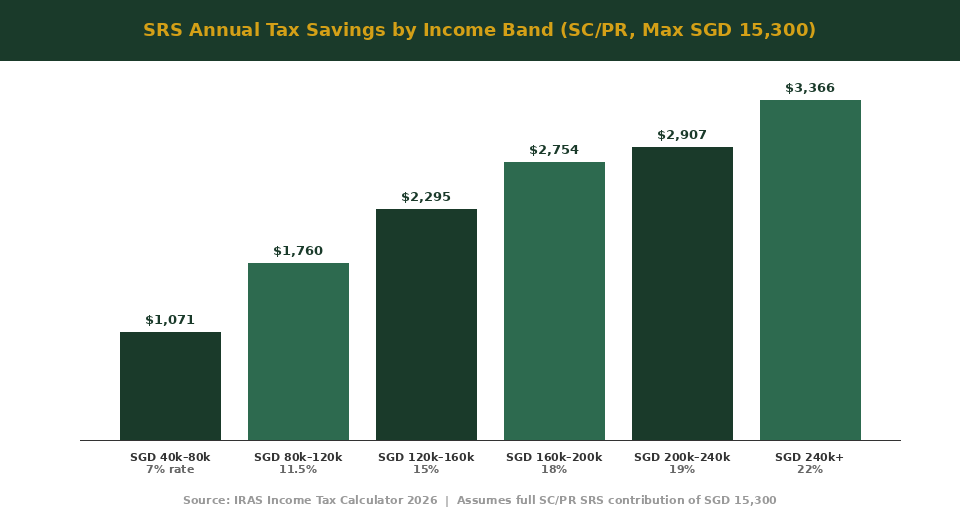
A concrete example for a Singapore Citizen earning SGD 160,000 annually (18% marginal rate): by contributing the full SGD 15,300 to SRS before 31 December, they reduce their assessable income to SGD 144,700 — saving SGD 2,754 in tax for YA 2027. Over 10 years of maxing out SRS, that compounds to over SGD 27,500 in tax savings alone, before counting any investment returns on the SRS funds.
For a Singapore Citizen at the top 22% bracket (income above SGD 320,000): the full SGD 15,300 contribution saves exactly SGD 3,366 — every single year.
The compounding effect of SRS tax savings is significant when you reinvest those savings. A SGD 3,366 annual tax refund invested in a low-cost ETF at 7% p.a. grows to approximately SGD 65,000 over 10 years — entirely separate from the growth of your SRS portfolio itself. If you’re interested in exploring how your SRS balance could grow alongside your broader retirement portfolio, try the Singapore retirement calculator to model different scenarios.
Year-End Top-Up: The Q4 2026 Deadline
With 31 December 2026 approaching, this is the most important window for Singapore investors who have not yet topped up their SRS for the year. Here is what you need to know:
- Deadline: Contributions must reach your SRS account by 23:59 on 31 December 2026. Inter-bank transfers can take 1–3 business days, so aim to initiate by 28 December at the latest.
- Partial top-ups count: If you cannot hit SGD 15,300, contribute whatever you can — any amount generates proportional tax relief.
- New accounts: You can open an SRS account and make your first contribution in the same session online — no need for a branch visit at DBS, OCBC, or UOB.
- Joint household strategy: Each individual has their own SRS account and cap. A dual-income couple can together contribute up to SGD 30,600 (SC/PR) for a combined tax saving of up to SGD 6,732 per year.
If your income has grown significantly in 2026 — for example, through a promotion, bonus, or side income — now is the time to revisit your SRS contribution. The tax relief is most valuable when your marginal rate is at its highest. If you’re also managing CPF contributions, it helps to read up on CPF investment strategy Singapore to see how SRS and CPF fit together in a complete retirement plan.
How to Open an SRS Account
Opening an SRS account takes less than 10 minutes online. All three operator banks offer full digital onboarding:
- DBS: Login to digibank → More Services → SRS → Open Account. Immediate activation.
- OCBC: Login to OCBC Digital → Apply → SRS Account. Requires existing OCBC relationship.
- UOB: Login to UOB TMRW → More → Accounts → SRS. Activation within 1 business day.
You will need your SingPass for authentication. Foreigners need to complete additional documentation (employment pass / S-pass details, tax residency declaration). Once your account is open, transfer funds via bank transfer — your SRS account number is used like a savings account for incoming credits.
The choice of operator bank does not significantly affect investment returns, since all three give access to the same universe of SRS-eligible investments. Choose based on which bank you already use for convenience.
What Can You Invest Your SRS In?
One of the lesser-known advantages of SRS is the breadth of investment options. SRS funds are not locked in a low-interest cash account — you can invest them actively across multiple asset classes. The table below summarises the major options:
| Investment Type | Examples | Notes |
|---|---|---|
| SGX-listed Stocks & REITs | DBS, CapitaLand, Ascendas REIT | Full universe of SGX-listed equities and REITs accessible through your operator bank’s brokerage |
| Unit Trusts / Funds | FSMOne funds, Endowus SRS | Wide selection via fund platforms; Endowus allows SRS investment in their portfolios at low cost |
| Singapore Government Securities | T-bills, SSBs, SGS bonds | Very low risk; Singapore T-bills 2026 currently yield ~3–4% p.a. |
| Insurance / Annuity Products | SRS-approved endowment, annuity plans | Suitable for those wanting guaranteed income in retirement; compare carefully against SSBs |
| Fixed Deposits (SRS FDs) | DBS SRS FD, OCBC SRS FD | Typically offer slightly higher rates than regular FDs; good for capital preservation near withdrawal age |
Source: Ministry of Finance Singapore, operator bank platforms, as at September 2026.
Robo-advisory platforms have emerged as one of the most popular ways to invest SRS funds. Endowus (use referral code 2V343 for SGD 20 off) allows you to invest your SRS directly into diversified fund portfolios at institutional rates — removing the need to select individual stocks or ETFs. Similarly, Syfe (referral code SRPRFFFCD) offers SRS-compatible portfolios through their Core and Income range. Both platforms eliminate the common mistake of leaving SRS funds sitting in cash earning 0.05% interest.
For investors who prefer a self-directed approach, FSMOne (referral code P0544985) provides access to a broad universe of SRS-eligible unit trusts with no sales charges, plus Singapore Government Securities and SGX-listed stocks.
If S-REITs form part of your retirement income strategy, they are also accessible via SRS through the SGX brokerage link at your operator bank. You can read more about high-yielding REIT options in our guide to the best S-REITs in Singapore 2026.
SRS Withdrawal Rules and Tax Treatment
The SRS withdrawal rules are designed to reward long-term, retirement-oriented savings. The key rules as at 2026:
- Penalty-free withdrawal age: 63 (the current Statutory Retirement Age). From this age, you can withdraw any amount, and only 50% of each withdrawal is added to your taxable income for that year.
- 10-year withdrawal window: You can spread withdrawals over up to 10 years after your first penalty-free withdrawal, allowing you to manage your annual taxable income carefully and potentially stay within the zero- or low-rate tax brackets.
- Early withdrawal (before age 63): A 5% penalty applies to the amount withdrawn, AND the full 100% (not 50%) of the withdrawal becomes taxable. This makes early withdrawal costly and generally inadvisable.
- Deemed withdrawal at age 62: If you do nothing, IRAS will not force a withdrawal — but you should plan your first withdrawal strategically. Many retirees begin small withdrawals from age 63 to use up their tax-free personal relief before income increases.
Worked example — tax-efficient SRS withdrawal: A Singapore Citizen retires at 65 with SGD 300,000 in SRS. She withdraws SGD 40,000 per year. Only SGD 20,000 (50%) is taxable income. After personal reliefs of ~SGD 10,000, she pays income tax on just SGD 10,000 — at the first-tier 2% rate, amounting to just SGD 200 in tax per year. This is extraordinarily tax-efficient compared to receiving a lump sum.
For a comprehensive model of how your SRS funds might grow and when to start withdrawing, the Singapore retirement calculator lets you input SRS-specific scenarios alongside your CPF projections.
SRS vs CPF: Key Differences
SRS and CPF serve different roles in a Singapore retirement plan. They are complementary — not competing — tools. The table below highlights the critical differences:
| Feature | SRS | CPF |
|---|---|---|
| Mandatory? | Voluntary | Mandatory (employees) |
| Investment control | Full control (stocks, ETFs, funds, FDs) | Limited (CPFIS, or default OA/SA rates) |
| Guaranteed interest rate | None (depends on investments) | 2.5% (OA), 4% (SA/RA) |
| Tax relief | Dollar-for-dollar (up to cap) | Top-up relief (SA/RA, up to SGD 8,000) |
| Withdrawal flexibility | From age 63, any amount (50% taxable) | Structured (CPF LIFE annuity payouts) |
Source: CPF Board, Ministry of Finance Singapore 2026.
In practice, a well-structured Singapore retirement plan uses both: CPF provides a guaranteed floor of income via CPF LIFE, while SRS provides flexibility and tax-deferred growth across a self-directed investment portfolio. For a deeper look at how to optimise your CPF alongside SRS, see our guide on CPF investment strategy Singapore.
Who Should Top Up SRS in 2026?
SRS delivers the most benefit to Singapore investors who:
- Pay income tax at 11.5% or above (assessable income above SGD 80,000): The absolute dollar saving is meaningful at these rates, and grows substantially at 15–22%.
- Have a long time horizon (at least 10–15 years to retirement age 63): The compounding effect of tax-deferred growth is most powerful over long periods.
- Are self-employed or receive significant variable income: SRS top-ups can be timed to high-income years to offset one-off spikes in assessable income (e.g. bonus years, asset sales).
- Are foreigners in Singapore: The SGD 35,700 cap and frequent top marginal rate exposure make SRS exceptionally valuable for expats.
SRS is less attractive for those below the 7% tax bracket (income below SGD 40,000), since the tax saving is minimal and liquidity is reduced. If you are unsure whether SRS makes sense for your situation, consider modelling the numbers on the Singapore retirement calculator alongside your passive income projections. Many TKN readers combine SRS with dividend income from S-REITs — see our overview of passive income Singapore 2026 for ideas on building that income stream.
Not financial advice. Always consult a licensed financial adviser or tax professional before making contribution decisions based on your personal tax situation.
Frequently Asked Questions: SRS Account Singapore 2026
What is the SRS contribution limit for 2026?
How much tax do I save by topping up SRS?
Can I open an SRS account if I already have a CPF account?
What happens to my SRS account if I withdraw early?
Which bank is best to open an SRS account with in Singapore?
Can foreigners open an SRS account in Singapore?
Should I invest my SRS in Singapore Savings Bonds or ETFs?
This article was researched with the help of AI. While we strive to keep all information accurate and up to date, there may be errors. If you notice any discrepancies, please contact us.