SRS Account Withdrawal Strategy Singapore 2026: How to Minimise Tax on Your SRS Withdrawals
The 50% tax exemption, 10-year window and optimal withdrawal amounts — a plain-English guide.Table of Contents
- Why Your Withdrawal Strategy Matters More Than Your Contributions
- The 50% Tax Exemption Explained
- The 10-Year Withdrawal Window: Your Most Powerful Lever
- How Much Should You Withdraw Each Year?
- The Optimal 10-Year Withdrawal Ladder
- What Happens If You Miss the Window?
- SRS Withdrawal: Step-by-Step Process
- Common Mistakes to Avoid
- Frequently Asked Questions
Your SRS account withdrawal strategy can make the difference between paying almost zero tax and handing thousands of dollars to IRAS each year. Under Singapore’s Supplementary Retirement Scheme, only 50% of your withdrawal is taxable. Spread over a 10-year window starting from your statutory retirement age, and you can withdraw S$500,000 with a total tax bill of under S$2,000. Here is how to do it right.
Not financial advice. All figures are for educational reference only. Based on IRAS 2026 tax rates unless otherwise noted.
- Only 50% of each SRS withdrawal is taxable — this is your biggest tax break
- You have a 10-year window from your first SRS withdrawal to use this exemption
- Withdraw about S$40,000 to S$50,000 per year to keep your tax bill at S$0 to S$100
Why Your Withdrawal Strategy Matters More Than Your Contributions
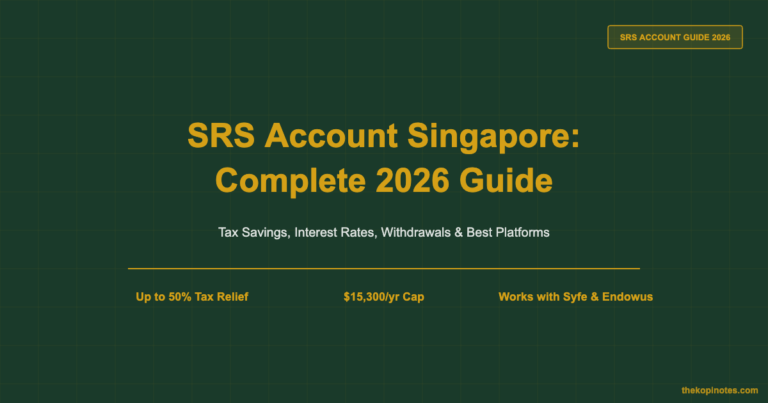
Most Singaporeans obsess over how much to top up their SRS account each year. The annual contribution cap is S$15,300 for Singapore Citizens and Permanent Residents, and S$35,700 for foreigners. Max it out, save on income tax today, invest the savings — that part is well understood.
What gets far less attention is what happens at the other end. How you withdraw your SRS savings determines whether this scheme saves you money overall — or merely defers your tax bill to retirement.
The good news: with a bit of planning, you can withdraw hundreds of thousands of dollars from your SRS account and pay minimal tax. The not-so-good news: if you withdraw the wrong way, you could face a bigger tax bill than if you had just kept the money in a regular savings account.
Before you decide where to invest your SRS funds, it helps to know what to do when it is time to take the money out. Check out the SRS account investment options Singapore guide for the full picture on building your SRS portfolio before you reach withdrawal age.
The 50% Tax Exemption Explained
When you withdraw money from your SRS account at or after your statutory retirement age, only 50% of the withdrawal amount is added to your taxable income. The other 50% is completely tax-free — no questions asked.
This is the core of the entire SRS tax strategy. Here is a simple example:
- You withdraw S$60,000 from your SRS account
- Only S$30,000 (50%) is taxable
- Under IRAS 2026 resident rates, you pay zero tax on the first S$20,000 and 2% on the next S$10,000
- Total tax payable: S$200
That is S$200 tax on a S$60,000 withdrawal. An effective rate of 0.33%.
Compare this to what you would have paid when you contributed. If you were earning S$100,000+ per year, your marginal rate was 11.5% or higher. By deferring via SRS, you shifted income from a high-tax period of your life to a low-tax retirement period.
Key rule: the 50% exemption only applies if you withdraw at or after your statutory retirement age.
| Scenario | Taxable Amount | Tax Exemption Applied? |
|---|---|---|
| Withdraw at/after statutory retirement age | 50% of withdrawal | Yes |
| Withdraw before statutory retirement age | 100% of withdrawal | No (plus 5% penalty) |
| After 10-year withdrawal window expires | 100% of balance | No |
Source: IRAS Singapore, CPF Board, 2026
The 10-Year Withdrawal Window: Your Most Powerful Lever
Once you make your first SRS withdrawal at or after your statutory retirement age, a 10-year clock starts running. During this 10-year window, every dollar you withdraw benefits from the 50% tax exemption.
Your statutory retirement age depends on when you opened your SRS account. If you opened it before 1 July 2022, your statutory retirement age is 62. If you opened it on or after 1 July 2022, your statutory retirement age is 63. For foreigners, it is 62 regardless of when the account was opened — check with your SRS operator bank for confirmation.
You do not have to start withdrawing the moment you hit statutory retirement age. Many people wait until they actually retire and their income drops, making the tax advantage even larger. However, once you make that first withdrawal, the 10-year window starts — so choose your first withdrawal year carefully.
The 10-year window is why spreading your withdrawals matters so much. Withdrawing everything in one year means you lose the benefit of spreading the taxable income across a decade of low marginal rates.
Use the Singapore retirement planning calculator to model your SRS balance at retirement and estimate your ideal annual withdrawal amount.
How Much Should You Withdraw Each Year?
The sweet spot is withdrawing enough to use your tax-free income band each year without pushing into higher marginal rates. Here is the calculation:
- Target taxable income: S$20,000 per year (0% tax band under IRAS 2026 rates)
- Since only 50% is taxable, you need to withdraw S$40,000 to generate S$20,000 taxable
- At S$40,000 per year, your tax bill is S$0
If you are comfortable paying a small amount of tax to withdraw more, S$50,000 per year gives you S$25,000 taxable income and a tax bill of about S$100. That is still extremely efficient.
If you have other income during retirement — rental income, dividends from non-SRS investments, part-time work — factor that in. Your SRS taxable portion stacks on top of your other income. If you already have S$20,000 of other income, you would want your SRS taxable portion to be S$0 (i.e., do not withdraw, or withdraw only what keeps total income below your next tax threshold).
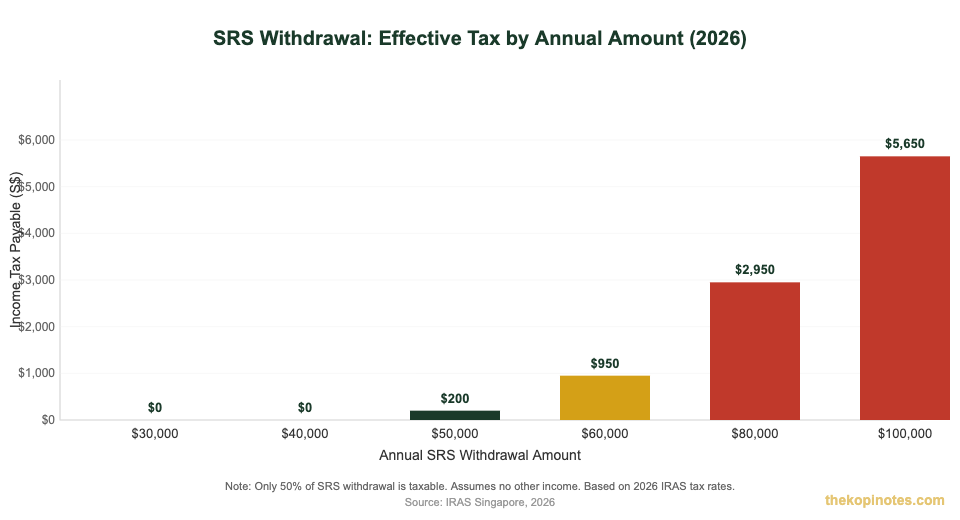
| Annual Withdrawal | Taxable Amount (50%) | Tax Payable (IRAS 2026) | Effective Rate |
|---|---|---|---|
| S$30,000 | S$15,000 | S$0 | 0% |
| S$40,000 | S$20,000 | S$0 | 0% |
| S$50,000 | S$25,000 | S$100 | 0.2% |
| S$60,000 | S$30,000 | S$200 | 0.33% |
| S$80,000 | S$40,000 | S$550 | 0.69% |
| S$100,000 | S$50,000 | S$1,250 | 1.25% |
Source: IRAS Singapore resident individual income tax rates, YA2024 onwards. Assumes SRS withdrawal is only source of income in retirement year.
The Optimal 10-Year Withdrawal Ladder
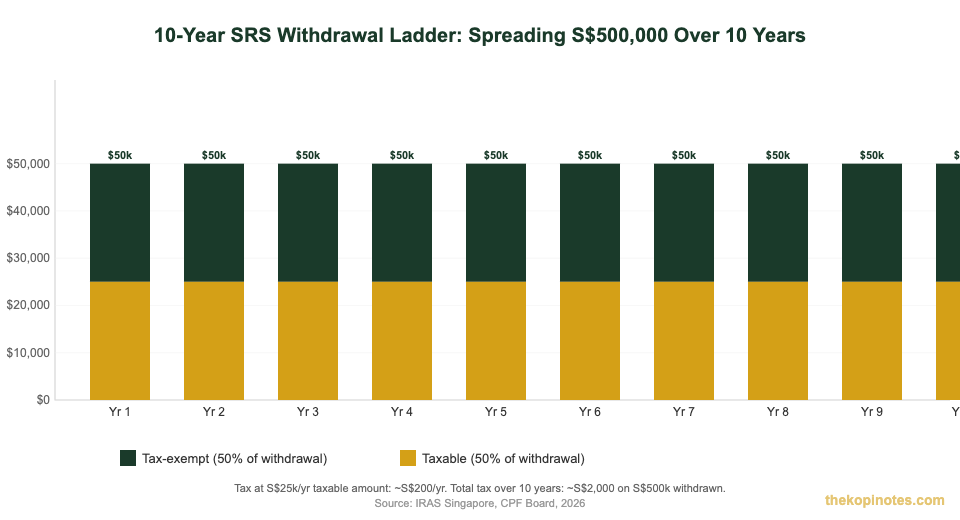
Here is a worked example for a Singapore Citizen with S$500,000 in their SRS account at statutory retirement age.
Strategy: Withdraw S$50,000 per year for 10 years starting from age 63.
- Annual withdrawal: S$50,000
- Taxable per year: S$25,000 (50% exemption applied)
- Annual tax: approximately S$100
- Total withdrawn over 10 years: S$500,000
- Total tax paid over 10 years: approximately S$1,000
That is a 0.2% total tax rate on S$500,000. If those same funds had been left in a regular investment account and withdrawn as income, the tax burden would have been far higher during your peak earning years.
If your SRS balance is larger — say S$700,000 — you can either withdraw slightly more each year (increasing the tax bill modestly) or start withdrawals a year earlier to give yourself more time within the window. The 10-year clock does not start until you make that first withdrawal, so timing that first withdrawal is critical.
This is also why platforms like Endowus and Syfe are popular SRS investment choices — they let you keep your SRS money growing inside the scheme right up until you are ready to begin your annual drawdown. Use referral code 2V343 for Endowus and SRPRFFFCD for Syfe to get started.
What Happens If You Miss the 10-Year Window?
This is the scenario every SRS account holder wants to avoid. If you do not fully withdraw your SRS balance within the 10-year window, whatever remains in your account on the day after the window closes is treated as a full withdrawal — with 100% taxable and no 50% exemption.
For example: if you have S$100,000 left in your SRS account after the 10-year window closes, the entire S$100,000 is added to your income in that year. If you have no other deductions, you could face a tax bill of S$3,350 or more on that single lump sum.
This is why it is essential to:
- Know exactly when your 10-year window expires
- Track your SRS balance each year
- Adjust annual withdrawal amounts in later years if your investments have grown faster than expected
- Consider liquidating SRS investments into cash well before the final year, so you are not forced to sell at a bad time
For more guidance on building a CPF and investment strategy that works alongside your SRS, see the CPF investment strategy guide.
SRS Withdrawal: Step-by-Step Process
Withdrawing from your SRS account is straightforward once you know the process. Here is what to do:
- Log in to your SRS operator bank. Your SRS account is held with DBS, OCBC, or UOB. Log in to your internet banking portal.
- Submit a withdrawal form. Each bank has an SRS withdrawal form — either online or at the branch. You will need to specify the withdrawal amount and confirm your retirement account details.
- Wait for processing. Most banks process SRS withdrawals within 3 to 5 business days. The funds will be credited to your linked bank account.
- File your taxes. Your SRS bank will report your withdrawal to IRAS. The taxable 50% portion will appear in your annual tax assessment. You do not need to do anything extra — IRAS handles this automatically.
- Reinvest the proceeds (optional). Once in your bank account, you are free to put the money into cash management accounts, fixed deposits, or other non-SRS investments. Consider FSMOne (referral code P0544985) for low-cost ETF investing with the proceeds.
Note: if your SRS funds are invested in stocks, bonds, or unit trusts, you will need to sell those investments first before withdrawing cash. Plan this 2 to 4 weeks in advance to avoid being forced to sell at an inopportune time.
Common SRS Withdrawal Mistakes to Avoid
Withdrawing before statutory retirement age. This is the costliest mistake. You lose the 50% exemption and pay a 5% penalty on the full withdrawal. There is almost no scenario where early withdrawal makes financial sense unless you face genuine financial hardship.
Withdrawing too much in one year. Even within the 10-year window, you can push yourself into a higher tax bracket if you withdraw too much in a single year. If you have other income in retirement, be extra careful.
Not tracking the 10-year clock. Many people forget to note the exact date of their first withdrawal. Set a reminder for year 9 so you have time to adjust withdrawals upward if needed.
Leaving investments too long inside SRS. Some people keep all their SRS money in stocks until the last moment. If markets fall sharply in your final withdrawal years, you may be forced to sell at a loss — or withdraw from a depleted account. Gradually shift to more liquid, lower-volatility assets in the 3 to 5 years before your planned withdrawal window ends.
Not considering spousal SRS accounts. If your spouse also has an SRS account, you can independently manage two 10-year withdrawal ladders. This can double the tax-free space available to your household in retirement.
Frequently Asked Questions
What is the statutory retirement age for SRS withdrawals?
Can I withdraw from my SRS account before retirement age?
What happens if I leave Singapore before retirement?
Do SRS withdrawals affect my CPF LIFE payouts or other government benefits?
Can I invest my SRS money while I am in the withdrawal phase?
What investments can I hold inside my SRS account?
Plan Your SRS Withdrawals Before You Retire
The best time to build your withdrawal strategy is 5 to 10 years before you start taking money out. Open a low-cost investment account today to grow your savings inside SRS. Use referral code 2V343 for Endowus or SRPRFFFCD for Syfe to get started with fee waivers on your SRS investments.
This article was researched with the help of AI. While we strive to keep all information accurate and up to date, there may be errors. If you notice any discrepancies, please contact us.