THIRD 4-WAY COMBO · DIGITAL BANKS + CPF/SRS · SINGAPORE 2026
TribeCar + Endowus + FSMOne + IBKR: The Relief-Ladder Strategy (Singapore 2026)
If you free up S$500 a month by not owning a car, which account should that money hit first? Not the one with the highest cap. Not the one with the best headline rate. The one that pays you back the fastest — through tax relief you get to keep whether the markets go up or down.
Table of Contents
What the Relief-Ladder Mechanic Actually Is
Tier 1: FSMOne SRS — the $15,300 Relief Cap
Tier 2: Endowus CPF Cash Top-Up — the $8,000 Cap
Tier 3: IBKR — the Uncapped Overflow
Worked Example: Where S$500/Month Actually Goes
Where This Breaks Down
FAQ
The Relief-Ladder Mechanic: Rank by Guaranteed Return, Not by Cap Size
The TribeCar pipeline articles on this site usually ask a simple question: once you stop paying for a car (insurance, parking, depreciation, COE renewal — easily S$500–S$800 a month for an average owner-driver), where should that freed-up cash go first?
Most of the thirteen 3-way combos already published here answer that with a time horizon (buffer then invest), a tax cap (SRS first, then overflow), an insurance ceiling (SDIC barbell), or a rate literacy gap (headline vs achievable). This one uses a different lens entirely: rank the destinations by how certain and how immediate the return is, then move to the next tier only once the current one is capped.
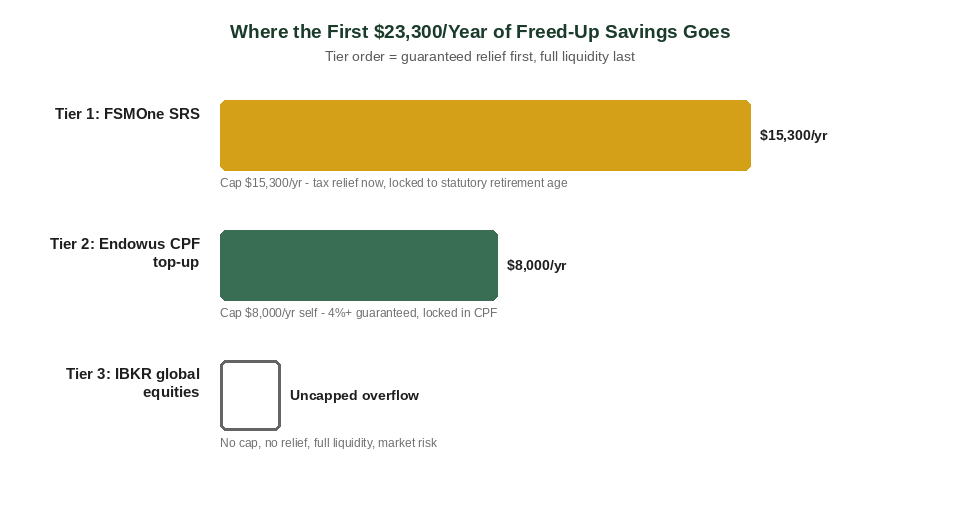
That gives three tiers, in this order:
- FSMOne SRS contribution — a guaranteed, dollar-for-dollar tax relief today, in exchange for locking the money up until your statutory retirement age.
- Endowus CPF cash top-up (RSTU) — also a dollar-for-dollar tax relief, plus CPF’s own guaranteed 4%+ interest on the Special/Retirement Account, but harder to unwind than SRS if you’re wrong.
- IBKR global equities (e.g. VWRA) — zero tax relief, zero guaranteed return, but zero lock-in. The overflow tier once both relief buckets are full.
The point isn’t that this order is universally correct for every reader — it depends on your marginal tax rate, how soon you might need the cash, and your CPF Full Retirement Sum status. It’s that relief-per-dollar, discounted for lock-in risk, is a genuinely different way to sequence savings than anything the prior twenty-plus platform combos on this site have used.
Tier 1: FSMOne SRS — The $15,300 Relief Cap
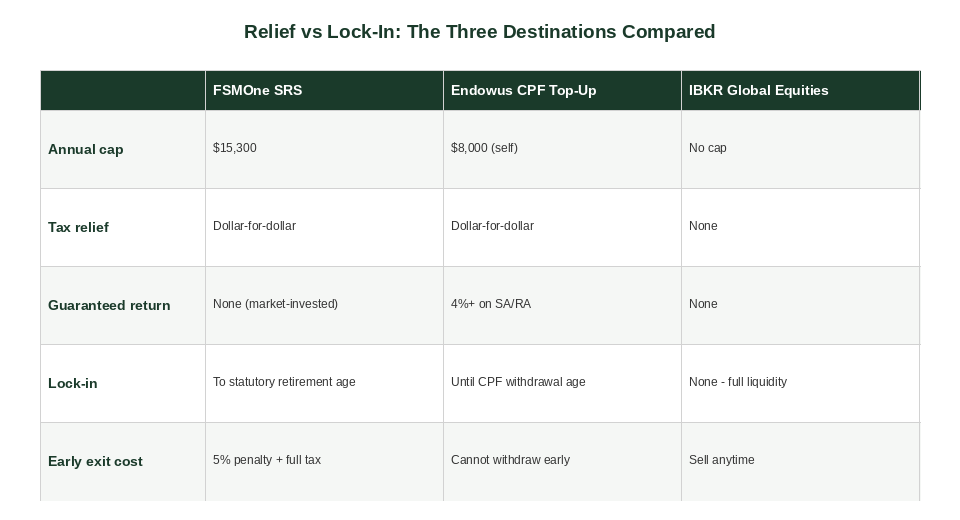
The Supplementary Retirement Scheme (SRS) contribution cap for Singapore Citizens and PRs is S$15,300 a year (S$35,700 for foreigners), and every dollar you put in reduces your assessable income for that Year of Assessment, dollar-for-dollar, subject to the overall S$80,000 personal tax relief cap.
Route this contribution through FSMOne, which charges 0% sales charge on SRS unit trust purchases — so the full contribution goes to work, not into a platform fee, and you still get the tax relief regardless of what you invest the SRS cash in afterward.
Why this is Tier 1: at a 15% marginal tax bracket, a full S$15,300 contribution saves roughly S$2,295 in tax the same year — a return you bank immediately, before a single dollar is invested. No CPF top-up or brokerage account offers a comparable instant, certain payback.
The cost: SRS funds are locked until your statutory retirement age (currently 63, scheduled to rise to 64 from 1 July 2026 for those turning 63 that year). Withdraw earlier than that and you pay a 5% penalty plus 100% of the withdrawal is taxed as income — effectively cancelling most of the relief you banked.
Tier 2: Endowus CPF Cash Top-Up — The $8,000 Cap
Once the SRS cap is filled (or if you’d rather diversify the relief across two schemes instead of maxing one), the next stop is a CPF cash top-up under the Retirement Sum Topping-Up Scheme (RSTU). Tax relief here is capped at S$8,000 a year for topping up your own Special Account (under 55) or Retirement Account (55 and above), plus a separate combined S$8,000 cap for topping up eligible family members — up to S$16,000 total relief, still bounded by the same S$80,000 overall cap.
Endowus is the practical way to route CPF-linked cash into a diversified portfolio once it’s inside your Ordinary Account, and its CPF-funded portfolios carry an access fee as low as 0.05% p.a. for the flagship Cash Smart-style tier — among the lowest all-in costs on the CPF-investing side of the platform market. (The CPF cash top-up relief itself is claimed automatically once CPFB records the top-up; Endowus doesn’t touch that part of the process.)
Why this is Tier 2, not Tier 1: the relief is the same dollar-for-dollar mechanic as SRS, and CPF Special/Retirement Account balances earn a guaranteed 4%+ per annum (versus SRS cash, which earns a token default rate until you actively invest it) — on paper, arguably a better guaranteed return. But once cash top-up money sits in your SA or RA, there is no early-withdrawal option at all, not even with a penalty. SRS at least lets you buy your way out for 5% plus tax. That makes CPF top-ups the second-most-locked, not the least.
See our full breakdown of CPF Ordinary Account top-up mechanics for how OA and SA/RA top-ups differ if you’re deciding which account to fund.
Tier 3: IBKR Global Equities — The Uncapped Overflow
Once SRS and the CPF cash top-up caps are both filled for the year — a combined S$23,300 in relief-generating contributions — any further freed-up TribeCar savings has nowhere left to earn tax relief. That’s where Interactive Brokers (IBKR) comes in, as the uncapped, fully liquid overflow tier for a globally diversified ETF like VWRA.
There’s no tax relief and no guaranteed return here — this tier carries full market risk. But it also carries none of the lock-in of the first two: sell whenever you want, no penalty, no statutory age requirement. One practical wrinkle worth knowing before you route cash here: IBKR does not pay interest on the first US$10,000 (or roughly the SGD equivalent) of uninvested cash sitting idle in the account — see our related piece on the SGD dead-zone problem with IBKR cash balances if you plan to let contributions sit before investing them.
Why this is Tier 3, last: it’s the only destination with zero guaranteed component. If your marginal tax rate is low enough that the SRS and CPF relief amounts barely move the needle, it can make sense to skip straight to this tier — see the caveats below.
Worked Example: Where S$500/Month Actually Goes
Take someone who sells their car via TribeCar‘s peer-to-peer marketplace instead of buying a new one, freeing up roughly S$500/month (S$6,000/year) in insurance, parking, depreciation, and COE-related costs they no longer carry.
| Year | Cumulative freed-up cash | Where it goes |
|---|---|---|
| Year 1 | S$6,000 | Entirely into FSMOne SRS (under the S$15,300 cap) |
| Year 2 (cumulative S$12,000) | S$12,000 | Still entirely into FSMOne SRS (still under cap) |
| Year 3 (cumulative S$18,000) | S$18,000 | S$15,300 tops out SRS; remaining S$2,700 starts an Endowus CPF top-up |
| Year 4+ (annual S$6,000) | S$6,000/year going forward | SRS re-capped each new year first, then CPF top-up until its S$8,000 cap, then any remainder into IBKR |
At this saving rate it takes roughly three years before any of the freed-up TribeCar cash reaches the CPF top-up tier, and considerably longer before it reaches IBKR at all — illustrating just how much runway the two relief tiers absorb for a typical single car-free household.
Where This Breaks Down
This relief-first ordering isn’t universal advice, and it can be the wrong call in a few common situations:
- Low marginal tax rate. If your chargeable income puts you in the 0% or 2% bracket, the relief from either SRS or CPF top-ups is worth very little in absolute dollars, while the lock-in cost is exactly the same. In that case, going straight to IBKR for liquidity and growth may make more sense.
- Emergency fund not yet built. Relief tiers are the wrong place for money you might need in the next 12 months. An emergency buffer should sit in a liquid, SDIC-insured account before any of this ladder applies.
- Approaching the CPF Full Retirement Sum already. Tax relief on CPF cash top-ups only applies up to the Full Retirement Sum (S$220,400 for 2026); topping up beyond that captures no additional relief, even though the top-up itself may still be allowed up to the Enhanced Retirement Sum.
- SRS withdrawal planning matters more than the contribution. How you withdraw SRS funds in retirement affects how much of the original relief you actually keep — see our dedicated SRS account guide for withdrawal-stage tax planning.
This article describes mechanics and public tax-relief rules; it is not personalised financial or tax advice. Marginal tax rates, CPF caps, and relief thresholds can change, and your own eligibility depends on your full tax situation — consult IRAS guidance or a licensed advisor for your specific numbers.
Get Started With Each Platform
Frequently Asked Questions
Should I max out my SRS before topping up CPF, or the other way round?
Can I withdraw a CPF cash top-up if I change my mind?
What happens to unused SRS or CPF top-up room if I don't use it this year?
Does IBKR charge fees for holding uninvested SGD cash?
Is this the same as the earlier TribeCar plus FSMOne plus IBKR three-way combo on this site?
This article was researched with the help of AI. While we strive to keep all information accurate and up to date, there may be errors. If you notice any discrepancies, please contact us.