SRS Account Investment Options Singapore 2026: Where to Put Your Money
7 ways to grow your SRS savings — ranked by risk and expected return
The Supplementary Retirement Scheme (SRS) lets Singapore residents contribute up to S$15,300 per year — S$35,700 for foreigners — and claim a full tax deduction on every dollar. When you retire, only 50% of each withdrawal is taxable. But SRS money sitting as cash earns just 0.05% per year. The right investment choice can turn that tax saving into a genuine retirement multiplier.
Not financial advice. All figures are for educational reference only. Data as at September 2026 unless noted.
- SRS funds can be invested in SSBs, T-bills, unit trusts, ETFs and more — not just left as cash
- Endowus and FSMOne are the most popular SRS investment platforms in 2026
- Investing your SRS rather than leaving it idle can add hundreds of thousands of dollars by retirement
Table of Contents
- What Is the SRS Account?
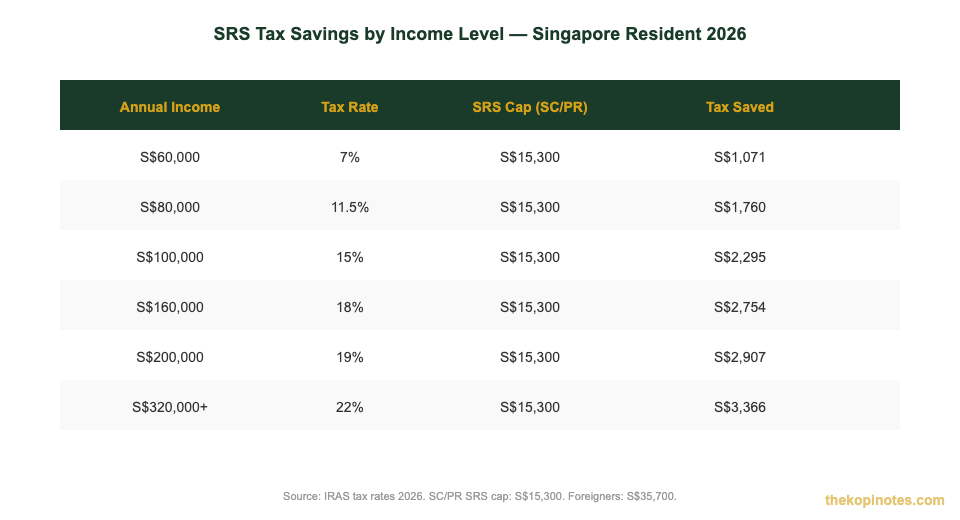
- SRS Contribution Limits and Tax Savings 2026
- The 7 SRS Investment Options at a Glance
- Low Risk: SSBs, T-Bills and Fixed Deposits
- Medium Risk: Unit Trusts via Endowus and FSMOne
- Growth: ETFs and Singapore Stocks
- Insurance and Retirement Annuities
- Platform Comparison 2026
- How to Start Investing Your SRS
- Frequently Asked Questions
What Is the SRS Account?
The SRS is a voluntary savings scheme run by three banks in Singapore: DBS, OCBC and UOB. You open an account with one of them, contribute money throughout the year, and deduct every dollar from your taxable income for that year.
The real power of SRS is the withdrawal tax treatment. When you draw down your SRS funds in retirement, only 50% of each withdrawal is added to your taxable income for that year. If you spread withdrawals over 10 years, the effective tax rate on your SRS savings can approach zero for most Singaporeans.
There is a catch: early withdrawal before statutory retirement age (63 as of 2026) incurs a 5% penalty plus 100% of the withdrawal becomes fully taxable. So SRS is firmly long-term money — ideal for investing rather than leaving as idle cash.
SRS Contribution Limits and Tax Savings 2026
Here is what you can contribute and how much tax you save at different income levels:
| Residency Status | Annual Cap | Eligible Banks |
|---|---|---|
| Singapore Citizen / PR | S$15,300 | DBS, OCBC, UOB |
| Foreigner (EP / SP holder) | S$35,700 | DBS, OCBC, UOB |
Source: Ministry of Finance Singapore, 2026.
The 7 SRS Investment Options at a Glance
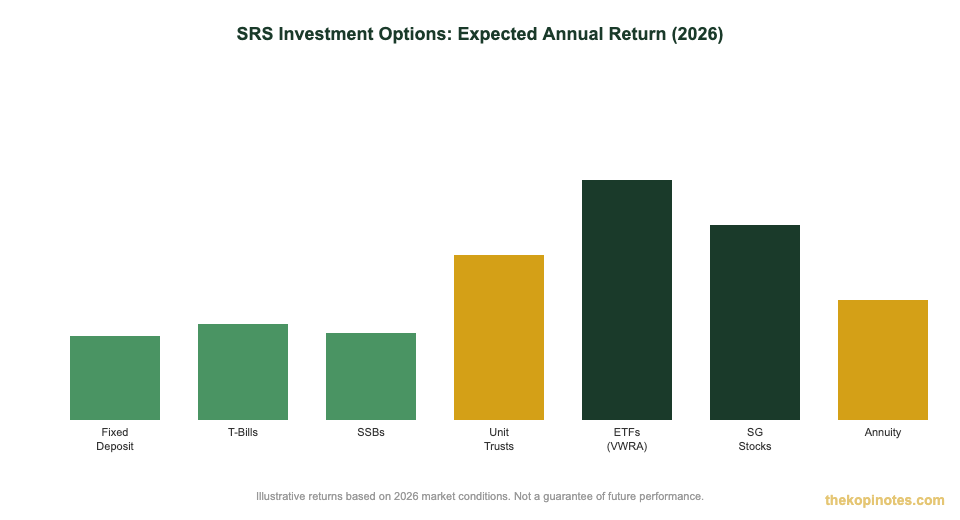
SRS money sitting as cash earns just 0.05% per year — roughly S$7.65 on a full S$15,300 contribution. Investing changes the picture. Here are your seven main options:
| Option | Risk Level | Est. Return (p.a.) | Platform |
|---|---|---|---|
| Fixed Deposits | Very Low | 2.5 – 3.0% | DBS / OCBC / UOB |
| Singapore Savings Bonds | Very Low | 2.8 – 3.0% | SRS bank iBanking / ATM |
| T-Bills (6-month) | Very Low | 3.0 – 3.3% | SRS bank (primary) |
| Unit Trusts | Low – Medium | 4 – 6% | Endowus, FSMOne, Syfe |
| ETFs (LSE-listed) | Medium – High | 7 – 9% (long-run) | IBKR, Saxo |
| Singapore Stocks / REITs | Medium – High | Varies | DBS Vickers, Saxo, IBKR |
| Retirement Annuities | Low | 3.5 – 4.5% | AIA, Prudential, Great Eastern |
Source: TKN research, September 2026. Returns are illustrative and not guaranteed.
Low Risk: SSBs, T-Bills and Fixed Deposits
If capital preservation is your priority, these three options give you predictable returns with essentially zero default risk.
Singapore Savings Bonds (SSBs) are government-backed and fully flexible. You can redeem early with no penalty — a key advantage over fixed deposits. Apply via your SRS bank using iBanking or ATM. The minimum is S$500 and you can hold up to S$200,000 total across all SSBs. Check the current yield at the MAS Singapore Savings Bonds page before applying each month.
T-bills offer slightly higher short-term yields. You bid via your SRS bank during each fortnightly auction. The most recent 6-month T-bill cut-off was around 3.2% — higher than most savings accounts. Our Singapore T-bills 2026 guide covers the full SRS application step-by-step.
Fixed deposits via your SRS bank are the simplest option. Rates sit around 2.5 – 3.0% in 2026. You lock in the rate for 3 to 24 months. The downside: early redemption usually means losing the interest accrued.
Medium Risk: Unit Trusts via Endowus and FSMOne
Unit trusts give you diversified exposure to equity and bond markets without picking individual stocks. Two platforms dominate the SRS unit trust space in Singapore.
Endowus SRS is the most popular choice for hands-off investors. You select a risk profile and Endowus builds a diversified portfolio of institutional-class funds. Total annual cost (platform fee plus fund expense ratios) runs between 0.6% and 1.1% depending on your portfolio. Use the Endowus referral code 2V343 to get S$20 off advisory fees on your first S$10,000 invested.
FSMOne SRS gives you direct access to over 500 unit trusts with low platform fees. It suits investors who want to build their own fund portfolio. The platform charges 0.08% per year (min S$1/month). Get started with our FSMOne referral code P0544985 for cashback rewards.
Syfe SRS offers managed portfolios starting from S$1,000. Their Core Equity100 portfolio has returned around 8% annually over five years. Use Syfe referral code SRPRFFFCD for fee waivers on your first three months.
Growth: ETFs and Singapore Stocks
For maximum long-run growth potential, globally diversified ETFs via a brokerage linked to your SRS account are the most cost-efficient option.
The most popular approach is buying London Stock Exchange-listed ETFs like VWRA (Vanguard FTSE All-World Acc) or CSPX (iShares Core S&P 500 UCITS ETF) through Interactive Brokers (IBKR). These are accumulating, UCITS-compliant ETFs with no US estate tax exposure — ideal for Singapore investors.
IBKR charges US$0 per trade for stocks and ETFs (tiered plan) and gives access to 135+ exchanges worldwide. Link your SRS account to your IBKR account at setup.
You can also buy SGX-listed blue chips and the best S-REITs in Singapore 2026 directly through SRS. S-REITs pay 5 – 7% distribution yields and are fully accessible via SRS-linked brokerage accounts. Use the Singapore retirement calculator to model how reinvesting distributions inside SRS affects your retirement target.
Insurance and Retirement Annuities
Single-premium retirement income policies let you convert a lump sum from your SRS into a guaranteed income stream starting at age 63 or 65. Major insurers like AIA, Prudential and Great Eastern all offer SRS-eligible plans.
Typical illustrated yields run from 3.5% to 4.5% per year depending on policy term and insurer. Participating policies offer upside via bonuses but are not fully guaranteed. Non-participating policies lock in the rate but offer less potential upside.
Annuities make sense if you want certainty over flexibility. For investors comfortable managing their own portfolio, ETFs or unit trusts will likely deliver better long-run outcomes.
Platform Comparison 2026
| Platform | Best For | Annual Fee | Min. Investment |
|---|---|---|---|
| Endowus SRS | Hands-off managed portfolios | 0.25 – 0.60% | S$1,000 |
| FSMOne SRS | DIY unit trust selection | 0.08% (min S$1/mo) | S$100 |
| Syfe SRS | Simple managed portfolios | 0.35 – 0.65% | S$1,000 |
| IBKR (SRS-linked) | Self-directed ETFs and stocks | No annual fee | No minimum |
| SRS Bank (DBS / OCBC / UOB) | SSBs, T-bills, FDs | No platform fee | S$500 (SSBs) |
Source: Platform websites, September 2026. Fees subject to change.
How to Start Investing Your SRS
If you do not yet have an SRS account, open one at DBS, OCBC or UOB. You get instant tax relief for the year of opening — even a late-year contribution counts toward that year’s tax deduction.
Want zero hassle? Contribute to SRS, transfer funds to Endowus and select Core Equity 100 or Core Balanced. Review once a year.
Want the lowest fees? Open FSMOne, link your SRS, and pick two or three low-cost index unit trusts — for example, Lion-Philip S-REIT Index Fund or Infinity Global Stock Index Fund.
Want full control? Link your SRS to an IBKR account and buy VWRA monthly via dollar-cost averaging. See the CPF investment strategy guide for how to pair SRS with CPF OA for a complete retirement plan.
The most important step is to invest your SRS rather than leaving it as cash. At 3% annual return — the current T-bill yield — S$15,300 contributed annually for 20 years becomes roughly S$411,000. At 7% — a reasonable long-run global equity ETF return — the same contributions reach approximately S$627,000.
Frequently Asked Questions
What can I invest SRS money in?
How much can I contribute to SRS in 2026?
Is SRS better than CPF for retirement savings?
Can I withdraw SRS money early?
Which platform is best for investing SRS money?
Are SSBs a good investment for SRS?
This article was researched with the help of AI. While we strive to keep all information accurate and up to date, there may be errors. If you notice any discrepancies, please contact us.