MediSave Withdrawal Limits Rising to $700 and $1,000 in 2027: The New “Chronic and Prevent Care” Scheme
CPF Board renames the MediSave 500/700 Scheme and raises annual withdrawal caps for chronic disease claims from 1 January 2027 — here’s what changes and who benefits.
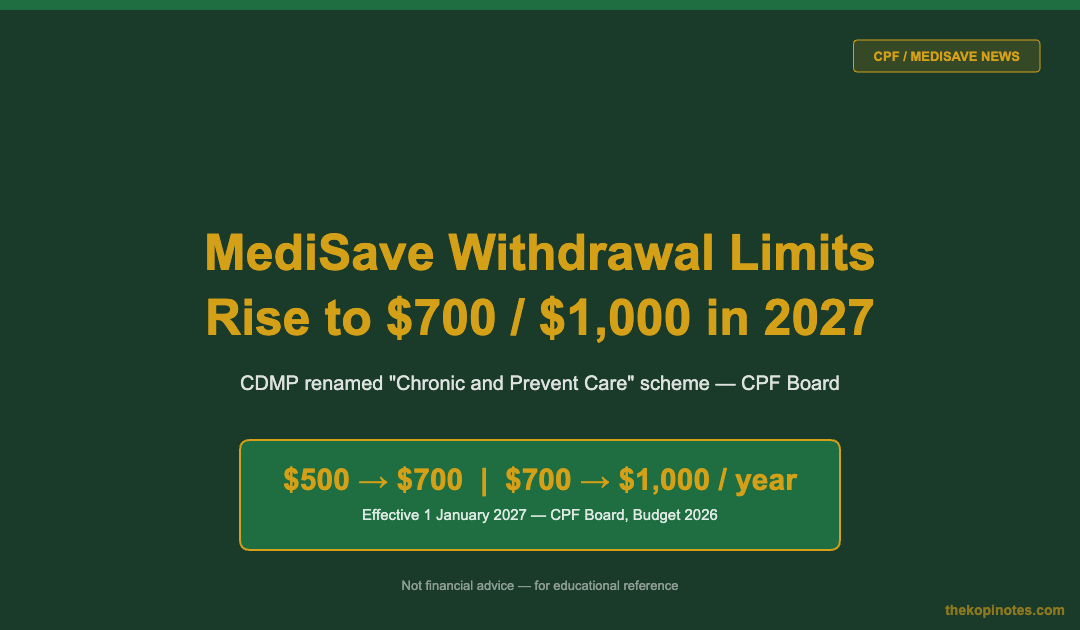
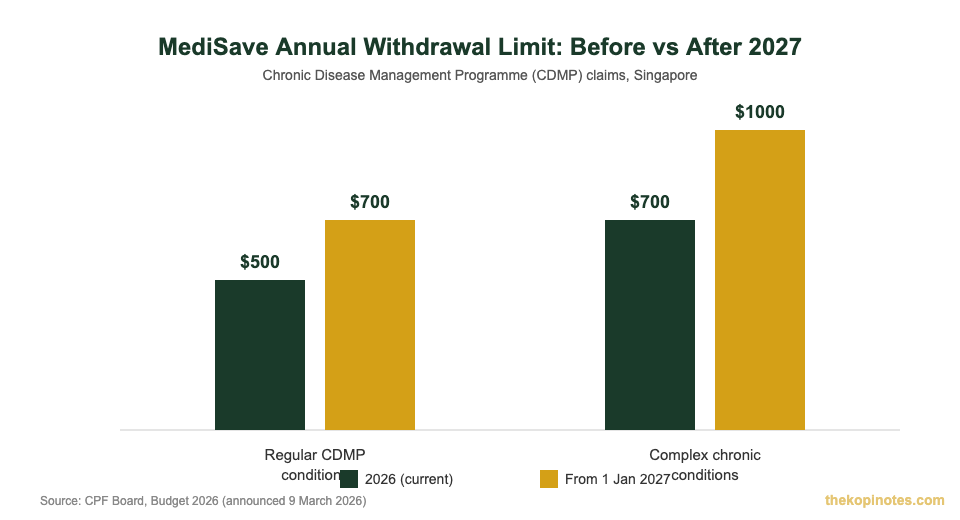
From 1 January 2027, Singaporeans on the Chronic Disease Management Programme (CDMP) can withdraw more from MediSave each year. The cap for regular chronic conditions rises from $500 to $700. For more complex chronic conditions, it rises from $700 to $1,000. The scheme is also being renamed the MediSave Chronic and Prevent Care Scheme, as announced by the CPF Board at Budget 2026.
Not financial advice. All figures are for educational reference only. Data as at August 2026, sourced from the CPF Board’s Budget 2026 announcement (9 March 2026).
- MediSave withdrawal limits for CDMP go up from 1 January 2027 — $500→$700 for regular chronic conditions, $700→$1,000 for complex ones.
- The “MediSave 500/700 Scheme” name is retired. It becomes the MediSave Chronic and Prevent Care Scheme.
- You don’t need to do anything to get this — it applies automatically if you’re already on CDMP for a covered condition like hypertension, diabetes, or stroke.
Table of Contents
What’s Changing in 2027
Right now, MediSave covers outpatient treatment for chronic conditions through the Chronic Disease Management Programme, or CDMP. Most people call it the “MediSave 500/700 Scheme” — $500 a year for regular chronic conditions, $700 a year if you have more complex ones.
That name is going away. From 1 January 2027, the CDMP withdrawal scheme will be called the MediSave Chronic and Prevent Care Scheme. It’s not just a rebrand — the withdrawal caps go up too.
Here’s why this matters. If you’re managing hypertension, diabetes, or a similar condition, MediSave withdrawal limits decide how much of your regular clinic visits, blood tests, and medication get paid from MediSave instead of your own pocket. A higher cap means less out-of-pocket cash for you.
The New Withdrawal Limits
Here’s the full breakdown of what changes on 1 January 2027, compared to today.
| Category | Current Limit (2026) | From 1 Jan 2027 |
|---|---|---|
| Regular CDMP conditions | $500 / year | $700 / year |
| Complex chronic conditions | $700 / year | $1,000 / year |
| Scheme name | MediSave 500/700 Scheme | MediSave Chronic and Prevent Care Scheme |
Source: CPF Board, Budget 2026 CPF changes announcement, 9 March 2026.
The higher caps also apply to a wider set of use cases. You’ll be able to claim for outpatient treatment, vaccinations, and preventive tests for conditions like hypertension and stroke — not just consultations and medication.
Who Qualifies for CDMP
The Chronic Disease Management Programme (CDMP) — basically the government’s list of chronic conditions you can use MediSave for — covers conditions like diabetes, hypertension, stroke, lipid disorders, and several others set by the Ministry of Health.
You’re automatically eligible if a CDMP-participating clinic or polyclinic has diagnosed and is actively managing one of these conditions for you. There’s no separate application. Your MediSave account simply allows the higher withdrawal once the new limits take effect.
If you’re not sure whether your condition qualifies, our MediSave Chronic Disease Management Programme (CDMP) claims guide breaks down the full list of covered conditions and how to check your eligibility.
What This Means for You
Say you’re managing both hypertension and high cholesterol — that puts you in the “complex chronic conditions” tier. Under today’s $700 cap, four quarterly check-ups plus medication can easily use up your MediSave allowance by October. Everything after that comes out of your own pocket.
From 2027, your cap rises to $1,000. That’s an extra $300 a year MediSave can absorb — roughly one more full quarter of check-ups and medication that no longer needs to come from cash.
If you’re on a single, regular chronic condition like diet-controlled diabetes, your cap goes from $500 to $700 — a 40% increase. For many patients, that’s the difference between topping up out-of-pocket mid-year and having enough MediSave to last through December.
How This Fits Other 2026 CPF Changes
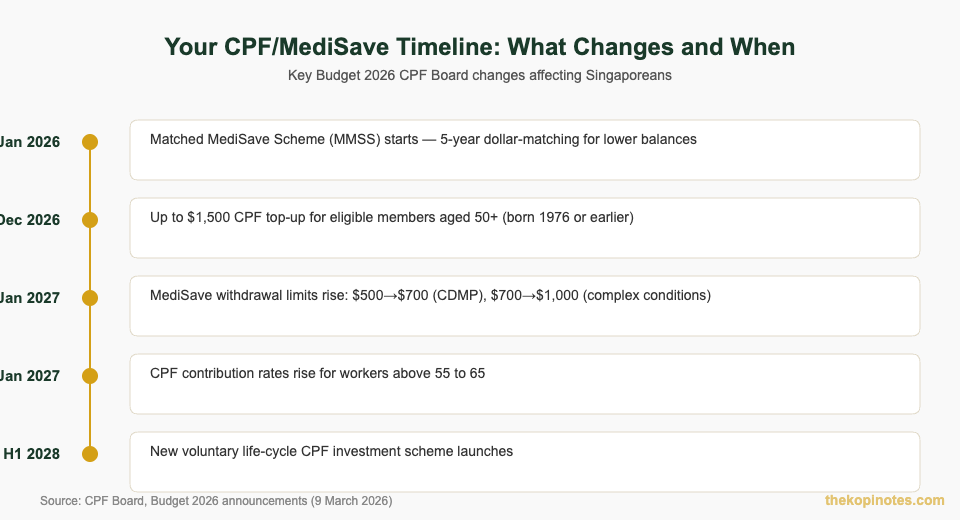
This isn’t the only CPF change working its way through 2026 and 2027. Budget 2026 also introduced a five-year Matched MediSave Scheme (MMSS), a one-off top-up for older members, and higher contribution rates for senior workers.
| Change | Effective | Who it affects |
|---|---|---|
| Matched MediSave Scheme (MMSS) | Jan 2026 – 2030 | CPF members aged 55–70 with lower MediSave balances |
| Up to $1,500 CPF top-up | Dec 2026 | Singaporeans born 1976 or earlier |
| MediSave withdrawal limit increase | Jan 2027 | CDMP patients (this article) |
| Higher contribution rates, workers 55–65 | Jan 2027 | Employees above 55 to 65 |
Source: CPF Board, Budget 2026 CPF changes announcement, 9 March 2026.
You can read the full breakdown of the senior worker changes in our CPF contribution rate changes for senior workers from 2027 guide, and see how the current MediSave withdrawal caps and MMSS scheme work in our MediSave withdrawal limits and MMSS explainer. If you want the fundamentals first, our complete guide to how CPF MediSave works is a good starting point.
However, don’t rely on MediSave withdrawal limits alone for chronic disease costs. If your out-of-pocket spending regularly exceeds your MediSave cap, it’s worth reviewing whether topping up your MediSave account makes sense — try our CPF cash top-up tax relief calculator to see the tax benefit of doing so, and our retirement planning calculator to check how healthcare costs factor into your broader retirement number.
Put Your Savings to Work While You Wait for 2027
Higher MediSave caps help with healthcare costs — but your cash and SRS savings can work harder too. Compare robo-advisor and brokerage options below.
Frequently Asked Questions
When do the new MediSave withdrawal limits start?
The higher limits take effect from 1 January 2027. Until then, the current $500 and $700 caps apply.
Do I need to apply for the higher MediSave limit?
No. If you’re already diagnosed and managed under the Chronic Disease Management Programme (CDMP), the higher cap applies automatically from 1 January 2027. There’s no separate form to fill in.
What is the MediSave Chronic and Prevent Care Scheme?
It’s the new name for what’s currently called the MediSave 500/700 Scheme. The rename reflects the higher $700 and $1,000 withdrawal caps taking effect from 1 January 2027, and covers outpatient treatment, vaccinations, and preventive tests for chronic conditions.
Which conditions are covered under CDMP?
CDMP covers a Ministry of Health-approved list of chronic conditions, including diabetes, hypertension, stroke, and lipid disorders, among others. Check with your CDMP-participating clinic to confirm your specific condition is on the list.
How is the complex chronic conditions tier different?
If you’re managing more than one chronic condition, or a condition classified as more complex by MOH, you fall under the higher tier — $700 today, rising to $1,000 a year from 2027, compared to $500 rising to $700 for regular conditions.
Can I still use MediSave for these claims if I've hit my annual cap?
Once you hit your annual CDMP withdrawal cap, further claims for that condition need to be paid out of pocket or through other MediSave withdrawal categories, such as the Flexi-MediSave scheme, if applicable, until the cap resets the following year.
Not financial advice. Figures are accurate as at August 2026, based on the CPF Board’s Budget 2026 announcement (published 9 March 2026). Always check the CPF Board and Ministry of Health websites for the latest official details before making healthcare financing decisions.
This article was researched with the help of AI. While we strive to keep all information accurate and up to date, there may be errors. If you notice any discrepancies, please contact us.