CDMP MediSave Singapore 2026: Complete Guide to Chronic Disease Claims
MediSave 500/700 · 23 CDMP Conditions · CHAS Subsidies · 2027 Changes
The Chronic Disease Management Programme (CDMP) lets you use your MediSave to pay for outpatient treatment of 23 chronic conditions at GPs, polyclinics and Specialist Outpatient Clinics across Singapore. You can withdraw up to $500 per year for non-complex conditions, or $700 for complex chronic conditions, with a 15% cash co-payment applying to each visit — waived entirely if you attend your enrolled Healthier SG clinic. From 1 January 2027, these limits rise to $700 and $1,000 respectively.
Not financial advice. All figures are for educational reference only. Data verified as at 10 July 2026. Sources: Ministry of Health Singapore, CPF Board.
- CDMP MediSave covers 23 chronic conditions — from diabetes to gout — at $500 or $700 per year.
- Enrol in Healthier SG to skip the 15% cash co-payment entirely at your chosen clinic.
- Stack with CHAS subsidies (up to $500/yr) and Pioneer/Merdeka Generation benefits (up to $540/yr) to lower costs further.
Table of Contents
Jump to a section
- What Is the Chronic Disease Management Programme (CDMP)?
- The 23 CDMP Conditions Covered in 2026
- How Much MediSave Can You Claim Under CDMP?
- Who Can You Use Your MediSave For?
- How to Use CDMP MediSave Step by Step
- Stack Your Savings: CHAS, Healthier SG & Flexi-MediSave
- 2027 Changes: What’s Coming Next
- Frequently Asked Questions
What Is the Chronic Disease Management Programme (CDMP)?
The CDMP is a government scheme that lets Singaporeans use their MediSave Account to pay for outpatient treatment of chronic conditions. Without CDMP, MediSave is mainly for inpatient hospital stays. CDMP extends that coverage to your regular GP and polyclinic visits.
The scheme was designed to keep chronic disease management affordable. Chronic conditions are typically lifelong — you’ll be visiting the doctor regularly for the rest of your life. Without CDMP, those costs add up fast. With CDMP, you can tap your MediSave savings to reduce out-of-pocket spending.
Here’s where you can use CDMP MediSave:
- Public hospital Specialist Outpatient Clinics (SOCs)
- Polyclinics (under MOH’s network)
- More than 1,250 CHAS GP clinics and private specialist clinics islandwide
Each CDMP claim is tracked separately in your CPF statement under a dedicated MediSave sub-account, so you can always see how much of your annual limit you’ve used. Log in to cpf.gov.sg with your Singpass to check your balance, or ask your clinic to check on your behalf.
The 23 CDMP Conditions Covered in 2026
As of 2026, CDMP covers 23 chronic conditions. The three most recent additions — gout, allergic rhinitis and chronic hepatitis B — joined the list from 1 July 2022. From January 2027, two more (hyperthyroidism and hypothyroidism) will be added, bringing the total to 25.
Here’s the full list, grouped by category:
| Category | Conditions Covered |
|---|---|
| Metabolic | Diabetes Mellitus / Pre-diabetes, Hypertension, Hyperlipidaemia (Lipid Disorders), Stroke, Ischaemic Heart Disease |
| Mental Health | Anxiety, Bipolar Disorder, Major Depression, Schizophrenia, Dementia |
| Respiratory | Asthma, Chronic Obstructive Pulmonary Disease (COPD), Allergic Rhinitis |
| Musculoskeletal | Osteoarthritis, Osteoporosis, Rheumatoid Arthritis, Gout |
| Other | Parkinson’s Disease, Chronic Kidney Disease (Nephrosis/Nephritis), Benign Prostatic Hyperplasia, Epilepsy, Psoriasis, Chronic Hepatitis B |
Source: Ministry of Health Singapore, July 2026. Full list at moh.gov.sg.
If you have more than one CDMP condition, your doctor can treat multiple conditions in a single visit — and you only pay the co-payment once per visit, not per condition. That can make a significant difference if you’re managing, say, diabetes and hypertension together (as most patients are).
How Much MediSave Can You Claim Under CDMP?
The scheme is called MediSave 500/700. The number refers to your annual MediSave withdrawal limit under CDMP, in SGD:
| Patient Type | Annual MediSave Limit (2026) | From Jan 2027 |
|---|---|---|
| Standard — treating one CDMP condition | $500 | $700 |
| Complex — treating 2+ CDMP conditions at a visit, or 1 condition with recognised complication | $700 | $1,000 |
Source: Ministry of Health Singapore; CPF Board. Limits are per patient, per calendar year.
These limits are per patient, per year — not per visit. So if your total CDMP outpatient bills come to $600 in a year and you qualify for the $700 limit, you can draw $600 from MediSave (leaving $0 cash balance used from MediSave, minus the 15% co-payment per visit).
The 15% Cash Co-Payment Rule
Every CDMP visit requires a 15% cash co-payment. MediSave covers the remaining 85% of the eligible bill, up to your annual limit.
For example: your GP bills you $40 for a CDMP consultation. You pay $6 in cash (15%) and $34 comes from your MediSave. That $34 counts towards your $500 annual limit.
There’s one important exception: if you’re enrolled in Healthier SG and visiting your enrolled clinic, the 15% co-payment is waived entirely. You pay nothing out of pocket for CDMP chronic disease management — MediSave covers 100%.
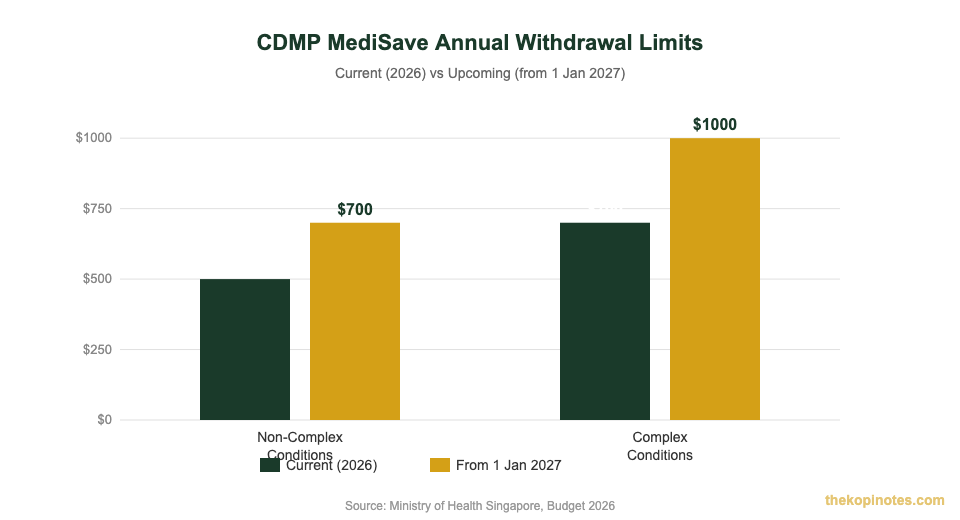
CDMP MediSave withdrawal limits 2026 vs 2027 — current limits will increase from 1 January 2027. Source: MOH Singapore.
You can check how much CDMP MediSave you’ve used this year by logging in to your MediSave Account on CPF’s portal. It’s listed as a separate line item from your general MediSave balance, so it’s easy to track.
Who Can You Use Your MediSave For?
Your MediSave isn’t just for you. Under CDMP, you can use your MediSave to pay for an approved dependant’s chronic disease treatment as well. This is a significant benefit — especially if you have elderly parents with multiple chronic conditions.
Approved dependants for CDMP MediSave claims include:
- Spouse — any nationality
- Children — any nationality
- Parents — any nationality
- Grandparents — must be Singapore Citizens or Permanent Residents
- Siblings — must be Singapore Citizens or Permanent Residents
This means if your mother has diabetes and is treated at a CHAS GP, you can tap your own MediSave to pay the CDMP-eligible portion of her bill — subject to the $500/$700 annual limit applying to her as the patient. Each patient has their own annual limit, regardless of whose MediSave is used to pay.
This makes CDMP a powerful family healthcare planning tool, especially for adult children helping to manage their parents’ healthcare costs. It’s worth checking if your parents have underutilised MediSave balances, or whether you should be drawing from your own MediSave for their visits to preserve theirs.
How to Use CDMP MediSave Step by Step
Using MediSave for CDMP visits is simple. You don’t need to pre-register or apply for anything separately — the clinic handles it on your behalf.
Step 1: Confirm your condition is on the CDMP list. Check the 23 conditions listed above. If your diagnosis is there, you’re eligible. Ask your doctor if you’re unsure — they’ll know whether your condition qualifies.
Step 2: Visit a CDMP-approved clinic. Go to any polyclinic, SOC, or CHAS-approved GP. You can find participating clinics on the CHAS website. Most GP clinics are participating — look for the CHAS sign at the entrance.
Step 3: Tell the clinic you want to use MediSave. Inform the reception desk before or at the point of payment. They’ll pull up your CDMP MediSave balance using your NRIC. No paperwork needed from your side.
Step 4: Pay the 15% co-payment in cash. The clinic charges 15% of the CDMP-eligible portion of your bill in cash. The remaining 85% is deducted from your MediSave. If you’re enrolled in Healthier SG at this clinic, the co-payment is waived.
Step 5: Track your annual limit. Check your remaining CDMP MediSave balance anytime via CPF Online. Once you hit the $500/$700 cap for the year, subsequent visits must be fully paid in cash — MediSave won’t be available until 1 January when the limit resets.
If you want a deeper breakdown of all MediSave uses and annual caps, see our MediSave withdrawal limit Singapore guide.
Stack Your Savings: CHAS, Healthier SG & Flexi-MediSave
The CDMP MediSave benefit doesn’t stand alone. You can combine it with several other government schemes to slash your out-of-pocket healthcare costs significantly. Here’s how they work together:
CHAS Subsidies
If you hold a CHAS (Community Health Assist Scheme) card, you’re entitled to subsidies of up to $500 per year for CDMP-related conditions at participating CHAS GP clinics. On top of that, Pioneer Generation (PG) cardholders receive special subsidies of up to $540 per year, and Merdeka Generation (MG) cardholders receive enhanced subsidies.
CHAS subsidies and MediSave work together — CHAS reduces the headline bill, and then MediSave covers the remaining 85% of the subsidised amount.
Healthier SG
If you’re enrolled in Healthier SG, you get two additional benefits for CDMP visits at your enrolled clinic:
- The 15% cash co-payment is completely waived
- Routine health screenings and nationally recommended vaccinations are subsidised
This makes Healthier SG one of the most impactful programmes for Singaporeans managing chronic conditions. Enrolment is free — you simply pick a regular GP, enrol online or at the clinic, and commit to annual health appointments. Check the Healthier SG enrolment page to get started.
Flexi-MediSave (Age 60 and Above)
If you’re aged 60 or above, you also have access to Flexi-MediSave — a separate annual limit of $400 for general outpatient treatments, including select restorative dental procedures. This is on top of your CDMP MediSave limit, not shared with it.
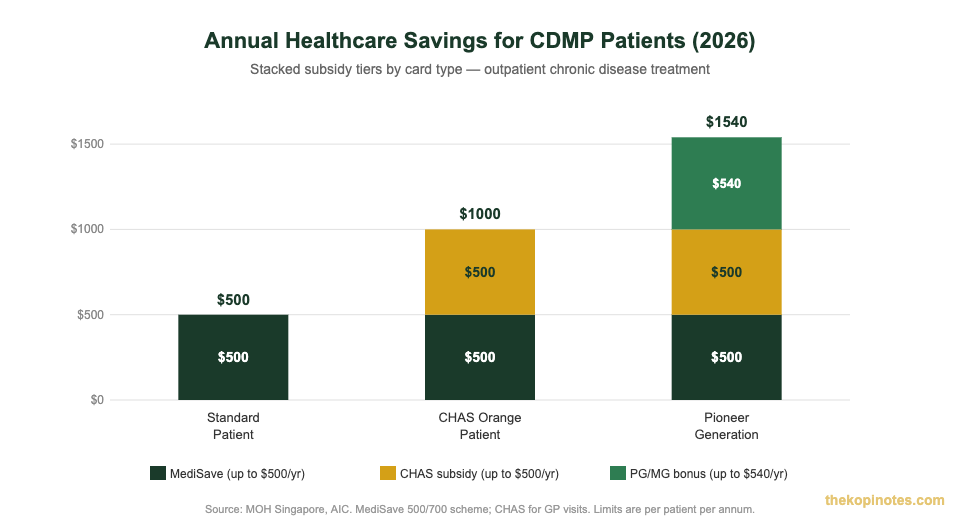
Annual savings stacking by patient type: MediSave alone vs. CHAS + MediSave vs. Pioneer Generation full stack. Source: MOH Singapore, AIC.
Stacking all three — CDMP MediSave ($500), CHAS subsidy ($500), and PG bonus ($540) — means a Pioneer Generation patient with chronic conditions could effectively receive up to $1,540 per year in annual healthcare support for outpatient visits. That’s a meaningful reduction in healthcare costs for seniors on fixed incomes.
2027 Changes: What’s Coming Next for CDMP MediSave
MOH announced significant improvements to the CDMP scheme starting 1 January 2027. These are the most substantial changes to the scheme since the complex-condition limit was introduced in 2021.
| Change | Current (2026) | From 1 Jan 2027 |
|---|---|---|
| Standard annual MediSave limit | $500 | $700 (+$200) |
| Complex chronic condition limit | $700 | $1,000 (+$300) |
| Number of CDMP conditions covered | 23 | 25 (+ thyroid) |
| Scheme name | MediSave 500/700 | MediSave Chronic and Preventive Care |
Source: Ministry of Health Singapore, Budget 2026 announcements.
The two new conditions are hyperthyroidism and hypothyroidism — thyroid disorders affecting a significant number of Singaporeans, particularly women over 40. If you’ve been managing a thyroid condition as an outpatient, you’ll be able to use MediSave for those visits from January 2027.
The scheme’s new name — MediSave Chronic and Preventive Care — also signals a broader intent: future expansions may cover more preventive healthcare visits, not just treatment of diagnosed conditions.
What This Means for You in 2026
If you’re currently on the standard tier ($500 limit), you should note that this limit goes up by 40% in January 2027. If you’re approaching your $500 annual cap before year-end, consider scheduling non-urgent CDMP visits for January when the higher limit kicks in.
If you’re approaching your cap on the complex tier, the same logic applies — your limit rises from $700 to $1,000, giving you an additional $300 of MediSave headroom from next year.
For a full picture of how MediSave fits into your overall healthcare financing strategy — including how it interacts with your integrated shield plan and MediShield Life — see our MediShield Life Singapore guide.
Frequently Asked Questions About CDMP MediSave
What is CDMP MediSave and how does it work?
How do I know if I qualify for the $700 CDMP limit instead of $500?
Can I use my MediSave for my parents' CDMP visits?
What happens if I exceed the CDMP MediSave limit for the year?
Does CDMP MediSave cover mental health conditions like anxiety and depression?
Will the CDMP MediSave limits change in 2027?
Is CDMP MediSave the same as Flexi-MediSave?
This article is for informational purposes only and does not constitute financial, medical or legal advice. CDMP data is sourced from the Ministry of Health Singapore and CPF Board. Verify all figures at moh.gov.sg before making healthcare decisions. Data verified as at 10 July 2026.
Get Free Insurance Advice
Speak with a licensed insurance advisor. No obligation, no cost.
By submitting this form, you agree to our Privacy Policy.
This article was researched with the help of AI. While we strive to keep all information accurate and up to date, there may be errors. If you notice any discrepancies, please contact us.