Singlife Shield Plan Premium: Full 2026 Breakdown (All Tiers & Ages)
Singlife Shield Plan premium in 2026 ranges from around $109 per year for a 30-year-old on the basic plan to over $6,000 per year for an 80-year-old on the enhanced Shield Plan 1 tier. Most of your premium can be paid from MediSave — you only top up cash when your premium exceeds the MediSave Additional Withdrawal Limit (MAWL) for your age. This guide breaks down every tier, every age band, and exactly how much comes out of your own pocket.
Not financial advice. All figures are for educational reference only. Data as at June 2026 unless noted.
- Singlife offers three tiers: Shield Plan 1 (Enhanced / private hospital), Shield Plan 2 (Standard / restructured A/B1), and Shield Plan (Basic / B2).
- All premiums can be paid with MediSave up to your age-band MAWL — younger policyholders typically pay zero cash.
- Add a rider to reduce your co-payment to 5% — but weigh the extra rider cost against your risk appetite.
What Is the Singlife Shield Plan?
The Singlife Shield Plan is an Integrated Shield Plan (ISP) — a type of health insurance sold by private insurers in Singapore that sits on top of MediShield Life. Your MediShield Life coverage remains active; the ISP upgrades what it pays.
Singlife (formerly Aviva) is one of six MOH-approved ISP providers in Singapore. Its plans allow you to access private hospitals or higher-class restructured hospital wards — depending on which tier you choose.
There are three plan tiers:
- Shield Plan 1 — covers private hospitals and Class A wards in restructured hospitals
- Shield Plan 2 — covers Class A wards in restructured hospitals
- Shield Plan (Basic) — covers Class B1 wards; the most affordable option
Every tier includes MediShield Life benefits automatically. You pay one combined premium — Singlife handles the split between MediShield Life and the private insurer portion.
Singlife Shield Plan Premium Table 2026
Below are indicative annual premiums for each plan tier, by age next birthday. These are total premiums — the MediShield Life component plus Singlife’s additional insurer premium combined.
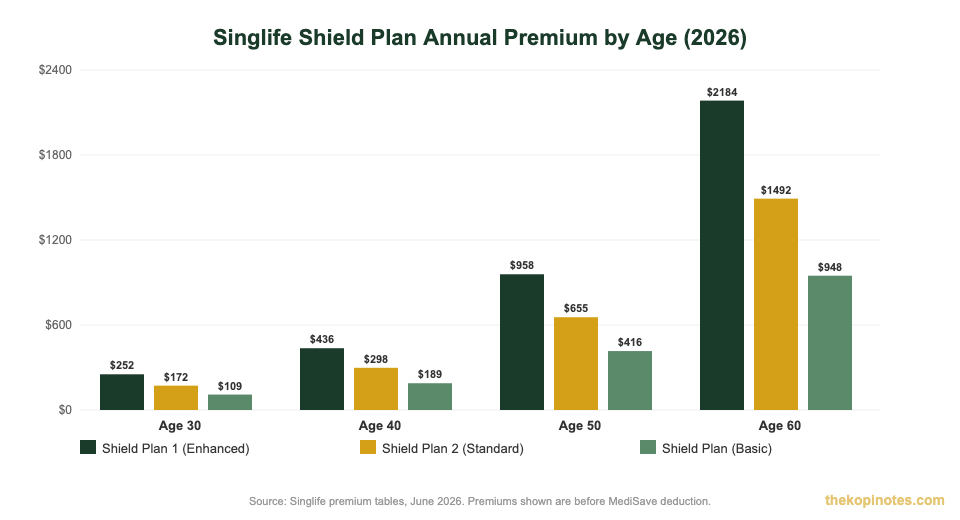
| Age Next Birthday | Shield Plan 1 | Shield Plan 2 | Shield Plan (Basic) |
|---|---|---|---|
| 1 – 20 | $209 | $141 | $90 |
| 21 – 30 | $252 | $172 | $109 |
| 31 – 40 | $436 | $298 | $189 |
| 41 – 50 | $958 | $655 | $416 |
| 51 – 60 | $2,184 | $1,492 | $948 |
| 61 – 70 | $3,850 | $2,630 | $1,670 |
| 71 – 80 | $6,200 | $4,240 | $2,694 |
| 81 – 85 | $9,800 | $6,700 | $4,252 |
Source: Singlife premium tables, June 2026. Premiums are indicative and subject to change. Figures include MediShield Life premiums. Verify exact amounts at singlife.com.
Notice how premiums jump after each decade. A 40-year-old pays $436/year for Shield Plan 1. By 50, that becomes $958. By 60, it’s $2,184. This is why getting covered early — while you’re healthy and premiums are low — is the conventional wisdom in Singapore insurance planning.
Also worth noting: Singlife reserves the right to revise premiums. Historically, ISP premiums have risen every few years as medical costs climb. Your premium is not locked in for life.
How MediSave Covers Your Singlife Shield Plan Premium
You do not pay your full Singlife Shield Plan premium in cash. CPF MediSave covers a portion via two channels:
- MediShield Life component — fully covered by MediSave (no cash needed for this part)
- Additional Insurer Premium (AIP) — the Singlife-specific top-up; covered by MediSave up to your MAWL
The MediSave Additional Withdrawal Limit (MAWL) is the maximum you can use from MediSave for the insurer’s portion. It increases with age:
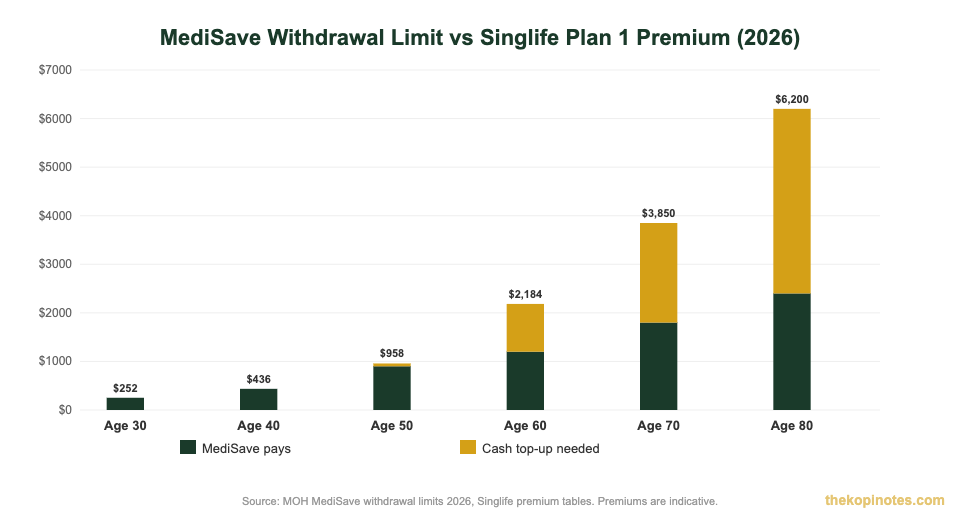
| Age | MAWL / Year | Plan 1 Premium | Est. Cash Top-Up |
|---|---|---|---|
| Age 30 | $300 | $252 | $0 |
| Age 40 | $600 | $436 | $0 |
| Age 50 | $900 | $958 | ~$58 |
| Age 60 | $1,200 | $2,184 | ~$984 |
| Age 70 | $1,800 | $3,850 | ~$2,050 |
Source: MOH MediSave withdrawal limits 2026, Singlife premium tables. MAWL figures are for the additional insurer premium only. The MediShield Life component is separately covered by MediSave.
The practical takeaway: if you’re under 50, you likely pay zero cash for your Singlife Shield Plan premium. MediSave covers everything. But once premiums climb past your MAWL in your 50s and 60s, you start needing to top up from your bank account.
This is one reason many Singaporeans try to lock in ISP coverage while young — the MediSave subsidy fully offsets the premium for decades, making it effectively free out-of-pocket.
If you’re looking at CPF investment strategy holistically, factoring in your MediSave balance is important. A high MediSave balance gives you decades of ISP coverage with zero cash outflow.
Singlife Shield Plan Rider: Is the Extra Cost Worth It?
Every ISP — including Singlife — comes with a co-payment obligation. Under the 2021 MOH rider reforms, ISP riders can now cover a maximum of 95% of your co-payment. You must always pay at least 5% from cash.
Singlife offers a rider called the Singlife Health Plus. Adding it reduces your co-payment to 5% (with a cash cap per policy year). Without the rider, you pay the standard deductible plus 10% co-insurance — which can be thousands of dollars for a major surgery.
Here’s how the math works for a $30,000 hospital bill at a private hospital (Shield Plan 1):
| Scenario | Without Rider | With Health Plus Rider |
|---|---|---|
| Hospital Bill | $30,000 | $30,000 |
| Deductible | $3,500 | Covered by rider |
| Co-insurance (10%) | ~$2,650 | Rider covers 95% |
| Your Out-of-Pocket | ~$6,150 | ~$300 (5% cap) |
Source: Illustrative example based on Shield Plan 1 deductible and co-insurance structure, June 2026. Actual figures depend on bill size, ward type, and policy terms.
The rider makes sense if you’d struggle to cover a $6,000+ out-of-pocket bill. It adds to your annual premium — typically $400 to $1,200 per year depending on age — and this rider premium must be paid entirely in cash (no MediSave allowed).
That said, if you have strong emergency savings and a high risk tolerance, some Singaporeans prefer to self-insure the co-payment and skip the rider. There’s no universal right answer — it depends on your financial buffer and peace of mind.
Singlife Shield Plan 1 vs Shield Plan 2 vs Basic: Which Tier Is Right for You?
Choosing a tier is really about deciding which hospital ward you want access to — and how much premium you’re willing to pay for that access. Here’s a direct comparison:
| Feature | Shield Plan 1 | Shield Plan 2 | Shield Plan (Basic) |
|---|---|---|---|
| Private hospital | ✅ | ❌ | ❌ |
| Class A ward (restructured) | ✅ | ✅ | ❌ |
| Class B1 ward | ✅ | ✅ | ✅ |
| Annual deductible (approx) | $3,500 | $2,000 | $1,500 |
| Premium (Age 40) | $436/yr | $298/yr | $189/yr |
| Rider available? | ✅ | ✅ | ✅ |
Source: Singlife product brochures, June 2026. Deductibles and premiums are indicative.
For most working Singaporeans in their 30s and 40s, Shield Plan 2 hits the sweet spot: you get Class A ward access in restructured hospitals (solid quality of care), while keeping premiums significantly lower than Plan 1.
Shield Plan 1 makes sense if you specifically want access to private hospitals like Mount Elizabeth, Gleneagles, or Raffles Hospital — or if you have a strong preference for a particular specialist who only practises privately.
The Basic plan is appropriate if cost is the priority and you’re comfortable with B1 wards in restructured hospitals. Public restructured hospitals like SGH and TTSH provide excellent care — many Singaporeans choose this tier intentionally.
You can find a full tier-by-tier deep dive in our Singlife Shield Plan review and Shield Plan 1 detailed guide.
If you’re also comparing against other ISP providers, our shield plan comparison guide puts Singlife alongside AIA, Prudential, and Great Eastern side by side.
How to Apply for Singlife Shield Plan
Applying is straightforward. Here are your options:
Option 1: Apply Directly via Singlife
Visit Singlife’s website, get a quote using your NRIC and date of birth, and apply online. Underwriting (health assessment) applies if you switch from another ISP or apply for a higher tier.
Option 2: Apply via a Financial Adviser
A licensed financial adviser (FA) can help you compare all six ISP providers, run through health declarations, and ensure you’re not under-insured. The FA earns a commission from Singlife — you pay no direct advisory fee.
Option 3: Use an Online Investment Platform
Some platforms like Endowus offer access to insurance products alongside investments. You can also use platforms like Syfe for your broader financial planning — while sourcing ISPs directly through insurers or FAs.
Key tips before applying:
- Apply before any pre-existing conditions develop — ISPs can exclude conditions if you declare them or if they’re discovered during underwriting
- Check if your employer provides group health insurance — you may already have some corporate coverage, though group coverage typically ends when you leave the job
- If upgrading from a lower tier, Singlife may require a fresh medical declaration and could impose waiting periods
It’s also worth thinking about your broader retirement planning. Use our Singapore retirement calculator to estimate how healthcare costs fit into your overall retirement picture — ISP premiums in your 60s and 70s can be a significant annual expense.
Frequently Asked Questions
How much does Singlife Shield Plan cost per year?
Can I use MediSave to pay for Singlife Shield Plan?
What is the difference between Singlife Shield Plan 1 and Shield Plan 2?
Does Singlife Shield Plan cover pre-existing conditions?
Can I switch from another ISP to Singlife?
Is the Singlife Health Plus rider worth buying?
How does Singlife Shield Plan compare to AIA HealthShield Gold Max?
Disclaimer: This article is for educational purposes only and does not constitute financial or insurance advice. Premiums shown are indicative and subject to change. Always verify current premiums with Singlife directly and consult a licensed financial adviser before making insurance decisions. The Kopi Notes may earn referral fees from some links on this page.
Get Free Insurance Advice
Speak with a licensed insurance advisor. No obligation, no cost.
By submitting this form, you agree to our Privacy Policy.
This article was researched with the help of AI. While we strive to keep all information accurate and up to date, there may be errors. If you notice any discrepancies, please contact us.